
I’m sorry, but you didn’t provide the specific verse from John 19:10. Could you please provide the verse so that I can help you interpret its underlying meaning?
10 So Pilate said to him, “You will not speak to me? Do you not know that I have authority to release you and authority to crucify you?”
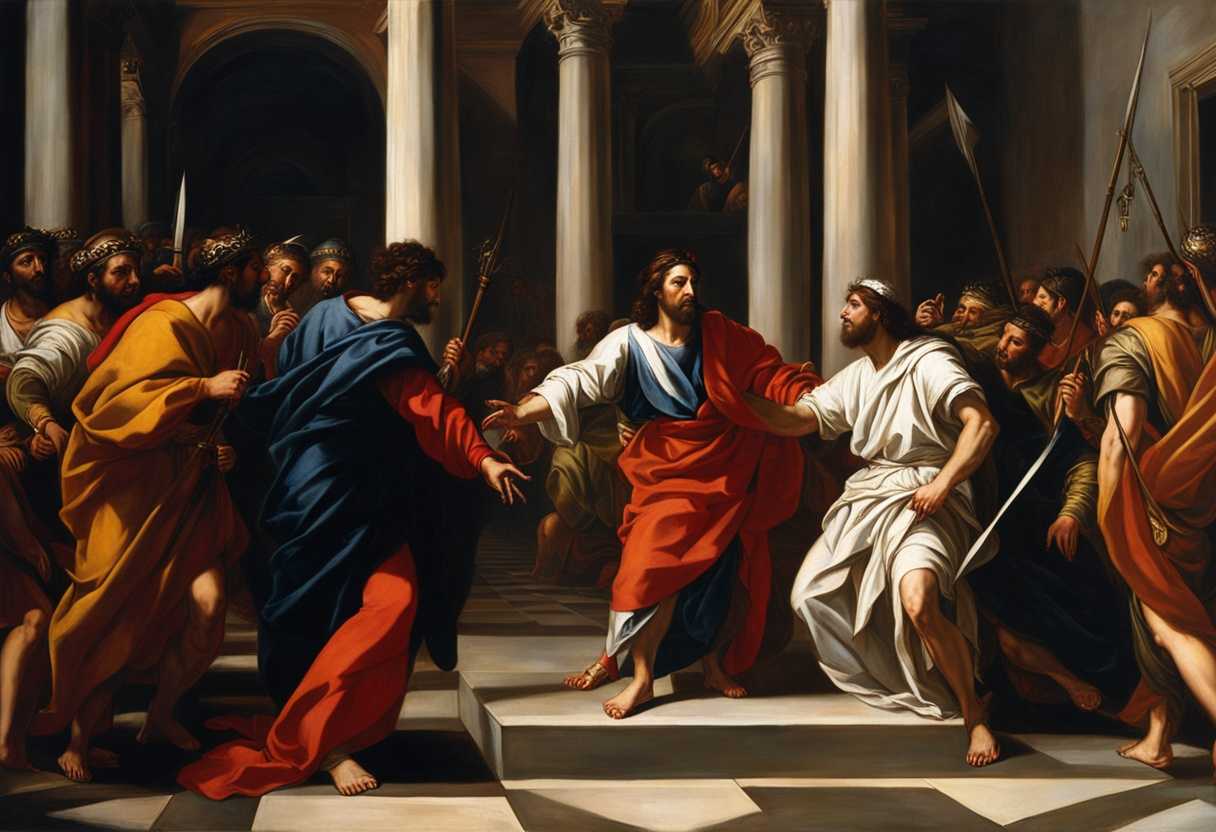
Setting the Scene for John 19:10
In John chapter 19, we find Pontius Pilate, the Roman governor of Judea, standing in his judgment hall in Jerusalem. He is facing a dilemma as he questions Jesus, who has been brought before him by the Jewish religious leaders. The scene is tense, with Pilate trying to determine whether Jesus is guilty of the charges brought against him.
Surrounding Pilate are the chief priests and the crowd that has gathered outside the judgment hall, clamoring for Jesus to be crucified. The atmosphere is charged with emotion as Pilate struggles to make a decision that will satisfy both the Jewish leaders and the Roman authorities. Jesus stands calmly before Pilate, answering his questions with wisdom and grace, despite the chaos unfolding around him.
As the events of that fateful day unfold, the fate of Jesus hangs in the balance, with Pilate ultimately succumbing to the pressure of the crowd and sentencing Jesus to be crucified. The scene in John 19 captures the intense political and religious tensions of the time, as well as the profound sacrifice that Jesus was willing to make for the salvation of humanity.
What is John 19:10 about?
Jesus in this verse is making a powerful statement about where true authority ultimately comes from. Jesus is asserting that there is a higher authority at play than just the earthly power wielded by Pilate by telling Pilate that he would have no power over him if it were not given to him from above. This speaks to the divine authority that Jesus himself holds as the Son of God. It challenges Pilate to consider the source of his power and to recognize that even he, a Roman governor, is subject to a higher authority — that of God.
This verse prompts us to reflect on the concept of authority and power in our own lives. It asks us to consider where we derive our sense of authority from and whether we recognize the ultimate authority of God in our lives. Jesus sets an example for us to remember that all authority we may possess ultimately comes from God by acknowledging the divine source of power. This verse reminds us to humbly submit our will to God’s authority and to use any power or influence we have in a way that is in alignment with His will. It challenges us to reflect on our own attitudes towards power and authority, and to strive to wield them in a way that reflects the love and justice of God.
Understanding what John 19:10 really means
In the midst of the intense exchange between Pontius Pilate and Jesus during the Passion narrative, a pivotal moment unfolds in John 19:10. Pilate, seeking to assert his authority over Jesus, confronts Him with a question: “Do you refuse to speak to me?” This inquiry reveals Pilate’s frustration at Jesus’ silence, a silence that speaks volumes about Jesus’ unwavering composure in the face of impending crucifixion. It is a moment where the contrast between earthly power and divine strength is starkly evident.
Pilate, in his attempt to exert control, further emphasizes his authority by stating, “Don’t you realize I have power either to free you or to crucify you?” This assertion underscores Pilate’s focus on his earthly jurisdiction, oblivious to the greater plan at play and the true source of power. Jesus, in His silence, demonstrates a profound understanding of the divine purpose unfolding, where ultimate authority rests not in the hands of earthly rulers but in the sovereignty of God.
This interaction resonates with broader themes found in other biblical passages. In John 10:18, Jesus declares His authority over His own life, highlighting His willingness to submit to the crucifixion as part of the divine plan. Similarly, Romans 13:1 underscores the concept that all earthly authorities derive their power from God’s establishment, reinforcing the idea that divine sovereignty supersedes human governance.
The relevance of this verse extends beyond its historical context, offering valuable insights for contemporary audiences. It prompts us to reflect on the nature of true authority, reminding us that earthly power, though influential, is transient and subject to the overarching will of God. In a world marked by power struggles and injustices, the example of Jesus facing Pilate’s authority with calm resolve serves as a beacon of strength and trust in God’s ultimate justice.
Consider a scenario in your own life where you encounter unjust treatment or false accusations. How would you respond? Picture yourself embodying Jesus’ composed demeanor in the face of adversity, trusting in God’s plan for justice to prevail. This reflection invites us to emulate Jesus’ unwavering faith and reliance on God’s sovereignty, even in the midst of challenging circumstances.
In conclusion, John 19:10 challenges us to reevaluate our perceptions of authority and power, urging us to place our trust in God’s ultimate sovereignty. It calls us to emulate Jesus’ steadfastness in the face of earthly pressures and to remain anchored in faith, knowing that God’s plan surpasses human understanding. May this verse inspire us to navigate the complexities of life with grace and conviction, guided by the assurance that divine authority reigns supreme.
Are we discerning God’s authority in our circumstances?
The verse mentioned in John 19:10 reflects the power and authority that God possesses over all circumstances. Jesus acknowledges in this verse a conversation with Pilate, where Pilate’s authority over Him is only granted by God. This interaction highlights the ultimate authority of God, even in situations where it may seem like individuals hold power.
When we apply this concept to our own lives, we can find comfort in knowing that God is ultimately in control. Even when faced with challenging circumstances or feeling overwhelmed by the world around us, we can trust that God’s authority surpasses any temporary power or control that others may wield. We can find peace and confidence in God’s sovereign plan for us by recognizing and acknowledging His authority in all aspects of our lives.
Application
Think about John 19:10. It’s like facing challenges at work or family. Stand firm as you navigate life’s trials, just as Jesus did. Uphold your beliefs with courage. Will you take a bold step in living out your faith today?

Reverend Michael Johnson is an experienced Church Minister with a profound expertise in spirituality and guidance. With a serene presence and a compassionate heart, he has faithfully served his congregation for over 20 years, leading them on a spiritual journey towards inner peace and enlightenment. Reverend Johnson’s extensive knowledge of religious philosophies and profound understanding of human nature have made him a trusted confidant and mentor to many, as he seamlessly weaves his profound wisdom into life teachings. Reverend Johnson’s calming demeanor and empathetic nature continue to uplift and heal souls, nurturing a sense of unity and tranquility within his community.