
Jeremiah 32:6-15 is about God instructing Jeremiah to buy a field as a symbol of hope and restoration for Israel, demonstrating that in the midst of destruction and exile, there is a promise of future redemption and a reminder that God’s plans are ultimately for good.
6 Jeremiah said, “The word of the Lord came to me:
7 Behold, Hanamel the son of Shallum your uncle will come to you and say, ‘Buy my field that is at Anathoth, for the right of redemption by purchase is yours.’
8 Then Hanamel my cousin came to me in the court of the guard, in accordance with the word of the Lord, and said to me, ‘Buy my field that is at Anathoth in the land of Benjamin, for the right of possession and redemption is yours; buy it for yourself.’ Then I knew that this was the word of the Lord.
9 So I bought the field at Anathoth from Hanamel my cousin, and weighed out the money to him, seventeen shekels of silver.
10 I signed the deed, sealed it, got witnesses, and weighed the money on the scales.
11 Then I took the sealed deed of purchase, containing the terms and conditions and the open copy.
12 And I gave the deed of purchase to Baruch the son of Neriah son of Mahseiah, in the presence of Hanamel my cousin, in the presence of the witnesses who signed the deed of purchase, and in the presence of all the Judeans who were sitting in the court of the guard.
13 And I charged Baruch in their presence, saying,
14 ‘Thus says the Lord of hosts, the God of Israel: Take these deeds, both this sealed deed of purchase and this open deed, and put them in an earthenware vessel, that they may last for a long time.’
15 For thus says the Lord of hosts, the God of Israel: Houses and fields and vineyards shall again be bought in this land.’
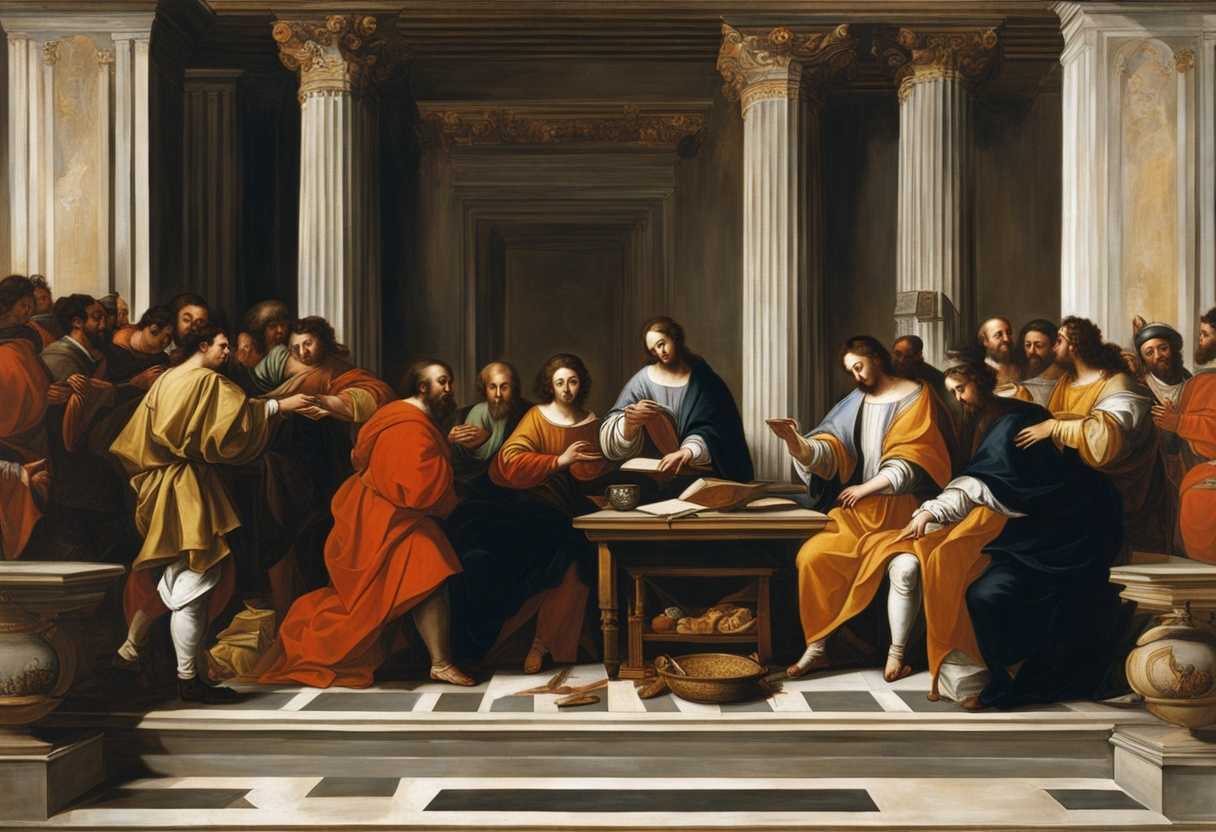
Setting the Scene for Jeremiah 32:6-15
In Jeremiah 32:6-15, we find the prophet Jeremiah in a challenging situation. The scene is set in Jerusalem, which is under siege by the Babylonian army. Jeremiah is confined in the courtyard of the guard in the royal palace of Judah. The city is in a state of turmoil, with the threat of invasion looming large.
Joining Jeremiah in this scene is his cousin Hanamel, who comes to him with a proposition to buy his field in Anathoth. Despite the impending doom and the fact that Jeremiah is imprisoned, Hanamel asks him to exercise his right of redemption and purchase the land. This seemingly irrational request is a test of Jeremiah’s faith and obedience to God’s promise of restoration for the people of Israel.
Surrounded by the chaos of war and uncertainty, Jeremiah’s actions in this scene symbolize his unwavering trust in God’s faithfulness and his belief in the future restoration of the land and people of Israel. The exchange between Jeremiah and Hanamel serves as a powerful demonstration of faith in the midst of adversity.
What is Jeremiah 32:6-15 about?
Jeremiah’s act of buying a field despite being in a time of distress and exile holds a profound message of hope and restoration from God in this verse. Jeremiah is demonstrating his faith in God’s promise of a future restoration for the Israelites by purchasing the land amid uncertainty and chaos. This act serves as a powerful symbol of faith, resilience, and trust in God’s plans, even when everything seems bleak and hopeless. Jeremiah’s investment in the land signifies planting a seed of hope for a future he may never witness himself. This act challenges us to reflect on our own faith and trust in God’s promises, especially during challenging times. What areas of our lives do we need to invest in, even when circumstances may seem discouraging? Just like Jeremiah, our actions rooted in faith and hope can pave the way for God’s restoration and blessings in our lives. Let’s draw inspiration from Jeremiah’s unwavering belief in God’s faithfulness and let it guide us to trust in His plans for our own restoration and renewal.
Understanding what Jeremiah 32:6-15 really means
Jeremiah 32:6-15 unfolds against the backdrop of a nation in turmoil, besieged by Babylon, with the prophet Jeremiah imprisoned for his unwavering message of Jerusalem’s impending fall. In the midst of this chaos, God’s voice breaks through, instructing Jeremiah to engage in a seemingly paradoxical act – to buy a field. This divine directive is laden with symbolism, representing hope and restoration in the face of destruction. It serves as a poignant reminder that God’s plans often defy human logic and understanding, calling for unwavering faith in His promises.
“The word of the Lord came to me,” a phrase that punctuates this passage, underscores the divine origin of Jeremiah’s actions. It serves as a powerful reminder that our obedience to God’s commands is not contingent on our comprehension but on our trust in His wisdom. The directive to “buy my field…for the right of redemption by purchase is yours” delves into the profound concept of redemption and the significance of familial ties in Israelite culture. It speaks to the enduring value placed on heritage and the restoration of what is rightfully ours in God’s eyes.
Amidst the impending doom, God’s promise resounds through Jeremiah’s actions – “Houses, fields, and vineyards shall again be bought in this land.” This declaration of restoration amidst desolation echoes through the ages, offering a beacon of hope in the darkest of times. It serves as a testament to God’s faithfulness and His unwavering commitment to His people, even when circumstances seem dire.
Drawing parallels to other biblical passages enriches our understanding of Jeremiah 32:6-15. Leviticus 25:25 elucidates the concept of redemption within the family, emphasizing the importance of preserving heritage and lineage. Isaiah 43:19’s proclamation of new beginnings resonates with the theme of hope and restoration present in Jeremiah’s purchase of the field. Romans 8:24-25 reinforces the virtue of patience and faith in God’s promises, urging believers to hold fast to hope even in the face of uncertainty.
The relevance of this passage transcends its historical context, speaking directly to the challenges we face today. In times of uncertainty and despair, Jeremiah’s unwavering faith and obedience serve as a beacon of light, guiding us to trust in God’s promises and to act with faith, even when the world around us seems bleak. The act of purchasing the field symbolizes investing in a future filled with hope, a lesson that resonates on personal, communal, and global levels.
Consider a family business teetering on the edge of collapse, mirroring the dire circumstances of Jeremiah’s time. Against all odds, a family member chooses to invest in the business, believing in its potential for revival. This act of faith and hope mirrors Jeremiah’s purchase of the field, illustrating the transformative power of trust in a brighter future amidst present challenges.
In conclusion, Jeremiah 32:6-15 beckons us to embrace faith, obedience, and hope in the face of adversity. It challenges us to trust in God’s plans, even when they seem counterintuitive, and to take actions that reflect our unwavering belief in His promises. By delving into the historical and cultural context of this passage and applying its timeless truths to our lives, we can find solace, strength, and inspiration in the unchanging faithfulness of our God.
What role does faith play in making decisions?
Faith plays a pivotal role in decision-making in the context of Jeremiah 32:6-15 as it involves trusting in God’s promises and guidance. Through faith, one can confidently take steps forward even when faced with uncertainty or seemingly impossible circumstances. The act of purchasing a field in a besieged city, as described in this passage, demonstrates faith in God’s plans for the future and His ability to bring about restoration and renewal, even in the midst of difficult times. Individuals can make decisions not solely based on immediate circumstances or logic, but on a deeper trust in God’s sovereignty and faithfulness by having faith. This kind of faith empowers believers to move forward boldly, knowing that God is in control and can work all things together for good. Making decisions anchored in faith requires surrendering one’s will to God’s, acknowledging His wisdom and leading in every aspect of life. Faith ultimately serves as a guiding force in decision-making, shaping choices that align with God’s purposes and bring about His intended outcomes.
Application
Reflect on Jeremiah’s unwavering faith and trust in God. Challenge yourself to mirror his obedience and confidence in the face of adversity. Are you ready to embrace God’s plan with faith, just like Jeremiah, even when things seem difficult?

Reverend Michael Johnson is an experienced Church Minister with a profound expertise in spirituality and guidance. With a serene presence and a compassionate heart, he has faithfully served his congregation for over 20 years, leading them on a spiritual journey towards inner peace and enlightenment. Reverend Johnson’s extensive knowledge of religious philosophies and profound understanding of human nature have made him a trusted confidant and mentor to many, as he seamlessly weaves his profound wisdom into life teachings. Reverend Johnson’s calming demeanor and empathetic nature continue to uplift and heal souls, nurturing a sense of unity and tranquility within his community.