
Deuteronomy 3:12-20 is about the division of the land conquered by the Israelites, where two and a half tribes are allotted territory on the east side of the Jordan River, signifying God’s provision and the importance of unity and obedience among the tribes as they prepare to enter the Promised Land.
12 all the kingdom of Og in Bashan, who reigned in Ashtaroth and in Edrei (he alone was left of the remnant of the Rephaim); these Moses had struck and driven out.
13 the rest of Gilead, and all Bashan, the kingdom of Og, that is, all the region of Argob, I gave to the half-tribe of Manasseh. (All that portion of Bashan is called the land of Rephaim.)
14 Jair the Manassite took all the region of Argob, that is, Bashan, as far as the border of the Geshurites and the Maacathites, and called the villages after his own name, Havvoth-jair, as it is to this day.
15 And I gave Gilead to Machir.
16 And to the Reubenites and the Gadites I gave the territory from Gilead as far as the Valley of the Arnon, with the middle of the valley as a border, as far over as the river Jabbok, the border of the Ammonites;
17 the Arabah also, with the Jordan as the border, from Chinnereth as far as the Sea of the Arabah, the Salt Sea, under the slopes of Pisgah on the east.
18 And I commanded you at that time, saying, ‘The Lord your God has given you this land to possess. All your men of valor shall cross over armed before your brothers, the people of Israel.’
19 Only your wives, your little ones, and your livestock (I know that you have much livestock) shall remain in the cities that I have given you,
20 until the Lord gives rest to your brothers, as to you, and they also occupy the land that the Lord your God gives them beyond the Jordan. Then each of you may return to his possession which I have given you.’
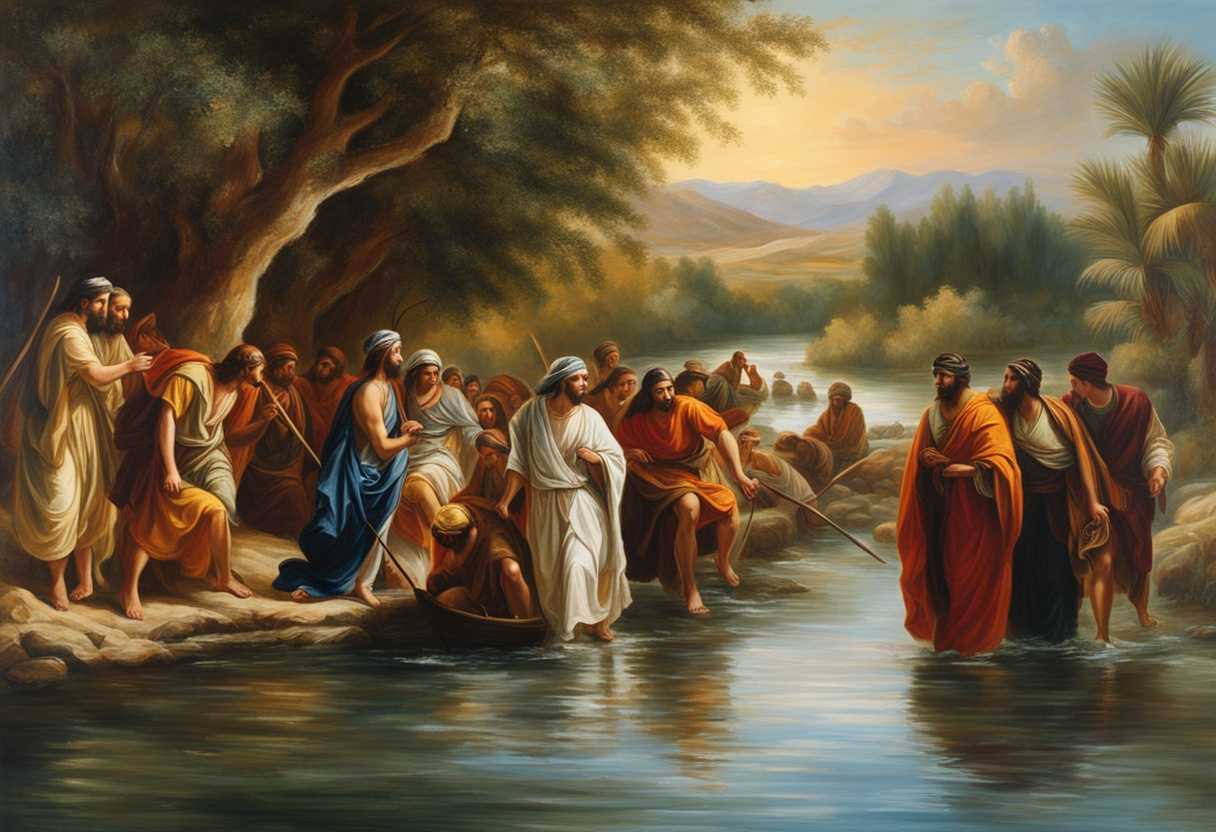
Setting the Scene for Deuteronomy 3:12-20
In the arid expanse of the Transjordan region, the air is thick with the scent of dry earth and the distant sound of rustling leaves. The sun hangs high in the sky, casting long shadows over the rugged terrain. Here, Moses stands before the people of Israel, a weary yet resolute leader, his face weathered by years of guiding his flock through trials and tribulations. The Israelites, a diverse assembly of tribes, gather around him, their faces reflecting a mixture of hope and uncertainty as they prepare to enter the Promised Land. This moment is pivotal; they are on the brink of a new chapter, yet the memory of their past wanderings lingers heavily in the air.
Moses, having received divine instruction, addresses the tribes of Reuben, Gad, and the half-tribe of Manasseh, who have expressed their desire to settle in the fertile lands east of the Jordan River. He recalls the victories they have achieved over the formidable kings Sihon and Og, whose territories now lie before them, ripe for the taking. The land is lush and inviting, dotted with rolling hills and valleys that promise prosperity. Yet, Moses reminds them of their responsibilities; they must not only claim this land but also support their fellow Israelites in the conquest of Canaan. The weight of leadership rests heavily on his shoulders as he emphasizes the importance of unity and commitment to the collective mission.
Surrounding them are the remnants of past battles, the echoes of triumph and loss etched into the landscape. The Israelites, clad in simple garments, clutch their staffs and tools, their eyes scanning the horizon where the Jordan River glimmers in the distance. Children play nearby, their laughter a stark contrast to the solemnity of the moment, while the elders listen intently, their faces lined with the wisdom of experience. As Moses speaks, the wind carries his words, weaving through the crowd, igniting a sense of purpose and determination. This scene is not just a gathering; it is a crossroads of faith and destiny, where the past meets the future, and the promise of a land flowing with milk and honey beckons them forward.
What is Deuteronomy 3:12-20 about?
Profound themes of promise and divine guidance that extend beyond the historical context are witnessed when delving into the passage concerning the division of land among the tribes of Israel. This distribution of land isn’t merely a logistical arrangement; it represents God’s fidelity to His people and His unwavering commitment to fulfilling promises made long ago. Can you imagine the anticipation and hope among the tribes as they received their designated portions? Each parcel of land served as a tangible reminder of God’s presence and faithfulness, anchoring their identity and future in Him.
Furthermore, this event raises intriguing questions about community and belonging. Why do you think God delineates specific territories for each tribe? This allocation promotes not only a sense of ownership but also accountability and stewardship. Each tribe’s responsibility to their land serves as a metaphor for how we are called to care for our own environments and communities. It challenges us to reflect on our own lives—how do we respond to the spaces we inhabit? What will we do with the resources we are entrusted with? The passage beckons us into a deeper relationship with God, encouraging us to recognize His guidance in our lives and to act with intention in our own communities. How might we carry this principle forward today?
Understanding what Deuteronomy 3:12-20 really means
In Deuteronomy 3:12-20, we encounter a pivotal moment in the journey of the Israelites as they prepare to enter the Promised Land. This passage not only recounts the division of land among the tribes of Reuben, Gad, and the half-tribe of Manasseh but also serves as a profound reminder of God’s faithfulness to His promises. The allocation of land signifies that the Israelites are receiving what was promised to their ancestors, a tangible manifestation of God’s unwavering commitment to His people.
One of the key themes in this passage is the concept of inheritance. The land represents more than just territory; it embodies the fulfillment of God’s covenant with His people. As modern readers, we can reflect on our own “promised lands”—those aspirations and goals we strive for in our lives. What does it mean to inherit something? It requires not only receiving but also recognizing the responsibility that comes with it. The Israelites were called to be obedient to God’s commands to fully enjoy the blessings of the land. How often do we overlook the responsibilities tied to our own blessings?
The passage also emphasizes the importance of obedience and stewardship. The tribes of Reuben and Gad express their desire to settle east of the Jordan, which raises questions about their commitment to the collective journey of the Israelites. Are we, too, tempted to seek comfort in our own desires while neglecting the greater good? The anecdote of a young couple purchasing their first home illustrates this point well. They worked hard for their inheritance, yet they soon realized that ownership comes with responsibilities. Just as the Israelites were called to be good stewards of their land, we must also be mindful of how we manage our blessings.
In this context, certain phrases stand out. “The land which we passed through” reminds us that our past experiences shape our present and future. Each step taken in faith contributes to our journey. Similarly, “You shall not fear them” encourages us to trust in God’s provision, even when faced with daunting challenges. Fear can paralyze us, but faith propels us forward. How can we cultivate a spirit of courage in our own lives?
Moreover, the inclusion of “your wives, your little ones, and your livestock” highlights the significance of family and community in our faith journey. Our decisions impact not just ourselves but also those we love. In a world that often prioritizes individualism, this reminder is crucial. How can we ensure that our choices reflect a commitment to our families and communities?
In conclusion, Deuteronomy 3:12-20 serves as a powerful reminder of God’s faithfulness and the importance of our response to His promises. As we navigate our own lives, may we strive to be good stewards of what we have been given. Let us act with courage in the face of fear and cherish the community around us. In doing so, we honor the legacy of faith that has been passed down to us and continue the journey toward our own promised lands.
What does it mean to find our true place?
Finding our true place refers to recognizing our inherent identity and purpose within a larger context, often relating to our relationships with others and our responsibilities in a community. This understanding goes beyond mere self-awareness; it involves acknowledging how our actions and decisions resonate within the broader tapestry of life, shaping not only our own existence but also influencing those around us. Such recognition can lead to personal fulfillment and a sense of belonging, as it aligns individual desires with communal values and aspirations.
Additionally, discovering our true place can entail understanding the roles assigned to us by circumstance, tradition, or divine guidance. It emphasizes the importance of stewardship, where individuals are urged to not only care for their immediate needs but also those of their communities. This sense of duty often enriches one’s life, as it fosters connections that transcend individualistic pursuits, creating a supportive environment that benefits everyone involved. When we embrace our designated roles, we actively participate in a dynamic interplay of give-and-take that strengthens communal ties. Finding our true place is ultimately a journey of alignment between our personal talents and the needs of our community, between individual aspirations and collective goals. It leads to a harmonious existence where each person’s unique contributions are valued, thus cultivating an atmosphere of mutual respect and support. We can better appreciate our individual paths while simultaneously embracing the interdependence that defines our shared human experience by realizing this interconnectedness.
Application
Imagine your life as a busy workplace, where every task and project matters. Just like each team member contributes to a bigger goal, you have a unique role in your community and family. God has equipped you with special gifts—are you using them to create positive change? Think about what actions you can take today that align with His plans. Don’t wait for tomorrow; seize this moment to step up and make a difference. Are you ready to embrace your part and transform your surroundings?

Reverend Michael Johnson is an experienced Church Minister with a profound expertise in spirituality and guidance. With a serene presence and a compassionate heart, he has faithfully served his congregation for over 20 years, leading them on a spiritual journey towards inner peace and enlightenment. Reverend Johnson’s extensive knowledge of religious philosophies and profound understanding of human nature have made him a trusted confidant and mentor to many, as he seamlessly weaves his profound wisdom into life teachings. Reverend Johnson’s calming demeanor and empathetic nature continue to uplift and heal souls, nurturing a sense of unity and tranquility within his community.