
1 Then the whole company of them arose and brought him before Pilate.
2 And they began to accuse him, saying, “We found this man misleading our nation and forbidding us to give tribute to Caesar, and saying that he himself is Christ, a king.”
3 So Pilate asked him, saying, “Are you the King of the Jews?” And he answered him, “You have said so.”
4 Then Pilate said to the chief priests and the crowds, “I find no guilt in this man.”
5 But they were urgent, saying, “He stirs up the people, teaching throughout all Judea, from Galilee even to this place.”
6 When Pilate heard this, he asked whether the man was a Galilean.
7 And when he learned that he belonged to Herod’s jurisdiction, he sent him over to Herod, who was himself in Jerusalem at that time.
8 When Herod saw Jesus, he was very glad, for he had long desired to see him, because he had heard about him, and he was hoping to see some sign done by him.
9 Then he questioned him with many words, but he made no answer.
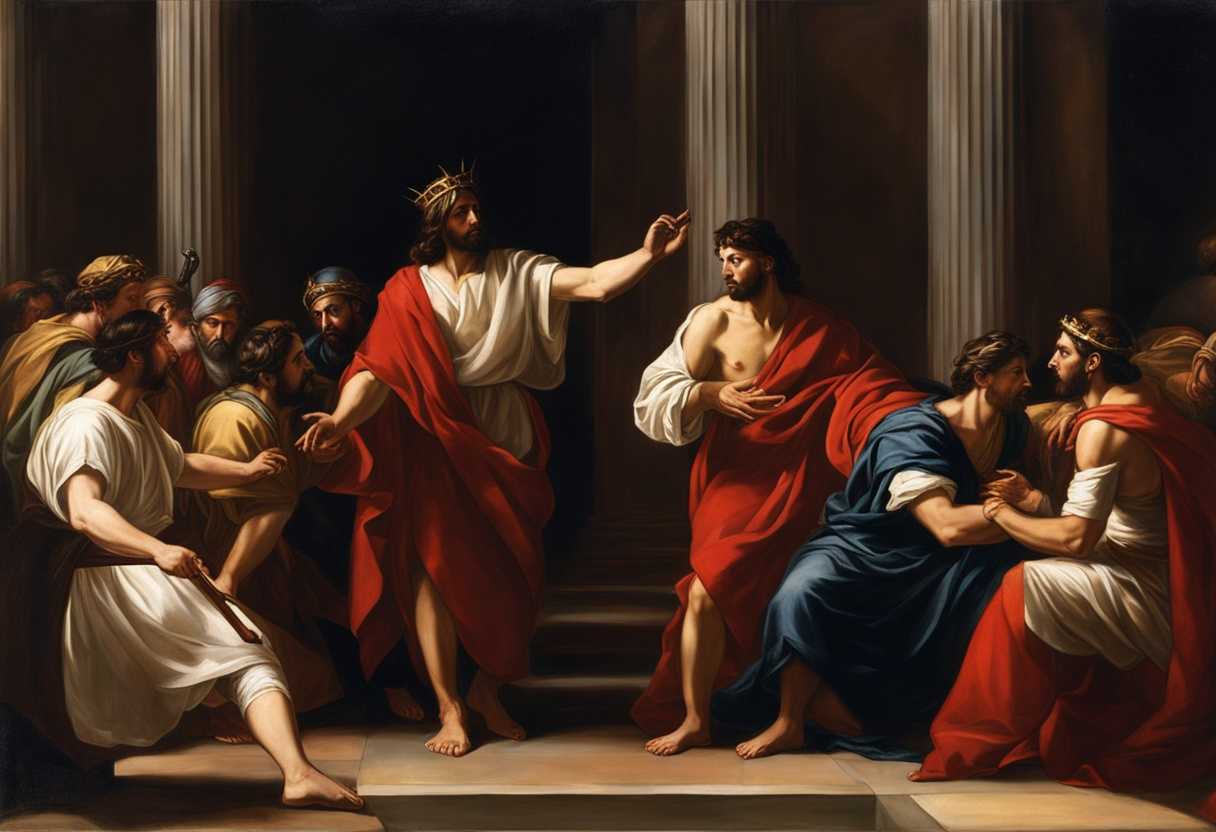
Setting the Scene for Luke 23:1-9
In Luke chapter 23, we find Jesus brought before Pontius Pilate, the Roman governor of Judea. The scene is set in the early morning in Jerusalem, the city bustling with activity as people prepare for the upcoming Passover feast. The air is filled with tension as the religious leaders, including the chief priests and scribes, bring Jesus to Pilate’s palace.
Pilate, a powerful and somewhat conflicted figure, is seated on his judgment seat, flanked by his guards. The religious leaders accuse Jesus of perverting the nation, forbidding the payment of taxes to Caesar, and claiming to be the Messiah, a king. Pilate questions Jesus, trying to discern the truth of the accusations against him. Meanwhile, the crowd outside the palace grows restless, with some supporting Jesus and others calling for his crucifixion.
Jesus stands calmly amidst the chaos, his demeanor radiating peace and truth. The clash of political power, religious authority, and the divine presence of Jesus creates a charged atmosphere, setting the stage for the pivotal events that will unfold in the hours to come.
What is Luke 23:1-9 about?
This verse illustrates a pivotal moment in the crucifixion narrative, where Jesus is brought before both Pilate and Herod for questioning. The interactions between Jesus and these two powerful figures serve to highlight the severity of the situation and the injustice being carried out against Jesus. We reflect on this scene, prompting us to consider the complexities of power dynamics, the role of authority, and the theme of innocence facing persecution.
Why was Jesus subjected to multiple rounds of questioning by both Pilate and Herod? What does this back-and-forth reveal about the motivations and fears of those in positions of power? How does Jesus’s demeanor and responses during these interrogations challenge the status quo and exemplify grace under pressure? Exploring the themes of justice, truth, and courage in the face of adversity encourages us to draw parallels to our own lives and the challenges we may encounter in standing up for what is right as we delve into this verse. Let us ponder the significance of this pivotal moment in the crucifixion narrative and find inspiration in Jesus’s unwavering commitment to his principles despite the trials he faced.
Understanding what Luke 23:1-9 really means
Jesus stands before Pilate, accused by the chief priests and rulers, in exploring Luke 23:1-9. This passage not only articulates the tension of the moment but also encapsulates deep theological and ethical implications relevant to our contemporary lives.
To begin, let’s consider the scene: Jesus, brought before the governance of Pilate, faces accusations of perversion of the nation and claiming Himself as king, a direct challenge to Roman authority. This setting highlights an essential theme of Jesus’ kingship and the kingdom of God, as opposed to earthly rulers and authorities. The phrase that Jesus is accused of forbidding tribute to Caesar, claiming Himself as a king, brings forth the question: What type of king is Jesus? Unlike earthly kings who might seek power through oppression or violence, Jesus’ kingship represents peace, justice, and truth.
What is particularly interesting in this passage is Pilate’s interaction with Jesus. Despite the grave accusations, Pilate finds no fault in Jesus, stating three times in the broader narrative that he finds no basis for a charge against Him. This speaks to the innocence of Jesus and sets the stage for the ultimate miscarriage of justice – His crucifixion. It’s a powerful reminder of the biblical theme of justice and innocence, resonating deeply with situations we face in a world rife with wrongful accusations and injustice. Pilate eventually shows indifference, despite recognizing Jesus’ innocence, which calls us to reflect on our own responses to truth and justice. Are we like Pilate, washing our hands when confronted with difficult decisions, or do we stand for truth, regardless of personal cost? This piece of the narrative pushes us to consider our actions in circumstances where truth is at stake.
This brings us to relevance. The passage raises a mirror to our society today. How often do we see truth sacrificed for convenience or safety? Corporate whistleblowers, or those in positions of power who stand against corruption at personal risk, should be considered. The courage to stand for truth, a theme central to this encounter between Jesus and Pilate, remains as critical today as it was then. We invite you not just to pass judgement on Pilate or the chief priests, but to use this as a moment of self-reflection in meditation on this scripture. Are we champions of truth and justice in our own lives, in our communities, and in our world? Or do we find ourselves, perhaps too often, choosing the easier wrong over the harder right? These are the questions that Luke 23:1-9 presses upon us, urging us to embody the principles of the kingdom that Jesus represented – a kingdom not of this world but alive in the hearts of those who choose to follow Him.
How can we show compassion and forgiveness like Jesus?
We can show compassion and forgiveness like Jesus by remembering that Jesus showed mercy towards those who wronged Him. Despite the injustices and betrayals He faced, Jesus forgave those who persecuted Him. Jesus exemplifies this compassionate nature in the passage from Luke by responding with grace and forgiveness, even in the face of false accusations and condemnation. Like Jesus, we can choose to respond with kindness and forgiveness towards those who may have hurt us or wronged us.
Furthermore, we can show compassion by seeking to understand and empathize with others, just as Jesus did. Jesus always looked beyond people’s actions to their hearts and motives, recognizing the brokenness and need for healing within them. We can strive to see others through the eyes of Jesus and extend grace and forgiveness even in difficult situations by showing empathy towards them. It is through this empathetic approach that we can truly embody the love and compassion that Jesus demonstrated throughout His life. We can cultivate a heart that is inclined towards love and understanding by ultimately following Jesus’ example of compassion and forgiveness. Rather than harboring resentment or seeking revenge, we can choose to extend grace and forgiveness towards others, reflecting the boundless love and mercy that Jesus showed to all. We not only honor Jesus’ teachings but also bear witness to His transformative power in our own lives and in the lives of those around us by doing so.
Application
Imagine yourself as a steadfast oak in a storm, deeply rooted in your values, as Jesus was before Herod. In the boardrooms, in the school halls, or at the dinner table with family, challenges to your beliefs lurk like shadows. Each moment, you have the power to stand tall and firm, to speak your truth with the courage of conviction, just as Jesus did. Let this passage be the wind beneath your wings, urging you to soar above the storm of dissent and ridicule. Will you rise and claim your voice in the face of opposition?

Reverend Michael Johnson is an experienced Church Minister with a profound expertise in spirituality and guidance. With a serene presence and a compassionate heart, he has faithfully served his congregation for over 20 years, leading them on a spiritual journey towards inner peace and enlightenment. Reverend Johnson’s extensive knowledge of religious philosophies and profound understanding of human nature have made him a trusted confidant and mentor to many, as he seamlessly weaves his profound wisdom into life teachings. Reverend Johnson’s calming demeanor and empathetic nature continue to uplift and heal souls, nurturing a sense of unity and tranquility within his community.