
1 Now Sarai, Abram’s wife, had borne him no children.
2 And Sarai said to Abram, “Behold now, the Lord has prevented me from bearing children. Go in to my servant; it may be that I shall obtain children by her.” And Abram listened to the voice of Sarai.
3 Then Sarai, Abram’s wife, took Hagar the Egyptian, her servant, and gave her to Abram her husband as a wife.
4 And he went in to Hagar, and she conceived. And when she saw that she had conceived, she looked with contempt on her mistress.
5 And Sarai said to Abram, “May the wrong done to me be on you! I gave my servant to your embrace, and when she saw that she had conceived, she looked on me with contempt. May the Lord judge between you and me!”
6 But Abram said to Sarai, “Behold, your servant is in your power; do to her as you please.” Then Sarai dealt harshly with her, and she fled from her.
7 The angel of the Lord found her by a spring of water in the wilderness, the spring on the way to Shur.
8 And he said, “Hagar, servant of Sarai, where have you come from and where are you going?” She said, “I am fleeing from my mistress Sarai.”
9 The angel of the Lord said to her, “Return to your mistress and submit to her.”
10 The angel of the Lord also said to her, “I will surely multiply your offspring so that they cannot be numbered for multitude.”
11 And the angel of the Lord said to her, “Behold, you are pregnant and shall bear a son. You shall call his name Ishmael, because the Lord has listened to your affliction.
12 He shall be a wild donkey of a man, his hand against everyone and everyone’s hand against him, and he shall dwell over against all his kinsmen.”
13 So she called the name of the Lord who spoke to her, “You are a God of seeing,” for she said, “Truly here I have seen him who looks after me.”
14 Therefore the well was called Beer-lahai-roi; it lies between Kadesh and Bered.
15 And Hagar bore Abram a son, and Abram called the name of his son, whom Hagar bore, Ishmael.
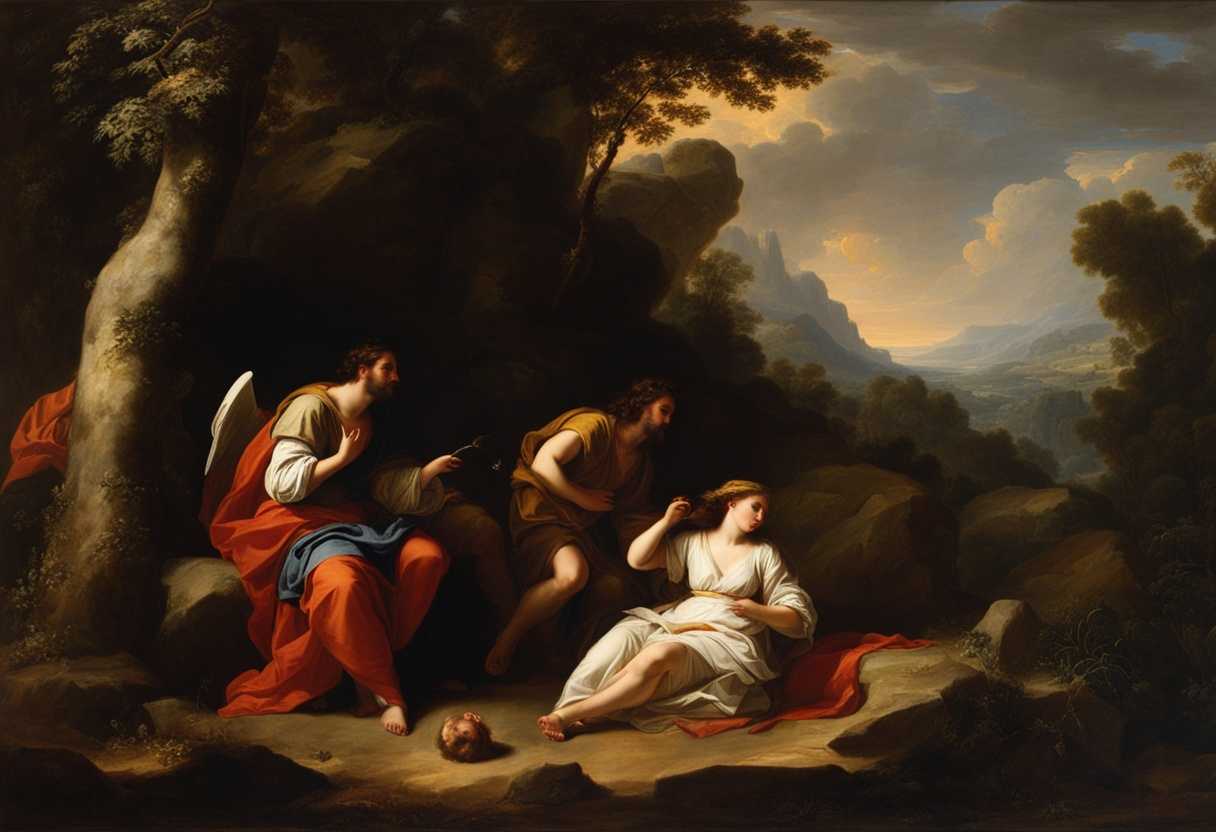
Setting the Scene for Genesis 16:1-15
In Genesis chapter 16, we find ourselves in the midst of a complex and emotional situation involving Abram (later known as Abraham), his wife Sarai (later known as Sarah), and their Egyptian maidservant, Hagar. The scene is set in the ancient land of Canaan, where Abram and Sarai had been living in obedience to God’s call. However, despite God’s promise to make Abram a great nation, Sarai remained childless, causing her great distress.
Feeling desperate and perhaps doubting God’s promise, Sarai suggests to Abram that he take Hagar as a second wife in order to have a child through her. Abram agrees, and Hagar becomes pregnant with his child. However, tensions rise between Sarai and Hagar as Hagar begins to look down on Sarai, causing Sarai to mistreat her. Hagar eventually flees into the wilderness, where she encounters an angel of the Lord who instructs her to return and submit to Sarai.
This scene is filled with a mix of human emotions – longing, jealousy, desperation, and ultimately, divine intervention. It serves as a reminder of the consequences of taking matters into our own hands instead of trusting in God’s timing and faithfulness. The setting of the ancient land of Canaan adds to the richness of the narrative, highlighting the cultural norms and challenges faced by the characters in their journey of faith.
What is Genesis 16:1-15 about?
Let’s dive into the story of Sarai, Hagar, and Abram in Genesis 16:1-15. Sarai, unable to bear children, decides to give her maidservant Hagar to her husband Abram so that he may have a child. This decision causes complexities in their family dynamic and leads to the birth of Ishmael. The narrative sheds light on issues of faith, human relationships, and the consequences of trying to take matters into our own hands instead of trusting in divine timing.
This story challenges us to reflect on our own lives. Are we patient enough to wait for what we desire, or do we try to make things happen on our own? Do we trust that God’s plan is unfolding as it should, even when we cannot see the bigger picture? Through the characters of Sarai, Hagar, and Abram, we are reminded of the importance of faith, patience, and surrendering control. It serves as a powerful lesson about the implications of our actions and the need to trust in a higher power.
Understanding what Genesis 16:1-15 really means
The complex narrative of Hagar, Sarai, and Abram challenges us to think deeply about our own interactions and moral choices in Genesis 16:1-15. This passage is rich with themes of desperation, human agency, and divine intervention, which resonate powerfully in our lives today.
Sarai’s inability to conceive led her to offer Hagar, her Egyptian slave, to Abram as a means to bear children. The phrase “that I may obtain children by her” reveals the extent of Sarai’s despair and the societal pressure to produce heirs. This prompts us to reflect, how often do we take matters into our own hands when faced with unmet expectations? Sarai’s decision, though culturally justified at the time, brings about strife and complexity in their household, underscoring the consequences of taking action without seeking divine guidance. Hagar conceives as the story unfolds, and her relationship with Sarai deteriorates, leading Sarai to mistreat her. Here, we see the destructive nature of human conflict and the pain that can arise from our own unthoughtful actions. This serves as a poignant reminder of the need for empathy and fairness in our dealings with others, asking us to consider, how do we treat those who disrupt our plans or challenge our status quo?
The turning point in this narrative occurs when the angel of the Lord finds Hagar by a spring in the desert. The angel’s directive to “return to your mistress and submit to her” and the subsequent promise that “I will so increase your descendants that they will be too numerous to count” introduces an extraordinary theme of redemption and hope. The angelic encounter reminds us that God sees our afflictions and is present even in our most desperate moments. How often do we feel overlooked or forgotten, only to find that God is there, working within our struggles?
This passage is highly relevant today as it raises questions about dealing with difficult decisions, treating others with respect, and recognizing God’s presence in our trials. It encourages readers to trust in God’s plan and timing, even when our current circumstances make it challenging to do so. An anecdote that beautifully illustrates this is about a parishioner who struggled with infertility. Like Sarai, she was overwhelmed by societal and personal pressures to have a child. It was not until she devoted her situation to prayer and trusted in God’s timing, rather than her own, that she found peace. Months later, she adopted a child who became her joy and blessing, reflecting Hagar’s own journey from despair to hope through divine assurance. We can contemplate this passage and ask ourselves how we can better align our actions with God’s will, treat others with kindness even under pressure, and trust in His presence and promises during our darkest times.
How can we trust God’s promises in times of waiting?
When we find ourselves waiting for God’s promises to be fulfilled, we can trust in His faithfulness and timing. God’s promises are sure and will come to pass in His perfect timing, so remember in times of waiting. Just like in the story of Hagar in Genesis 16, even when circumstances may cause us to doubt or take matters into our own hands, we can trust that God sees us, hears our cries, and will fulfill His promises to us.
During the waiting period, it is crucial to remain patient and faithful, knowing that God’s promises are worth the wait. Our role is to trust in Him, seek His will, and continue to hold on to the hope that He will fulfill what He has spoken. We can be confident that His promises will manifest in ways beyond what we can imagine by allowing God to work in His perfect timing. Trusting in God’s promises during times of waiting ultimately strengthens our faith and deepens our relationship with Him.
Application
Navigating life’s challenges can sometimes feel like steering through a storm without a compass. Like Sarah and Hagar from Genesis 16:1-15, we often grapple with the urge to grab the wheel before remembering that God has the map laid out for us. Each day presents a choice: forge ahead with our plan or wait for God’s signal. Think of yourself at a crossroads where one path is worn and familiar—the shortcut—and the other, though less traveled, is lined with the promises of God. When the pressure mounts, whether in the conference room or at the family dinner table, embracing patience and trusting in His divine schedule could lead to outcomes far greater than our own designs. Can you let go of the steering wheel and trust that God’s GPS is set to the best destination for you?

Reverend Michael Johnson is an experienced Church Minister with a profound expertise in spirituality and guidance. With a serene presence and a compassionate heart, he has faithfully served his congregation for over 20 years, leading them on a spiritual journey towards inner peace and enlightenment. Reverend Johnson’s extensive knowledge of religious philosophies and profound understanding of human nature have made him a trusted confidant and mentor to many, as he seamlessly weaves his profound wisdom into life teachings. Reverend Johnson’s calming demeanor and empathetic nature continue to uplift and heal souls, nurturing a sense of unity and tranquility within his community.