
1 After this, Joseph was told, “Behold, your father is ill.” So he took with him his two sons, Manasseh and Ephraim.
2 And it was told to Jacob, “Your son Joseph has come to you.” Then Israel summoned his strength and sat up in bed.
3 Then Jacob said to Joseph, “God Almighty appeared to me at Luz in the land of Canaan and blessed me,
4 and said to me, ‘Behold, I will make you fruitful and multiply you, and I will make of you a company of peoples and will give this land to your offspring after you for an everlasting possession.’
5 And now your two sons, who were born to you in the land of Egypt before I came to you in Egypt, are mine; Ephraim and Manasseh shall be mine, as Reuben and Simeon are.
6 And your offspring, whom you father after them, shall be yours. They shall be called by the name of their brothers in their inheritance.
7 As for me, when I came from Paddan, to my sorrow Rachel died in the land of Canaan on the way, when there was still some distance to go to Ephrath, and I buried her there on the way to Ephrath (that is, Bethlehem).
8 When Israel saw Joseph’s sons, he said, “Who are these?”
9 And Joseph said to his father, “They are my sons, whom God has given me here.” And he said, “Bring them to me, please, that I may bless them.”
10 Now the eyes of Israel were dim with age, so that he could not see. So Joseph brought them near him, and he kissed them and embraced them.
11 And Israel said to Joseph, “I never expected to see your face; and behold, God has let me see your offspring also.”
12 Then Joseph removed them from his knees, and he bowed himself with his face to the earth.
13 And Joseph took them both, Ephraim in his right hand toward Israel’s left hand, and Manasseh in his left hand toward Israel’s right hand, and brought them near him.
14 And Israel stretched out his right hand and laid it on the head of Ephraim, who was the younger, and his left hand on the head of Manasseh, crossing his hands (for Manasseh was the firstborn).
15 And he blessed Joseph and said, “The God before whom my fathers Abraham and Isaac walked, the God who has been my shepherd all my life long to this day,
16 the angel who has redeemed me from all evil, bless the boys; and in them let my name be carried on, and the name of my fathers Abraham and Isaac; and let them grow into a multitude in the midst of the earth.”
17 When Joseph saw that his father laid his right hand on the head of Ephraim, it displeased him, and he took his father’s hand to move it from Ephraim’s head to Manasseh’s head.
18 And Joseph said to his father, “Not this way, my father; since this one is the firstborn, put your right hand on his head.”
19 But his father refused and said, “I know, my son, I know. He also shall become a people, and he also shall be great. Nevertheless, his younger brother shall be greater than he, and his offspring shall become a multitude of nations.”
20 So he blessed them that day, saying, “By you Israel will pronounce blessings, saying, ‘God make you as Ephraim and as Manasseh.’” So he put Ephraim before Manasseh.
21 Then Israel said to Joseph, “Behold, I am about to die, but God will be with you and will bring you again to the land of your fathers.
22 Moreover, I have given to you rather than to your brothers one mountain slope that I took from the hand of the Amorites with my sword and with my bow.”
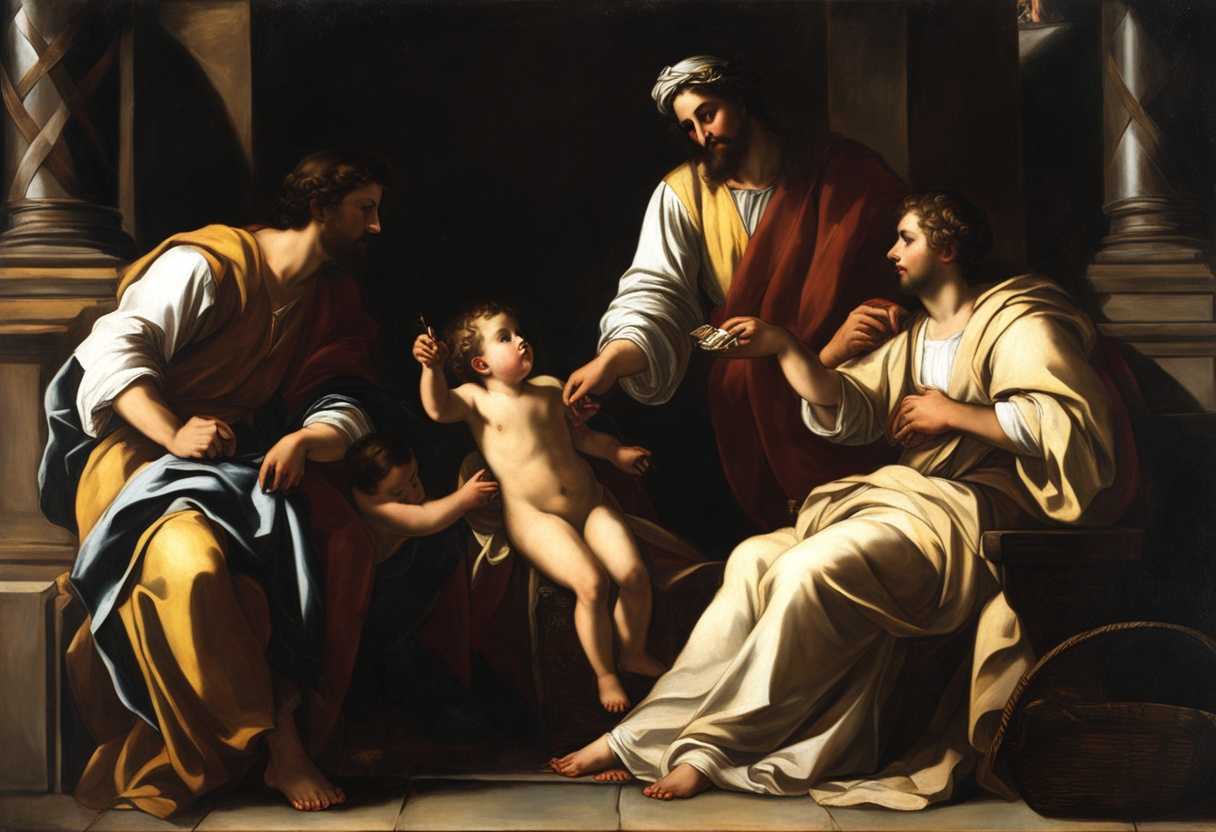
The True Meaning of Genesis 48
This chapter of Genesis is attributed to the author Moses, who was a prominent figure in the Israelite tradition. Moses, who guided the Israelites out of slavery in Egypt and towards the Promised Land, had a unique perspective on the events unfolding in the lives of the patriarchs. Jacob, also known as Israel, bestows his final blessings upon his grandsons, Ephraim and Manasseh, the sons of Joseph, in this chapter. This moment holds great significance, as it not only solidifies the lineage of the Israelite people but also foreshadows the future divisions and rivalries that will shape the nation. The chapter also echoes the earlier blessing of Jacob by his father, Isaac, as recorded in Genesis 27. As we delve into this passage, Jacob reflects the hand of God guiding the destiny of His chosen people through his actions and words. The chapter serves as a bridge between the patriarchal era and the emergence of the Israelite nation, setting the stage for the pivotal events that will unfold in the subsequent books of the Bible.
Genesis 48:1-7
Jacob, Joseph, and Joseph’s two sons, Ephraim and Manasseh, have an important interaction in Genesis 48:1-7. This scene sets the stage for Jacob’s blessings upon Joseph’s sons. Jacob was sick and approaching the end of his life in verse 1. Amidst his failing health, Joseph is informed that his father is ill. This prompts Joseph to bring his two sons, Ephraim and Manasseh, to Jacob for his final blessings. Jacob brings his sons to Joseph and recounts a significant event in their family’s history. He reminds Joseph of Rachel, Joseph’s mother, who died giving birth to Benjamin, Joseph’s younger brother. This reminder is crucial as it links the present moment with the past, demonstrating the continuation of God’s promises through the generations of Jacob’s family.
Jacob’s mention of Rachel’s death also adds a layer of emotional depth to the scene. It is a reminder of the hardships and losses the family has faced, yet it also serves as a testament to God’s faithfulness in sustaining them through trials. Jacob’s words clearly show the love he had for Rachel. Despite the passage of time and the hardships endured, the memory of Rachel remains a poignant part of Jacob’s life. This reinforces the theme of love and family bonds that run throughout the Bible, showing the significance of familial relationships in the narrative of God’s people. Jacob sees Joseph’s sons, Ephraim and Manasseh, and recognizes that they will be considered his own, on the same level as Reuben and Simeon. Jacob effectively ensures that the blessings and promises of God will continue through Ephraim and Manasseh by adopting Joseph’s sons as his own, demonstrating God’s faithfulness in fulfilling His covenant with Abraham to make his descendants as numerous as the stars.
This act of adoption is significant because it signifies the passing on of blessings, inheritance, and responsibilities within the family lineage. These symbolic gestures hold immense importance in the Bible as they represent God’s choosing of individuals and families to carry out His divine plan. Genesis 48:1-7 captures a pivotal moment in the lives of Jacob, Joseph, and Joseph’s sons, Ephraim and Manasseh. It showcases the themes of lineage, blessings, remembrance, and God’s faithfulness that run throughout the Bible. Through Jacob’s blessings upon Joseph’s sons, we see the continuation of God’s promises and the reaffirmation of His covenant with His people.
Genesis 48:8-16
Jacob, also known as Israel, has a poignant moment with his grandchildren Ephraim and Manasseh in Genesis 48:8-16. Jacob had been living in Egypt for some time due to a famine, and now he was nearing the end of his life. Joseph, his beloved son whom he thought was dead, had become a high official in Egypt and had brought his sons to see their grandfather before his passing.
One of the key aspects of this passage is Jacob’s decision to bless Ephraim and Manasseh, Joseph’s sons. Typically, the firstborn received the greater blessing and inheritance, but Jacob intentionally crosses his hands, placing his right hand – the hand of blessing – on the younger son, Ephraim, and his left hand on the older son, Manasseh. This act surprises Joseph and prompts him to try to correct his father, but Jacob insists that he knew what he was doing.
This moment symbolizes a shift in the natural order of inheritance and blessings, foreshadowing how God often chooses the unexpected and the seemingly less important in the eyes of the world to fulfill His plans. This theme can be seen throughout the Bible, from God choosing the younger David over his older brothers to be king (1 Samuel 16) to Jesus selecting common fishermen as His disciples to carry out His ministry (Matthew 4).
Jacob’s deliberate act also emphasizes the importance of God’s sovereignty over human traditions and norms. God’s ways are higher than our ways (Isaiah 55:8-9), and He can use anyone, regardless of their position or birth order, to accomplish His purposes. This message serves as a reminder to not underestimate the potential of those who may be overlooked or undervalued by society, as seen in the case of Ephraim and Manasseh.
Furthermore, this event showcases the continuity of God’s promises throughout generations. Jacob reaffirms the covenant that God made with Abraham, Isaac, and himself by blessing Joseph’s sons. The blessings and promises of God are not just for one generation but are meant to be passed down and fulfilled through the descendants, underscoring the importance of faithfulness and obedience in each generation. The account of Jacob blessing Ephraim and Manasseh in Genesis 48:8-16 teaches us about God’s sovereignty, the unexpected ways He works, the importance of passing down faith from generation to generation, and how His promises endure through time. It challenges us to trust in God’s wisdom and to value all individuals as vessels through which God can accomplish His divine purposes, regardless of societal conventions or perceptions.
Genesis 48:17-22
Jacob, nearing the end of his life, blesses his grandsons Ephraim and Manasseh in a powerful scene in Genesis 48:17-22. Jacob is old and his eyes are dim with age, yet his spiritual insight remains sharp as ever. Joseph presents his two sons to Jacob seeking his blessing in this passage, following the tradition where the firstborn would receive the greater blessing. However, Jacob deliberately crosses his arms, placing his right hand on the younger Ephraim and his left hand on the elder Manasseh, displaying a reversal in the normal order of blessing.
This act of Jacob is significant as it emphasizes God’s sovereignty in choosing whom He will bless and demonstrate that His blessings do not always follow human conventions or expectations. It also reaffirms the recurring theme in the Bible where the younger is chosen over the elder to carry out God’s purposes, as seen with Cain and Abel, Isaac and Ishmael, and Jacob and Esau. Jacob shows that the fulfillment of God’s promises is not dependent on human traditions or societal norms, but on God’s divine will and plan by adopting this unconventional approach. Jacob underscores the principle of grace by blessing Ephraim and Manasseh equally and even elevating Ephraim above his older brother, blessing that are given freely by God without regard to merit but solely out of His love and mercy. This serves as a foreshadowing of the New Testament teachings on grace, where salvation is offered to all, not based on works, but through faith in Christ (Ephesians 2:8-9). Jacob’s actions with Ephraim and Manasseh highlight that God’s blessings are not restricted by human hierarchies or expectations, but are poured out abundantly on those He chooses, regardless of their position or status in society.
Furthermore, Jacob’s blessing on Ephraim and Manasseh carries a prophetic element, as he foresees the future greatness of these tribes. Ephraim and Manasseh would go on to become two of the most prominent tribes in Israel, with Ephraim eventually representing the northern kingdom of Israel. This blessing demonstrates God’s foresight and strategic planning in shaping the future of His chosen people. It also signifies the importance of generational blessings and how the actions and decisions of one generation can have a lasting impact on the trajectory of their descendants, echoing the concept of generational blessings and curses mentioned in the Bible (Exodus 20:5). Genesis 48:17-22 showcases the divine prerogative in blessing, the principle of grace, the reversal of human expectations, and the prophetic insight into the future. It serves as a reminder of God’s sovereignty in choosing whom He will bless, the importance of grace in receiving His blessings, and the enduring impact of generational blessings. Jacob’s blessing on Ephraim and Manasseh not only shapes the destiny of these tribes but also reinforces timeless truths about God’s faithfulness, providence, and the redemptive plan He has for His people throughout history.
After Genesis 48
The old man Jacob had blessed his grandsons, Ephraim and Manasseh. He had placed his hands on their heads and spoken words of prophecy over them. Jacob’s time on this earth was drawing to a close. He knew his death was near. I, as the reverend, must now prepare the congregation for the passing of this great patriarch. For in the next chapter, we will witness Jacob’s final moments and the blessings he bestows upon his twelve sons. The Lord’s plan for His chosen people is about to unfold in a profound way. Let us ready our hearts to receive the wisdom that Jacob’s lips flow in his last days.

Reverend Michael Johnson is an experienced Church Minister with a profound expertise in spirituality and guidance. With a serene presence and a compassionate heart, he has faithfully served his congregation for over 20 years, leading them on a spiritual journey towards inner peace and enlightenment. Reverend Johnson’s extensive knowledge of religious philosophies and profound understanding of human nature have made him a trusted confidant and mentor to many, as he seamlessly weaves his profound wisdom into life teachings. Reverend Johnson’s calming demeanor and empathetic nature continue to uplift and heal souls, nurturing a sense of unity and tranquility within his community.