
John 1:6-8, 19-28 is about John the Baptist testifying about the arrival of the true Light (Jesus) and humbly acknowledging his own role as a witness pointing others towards the Messiah.
6 There was a man sent from God, whose name was John.
7 He came as a witness, to bear witness about the light, that all might believe through him.
8 He was not the light, but came to bear witness about the light.
19 And this is the testimony of John, when the Jews sent priests and Levites from Jerusalem to ask him, “Who are you?”
20 He confessed, and did not deny, but confessed, “I am not the Christ.”
21 And they asked him, “What then? Are you Elijah?” He said, “I am not.” “Are you the Prophet?” And he answered, “No.”
22 So they said to him, “Who are you? We need to give an answer to those who sent us. What do you say about yourself?”
23 He said, “I am the voice of one crying out in the wilderness, ‘Make straight the way of the Lord,’ as the prophet Isaiah said.”
24 (Now they had been sent from the Pharisees.)
25 They asked him, “Then why are you baptizing, if you are neither the Christ, nor Elijah, nor the Prophet?”
26 John answered them, “I baptize with water, but among you stands one you do not know,
27 He it is who coming after me is preferred before me, whose shoe’s latchet I am not worthy to unloose.
28 These things took place in Bethany across the Jordan, where John was baptizing.
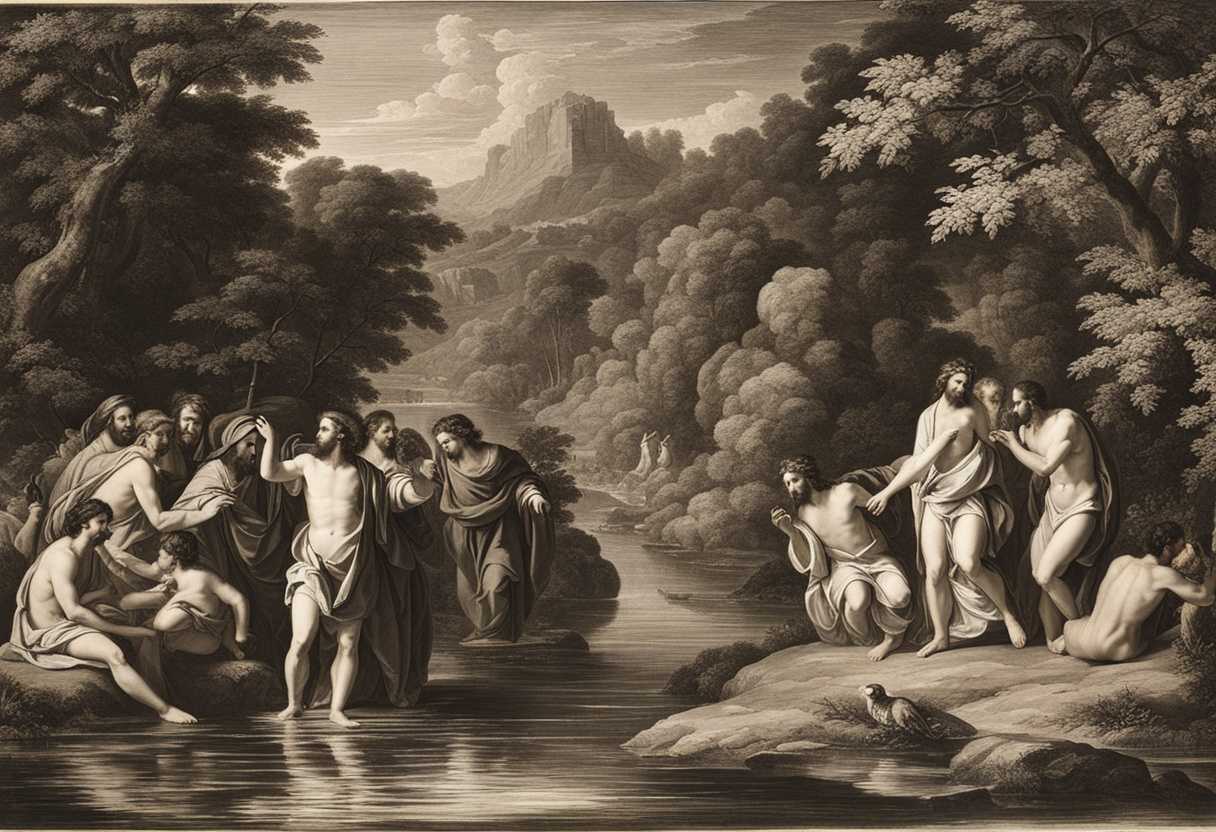
Setting the Scene for John 1:6-8, 19-28
The scene in John chapter 1 opens with a bustling crowd gathered near the Jordan River. The sun is shining brightly, casting a warm glow over the landscape. People from all walks of life have come to witness the events unfolding before them. Among the crowd are Pharisees and priests sent from Jerusalem to question a man named John. John, a rugged figure with a commanding presence, stands at the water’s edge, dressed in simple garments made of camel’s hair, his voice carrying over the murmurs of the crowd.
John, known as John the Baptist, has been drawing large crowds with his fiery preaching and calls for repentance. His message is one of preparation for the coming of the Messiah. As the Pharisees and priests question him about his identity and purpose, John’s responses are filled with conviction and authority. He declares that he is not the Messiah but rather a voice crying out in the wilderness, preparing the way for the one who is to come.
The tension in the air is palpable as the religious leaders press John for answers. Despite their skepticism, John remains steadfast in his mission, pointing to the one who is greater than himself. The scene is charged with anticipation and expectation as the crowd waits to see what will unfold next in this pivotal moment in history.
What is John 1:6-8, 19-28 about?
John the Baptist serves as a precursor to the coming of Jesus Christ in this verse. John is acknowledging Jesus as the savior and the source of truth and life by testifying about Jesus as the light. John’s role is to prepare the way for Jesus, to announce His arrival and to bring attention to the transformative power of His teachings. John’s recognition of Jesus as the light also serves as a metaphor for the guidance and enlightenment that Jesus brings to the world.
Have you ever thought about how crucial it is to have someone like John the Baptist to pave the way for a significant event or person? John’s actions are not just about preparing the physical path for Jesus but also about preparing people’s hearts and minds to receive and understand the significance of Jesus’ message. Just like a guide leading the way through a dark forest, John’s testimony illuminates the path to Jesus and invites others to follow suit. This verse reminds us of the importance of being open to receiving guidance and enlightenment from those who have insights to offer, especially when it comes to matters of faith and spirituality.
Understanding what John 1:6-8, 19-28 really means
In the Gospel of John, we encounter the introduction of John the Baptist, a pivotal figure in the divine plan of salvation. John 1:6-8 illuminates John’s purpose as a witness to the Light, symbolizing Jesus Christ, who brings salvation and truth to the world. His mission was not to shine as the Light himself but to point others towards the true source of light and life. This distinction emphasizes the humility and clarity with which John approached his role, setting an example for all believers to follow in recognizing and fulfilling their own God-given purposes.
The passage further delves into John’s testimony and encounters with religious leaders in John 1:19-28. Despite facing scrutiny and questioning about his identity and purpose, John remains steadfast in his mission to prepare the way for the coming of Christ. His unwavering commitment to his divine calling serves as a reminder to believers of the importance of staying true to God’s purpose for their lives, even in the face of opposition or doubt.
Key phrases in these verses highlight the divine appointment of John the Baptist, emphasizing the significance of being called by God for a specific mission. His role as a witness to the Light underscores the essential task of bearing testimony to Jesus Christ, inviting others to believe and experience the transformative power of faith. Through John’s example, we are reminded of the profound impact that faithful witnessing can have on those around us, leading them towards a deeper relationship with Christ.
Drawing parallels to Old Testament prophecies in Isaiah and Malachi, we see the fulfillment of John’s role as the messenger preparing the way for the Lord. His humility in acknowledging Jesus’ superiority and his willingness to fulfill his preparatory mission with humility and purpose serve as a timeless example for believers today. Just as John paved the way for Christ’s first coming, we are called to prepare our hearts and the hearts of others for His return, embodying the spirit of anticipation and readiness.
In our contemporary context, the themes of witnessing, humility, and purpose remain as relevant and essential as ever. Like John the Baptist, we are called to bear witness to the light of Christ in our lives, sharing our faith with others and pointing them towards the source of true salvation. By embracing humility and recognizing our unique God-given purposes, we can serve faithfully and selflessly, seeking to glorify God rather than ourselves. As we reflect on John’s life and mission, may we be inspired to live out our faith boldly, preparing the way for Christ’s presence in our lives and in the world around us.
Consider the imagery of a lighthouse keeper diligently tending to the light that guides ships safely to shore. The keeper understands that the true beacon is the light itself, not his own actions. Similarly, John the Baptist faithfully fulfilled his role in directing people to Jesus, the ultimate Light of the world. In our daily lives, we can embody the humility and purpose of the lighthouse keeper, guiding others towards the safety and salvation found in Christ with unwavering dedication and clarity.
In conclusion, John the Baptist’s life and ministry offer a profound example of faithful witness, humility, and purpose that resonate across time and culture. By internalizing these principles and applying them to our own lives, we can effectively share our faith, fulfill our divine calling, and prepare the way for Christ’s presence in our hearts and in the world. Let us heed the lessons of John’s story, embracing our roles as witnesses to the Light and heralds of the Good News, shining brightly in a world that longs for the hope and truth found in Jesus Christ.
Are we willing to decrease so God may increase?
Yes, we should be willing to decrease so that God may increase in our lives. This means humbling ourselves and putting aside our own desires, ambitions, and pride to make more room for God’s will and presence. We should also strive to decrease our own self-importance and allow God to take center stage in our lives, just as John the Baptist recognized his role as a messenger to prepare the way for Christ. We acknowledge our need for God and His power to work in and through us by decreasing ourselves. It is important to remember that when we decrease, it is not a loss but a gain – as we make more room for God’s grace, love, and blessings to flow abundantly in our lives. Decreasing ourselves ultimately allows God’s light to shine brighter through us, pointing others to Him and glorifying His name in all that we do.
Application
Reflect on John the Baptist’s humility in pointing others to Jesus as the light of the world. Like him, we have a unique purpose to fulfill in God’s kingdom. Are we dedicated and convicted in fulfilling our divine tasks? Let’s seek our calling with faith and zeal. How will you answer God’s call in your life today?

Reverend Michael Johnson is an experienced Church Minister with a profound expertise in spirituality and guidance. With a serene presence and a compassionate heart, he has faithfully served his congregation for over 20 years, leading them on a spiritual journey towards inner peace and enlightenment. Reverend Johnson’s extensive knowledge of religious philosophies and profound understanding of human nature have made him a trusted confidant and mentor to many, as he seamlessly weaves his profound wisdom into life teachings. Reverend Johnson’s calming demeanor and empathetic nature continue to uplift and heal souls, nurturing a sense of unity and tranquility within his community.