
Deuteronomy 11:26-16:17 is about reminding and instructing the Israelites to choose obedience to God’s commands, emphasizing blessings for faithfulness and consequences for disobedience, as well as the importance of celebrating feasts and giving tithes to honor the covenant relationship with God.
26 “See, I am setting before you today a blessing and a curse:”
27 a blessing, if you obey the commandments of the Lord your God, which I command you today,
28 and the curse, if you do not obey the commandments of the Lord your God, but turn aside from the way that I am commanding you today, to go after other gods that you have not known.
29 And when the Lord your God brings you into the land that you are entering to take possession of it, you shall set the blessing on Mount Gerizim and the curse on Mount Ebal.
30 Are they not beyond the Jordan, west of the road, toward the going down of the sun, in the land of the Canaanites who live in the Arabah, opposite Gilgal, beside the oak of Moreh?
31 For you are to cross over the Jordan to go in to take possession of the land that the Lord your God is giving you. And when you possess it and live in it,
32 And you shall be careful to do all the statutes and the rules that I am setting before you today.
1 “These are the statutes and rules that you shall be careful to do in the land that the Lord, the God of your fathers, has given you to possess, all the days that you live on the earth.
2 You shall surely destroy all the places where the nations whom you shall dispossess served their gods, on the high mountains and on the hills and under every green tree.
3 You shall tear down their altars and dash in pieces their pillars and burn their Asherim with fire. You shall chop down the carved images of their gods and destroy their name out of that place.
4 You shall not worship the Lord your God in that way.
5 But you shall seek the place that the Lord your God will choose out of all your tribes to put his name and make his habitation there. There you shall go,
6 And there you shall bring your burnt offerings and your sacrifices, your tithes and the contribution that you present, your vow offerings, your freewill offerings, and the firstborn of your herd and of your flock.
7 And there you shall eat before the Lord your God, and you shall rejoice, you and your households, in all that you undertake, in which the Lord your God has blessed you.
8 “You shall not do according to all that we are doing here today, everyone doing whatever is right in his own eyes,”
9 for you have not as yet come to the rest and to the inheritance that the Lord your God is giving you.
10 But when you go over the Jordan and live in the land that the Lord your God is giving you to inherit, and when he gives you rest from all your enemies around, so that you live in safety,
11 then to the place that the Lord your God will choose, to make his name dwell there, there you shall bring all that I command you: your burnt offerings and your sacrifices, your tithes and the contribution that you present, and all your finest vow offerings that you vow to the Lord.
12 And you shall rejoice before the Lord your God, you and your sons and your daughters, your male servants and your female servants, and the Levite that is within your towns, since he has no portion or inheritance with you.
13 Take care that you do not offer your burnt offerings at any place that you see,
14 But in the place that the Lord will choose in one of your tribes, there you shall offer your burnt offerings, and there you shall do all that I am commanding you.
15 “However, you may slaughter and eat meat within any of your towns, as much as you desire, according to the blessing of the Lord your God that he has given you. The unclean and the clean may eat of it, as of the gazelle and as of the deer.”
16 Only you shall not eat the blood; you shall pour it out on the earth like water.
17 You may not eat within your towns the tithe of your grain or of your wine or of your oil, or the firstborn of your herd or of your flock, or any of your vow offerings that you vow, or your freewill offerings or the contribution that you present,
18 but you shall eat them before the Lord your God in the place that the Lord your God will choose, you and your son and your daughter, your male servant and your female servant, and the Levite who is within your towns. And you shall rejoice before the Lord your God in all that you undertake.
19 Take care that you do not neglect the Levite as long as you live in your land.
20 “When the Lord your God enlarges your territory, as he has promised you, and you say, ‘I will eat meat,’ because you crave meat, you may eat meat whenever you desire.
21 If the place that the Lord your God will choose to put his name there is too far from you, then you may kill any of your herd or your flock, which the Lord has given you, as I have commanded you, and you may eat within your towns whenever you desire.
22 Just as the gazelle or the deer is eaten, so you may eat of it. The unclean and the clean alike may eat of it.
23 Only be sure that you do not eat the blood, for the blood is the life, and you shall not eat the life with the flesh.
24 You shall not eat it; you shall pour it out on the earth like water.
25 You shall not eat it, that all may go well with you and with your children after you, when you do what is right in the sight of the Lord.
26 But the holy things that are due from you, and your vow offerings, you shall take, and you shall go to the place that the Lord will choose,
27 And you shall offer your burnt offerings, the flesh and the blood, on the altar of the Lord your God.
28 Be careful to obey all these words that I command you, that it may go well with you and with your children after you forever, when you do what is good and right in the sight of the Lord your God.
29 “When the Lord your God cuts off before you the nations whom you go in to dispossess, and you dispossess them and dwell in their land,”
30 take care that you be not ensnared to follow them, after they have been destroyed before you, and that you do not inquire about their gods, saying, ‘How did these nations serve their gods?—that I also may do the same.’
31 You shall not worship the Lord your God in that way, for every abominable thing that the Lord hates they have done for their gods, for they even burn their sons and their daughters in the fire to their gods.
32 “Everything that I command you, you shall be careful to do. You shall not add to it or take from it.
1 “If a prophet or a dreamer of dreams arises among you and gives you a sign or a wonder,”
2 and the sign or wonder that he tells you comes to pass, and if he says, ‘Let us go after other gods,’ which you have not known, ‘and let us serve them,’
3 you shall not listen to the words of that prophet or that dreamer of dreams. For the Lord your God is testing you, to know whether you love the Lord your God with all your heart and with all your soul.
4 You shall walk after the Lord your God and fear him and keep his commandments and obey his voice, and you shall serve him and hold fast to him.
5 But that prophet or that dreamer of dreams shall be put to death, because he has taught rebellion against the Lord your God, who brought you out of the land of Egypt and redeemed you out of the house of slavery, to make you leave the way in which the Lord your God commanded you to walk. So you shall purge the evil from your midst.
6 “If your brother, the son of your mother, or your son or your daughter or the wife you embrace or your friend who is as your own soul entices you secretly, saying, ‘Let us go and serve other gods,’ which you have not known, you or your fathers,
7 Some of the gods of the peoples who are around you, whether near you or far off from you, from the one end of the earth to the other,
8 you shall not yield to him or listen to him, nor shall your eye pity him, nor shall you spare him, nor shall you conceal him.
9 But you shall kill him. Your hand shall be first against him to put him to death, and afterward the hand of all the people.
10 You shall stone him to death with stones, because he sought to draw you away from the Lord your God, who brought you out of the land of Egypt, out of the house of slavery.
11 then you shall do to him as he had meant to do to his brother. So you shall purge the evil from your midst.
12 “If you hear in one of your cities, which the Lord your God is giving you to dwell there,”
13 that certain worthless fellows have gone out among you and have drawn away the inhabitants of their city, saying, ‘Let us go and serve other gods,’ which you have not known,
14 then you shall inquire and make search and ask diligently. And behold, if it be true and certain that such an abomination has been done among you,
15 you shall surely put the inhabitants of that city to the sword, devoting it to destruction, all who are in it and its cattle, with the edge of the sword.
16 You shall gather all its spoil into the midst of its open square and burn the city and all its spoil with fire, as a whole burnt offering to the Lord your God. It shall be a heap forever. It shall not be built again.
17 None of the devoted things shall stick to your hand, that the Lord may turn from the fierceness of his anger and show you mercy and have compassion on you and multiply you, as he swore to your fathers.
18 you shall be careful to do what has passed your lips, for you have voluntarily vowed to the Lord your God what you have promised.
1 “You are the sons of the Lord your God. You shall not cut yourselves or make any baldness on your foreheads for the dead.”
2 for you are a people holy to the Lord your God, and the Lord has chosen you to be a people for his treasured possession, out of all the peoples who are on the face of the earth.
3 You shall not eat any abomination.
4 These are the animals you may eat: the ox, the sheep, the goat,
5 the deer, the gazelle, the roebuck, the wild goat, the ibex, the antelope, and the mountain sheep.
6 And every beast that parts the hoof and has the hoof cloven in two and chews the cud, among the animals, you may eat.
7 Yet of those that chew the cud or have the hoof cloven you shall not eat these: the camel, the hare, and the rock badger, because they chew the cud but do not part the hoof, are unclean for you.
8 And the pig, because it parts the hoof and is cloven-footed but does not chew the cud, is unclean to you.
9 “These you may eat of all that are in the waters. Everything in the waters that has fins and scales, whether in the seas or in the rivers, you may eat.
10 but anything that does not have fins and scales you shall not eat; it is unclean for you.
11 You may eat all clean birds.
12 But these are the ones that you shall not eat: the eagle, the bearded vulture, the black vulture,
13 and the glede, the kite, the falcon, all kinds of hawks,
14 And every raven according to its kind,
15 the pig, because it parts the hoof and is cloven-footed but does not chew the cud, is unclean to you.
16 You shall not eat any abomination.
17 the little owl, the cormorant, the short-eared owl,
18 the stork, the heron of any kind, the hoopoe, and the bat.
19 “Every swarming thing that flies is unclean to you; they shall not be eaten.
20 You shall eat it, the clean bird, according to its kind, the clean animal, according to its kind, and everything that creeps on the ground, according to its kind.
21 “You shall not eat anything that has died naturally. You may give it to the sojourner who is within your towns, that he may eat it, or you may sell it to a foreigner. For you are a people holy to the Lord your God. ”
22 “You shall tithe all the yield of your seed that comes from the field year by year.
23 And before the Lord your God, in the place that he will choose, to make his name dwell there, you shall eat the tithe of your grain, of your wine, and of your oil, and the firstborn of your herd and flock, that you may learn to fear the Lord your God always.
24 And if the way is too long for you, so that you are not able to carry the tithe, when the Lord your God blesses you, because the place is too far from you, which the Lord your God chooses, to set his name there,
25 then you shall turn it into money and bind up the money in your hand and go to the place that the Lord your God chooses
26 and spend the money for whatever you desire—oxen or sheep or wine or strong drink, whatever your appetite craves. And you shall eat there before the Lord your God and rejoice, you and your household.
27 And you shall not neglect the Levite who is within your towns, for he has no portion or inheritance with you.
28 “At the end of every three years you shall bring out all the tithe of your produce in the same year and lay it up within your towns.
29 And the Levite, because he has no portion or inheritance with you, and the sojourner, the fatherless, and the widow, who are within your towns, shall come and eat and be filled, that the Lord your God may bless you in all the work of your hands that you do.
1 “At the end of every seven years you shall grant a release.”
2 And this is the manner of the release: every creditor shall release what he has lent to his neighbor. He shall not exact it of his neighbor, his brother, because the Lord’s release has been proclaimed.
3 Of a foreigner you may exact it, but whatever of yours is with your brother your hand shall release.
4 But there will be no poor among you; for the Lord will bless you in the land that the Lord your God is giving you for an inheritance to possess—
5 if only you will strictly obey the voice of the Lord your God, being careful to do all this commandment that I command you today.
6 For the Lord your God will bless you, as he promised you, and you shall lend to many nations, but you shall not borrow, and you shall rule over many nations, but they shall not rule over you.
7 If among you, one of your brothers should become poor, in any of your towns within your land that the Lord your God is giving you, you shall not harden your heart or shut your hand against your poor brother,
8 but you shall open your hand to him and lend him sufficient for his need, whatever it may be.
9 Take care lest there be an unworthy thought in your heart and you say, ‘The seventh year, the year of release is near,’ and your eye look grudgingly on your poor brother, and you give him nothing, and he cry to the Lord against you, and you be guilty of sin.
10 You shall give to him freely, and your heart shall not be grudging when you give to him, because for this the Lord your God will bless you in all your work and in all that you undertake.
11 For there will never cease to be poor in the land. Therefore I command you, ‘You shall open wide your hand to your brother, to the needy and to the poor, in your land.’
12 If your brother, a Hebrew man or a Hebrew woman, is sold to you, he shall serve you six years, and in the seventh year you shall let him go free from you.
13 And when you let him go free from you, you shall not let him go empty-handed.
14 You shall furnish him liberally out of your flock, out of your threshing floor, and out of your winepress. As the Lord your God has blessed you, you shall give to him.
15 You shall remember that you were a slave in the land of Egypt, and the Lord your God redeemed you; therefore I command you this today.
16 But if he says to you, ‘I will not go out from you,’ because he loves you and your household, since he is well-off with you,
17 then you shall take an awl, and put it through his ear into the door, and he shall be your slave forever. And to your female slave you shall do the same.
18 It shall not seem hard to you when you let him go free from you, for at half the cost of a hired worker he has served you six years. So the Lord your God will bless you in all that you do.
19 “All the firstborn males that are born of your herd and flock you shall dedicate to the Lord your God. You shall do no work with the firstborn of your herd, nor shear the firstborn of your flock.
20 You shall eat it, you and your household, before the Lord your God year by year at the place that the Lord will choose.
21 But if it has any blemish, if it is lame or blind or has any serious blemish whatever, you shall not sacrifice it to the Lord your God.
22 You shall eat it, the unclean and the clean alike, as the gazelle and as the deer.
23 Only you shall not eat its blood; you shall pour it out on the ground like water.
1 “Observe the month of Abib and keep the Passover to the Lord your God, for in the month of Abib the Lord your God brought you out of Egypt by night.
2 You shall offer the Passover sacrifice to the Lord your God, from the flock or the herd, at the place that the Lord will choose, to make his name dwell there.
3 You shall eat no leavened bread with it. Seven days you shall eat it with unleavened bread, the bread of affliction—for you came out of the land of Egypt in haste—that all the days of your life you may remember the day when you came out of the land of Egypt.
4 And no leaven shall be seen with you in all your territory for seven days, and none of the flesh that you sacrifice on the evening of the first day shall remain all night until morning.
5 You may not offer the Passover sacrifice within any of your towns that the Lord your God is giving you,
6 but at the place that the Lord your God will choose, to make his name dwell in it, there you shall offer the Passover sacrifice, in the evening at sunset, at the time you came out of Egypt.
7 You shall cook it and eat it at the place that the Lord your God will choose. And in the morning you shall turn and go to your tents.
8 Six days you shall eat unleavened bread, and on the seventh day there shall be a solemn assembly to the Lord your God. You shall do no work on it.
9 You shall count seven weeks. Begin to count the seven weeks from the time the sickle is first put to the standing grain.
10 Then you shall keep the Feast of Weeks to the Lord your God with the tribute of a freewill offering from your hand, which you shall give as the Lord your God blesses you.
11 You shall rejoice before the Lord your God, you and your son and your daughter, your male servant and your female servant, the Levite who is within your towns, the sojourner, the fatherless, and the widow who are among you, at the place that the Lord your God will choose, to make his name dwell there.
12 You shall remember that you were a slave in Egypt; and you shall be careful to observe these statutes.
13 “You shall keep the Feast of Booths seven days, when you have gathered in the produce from your threshing floor and your winepress.”
14 You shall rejoice in your feast, you and your son and your daughter, your male servant and your female servant, the Levite, the sojourner, the fatherless, and the widow who are within your towns.
15 Seven days you shall keep a solemn feast to the Lord your God in the place that the Lord will choose, because the Lord your God will bless you in all your produce and in all the work of your hands, so that you will be altogether joyful.
16 “Three times a year all your males shall appear before the Lord your God at the place that he will choose: at the Feast of Unleavened Bread, at the Feast of Weeks, and at the Feast of Booths. They shall not appear before the Lord empty-handed.”
17 Every man shall give as he is able, according to the blessing of the Lord your God that he has given you.
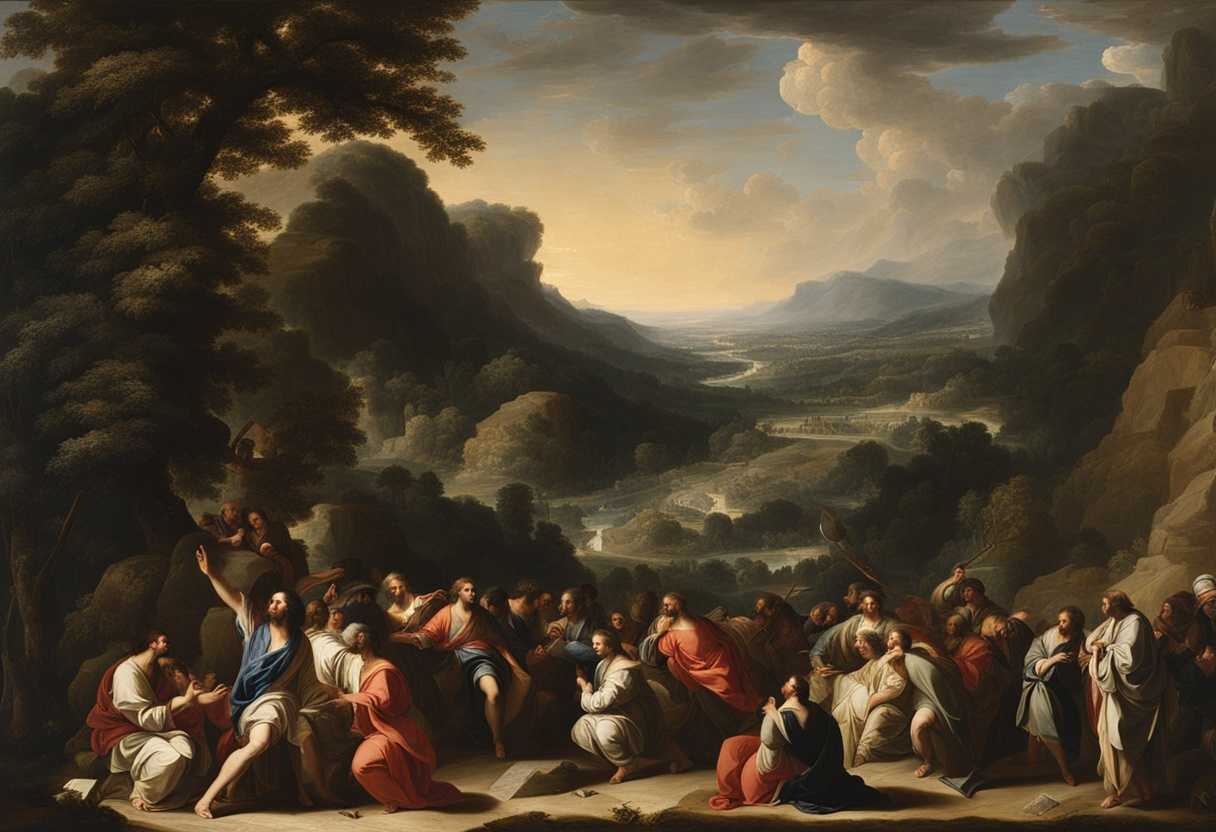
Setting the Scene for Deuteronomy 11:26-16:17
The scene in Deuteronomy 11:26-16:17 takes place in the vast plains of Moab, with the Israelites encamped near the Jordan River. Moses, the revered leader of the Israelites, stands before the entire congregation, including men, women, and children. They have journeyed through the wilderness for forty years, guided by the hand of God, and are now on the cusp of entering the Promised Land.
As the sun sets in the distance, casting a warm glow over the camp, Moses begins to recount the laws and commandments that God has given them. He emphasizes the importance of obedience and faithfulness to God, reminding them of the blessings that come with following His ways and the consequences of turning away from Him. The people listen intently, their faces illuminated by the flickering light of the campfires that dot the landscape.
Surrounded by the majestic mountains and the flowing waters of the Jordan River, the Israelites are reminded of God’s faithfulness throughout their journey. They are on the brink of a new chapter in their history, filled with both challenges and blessings, and Moses’ words serve as a final exhortation to remain steadfast in their commitment to God as they prepare to cross over into the land He has promised them.
What is Deuteronomy 11:26-16:17 about?
This verse emphasizes that God’s blessings are directly connected to our obedience to His commands. When we follow His teachings and live in accordance with His will, we open ourselves up to receive the abundant blessings He has in store for us. God rewards us for our obedience by showering us with His grace, protection, and provision, just as a loving parent rewards a child for good behavior.
Conversely, the verse also warns us of the consequences of disobedience. When we stray from God’s commands and choose to walk our own path, we separate ourselves from His blessings and open ourselves up to negative consequences. When we rebel against God’s will, we distance ourselves from His protection and guidance.
Reflecting on this verse prompts us to consider our own obedience to God’s commands. Are we actively seeking to follow His will in our lives, or are we allowing disobedience to hinder our relationship with Him? We position ourselves to receive His abundant blessings and experience the fullness of His grace and love by embracing obedience and aligning our lives with God’s teachings.
Understanding what Deuteronomy 11:26-16:17 really means
In Deuteronomy 11:26-16:17, Moses delivers a crucial message to the Israelites before they enter the Promised Land. The passage sets the stage by presenting a stark choice between blessing and curse, illustrating the outcomes of obedience and disobedience to God’s commandments. This theme of choice and consequence resonates throughout the text, urging readers to consider the impact of their actions on their relationship with God. The repeated reference to “The Place the Lord Will Choose” underscores the significance of centralized worship, emphasizing unity and community in faith. This concept of a designated place for worship echoes in other biblical passages like Solomon’s prayer in 1 Kings 8:29, highlighting the importance of a collective approach to honoring God.
Moreover, the call to “Remember the Lord Your God” serves as a reminder to stay grounded in faith and gratitude, reflecting on God’s past deeds and maintaining steadfast devotion. This emphasis on remembrance and gratitude is a timeless lesson that holds relevance in today’s fast-paced world. Just as the Israelites were called to remember God’s faithfulness, we are encouraged to cultivate a habit of mindfulness and thankfulness in our daily lives. The passage’s enduring themes of choice, worship, and remembrance offer valuable insights for contemporary believers seeking to deepen their spiritual walk.
One poignant anecdote shared by a congregant illustrates the practical application of these principles. Faced with a challenging decision at work, they chose integrity over expediency, aligning their actions with God’s principles. Despite initial difficulties, their obedience led to unexpected blessings, affirming the enduring truth that following God’s ways brings long-term rewards. This personal testimony underscores the transformative power of aligning our choices with God’s will, even when it seems counterintuitive or challenging.
In delving deeper into the phrases within the passage, we uncover layers of meaning that enrich our understanding of God’s expectations for His people. “Blessing and Curse” symbolize the divergent paths before us, highlighting the consequences of our choices. “The Place the Lord Will Choose” signifies the importance of communal worship and unity in faith, while “Remember the Lord Your God” underscores the significance of gratitude and mindfulness in our spiritual journey.
In conclusion, Deuteronomy 11:26-16:17 serves as a timeless guide for believers, prompting us to make intentional choices, prioritize communal worship, and cultivate a spirit of remembrance and gratitude. By reflecting on these foundational principles and applying them in our lives, we can navigate the complexities of our world with wisdom, faithfulness, and a deepened relationship with God. Let us heed the call to action embedded in this passage, embracing the challenge to live out our faith authentically and purposefully in today’s ever-changing landscape.
How can we truly love and obey God?
To truly love and obey God means to wholeheartedly cherish and prioritize Him above all else. It entails having a deep-seated affection for God and His ways, and allowing this love to permeate every aspect of our lives. Genuine love for God involves a sincere desire to please Him, to follow His commandments, and to walk in His ways. This love should not be lukewarm or half-hearted, but rather a fervent devotion that propels us to action.
Obedience to God is an outward demonstration of our love for Him. It involves aligning our actions, thoughts, and words with His will, even when it may be challenging or unpopular. True obedience requires humility, submission, and a willingness to surrender our own desires in favor of God’s perfect plan. It is a continual journey of growth and transformation, as we strive to live in accordance with His principles and teachings. Loving and obeying God ultimately require intentionality, discipline, and a reliance on His strength and grace throughout a lifetime. It is a daily choice to put God first in all things, to seek His guidance and direction, and to trust in His unfailing love. We demonstrate our devotion and honor to the One who created us and offers us abundant life by cultivating a deep love for God and striving to obey Him wholeheartedly.
Application
Embrace the power to shape your destiny with each choice you make. By staying true to His teachings, you unlock a future filled with blessings and favor. Will you stand firm in obedience to unlock the boundless blessings awaiting you?

Reverend Michael Johnson is an experienced Church Minister with a profound expertise in spirituality and guidance. With a serene presence and a compassionate heart, he has faithfully served his congregation for over 20 years, leading them on a spiritual journey towards inner peace and enlightenment. Reverend Johnson’s extensive knowledge of religious philosophies and profound understanding of human nature have made him a trusted confidant and mentor to many, as he seamlessly weaves his profound wisdom into life teachings. Reverend Johnson’s calming demeanor and empathetic nature continue to uplift and heal souls, nurturing a sense of unity and tranquility within his community.