
2 Samuel 12:7-24 is about the consequences of King David’s sins of adultery and murder, focusing on the loss of his child as a result of these transgressions and the redemption found in his repentance and acceptance of God’s judgment.
7 Nathan said to David, “You are the man! Thus says the Lord, the God of Israel, ‘I anointed you king over Israel, and I delivered you out of the hand of Saul.
8 And I gave you your master’s house and your master’s wives into your arms and gave you the house of Israel and of Judah. And if this were too little, I would add to you as much more.
11 Thus says the Lord, ‘Behold, I will raise up evil against you out of your own house. And I will take your wives before your eyes and give them to your neighbor, and he shall lie with your wives in the sight of this sun.
10 Now therefore the sword shall never depart from your house, because you have despised me and have taken the wife of Uriah the Hittite to be your wife.
11 Thus says the Lord, ‘Behold, I will raise up evil against you out of your own house. And I will take your wives before your eyes and give them to your neighbor, and he shall lie with your wives in the sight of this sun.
12 For you did it secretly, but I will do this thing before all Israel and before the sun.’”
13 David said to Nathan, “I have sinned against the Lord.” And Nathan said to David, “The Lord also has put away your sin; you shall not die.
14 Nevertheless, because by this deed you have utterly scorned the Lord, the child who is born to you shall die.”
15 Then Nathan went to his house.
16 David therefore sought God on behalf of the child. And David fasted and went in and lay all night on the ground.
17 And the elders of his house stood beside him, to raise him from the ground, but he would not, nor did he eat food with them.
18 On the seventh day the child died. But the servants of David were afraid to tell him that the child was dead, for they said, “Behold, while the child was yet alive, we spoke to him, and he did not listen to us. How then can we say to him the child is dead? He may do himself some harm.”
19 But when David saw that his servants were whispering together, David understood that the child was dead.
20 Then David arose from the earth and washed and anointed himself and changed his clothes. And he went into the house of the Lord and worshiped. He then went to his own house. And when he asked, they set food before him, and he ate.
21 Then his servants said to him, “What is this thing that you have done? You fasted and wept for the child while he was alive, but when the child died, you arose and ate food.”
22 He said, “While the child was still alive, I fasted and wept, for I said, ‘Who knows whether the Lord will be gracious to me, that the child may live?’
23 But now he is dead. Why should I fast? Can I bring him back again? I shall go to him, but he will not return to me.”
24 Then David comforted his wife, Bathsheba, and went in to her and lay with her, and she bore a son, and he called his name Solomon. And the Lord loved him
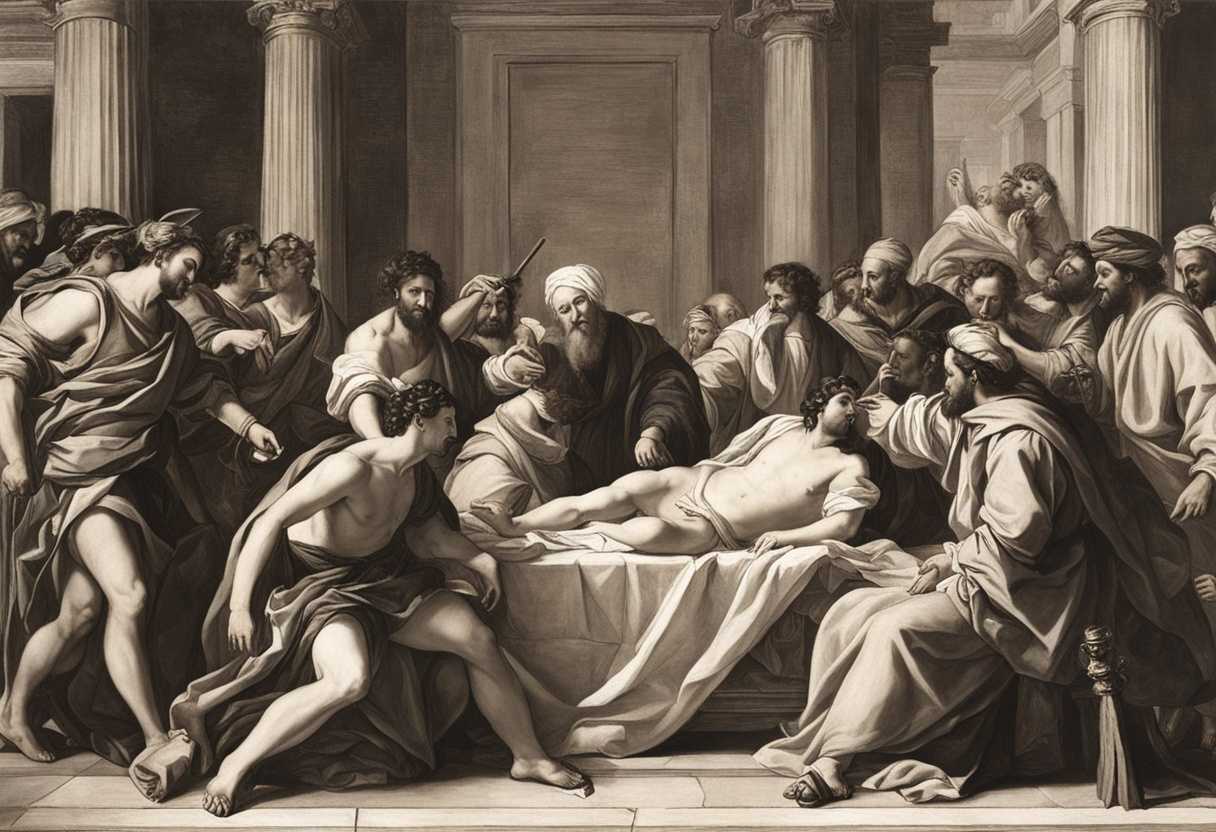
Setting the Scene for 2 Samuel 12:7-24
The scene in 2 Samuel 12:7-24 takes place in the royal court of King David in Jerusalem. Nathan the prophet has just confronted David about his sin with Bathsheba and the murder of her husband, Uriah. The atmosphere is tense as Nathan delivers a powerful message from God, revealing the consequences of David’s actions. David, known for his wisdom and leadership, is now faced with the harsh reality of his wrongdoing.
Surrounded by his advisors and court officials, David listens intently as Nathan recounts a parable about a rich man who took a poor man’s only lamb. The story serves as an allegory for David’s own actions, highlighting the injustice and cruelty of his behavior. As the weight of his sin sinks in, David’s heart is convicted, and he acknowledges his guilt before God and the people gathered in the court.
The room is filled with a sense of solemnity and reflection as David repents and seeks forgiveness from the Lord. The consequences of his actions are severe, as Nathan prophesies the death of the child born to David and Bathsheba. Despite the gravity of the situation, this moment of repentance marks a turning point in David’s life, demonstrating his humility and willingness to seek reconciliation with God.
What is 2 Samuel 12:7-24 about?
This verse carries a powerful message about the consequences of our actions and the importance of seeking forgiveness and repentance. Despite his deep regret and genuine remorse, David still faced the painful consequence of losing his child. It serves as a reminder that even when we seek forgiveness and attempt to make amends, there may still be repercussions for our actions that we must face.
The story of David and Bathsheba highlights the complexities of sin, forgiveness, and accountability. It prompts us to reflect on the weight of our decisions and the ripple effects they can have on our lives and the lives of others. Why did David’s child have to suffer for his father’s sins? What does this teach us about the interconnectedness of our actions and the need to take responsibility for them? This verse serves as a sobering reminder of the fragility of life and the importance of seeking redemption with a humble heart as we navigate our own journeys of repentance and forgiveness.
Understanding what 2 Samuel 12:7-24 really means
In 2 Samuel 12:7-24, we witness a pivotal moment in King David’s life as the prophet Nathan confronts him about his grievous sins. Nathan’s use of a parable to expose David’s transgressions serves as a poignant reminder of the consequences of unchecked wrongdoing. The phrase “You are the man!” reverberates with the weight of truth, piercing through David’s facade of power and authority to reveal his moral failings. It serves as a stark reminder that no one is above accountability, not even a king anointed by God.
As Nathan reminds David of God’s blessings and the responsibilities that accompany them, we are prompted to reflect on our own blessings and the ways in which we may have fallen short. The prophecy of ongoing strife within David’s house serves as a sobering reminder that our actions have lasting repercussions, even if we seek forgiveness. David’s humble admission, “I have sinned against the Lord,” showcases the first step towards repentance – acknowledging our wrongs before God and seeking His forgiveness.
God’s response to David’s repentance is a testament to His mercy and grace. Despite the gravity of David’s sins, the assurance that “The Lord has taken away your sin” offers hope and redemption. The immediate consequence of the child’s death serves as a poignant reminder that while forgiveness is available, we are not exempt from earthly repercussions. This narrative underscores the importance of genuine repentance and the reality of facing the consequences of our actions.
The story of David and Nathan resonates with us today, reminding us of the universal need for accountability and repentance. It serves as a cautionary tale that even the most favored individuals can stumble, but God’s grace is sufficient for all who turn to Him in genuine repentance. As we contemplate David’s journey from sin to restoration, we are encouraged to examine our own lives, seeking forgiveness where needed and striving to live righteously in the sight of God.
Consider the parallels in your own life to David’s story. Are there areas where you need to seek forgiveness and make amends? Reflect on the importance of accountability and the role of trusted individuals in guiding you towards righteousness. Embrace the grace and mercy of God, knowing that true repentance leads to forgiveness and restoration. Just as David found redemption through humility and contrition, may we too find solace in God’s unfailing love and forgiveness.
What consequences in my life are a result of my past actions?
David’s actions of committing adultery with Bathsheba and arranging for her husband Uriah to be killed had severe consequences in his life. The child conceived from this sinful affair became seriously ill and died, despite David’s fasting and praying for the child. Additionally, David’s household faced turmoil and division as a result of his actions. His son Amnon committed a heinous act against his half-sister Tamar, leading to further discord within the family.
These consequences serve as a reminder that our past actions have a way of catching up with us. David’s sin not only impacted his own life but also affected those around him, leading to pain and suffering for his family. It is a stark reminder of the importance of living a righteous and moral life, as our actions can have far-reaching consequences beyond what we may initially anticipate. David’s actions ultimately demonstrate the biblical principle that we reap what we sow. Despite David’s deep regret and repentance for his sins, the repercussions of his choices lingered on, emphasizing the significance of making wise and virtuous decisions in our lives to avoid unnecessary pain and strife.
Application
Imagine your life as a complex web of connections—work, family, friends. When you make mistakes, it’s like tearing at that web. But there’s a chance to mend it. God’s mercy is the thread that can make it whole again. Will you pause, admit where you’ve gone wrong, and seek His forgiveness to restore your life’s balance?

Reverend Michael Johnson is an experienced Church Minister with a profound expertise in spirituality and guidance. With a serene presence and a compassionate heart, he has faithfully served his congregation for over 20 years, leading them on a spiritual journey towards inner peace and enlightenment. Reverend Johnson’s extensive knowledge of religious philosophies and profound understanding of human nature have made him a trusted confidant and mentor to many, as he seamlessly weaves his profound wisdom into life teachings. Reverend Johnson’s calming demeanor and empathetic nature continue to uplift and heal souls, nurturing a sense of unity and tranquility within his community.