
Genesis 24:11-20 is about the faithfulness and providence of God in guiding Abraham’s servant to find a suitable wife for Isaac, showcasing the importance of seeking God’s guidance in matters of great importance.
11 And he made the camels kneel down outside the city by the well of water at the time of evening, the time when women go out to draw water.
12 And he said, “O Lord, God of my master Abraham, please grant me success today and show steadfast love to my master Abraham.
13 Behold, I am standing by the spring of water.
14 Let the young woman to whom I shall say, ‘Please let down your jar that I may drink,’ and who shall say, ‘Drink, and I will water your camels’—let her be the one whom you have appointed for your servant Isaac. By this I shall know that you have shown steadfast love to my master.”
15 Before he had finished speaking, behold, Rebekah, who was born to Bethuel the son of Milcah, the wife of Nahor, Abraham’s brother, came out with her water jar on her shoulder.
16 The young woman was very attractive in appearance, a maiden whom no man had known.
17 The servant ran to meet her and said, “Please give me a little water to drink from your jar.”
18 She said, “Drink, my lord.” And she quickly let down her jar upon her hand and gave him a drink.
19 After she had given him a drink, she said, “I will draw water for your camels also, until they have finished drinking.”
20 and quickly emptied her jar into the trough and ran again to the well to draw water, and she drew for all his camels.
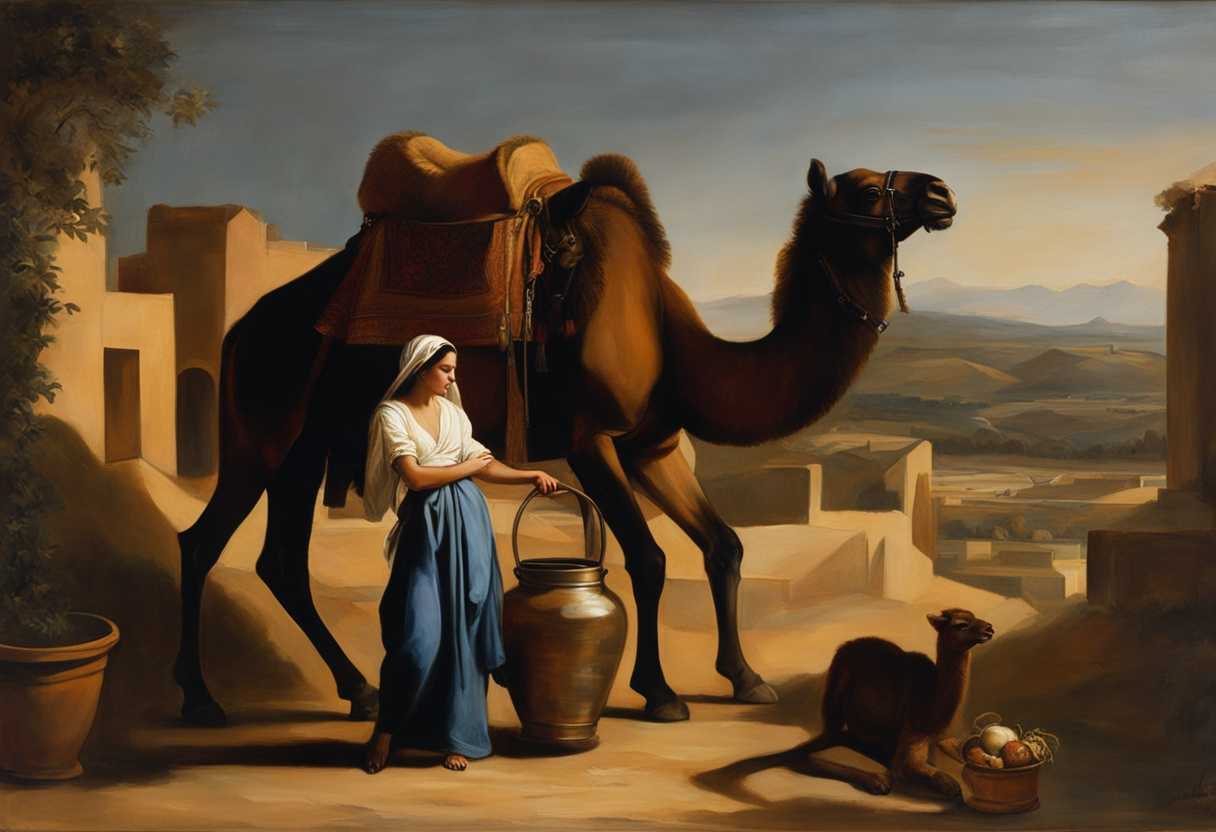
Setting the Scene for Genesis 24:11-20
In the scene described in Genesis 24:11-20, we find Abraham’s servant on a crucial mission to find a wife for Isaac, Abraham’s son. The servant, whose name is not mentioned in this passage, has traveled a great distance to the city of Nahor, where Abraham’s relatives reside. As he arrives at the well outside the city, he pauses to pray, asking for a sign from God to guide him in selecting the right woman for Isaac.
Meanwhile, Rebekah, the young and beautiful daughter of Bethuel, the son of Abraham’s brother Nahor, comes to the well to draw water. Unbeknownst to her, she is about to play a pivotal role in God’s plan for Isaac’s future. The servant approaches her and asks for a drink of water. In a display of kindness and generosity, Rebekah not only gives him a drink but also offers to draw water for his camels, showing her hospitality and compassion.
The scene is set at a bustling well outside the city of Nahor, with the hot sun beating down on the dusty ground. The air is filled with the sounds of camels grunting and the chatter of women who have come to draw water. The servant, weary from his journey, watches as Rebekah approaches with her water jug, her graceful movements catching his eye. Little do they know that their meeting is the beginning of a divine plan that will unite Isaac and Rebekah in marriage, fulfilling God’s promise to Abraham.
What is Genesis 24:11-20 about?
Isn’t it remarkable how a simple act of kindness can lead to something truly extraordinary? Rebekah’s compassion and hospitality towards Abraham’s servant shaped the course of history in this verse. She demonstrated her generosity and aligned herself with God’s plan for Isaac by offering water to the traveler and his camels. This act of kindness paved the way for an important divine appointment between Isaac and Rebekah, ultimately leading to the continuation of God’s covenant with the descendants of Abraham. Reflecting on this verse reminds us of the power of showing kindness to others, even in seemingly small and everyday interactions. Rebekah’s kindness was not just a random act; it was a pivotal moment in the grand scheme of God’s plan for His people. It challenges us to consider how our own acts of kindness and hospitality towards others could be shaping the future in ways we may not even realize. Rebekah’s example inspires us to strive to extend kindness to those we encounter, knowing that our actions, no matter how small, can have a meaningful and lasting impact.
Understanding what Genesis 24:11-20 really means
In Genesis 24:11-20, we witness a beautiful encounter between Abraham’s servant and Rebekah at a well. The servant, on a mission to find a wife for Isaac, prays for a sign from God. Rebekah, displaying kindness and hospitality, fulfills this sign by offering water not only to the servant but also to his camels. This act of generosity and diligence showcases Rebekah’s character and sets the stage for a significant event in biblical history.
The key phrases in this passage hold profound meanings that resonate with timeless virtues. When Rebekah “let down her jar,” it symbolizes her willingness to serve and her proactive nature. Her immediate response to the servant’s request reflects her readiness to help without hesitation, embodying the essence of selflessness. Additionally, her respectful address of “Drink, my lord” highlights her humility and politeness, virtues that are highly regarded in biblical teachings.
Drawing water for the camels, a laborious task, Rebekah demonstrates her generosity and diligence. This act goes beyond mere hospitality; it reveals her willingness to go the extra mile to care for others. Such selfless actions echo the teachings found in Proverbs 31:20 and Matthew 25:35, emphasizing the importance of extending kindness and aid to those in need. Rebekah’s example serves as a timeless reminder of the value of compassion and service in our interactions with others.
In today’s world, where self-interest often takes precedence, the story of Rebekah at the well serves as a poignant lesson on the significance of kindness and hospitality. By reflecting on modern-day scenarios where individuals extend help to strangers in need, we can appreciate the impact of small acts of kindness. Just as Rebekah’s actions had a profound effect, our gestures of generosity and care can make a difference in someone’s life, no matter how seemingly insignificant.
Applying the virtues exemplified by Rebekah involves incorporating kindness and hospitality into our daily lives. Whether it’s assisting a neighbor, volunteering in the community, or simply showing empathy towards others, these actions mirror Rebekah’s spirit of service. By encouraging others to embrace opportunities for generosity and support, we can foster a culture of compassion and communal care, enriching both our own lives and those of others.
By internalizing the lessons from Genesis 24:11-20 and embodying the virtues displayed by Rebekah, we can cultivate a mindset centered on compassion and service. Through acts of kindness and hospitality, we not only enhance our personal well-being but also contribute to creating a more caring and interconnected society. Let us strive to emulate Rebekah’s example, spreading warmth and goodwill wherever we go.
How can we practice kindness and generosity in daily life?
We can practice kindness and generosity in daily life by showing hospitality towards others. Just like how Rebekah generously offered water to Abraham’s servant and his camels, we can welcome others with open arms and provide for their needs. This can be as simple as offering a meal to a hungry friend, a listening ear to someone in need, or a helping hand to a stranger.
Furthermore, we can practice kindness by actively looking out for the well-being of others. Rebekah showed her generosity and went the extra mile by offering to draw water for the camels as well, caring for the needs of others. We can embody the spirit of kindness and selflessness by being attentive to the needs of those around us and offering our assistance without expecting anything in return.
Lastly, practicing kindness and generosity in daily life also involves having a genuine and compassionate attitude towards others. This means approaching interactions with a heart full of love, empathy, and understanding. Rebekah’s kind actions had a significant impact on Abraham’s servant and ultimately led to a chain of blessings because she showed compassion towards others and treated them with respect and dignity, spreading positivity and making the world a better place.
Application
Let’s channel Rebekah’s unwavering faith and prompt action into our daily lives. Just like she selflessly helped Abraham’s servant, let’s show kindness and hospitality in every interaction. It’s our chance to be a beacon of warmth and generosity in a world that often feels cold and distant. How can we embody Rebekah’s spirit today, at work, at home, with every person we meet?

Reverend Michael Johnson is an experienced Church Minister with a profound expertise in spirituality and guidance. With a serene presence and a compassionate heart, he has faithfully served his congregation for over 20 years, leading them on a spiritual journey towards inner peace and enlightenment. Reverend Johnson’s extensive knowledge of religious philosophies and profound understanding of human nature have made him a trusted confidant and mentor to many, as he seamlessly weaves his profound wisdom into life teachings. Reverend Johnson’s calming demeanor and empathetic nature continue to uplift and heal souls, nurturing a sense of unity and tranquility within his community.