
John 6:1-9 is about Jesus performing the miracle of feeding the five thousand with five barley loaves and two fish, illustrating his divine power and provision for his followers.
1 After this Jesus went away to the other side of the Sea of Galilee, which is the Sea of Tiberias.
2 And a large crowd was following him, because they saw the signs that he was doing on the sick.
3 And Jesus went up on the mountain, and there he sat down with his disciples.
4 Now the Passover, the feast of the Jews, was at hand.
5 Lifting up his eyes, then, and seeing that a large crowd was coming toward him, Jesus said to Philip, “Where are we to buy bread, so that these people may eat?”
6 He said this to test him, for he himself knew what he would do.
7 Philip answered him, “Two hundred denarii worth of bread would not be enough for each of them to get a little.”
8 One of his disciples, Andrew, Simon Peter’s brother, said to him,
9 “There is a boy here who has five barley loaves and two fish, but what are they for so many?”
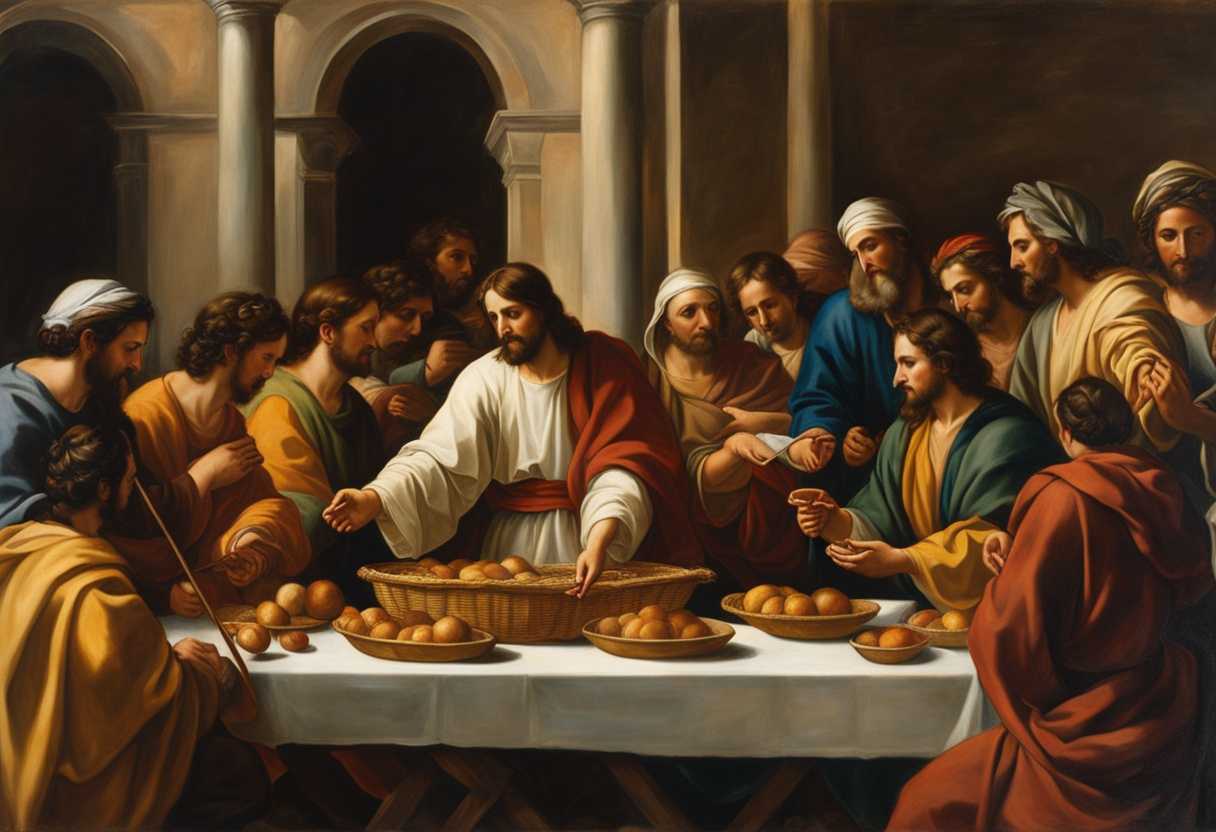
Setting the Scene for John 6:1-9
In John chapter 6, we find Jesus and His disciples by the Sea of Galilee. The scene is set on a grassy hillside overlooking the sea, with the gentle waves lapping against the shore. The sun is beginning to set, casting a warm golden glow over the landscape. Jesus has been teaching a large crowd of people who have gathered to hear Him speak about the Kingdom of God.
As the evening approaches, the disciples realize that the people are hungry and suggest to Jesus that they should send them away to find food in the nearby villages. However, Jesus has a different plan in mind. He asks Philip, one of His disciples, where they can buy bread to feed the crowd. Philip is taken aback by the enormity of the task, as it would take more than half a year’s wages to buy enough bread for everyone to have even a little.
Andrew, another disciple, then speaks up and mentions a boy who has five barley loaves and two fish. Jesus instructs the disciples to have the people sit down on the grass. The disciples distribute the food, and miraculously, Jesus multiplies the loaves and fish to feed the entire crowd of five thousand men, plus women and children. This miraculous feeding serves as a powerful demonstration of Jesus’ compassion and divine power.
What is John 6:1-9 about?
Imagine witnessing Jesus miraculously multiplying five loaves of bread and two fish to feed a crowd of 5,000 people. This astounding event not only showcases Jesus’ divine power but also His compassion and provision for those in need. It speaks to the limitless abundance that is available through faith in Him. Through this miracle, Jesus teaches us to trust in Him to provide for our needs, even when the resources seem scarce.
Have you ever felt like you didn’t have enough to meet the demands of a situation? This verse challenges us to have faith in God’s abundance and to rely on His provision, knowing that He can take our meager offerings and multiply them beyond our imagination. It also reminds us of the importance of sharing and generosity, as the little that we have can be used by God to bless many. So, let us hold onto the faith that Jesus is not limited by what we see as scarcity, but He can work miracles with the little we have to offer.
Understanding what John 6:1-9 really means
In the Gospel of John, we are presented with a captivating narrative that sets the stage for one of Jesus’ most renowned miracles—the feeding of the 5,000. As Jesus traverses the Sea of Galilee, a multitude trails after Him, drawn by the miraculous healings He has performed. Picture this scene: Jesus ascends a mountainside, His disciples by His side, as the crowd steadily approaches. The setting is ripe with anticipation, a palpable energy hanging in the air.
The phrase “A large crowd was following Him” speaks volumes about the growing fame and allure of Jesus. People flock to witness His wonders, eager to experience His transformative power firsthand. As Jesus climbs the mountain, we are reminded of the biblical symbolism attached to mountains—a place of divine revelation and profound teaching. It is on this elevated ground that Jesus will impart a lesson that transcends mere sustenance.
In a moment of testing, Jesus turns to Philip and poses a question that cuts to the core of faith and reliance on divine provision. “Where are we to buy bread, so that these people may eat?” Jesus already knows the answer, yet He seeks to illuminate a deeper truth. This interaction underscores the importance of unwavering faith in the face of apparent scarcity, trusting in God’s ability to provide abundantly.
Drawing parallels with other biblical passages enriches our understanding of this miraculous event. The account in Matthew 14:13-21 echoes themes of compassion and miraculous provision, emphasizing Jesus’ unwavering care for His followers. Similarly, the story of Elisha feeding a hundred men with meager resources in 2 Kings 4:42-44 foreshadows Jesus’ miracle, showcasing God’s provision through His chosen vessels.
The relevance of this narrative extends beyond its historical context, resonating with contemporary audiences in profound ways. It prompts us to reflect on our faith in God’s provision, urging us to trust in His abundant supply even when resources appear scarce. Jesus’ compassion towards the physical needs of the crowd serves as a poignant reminder of our call to care for others, embodying His love through acts of service and generosity.
Imagine a scenario where a community faces a crisis, resources dwindling as needs escalate. Yet, through collective effort and unwavering faith, provisions multiply, surpassing all expectations. This modern-day parallel to the miracle of the loaves and fishes illustrates the transformative power of faith and unity, showcasing how God can work through ordinary individuals to achieve extraordinary outcomes.
In conclusion, the narrative of Jesus feeding the 5,000 beckons us to embrace trust in God’s provision, embody compassion towards others, and view challenges as opportunities for faith to flourish. It serves as a poignant reminder that God is not only aware of our needs but also capable of meeting them in ways that defy human logic. May we heed the lessons embedded in this miraculous account, allowing them to shape our perspectives and actions in profound ways.
How can we trust God’s provision in scarcity?
We can trust God’s provision in times of scarcity by remembering the example set in John 6. The story of Jesus feeding the multitude with only five loaves and two fish showcases God’s power and ability to provide abundantly even in the face of scarcity. We learn the importance of trusting God to work miraculously in our lives by observing the faith and obedience displayed by the disciples in handing over the little they had. God is able to transform our meager resources into an abundance that meets our needs, just as Jesus took the small offering of bread and fish and multiplied it to feed thousands. This biblical account reminds us that God’s provision is not limited by earthly circumstances or our own limitations. Therefore, we can trust in His faithfulness to supply all our needs, even when faced with scarcity or lack. The story in John 6 ultimately illustrates the importance of relying on God’s provision rather than our own understanding or abilities. We acknowledge His sovereignty and trust that He will provide for us in ways that surpass our expectations by surrendering our resources and needs to Him. We can have confidence in His provision, even in the midst of scarcity, just as Jesus fed the hungry crowd with a few loaves and fish.
Application
Think of your daily grind at work or the time you spend with family. Imagine offering even the smallest bit of your effort, like the boy’s five loaves and two fish. What if that little contribution could transform everything? Surrender your skills and time to a higher purpose. Will you trust that your small offering can create big change?

Reverend Michael Johnson is an experienced Church Minister with a profound expertise in spirituality and guidance. With a serene presence and a compassionate heart, he has faithfully served his congregation for over 20 years, leading them on a spiritual journey towards inner peace and enlightenment. Reverend Johnson’s extensive knowledge of religious philosophies and profound understanding of human nature have made him a trusted confidant and mentor to many, as he seamlessly weaves his profound wisdom into life teachings. Reverend Johnson’s calming demeanor and empathetic nature continue to uplift and heal souls, nurturing a sense of unity and tranquility within his community.