
John 5:1-3 is about a feast of the Jews where Jesus went up to Jerusalem and encountered a multitude of sick people waiting by the pool of Bethesda, believed to have healing powers when an angel stirred the waters, reflecting the theme of healing and restoration through faith in Christ.
1 After this there was a feast of the Jews, and Jesus went up to Jerusalem.
2 Now there is in Jerusalem by the Sheep Gate a pool, in Aramaic called Bethesda, which has five roofed colonnades.
3 In these lay a multitude of invalids—blind, lame, and paralyzed.
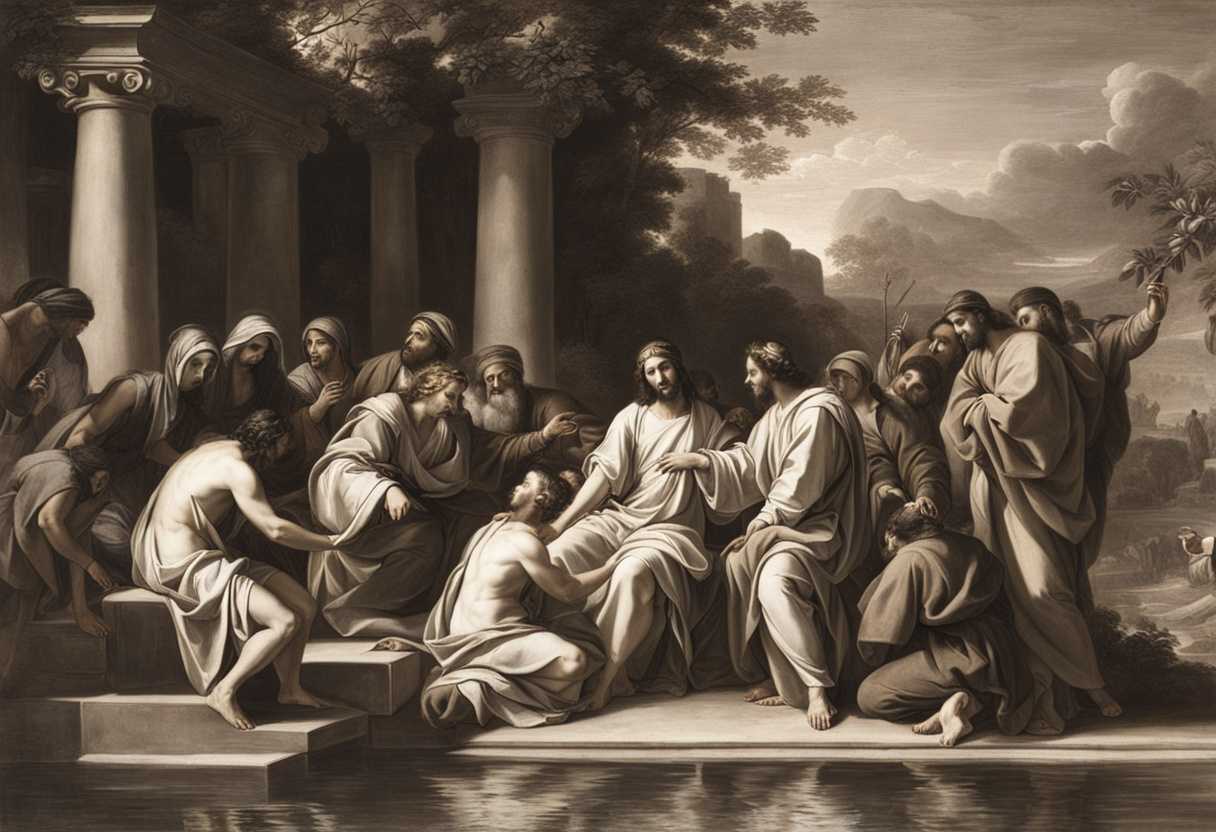
Setting the Scene for John 5:1-3
In John chapter 5, we find Jesus in Jerusalem during one of the Jewish festivals. The scene is set at the Pool of Bethesda, a place known for its healing properties. The pool is surrounded by five covered colonnades, providing shade and shelter for those who come seeking healing. The atmosphere is filled with anticipation and hope as a great number of disabled people, blind, lame, and paralyzed, gather around the pool.
Among the crowd is a man who has been paralyzed for thirty-eight years. He is lying on a mat, patiently waiting for the stirring of the waters, believed to be an indication of healing powers. The man’s eyes are filled with longing as he watches others around him receive their healing. Jesus approaches the man, knowing his condition and his long wait for healing. The man looks up in surprise as Jesus asks him, “Do you want to get well?” The man’s faith is tested as he explains his situation, not realizing that the one who can truly heal him is standing right in front of him.
What is John 5:1-3 about?
This verse demonstrates the compassion and power of Jesus in healing those who are suffering. Jesus challenges the rigid religious teachings of the time by choosing to heal the paralyzed man on the Sabbath, a day traditionally reserved for rest and worship. He emphasizes the importance of showing love and mercy to others, even if it means going against societal norms. This act also serves as a reminder that the Kingdom of God operates on different principles than the world’s expectations. We are invited to consider how we can follow Jesus’ example of compassion and breaking barriers to help those in need as we reflect on this verse. Are we willing to step out of our comfort zones and challenge unjust systems to bring healing and restoration to others? This account reminds us that true faith calls us to actively show love and mercy to our neighbors, even if it means going against the status quo. Let Jesus’ actions inspire us to be agents of healing and transformation, in both our communities and the world around us.
Understanding what John 5:1-3 really means
The setting of John 5:1-3 places us near the Sheep Gate in Jerusalem, at a pool called Bethesda, known for its healing properties. This pool was a gathering place for the disabled—blind, lame, and paralyzed—seeking healing. The Sheep Gate symbolizes the entry point to a place of healing and sacrifice, while Bethesda, meaning “house of mercy” or “house of grace,” highlights the seeking of God’s mercy and grace in that space. The five covered colonnades surrounding the pool provided shelter, symbolizing God’s provision and care for the suffering individuals gathered there.
In John 10:9, Jesus refers to Himself as the gate to salvation, connecting to the Sheep Gate in this passage and emphasizing Him as the entry point to healing. Isaiah 35:5-6 prophesies about the healing that comes with God’s kingdom, echoing the hope of healing at Bethesda. Psalm 23:1-3 speaks of God’s guidance and provision, akin to the care offered at the pool of Bethesda, reinforcing the theme of divine care and support.
Today, people seek hope and healing in various forms, much like those who gathered at Bethesda. Churches and support groups serve as modern-day colonnades, offering community and support to those in need. The name Bethesda reminds us of God’s ever-present mercy and grace, available even in our most desperate times. Just as a hospital waiting room is filled with individuals seeking healing, the pool of Bethesda was a place of shared hope for divine intervention, mirroring the diverse needs and common desire for restoration.
The passage from John 5:1-3 encourages us to embrace the hope, community, and divine mercy available to us. It prompts us to seek God’s healing touch and to extend support and encouragement to others in their times of need. Like the disabled at Bethesda, we can gather in faith, anticipating God’s transformative power in our lives and in the lives of those around us.
How can we show compassion to those in need?
We can show compassion to those in need by acknowledging and responding to their struggles and challenges with empathy and kindness, just as Jesus did in the passage from John 5:1-3. Compassion involves not only recognizing the suffering of others but also taking action to help alleviate their pain and provide support. This may involve offering a listening ear, providing practical assistance, or extending a hand of friendship. We can show compassion to those in need by actively seeking out opportunities to help and serve others, following the example set by Jesus in the Bible verse. This can include reaching out to marginalized individuals, offering a helping hand to those facing difficulties, and showing understanding and care to those who are vulnerable. Through our actions and words, we can demonstrate love and compassion to those around us, just as Jesus did during his ministry on earth.
Application
Imagine your life is a busy highway, filled with work meetings and family moments, but every now and then you need to take an exit to help someone stalled on the side. Like Jesus, who noticed the man suffering for thirty-eight years, you are capable of seeing and attending to those around you. Lend a hand, show compassion, and make a difference in someone’s day. Will you step off your high-speed route for a moment to bring kindness and support to others today?

Reverend Michael Johnson is an experienced Church Minister with a profound expertise in spirituality and guidance. With a serene presence and a compassionate heart, he has faithfully served his congregation for over 20 years, leading them on a spiritual journey towards inner peace and enlightenment. Reverend Johnson’s extensive knowledge of religious philosophies and profound understanding of human nature have made him a trusted confidant and mentor to many, as he seamlessly weaves his profound wisdom into life teachings. Reverend Johnson’s calming demeanor and empathetic nature continue to uplift and heal souls, nurturing a sense of unity and tranquility within his community.