
1 Kings 18:1-40 is about the prophet Elijah proving the power of the God of Israel over the false gods of Baal through a dramatic display of fire from heaven in a contest on Mount Carmel.
1 After many days the word of the Lord came to Elijah, in the third year, saying, “Go, show yourself to Ahab, and I will send rain upon the earth.”
2 So Elijah went to show himself to Ahab. Now the famine was severe in Samaria.
3 And Ahab called Obadiah, who was over the household. (Now Obadiah feared the Lord greatly, )
4 And when Jezebel cut off the prophets of the Lord, Obadiah took a hundred prophets and hid them by fifties in a cave and fed them with bread and water.
5 And Ahab said to Obadiah, “Go through the land to all the springs of water and to all the valleys. Perhaps we may find grass and save the horses and mules alive, and not lose some of the animals.”
6 So they divided the land between them to pass through it. Ahab went in one direction by himself, and Obadiah went in another direction by himself.
7 And as Obadiah was on the way, behold, Elijah met him. And Obadiah recognized him and fell on his face and said, “Is it you, my lord Elijah?”
8 And he answered him, “I am the prophet of the Lord. But how have I sinned, that you would deliver your servant into the hand of Ahab, to kill me?
9 And he said, “What have I sinned, that you would give your servant into the hand of Ahab, to kill me?
10 As the Lord your God lives, there is no nation or kingdom where my lord has not sent to seek you. And when they would say, ‘He is not here,’ he would take an oath of the kingdom or nation, that they had not found you.
11 And now you say, ‘Go, tell your lord, “Behold, Elijah is here.”‘
12 And as soon as I have gone from you, the Spirit of the Lord will carry you I know not where. So, when I come and tell Ahab and he cannot find you, he will kill me, although I your servant have feared the Lord from my youth.
13 Has it not been told my lord what I did when Jezebel killed the prophets of the Lord, how I hid a hundred men of the Lord’s prophets by fifties in a cave and fed them with bread and water?
14 And now you say, ‘Go, tell your lord, “Behold, Elijah is here”‘; and he will kill me.”
15 And Elijah said, “As the Lord of hosts lives, before whom I stand, I will surely show myself to him today.”
16 So Obadiah went to meet Ahab, and told him. And Ahab went to meet Elijah.
17 When Ahab saw Elijah, Ahab said to him, “Is it you, you troubler of Israel?”
18 And he answered, “I have not troubled Israel, but you have, and your father’s house, because you have abandoned the commandments of the Lord and followed the Baals.
19 Now therefore send and gather all Israel to me at Mount Carmel, and the 450 prophets of Baal and the 400 prophets of Asherah, who eat at Jezebel’s table.”
20 So Ahab sent to all the people of Israel and gathered the prophets together at Mount Carmel.
21 And Elijah came near to all the people and said, “How long will you go limping between two different opinions? If the Lord is God, follow him; but if Baal, then follow him.” And the people did not answer him a word.
22 Then Elijah said to the people, “I, even I only, am left a prophet of the Lord, but Baal’s prophets are 450 men.
23 Let two bulls be given to us, and let them choose one bull for themselves and cut it in pieces and lay it on the wood, but put no fire to it. And I will prepare the other bull and lay it on the wood and put no fire to it.
24 And you call upon the name of your god, and I will call upon the name of the Lord, and the God who answers by fire, he is God.” And all the people answered, “It is well spoken.”
25 Then Elijah said to the prophets of Baal, “Choose for yourselves one bull and prepare it first, for you are many, and call upon the name of your god, but put no fire to it.”
26 And they took the bull that was given them, and they prepared it and called upon the name of Baal from morning until noon, saying, “O Baal, answer us!” But there was no voice, and no one answered. And they limped around the altar that they had made.
27 And at noon Elijah mocked them, saying, “Cry aloud, for he is a god. Either he is musing, or he is relieving himself, or he is on a journey, or perhaps he is asleep and must be awakened.”
28 And they cried aloud and cut themselves after their custom with swords and lances, until the blood gushed out upon them.
29 And as midday passed, they raved on until the time of the offering of the oblation, but there was no voice. No one answered; no one paid attention.
30 Then Elijah said to all the people, “Come near to me.” And all the people came near to him. And he repaired the altar of the Lord that had been thrown down.
31 Elijah took twelve stones, according to the number of the tribes of the sons of Jacob, to whom the word of the Lord came, saying, “Israel shall be your name,”
32 And with the stones he built an altar in the name of the Lord.
33 And he put the wood in order and cut the bull in pieces and laid it on the wood. And he said, “Fill four jars with water and pour it on the burnt offering and on the wood.”
34 And he said, “Fill four jars with water and pour it on the burnt offering and on the wood.”
35 And the water ran around the altar and filled the trench also with water.
36 And at the time of the offering of the oblation, Elijah the prophet came near and said, “O Lord, God of Abraham, Isaac, and Israel, let it be known this day that you are God in Israel, and that I am your servant, and that I have done all these things at your word.
37 Answer me, O Lord, answer me, that this people may know that you, O Lord, are God, and that you have turned their hearts back.”
38 Then the fire of the Lord fell and consumed the burnt offering and the wood and the stones and the dust, and licked up the water that was in the trench.
39 And when all the people saw it, they fell on their faces and said, “The Lord, he is God; the Lord, he is God.”
40 And Elijah said to them, “Seize the prophets of Baal; let not one of them escape.” And they seized them. And Elijah brought them down to the brook Kishon and slaughtered them there.
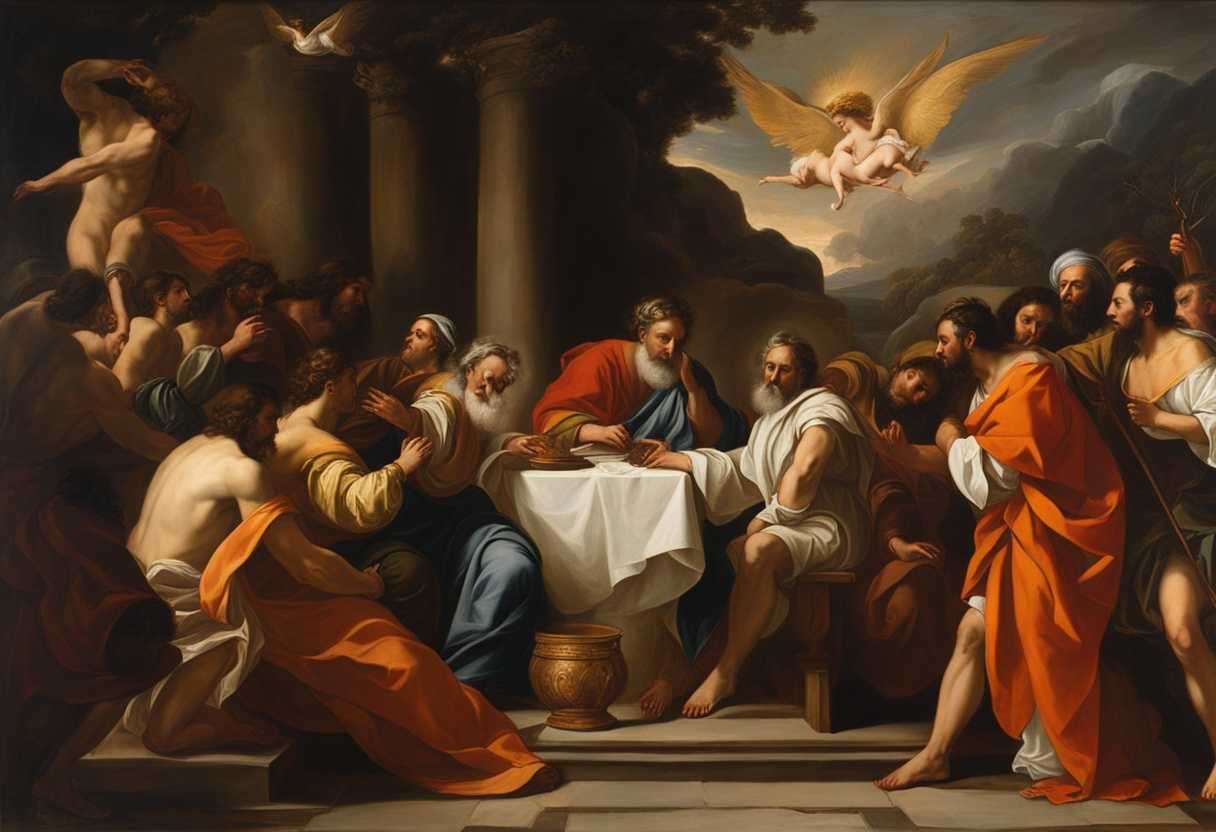
Setting the Scene for 1 Kings 18:1-40
In 1 Kings chapter 18, the scene is set on Mount Carmel, a prominent mountain in Israel overlooking the Mediterranean Sea. The main characters in this scene are the prophet Elijah and the prophets of Baal, along with a large crowd of Israelites. The events leading up to this dramatic confrontation began with a severe drought in the land, which Elijah had prophesied as a judgment from God due to the people’s idolatry.
Elijah challenges the prophets of Baal, who were followers of the false god Baal, to a showdown to prove the power of the one true God. The prophets of Baal set up an altar and call on Baal to send fire to consume their sacrifice, but nothing happens. Elijah then repairs the altar of the Lord, drenches it with water three times, and calls on the Lord to send fire. In a spectacular display of power, God sends fire from heaven to consume the sacrifice, the altar, and even the water in the trench around the altar. This miraculous event leads the people to repent and acknowledge the Lord as the true God.
The scene on Mount Carmel is filled with tension, anticipation, and ultimately awe as the power of God is displayed in a dramatic and undeniable way. The faith of Elijah, the desperation of the prophets of Baal, and the response of the people all come together in a powerful moment that reaffirms the sovereignty and majesty of the Lord.
What is 1 Kings 18:1-40 about?
Elijah is confronting the prophets of Baal in a bold demonstration of God’s sovereignty and faithfulness in this powerful moment from the Bible. Elijah challenges the prophets of Baal to call upon their god to consume a sacrifice with fire, showing his unwavering trust in the one true God and revealing the futility of following false idols. This event showcases the immense power of God and the importance of staying steadfast in our faith even in the face of adversity.
Reflecting on this verse, we are reminded of the significance of standing firm in our beliefs, just like Elijah did in front of the prophets of Baal. It prompts us to question our own allegiances and the things we place our trust in. Are we wholeheartedly devoted to the true God, or are we allowing false idols to take precedence in our lives? Elijah’s actions inspire us to have the courage to challenge the status quo and boldly proclaim our faith, knowing that God will always demonstrate His power and faithfulness to those who remain steadfast in Him.
Understanding what 1 Kings 18:1-40 really means
In the historical context of 1 Kings 18:1-40, we find ourselves amidst a tumultuous period in Israel’s history. King Ahab’s reign, influenced by Queen Jezebel, saw the proliferation of Baal worship, leading the people astray from the true worship of Yahweh. It is in this backdrop that the prophet Elijah emerges as a pivotal figure, commissioned by God to confront the idolatry and guide the people back to the path of righteousness.
One of the key phrases in this passage is when God instructs Elijah to “Go, present yourself to Ahab, and I will send rain on the land.” This statement not only showcases God’s sovereignty over nature but also underscores Elijah’s unwavering obedience and faith in God’s promises. It serves as a powerful reminder of God’s ability to intervene in the natural world in response to the faith and actions of His servants.
Elijah’s challenge to the people, “How long will you waver between two opinions? If the Lord is God, follow him; but if Baal is God, follow him,” cuts to the core of the issue at hand – the necessity of making a definitive choice in matters of faith. This call for undivided loyalty resonates with us today, urging us to prioritize our relationship with God above all else and not succumb to the distractions and temptations that vie for our allegiance.
The declaration, “The God who answers by fire—he is God,” sets the stage for a dramatic showdown between the impotent Baal and the omnipotent Yahweh. This showdown serves as a vivid demonstration of God’s power and supremacy, showcasing His ability to manifest His glory in ways that defy human understanding. It challenges us to trust in God’s might and to witness His miraculous works in our lives.
Drawing parallels from related biblical passages such as James 5:17-18, Matthew 6:24, and Exodus 20:3, we see a consistent theme of righteousness, undivided loyalty, and the prohibition of idolatry. These themes remain relevant to us today, reminding us of the importance of faith, obedience, and prayer in our walk with God.
In a contemporary context, we can envision a scenario where a community, facing a crisis akin to the drought in Elijah’s time, comes together in prayer and fasting, seeking God’s intervention. Just as Elijah’s prayers brought rain and fire, this anecdote illustrates the enduring power of faith-filled prayer and God’s responsiveness to the cries of His people.
By delving into the nuances of the phrases and themes present in 1 Kings 18:1-40, we glean valuable insights into the nature of faith, obedience, and divine intervention. Elijah’s story serves as a beacon of inspiration, guiding us to deepen our relationship with God, stand firm in our convictions, and trust in His unfailing power to work wonders in our lives.
Whom will we choose to follow, God or idols?
The verse highlights the choice presented to the people of Israel: to follow God or idols. Elijah confronts the people, calling them to make a decision and not waver between two opinions. We are faced with the choice of whom we will follow in our lives—will it be God, the one true and living God, or idols that seek to draw our hearts away from Him? We are also challenged to examine our own hearts and decide whom we will serve, just as the people of Israel were called to choose between God and idols. God desires our wholehearted devotion and worship, and He alone is worthy of our allegiance. When we choose to follow Him faithfully, we experience His blessings, provision, and guidance in our lives. On the contrary, idols only lead to emptiness, deception, and ultimately separation from the one true God.
The story of Elijah and the people of Israel serves as a powerful reminder for us today that we must make a conscious decision to follow God wholeheartedly and reject any idols that may be vying for our attention and affection. When we make the choice to prioritize our relationship with God above all else, we align ourselves with His will and experience the abundant life He has in store for us.
Application
Let’s channel Elijah’s unwavering faith in God from 1 Kings 18. Just like Elijah boldly faced his challenges with trust in the Almighty, so can we in our daily battles. Let’s show the same conviction in our beliefs and seek divine support through the twists and turns of life. Will you meet this challenge with the same unwavering faith as Elijah did?

Reverend Michael Johnson is an experienced Church Minister with a profound expertise in spirituality and guidance. With a serene presence and a compassionate heart, he has faithfully served his congregation for over 20 years, leading them on a spiritual journey towards inner peace and enlightenment. Reverend Johnson’s extensive knowledge of religious philosophies and profound understanding of human nature have made him a trusted confidant and mentor to many, as he seamlessly weaves his profound wisdom into life teachings. Reverend Johnson’s calming demeanor and empathetic nature continue to uplift and heal souls, nurturing a sense of unity and tranquility within his community.