
Exodus 18:1-20:23 is about the organization and establishment of God’s laws and instructions for His people, delivered through Moses, emphasizing the importance of community, leadership, and living in accordance with the commandments set by God.
1 Jethro, the priest of Midian, Moses’ father-in-law, heard of all that God had done for Moses and for Israel his people, how the Lord had brought Israel out of Egypt.
2 Now Jethro, Moses’ father-in-law, had taken Zipporah, Moses’ wife, after he had sent her home,
3 Moses went out to meet his father-in-law and bowed down and kissed him. They asked each other of their welfare and went into the tent.
4 And the name of the other was Eliezer, for he said, “The God of my father was my help, and delivered me from the sword of Pharaoh.”
5 Jethro, Moses’ father-in-law, came with his sons and his wife to Moses in the wilderness where he was encamped at the mountain of God.
6 He had said to Moses, “I, your father-in-law Jethro, am coming to you with your wife and her two sons with her.”
7 Then Moses went out to meet his father-in-law and bowed down and kissed him. And they asked each other of their welfare and went into the tent.
8 Then Moses told his father-in-law all that the Lord had done to Pharaoh and to the Egyptians for Israel’s sake, all the hardship that had come upon them in the way, and how the Lord had delivered them.
9 Jethro rejoiced for all the good that the Lord had done to Israel, in that he had delivered them out of the hand of the Egyptians.
10 Jethro said, “Blessed be the Lord, who has delivered you out of the hand of the Egyptians and out of the hand of Pharaoh and has delivered the people from under the hand of the Egyptians.
11 Now I know that the Lord is greater than all gods, because in this affair they dealt arrogantly with the people.
12 And Jethro, Moses’ father-in-law, brought a burnt offering and sacrifices to God; and Aaron came with all the elders of Israel to eat bread with Moses’ father-in-law before God.
13 The next day Moses sat to judge the people, and the people stood around Moses from morning till evening.
14 When Moses’ father-in-law saw all that he was doing for the people, he said, “What is this that you are doing for the people? Why do you sit alone, and all the people stand around you from morning till evening?”
15 And Moses said to his father-in-law, “Because the people come to me to inquire of God;
16 When they have a dispute, they come to me and I decide between one person and another, and I make them know the statutes of God and his laws.”
17 Moses’ father-in-law said to him, “What you are doing is not good.
18 You and the people with you will certainly wear yourselves out, for the thing is too heavy for you. You are not able to do it alone.
19 Now obey my voice; I will give you advice, and God be with you! You shall represent the people before God and bring their cases to God,
20 and you shall warn them about the statutes and the laws, and make them know the way in which they must walk and what they must do.
21 Moreover, look for able men from all the people, men who fear God, who are trustworthy and hate a bribe, and place such men over the people as chiefs of thousands, of hundreds, of fifties, and of tens.
22 And let them judge the people at all times. Every great matter they shall bring to you, but any small matter they shall decide themselves. So it will be easier for you, and they will bear the burden with you.
23 If you do this, God will direct you, you will be able to endure, and all this people also will go to their place in peace.”
24 So Moses listened to the voice of his father-in-law and did all that he had said.
25 And Moses chose able men out of all Israel and made them heads over the people, chiefs of thousands, of hundreds, of fifties, and of tens.
26 They judged the people at all times; the hard cases they brought to Moses, but any small matter they decided themselves.
27 Now Moses let his father-in-law depart, and he went away to his own country.
1 On the third new moon after the people of Israel had gone out of the land of Egypt, on that day they came into the wilderness of Sinai.
2 They set out from Rephidim and came into the wilderness of Sinai, and they encamped in the wilderness. There Israel encamped before the mountain,
3 while Moses went up to God. The Lord called to him out of the mountain, saying, “Thus you shall say to the house of Jacob, and tell the people of Israel:
4 You yourselves have seen what I did to the Egyptians, and how I bore you on eagles’ wings and brought you to myself.
5 Now therefore, if you will indeed obey my voice and keep my covenant, you shall be my treasured possession among all peoples, for all the earth is mine.
6 and you shall be to me a kingdom of priests and a holy nation. These are the words that you shall speak to the people of Israel.”
7 So Moses came and called the elders of the people and set before them all these words that the Lord had commanded him.
8 All the people answered together and said, “All that the Lord has spoken we will do.” And Moses reported the words of the people to the Lord.
9 And the Lord said to Moses, “Behold, I am coming to you in a thick cloud, that the people may hear when I speak with you, and may also believe you forever.”
10 the Lord said to Moses, “Go to the people and consecrate them today and tomorrow, and let them wash their garments.
11 and be ready for the third day. For on the third day the Lord will come down on Mount Sinai in the sight of all the people.
12 And you shall set limits for the people all around, saying, ‘Take care not to go up into the mountain or touch the edge of it. Whoever touches the mountain shall be put to death.
13 No hand shall touch him, but he shall be stoned or shot; whether beast or man, he shall not live.’ When the trumpet sounds a long blast, they shall come up to the mountain.”
14 So Moses went down from the mountain to the people and consecrated the people, and they washed their garments.
15 And he said to the people, “Be ready for the third day; do not go near a woman.”
16 On the morning of the third day there were thunders and lightnings and a thick cloud on the mountain and a very loud trumpet blast, so that all the people in the camp trembled.
17 Then Moses brought the people out of the camp to meet God, and they took their stand at the foot of the mountain.
18 Now Mount Sinai was wrapped in smoke because the Lord had descended on it in fire. The smoke of it went up like the smoke of a kiln, and the whole mountain trembled greatly.
19 As the sound of the trumpet grew louder and louder, Moses spoke, and God answered him in thunder.
20 The Lord came down on Mount Sinai, to the top of the mountain.
21 And the Lord said to Moses, “Go down and warn the people, lest they break through to the Lord to look and many of them perish.
22 Also let the priests who come near to the Lord consecrate themselves, lest the Lord break out against them.”
23 Then Moses said to the Lord, “The people cannot come up to Mount Sinai, for you yourself warned us, saying, ‘Set limits around the mountain and consecrate it.’”
24 And the Lord said to him, “Go down, and come up bringing Aaron with you. But do not let the priests and the people break through to come up to the Lord, lest he break out against them.”
25 So Moses went down to the people and told them.
1 And God spoke all these words, saying,
2 “I am the Lord your God, who brought you out of the land of Egypt, out of the house of slavery.
3 “You shall have no other gods before me.
4 “You shall not make for yourself a carved image, or any likeness of anything that is in heaven above, or that is in the earth beneath, or that is in the water under the earth.
5 You shall not bow down to them or serve them, for I the Lord your God am a jealous God, visiting the iniquity of the fathers on the children to the third and the fourth generation of those who hate me,
6 but showing steadfast love to thousands of those who love me and keep my commandments.
7 You shall not take the name of the Lord your God in vain, for the Lord will not hold him guiltless who takes his name in vain.
8 “Remember the Sabbath day, to keep it holy.
9 Six days you shall labor, and do all your work,
10 but the seventh day is a Sabbath to the Lord your God. On it you shall not do any work, you, or your son, or your daughter, your male servant, or your female servant, or your livestock, or the sojourner who is within your gates.
11 For in six days the Lord made heaven and earth, the sea, and all that is in them, and rested on the seventh day. Therefore the Lord blessed the Sabbath day and made it holy.
12 “Honor your father and your mother, that your days may be long in the land that the Lord your God is giving you.
13 “You shall not murder.”
14 “You shall not commit adultery.”
15 “You shall not steal.”
16 “You shall not bear false witness against your neighbor.”
17 “You shall not covet your neighbor’s house; you shall not covet your neighbor’s wife, or his male servant, or his female servant, or his ox, or his donkey, or anything that is your neighbor’s.”
18 Now when all the people saw the thunder and the flashes of lightning and the sound of the trumpet and the mountain smoking, the people were afraid and trembled, and they stood far off.
19 and said to Moses, “You speak to us, and we will listen; but do not let God speak to us, lest we die.”
20 Moses said to the people, “Do not fear, for God has come to test you, that the fear of him may be before you, that you may not sin.”
21 The people stood far off, while Moses drew near to the thick darkness where God was.
22 And the Lord said to Moses, “Thus you shall say to the people of Israel: ‘You have seen for yourselves that I have talked with you from heaven.
23 You shall not make gods of silver to be with me, nor shall you make for yourselves gods of gold.
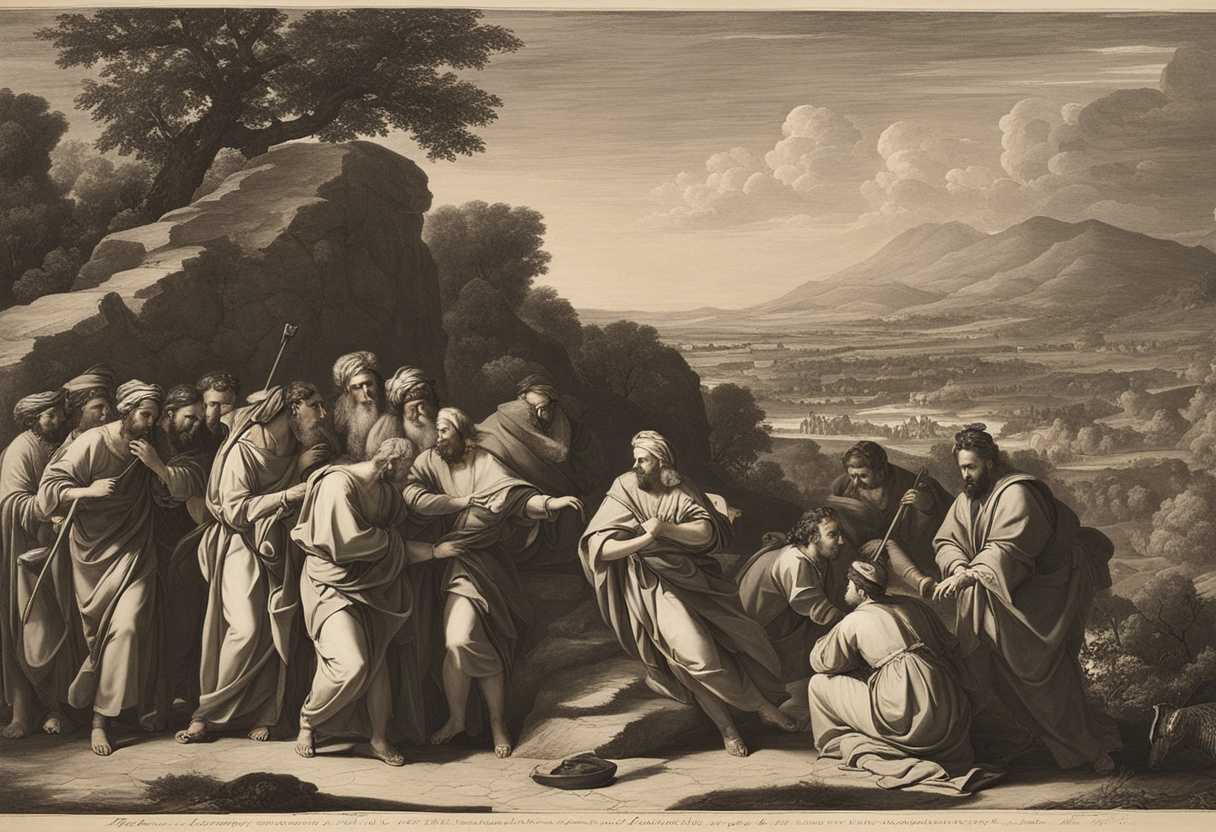
Setting the Scene for Exodus 18:1-20:23
In Exodus 18, we find Moses reuniting with his father-in-law, Jethro, who brings Moses’ wife, Zipporah, and their two sons, Gershom and Eliezer, to meet him in the wilderness. The scene is set in the vast desert, with the Israelites camped around Mount Sinai. Jethro, a priest of Midian, had heard of all the wonders that God had done for the Israelites, including their deliverance from Egypt, and he comes to visit Moses to offer sacrifices and share in the joy of their newfound freedom.
As the sun sets over the horizon, Moses and Jethro sit by a crackling campfire, surrounded by the sounds of the desert night. Jethro listens intently as Moses recounts the miraculous events that have unfolded since they left Egypt. The flickering flames cast dancing shadows on their faces as they discuss the challenges of leading such a vast multitude through the wilderness. Jethro observes Moses as he tirelessly judges the people’s disputes from morning till evening, and he offers wise counsel on delegating responsibilities to capable leaders to share the burden.
In Exodus 19, the Israelites arrive at the foot of Mount Sinai, where God descends in a thick cloud with thunder and lightning, signaling the beginning of a profound encounter. The scene is shrouded in mystery and awe as the people witness the power and majesty of God. Moses ascends the mountain to receive the Ten Commandments and the laws that will govern the Israelites’ relationship with God and each other. The atmosphere is charged with anticipation and reverence as the people prepare to enter into a covenant with the Almighty.
What is Exodus 18:1-20:23 about?
This verse highlights an important aspect of leadership – the need for delegation and seeking advice from wise mentors. Moses, a revered figure in the Bible, receives guidance from his father-in-law, Jethro, on how to effectively lead the Israelites in this particular instance. This interaction emphasizes the idea that even the most powerful and knowledgeable leaders can benefit from the insights and perspectives of others.
Just imagine the humility and wisdom displayed by Moses as he listens to Jethro’s advice. It is a reminder that leaders should not always rely solely on their own understanding, but should be open to receiving counsel and guidance from trusted sources. This verse serves as a powerful lesson for all leaders, emphasizing the importance of humility, openness to feedback, and the value of seeking advice from those with different perspectives and experiences. Let us reflect on this example and consider how we can apply the principles of leadership and delegation in our own lives and roles.
Understanding what Exodus 18:1-20:23 really means
The passage from Exodus 18:1-20:23 delves into a crucial phase of the Israelites’ journey post their exodus from Egypt, encompassing the arrival of Jethro, Moses’ father-in-law, and the pivotal moment of the giving of the Ten Commandments at Mount Sinai. These events underscore themes of leadership, divine guidance, and the establishment of a covenant between God and His people.
In Exodus 18, Jethro, a Midianite priest, visits Moses and imparts sagacious advice on leadership and delegation. His observation, “What you are doing is not good,” serves as a poignant reminder of the necessity for shared leadership and communal support. Jethro’s counsel highlights the significance of recognizing one’s limitations and distributing responsibilities effectively among capable individuals.
As the Israelites reach Mount Sinai in Exodus 19, God prepares to forge a covenant with them, proclaiming, “You will be for me a kingdom of priests and a holy nation.” This declaration signifies the Israelites’ consecration for a divine purpose, emphasizing their chosen status and unique role in God’s plan. It underscores the idea of being set apart and called to a higher standard of living.
The delivery of the Ten Commandments in Exodus 20 solidifies the moral foundation for the Israelite community. The preamble, “I am the Lord your God, who brought you out of Egypt, out of the land of slavery,” establishes God’s authority to impart these laws and reminds the Israelites of His deliverance. This connection between divine liberation and moral obligation underscores the intertwined nature of faith and ethical conduct.
In modern contexts, the principles of shared leadership and delegation advocated by Jethro remain pertinent. Effective leaders acknowledge their limitations and empower others, fostering a culture of collaboration and efficiency. The concept of divine calling and purpose resonates with individuals seeking meaning and direction, offering a framework for understanding oneself within a larger, divine narrative.
The enduring relevance of the Ten Commandments is evident in their influence on ethical standards and legal systems globally. These timeless principles provide a moral compass for living harmoniously with God and others, transcending cultural and temporal boundaries. By reflecting on the lessons from Exodus 18:1-20:23 and applying them to our lives, we can glean guidance and inspiration for our personal and communal journeys.
In conclusion, the narrative in Exodus encapsulates profound insights into leadership, divine purpose, and moral living. By contemplating these themes and integrating them into our daily lives, we can draw wisdom and motivation for navigating the complexities of our individual and collective paths.
How can we honor God and others in leadership?
Adhering to the principles outlined in the verse honors God and others in leadership. Leaders can make decisions that are in alignment with God’s will and bring honor to Him by seeking guidance and wisdom through prayer and discernment. Additionally, leaders can honor others by recognizing and valuing the unique gifts and abilities that each individual brings to the table. Leaders can foster a culture of collaboration and unity by empowering and equipping those under their leadership. Leaders can honor God and others by leading with integrity, humility, and servant-heartedness. Leaders can inspire trust and respect among their team members by staying true to their values and principles. Furthermore, by putting the needs of others before their own and serving with a spirit of humility, leaders can demonstrate a Christ-like example of leadership that prioritizes the well-being and growth of those they lead. Leaders can honor both God and others in their leadership roles by leading in a manner that reflects God’s love and truth.
Application
Dear friend, in the journey of life, seeking wise counsel is like collaborating with a trusted colleague for better results. Just like Moses shared his burden with Jethro, let us not be afraid to lean on others for advice and support. The Ten Commandments are our guiding principles in this fast-paced world, urging us to stay grounded amidst chaos. How will you embrace advice from those around you and follow the moral compass in your daily decisions?

Reverend Michael Johnson is an experienced Church Minister with a profound expertise in spirituality and guidance. With a serene presence and a compassionate heart, he has faithfully served his congregation for over 20 years, leading them on a spiritual journey towards inner peace and enlightenment. Reverend Johnson’s extensive knowledge of religious philosophies and profound understanding of human nature have made him a trusted confidant and mentor to many, as he seamlessly weaves his profound wisdom into life teachings. Reverend Johnson’s calming demeanor and empathetic nature continue to uplift and heal souls, nurturing a sense of unity and tranquility within his community.