
1 When Saul returned from following the Philistines, he was told, “Behold, David is in the wilderness of Engedi.”
2 Then Saul took three thousand chosen men out of all Israel and went to seek David and his men in front of the Wildgoats’ Rocks.
3 And he came to the sheepfolds by the way, where there was a cave, and Saul went in to relieve himself. Now David and his men were sitting in the innermost parts of the cave.
4 And the men of David said to him, “Here is the day of which the Lord said to you, ‘Behold, I will give your enemy into your hand, and you shall do to him as it shall seem good to you.’” Then David arose and stealthily cut off a corner of Saul’s robe.
5 And afterward David’s heart struck him, because he had cut off a corner of Saul’s robe.
6 He said to his men, “The Lord forbid that I should do this thing to my lord, the Lord’s anointed, to put out my hand against him, seeing he is the Lord’s anointed.”
7 So David persuaded his men with these words and did not permit them to attack Saul. And Saul rose up and left the cave and went on his way.
8 Afterward David also arose and went out of the cave, and called after Saul, “My lord the king!” And when Saul looked behind him, David bowed with his face to the earth and paid homage.
9 And David said to Saul, “Why do you listen to the words of men who say, ‘Behold, David seeks your harm’?
10 Behold, this day your eyes have seen how the Lord gave you today into my hand in the cave. And some told me to kill you, but I spared you. I said, ‘I will not put out my hand against my lord, for he is the Lord’s anointed.’
11 See, my father, see the corner of your robe in my hand. For by the fact that I cut off the corner of your robe and did not kill you, you may know and see that there is no wrong or treason in my hands. I have not sinned against you, though you hunt my life to take it.
12 May the Lord judge between me and you, may the Lord avenge me against you, but my hand shall not be against you.
13 As the proverb of the ancients says, ‘Out of the wicked comes wickedness.’ But my hand shall not be against you.
14 After whom has the king of Israel come out? After whom do you pursue? After a dead dog! After a flea!
15 May the Lord therefore be judge and give sentence between me and you, and see to it and plead my cause and deliver me from your hand.”
16 As soon as David had finished speaking these words to Saul, Saul said, “Is this your voice, my son David?” And Saul lifted up his voice and wept.
17 He said to David, “You are more righteous than I, for you have repaid me good, whereas I have repaid you evil.
18 And you have declared this day how you have dealt well with me, in that you did not kill me when the Lord put me into your hands.
19 For if a man finds his enemy, will he let him go away safe? So may the Lord reward you with good for what you have done to me this day.
20 And now, behold, I know that you shall surely be king, and that the kingdom of Israel shall be established in your hand.
21 Swear to me therefore by the Lord that you will not cut off my offspring after me, and that you will not destroy my name out of my father’s house.
22 And David swore this to Saul. Then Saul went home, but David and his men went up to the stronghold.
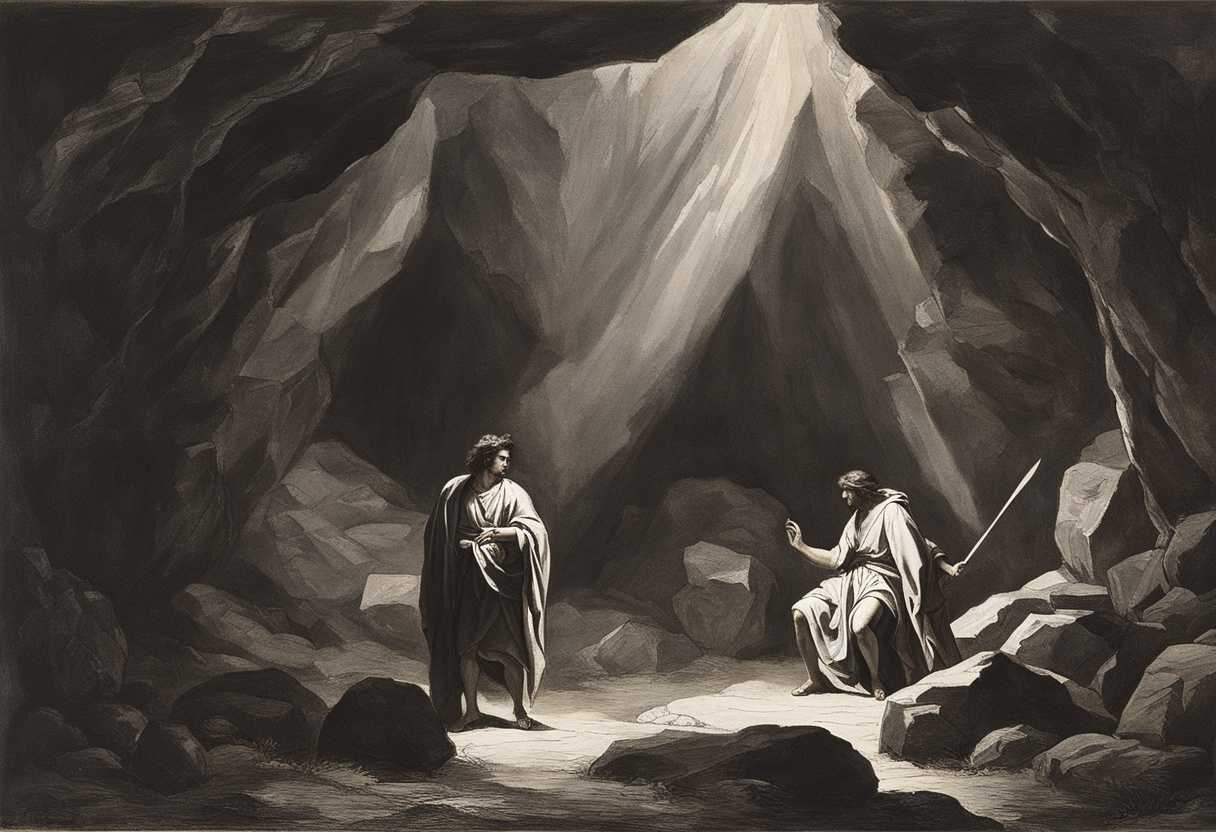
The True Meaning of 1 Samuel 24
The book of 1 Samuel was written by the prophet Samuel, who played a crucial role in the transition from the era of judges to the establishment of the monarchy in ancient Israel. King Saul and his pursuit of the young David, who had been anointed as the future king, are witnessed in this particular chapter. David’s compassion and restraint foreshadow the kind of leader he will become as we delve into this chapter in the face of his adversary, Saul. The events that unfold here not only reveal the character of these two men but also provide insight into the divine plan unfolding in the lives of the Israelites.
Throughout this passage, we will find echoes of other significant biblical narratives, such as the story of David and Goliath (1 Samuel 17) and the prophecy of Samuel regarding the future king (1 Samuel 16:13). These connections will help us understand the broader context and the significance of the events that are about to unfold.
1 Samuel 24:1-7
-
Verse 1: “After Saul returned from pursuing the Philistines, he was told, ‘David is in the Desert of En Gedi. King Saul returns from a battle against the Philistines and discovers that David, whom he perceived as a threat to his kingship, is hiding in the Desert of En Gedi. This sets the stage for the encounter between Saul and David, where David has a chance to demonstrate his loyalty and respect for the king, despite the king’s hostile intentions towards him.
-
Verses 2-7: “So Saul took three thousand able young men from all Israel and set out to look for David and his men near the Crags of the Wild Goats. He came to the sheep pens along the way; a cave was there, and Saul went in to relieve himself. David and his men were far back in the cave. The men said, ‘This is the day the Lord spoke of when he said to you, “I will give your enemy into your hands for you to deal with as you wish.”’ Then David crept up unnoticed and cut off a corner of Saul’s robe.”
This section describes a dramatic encounter between King Saul and David in the cave. Saul, who was accompanied by three thousand men, unknowingly enters the same cave where David and his men are hiding. The men with David interpret this as a divine opportunity to eliminate their enemy, Saul, as David had been anointed as the future king by Samuel. Despite this significant moment, David chooses not to harm Saul, but rather cuts off a corner of Saul’s robe stealthily to prove how close he was to Saul without harming him.
David’s actions here are a testament to his respect for the Lord’s anointed king, Saul, even though Saul was seeking his life unjustly. This act of mercy and restraint showcases David’s faith in God’s timing and justice, as he believed that it was not his place to harm the king chosen by God, regardless of Saul’s actions towards him. This act of non-violence in the face of personal danger is a powerful example of David’s character and his faith in God’s plan.
This passage also highlights the theme of forgiveness and the importance of showing mercy even to those who may have wronged us. It serves as a valuable lesson on resisting the temptation for revenge and letting God be the ultimate judge. It echoes Jesus’ teachings on turning the other cheek and loving one’s enemies in the New Testament (Matthew 5:38-48), emphasizing the timeless message of forgiveness and grace.
1 Samuel 24:8-15
David, who is relentlessly pursued by King Saul out of jealousy and fear of losing his throne, experiences a pivotal moment in his life in 1 Samuel 24:8-15. David chooses to spare Saul’s life when he finds him vulnerable in a cave, instead of taking revenge. David’s conflicting emotions are witnessed in verse 8 as he secretly cuts off a corner of Saul’s robe, feeling guilty even for this seemingly small act of disrespect towards the anointed king. This shows David’s deep reverence for the authority that Saul holds, despite Saul’s unjust treatment of him. David’s conscience pricks him even for going that far, and we see his conflict between his desire for justice and his respect for Saul’s position as the Lord’s anointed. David reveals himself and confronts Saul in verses 10-12 as Saul leaves the cave unaware of David’s presence. David acknowledges that he had the opportunity to harm Saul but chose not to because he recognizes that it is not his place to harm the king whom God has chosen. David’s words in verse 12, “May the Lord judge between you and me, and may the Lord avenge me on you, but my hand shall not be against you,” exemplify his trust in God’s justice and his refusal to take matters into his own hands. David’s actions in this passage highlight his faith in God’s timing and deliverance. Though he has been anointed as the future king, David does not forcefully try to take the throne but instead waits for God’s perfect timing. This demonstrates an important lesson in patience, humility, and trust in God’s sovereignty—a theme echoed throughout the Bible in stories like Joseph’s rise to power in Egypt (Genesis 37-50) and Jesus’ submission to God’s will in the Garden of Gethsemane (Matthew 26:39).
Saul’s response to David’s mercy in verses 16-22 showcases Saul’s temporary acknowledgment of David’s righteousness, even though he ultimately remains intent on killing David. This highlights the tragic nature of Saul’s downfall—a once anointed king who started well but succumbed to jealousy, paranoia, and disobedience to God’s commands. 1 Samuel 24:8-15 provides a powerful lesson on forgiveness, mercy, and trusting in God’s justice. David’s actions exemplify the importance of honoring authority, seeking God’s timing, and leaving vengeance to the Lord. Saul’s response serves as a cautionary tale of the destructive nature of jealousy and the consequences of turning away from God’s ways. It reminds us of the timeless truth that vengeance belongs to the Lord (Romans 12:19) and that we are called to show mercy even to those who may wrong us.
1 Samuel 24:16-22
The verse in 1 Samuel 24:16-22 can be broken down into several important sections. “When David finished saying this, Saul asked, ‘Is that your voice, David my son?’ And he wept aloud.” This section depicts an emotional moment where King Saul confronts David after David spared his life in the cave. Saul, who had been pursuing David relentlessly, finally comes face to face with the man he once saw as a threat to his rule. Saul’s emotional reaction reveals a sense of regret and vulnerability. Despite his previous attempts to harm David, Saul is moved to tears by David’s kindness and mercy towards him.
-
” ‘You are more righteous that I,’ he said. ‘You have treated me well, but I have treated you badly.’ ” Here, Saul acknowledges David’s righteousness and contrasts it with his own actions. Saul humbles himself before David, admitting his wrongdoings and expressing remorse for his past behavior. This moment is significant as it highlights the contrast between David, a man after God’s own heart, and Saul, a king who repeatedly disobeyed God’s commands.
-
“May the Lord reward you well for the way you treated me today.” Saul’s acknowledgment of David’s virtues is accompanied by a blessing for David. Despite their tumultuous history and Saul’s previous attempts to kill David, he recognizes and appreciates David’s benevolence towards him. This scene illustrates the power of forgiveness and the ability to show grace even to those who have wronged us. It also underscores the importance of humility and acknowledging one’s mistakes.
-
“I know that you will surely be king and that the kingdom of Israel will be established in your hands. Saul acknowledges David’s destiny to become king of Israel in this final section. Despite Saul’s own aspirations to maintain his kingship, he acknowledges God’s plan for David’s kingship. This acknowledgment marks a pivotal moment in the narrative, foreshadowing David’s future reign and the eventual downfall of Saul’s reign. 1 Samuel 24:16-22 captures a profound moment of reconciliation and recognition between David and Saul. It underscores the themes of forgiveness, humility, righteousness, and God’s sovereignty. The interaction between these two figures serves as a powerful lesson on how to respond to those who wrong us, the importance of showing mercy, and the consequences of disobedience to God’s will. This passage also sets the stage for the unfolding of David’s journey towards kingship and the fulfillment of God’s promises to His people.
After 1 Samuel 24
The Lord had delivered Saul into David’s hands, yet David spared his life. David’s men urged him to strike, but he refused, for he would not raise his hand against the Lord’s anointed. Instead, David cut off a corner of Saul’s robe, showing that he had the chance to kill him but chose not to. This act of mercy and restraint left Saul in awe, and he acknowledged that David would one day be king. Little did Saul know that his days were numbered as he departed. The Lord had already rejected him as king, and the path was being cleared for David to ascend the throne. The stage was set for the final confrontation between these two men – a confrontation that would determine the future of Israel. The next chapter would reveal the dramatic events that would unfold, shaping the destiny of a nation.

Reverend Michael Johnson is an experienced Church Minister with a profound expertise in spirituality and guidance. With a serene presence and a compassionate heart, he has faithfully served his congregation for over 20 years, leading them on a spiritual journey towards inner peace and enlightenment. Reverend Johnson’s extensive knowledge of religious philosophies and profound understanding of human nature have made him a trusted confidant and mentor to many, as he seamlessly weaves his profound wisdom into life teachings. Reverend Johnson’s calming demeanor and empathetic nature continue to uplift and heal souls, nurturing a sense of unity and tranquility within his community.