
1 Chronicles 21:1-30 is about King David’s decision to conduct a census of Israel, which leads to divine judgment in the form of a plague, ultimately emphasizing themes of pride, accountability, and the need for repentance as David seeks to make amends through sacrificial worship at the threshing floor of Ornan.
1 Then Satan stood against Israel and incited David to number Israel.
2 So David said to Joab and the commanders of the army, “Go, number Israel, from Beersheba to Dan, and bring me a report, that I may know their number.”
3 But Joab said, “May the Lord add to his people a hundred times as many as they are! Are they not, my lord the king, all of them my lord’s servants? Why then should my lord require this? Why should it be a cause of guilt for Israel?”
4 But the king’s word prevailed against Joab. So Joab departed and went throughout all Israel and came back to Jerusalem.
5 And Joab gave the sum of the numbering of the people to David. In all Israel there were 1,100,000 men who drew the sword, and in Judah 470,000 who drew the sword.
6 But he did not include Levi and Benjamin in the numbering, for the king’s command was abhorrent to Joab.
7 But God was displeased with this thing, and he struck Israel.
8 And David said to God, “I have sinned greatly in that I have done this thing. But now, please take away the iniquity of your servant, for I have acted very foolishly.”
9 And the Lord spoke to Gad, David’s seer, saying,
10 Now I will raise up your offspring after you, who shall be born to you, and I will establish his kingdom.
11 So Gad came to David and said to him, “Thus says the Lord, ‘Choose what you will:
12 either three years of famine, or three months of devastation by your foes while the sword of your enemies overtakes you, or else three days of the sword of the Lord, pestilence on the land, with the angel of the Lord destroying throughout all the territory of Israel.’ Now decide what answer I shall return to him who sent me.”
13 David said to Gad, “I am in great distress. Let me fall into the hand of the Lord, for his mercy is very great, but do not let me fall into the hand of man.”
14 So the Lord sent a pestilence on Israel, and 70,000 men of Israel fell.
15 And God sent the angel to Jerusalem to destroy it, but as he was about to destroy it, the Lord saw, and he relented from the calamity.
16 And David lifted his eyes and saw the angel of the Lord standing between earth and heaven, and in his hand a drawn sword stretched out over Jerusalem. Then David and the elders, clothed in sackcloth, fell upon their faces.
17 And David said to God, “Was it not I who gave command to number the people? It is I who have sinned and done great evil. But these sheep, what have they done? Please let your hand, O Lord my God, be against me and against my father’s house.
18 Now the angel of the Lord had commanded Gad to say to David that David should go up and raise an altar to the Lord on the threshing floor of Ornan the Jebusite.
19 So David went up at Gad’s word, which he had spoken in the name of the Lord.
20 And Ornan turned back and saw the angel, and his four sons who were with him hid themselves.
21 And as David came to Ornan, Ornan looked and saw David and went out from the threshing floor and paid homage to David with his face to the ground.
22 Then David said to Ornan, “Grant me the site of the threshing floor that I may build an altar on it to the Lord; grant it to me at its full price, that the plague may be averted from the people.”
23 Then Ornan said to David, “Take it, and let my lord the king do what seems good to him. See, I give the oxen for burnt offerings and the threshing sledges for the wood and the wheat for a grain offering; I give it all.”
24 But King David said to Ornan, “No, but I will buy them for the full price. I will not take for the Lord what is yours, nor offer burnt offerings that cost me nothing.”
25 So David paid Ornan 600 shekels of gold by weight for the site.
26 And David built there an altar to the Lord and presented burnt offerings and peace offerings and called on the Lord, and the Lord answered him with fire from heaven upon the altar of burnt offering.
27 And the Lord commanded the angel, and he put his sword back into its sheath.
28 At that time, when David saw that the Lord had answered him at the threshing floor of Ornan the Jebusite, he sacrificed there.
29 For the tabernacle of the Lord, which Moses had made in the wilderness, and the altar of burnt offering were at that time in the high place at Gibeon,
30 But David could not go before it to inquire of God, for he was afraid of the sword of the angel of the Lord.
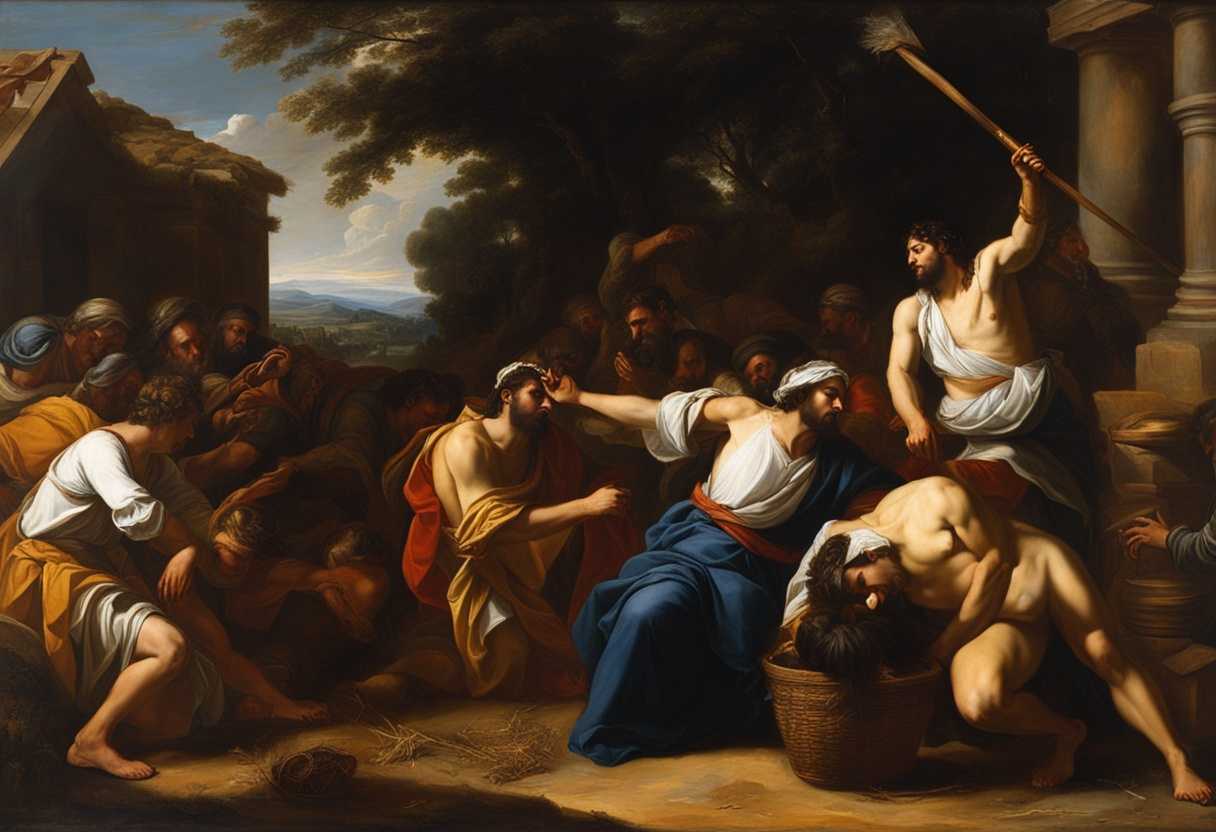
Setting the Scene for 1 Chronicles 21:1-30
In the heart of ancient Israel, a tense atmosphere enveloped the royal city of Jerusalem. King David, a man after God’s own heart, found himself in a moment of vulnerability, grappling with the weight of his decisions and the consequences they bore. The scene unfolds against the backdrop of a sprawling kingdom, where the sun casts long shadows over the majestic Temple, still in the early stages of its construction. The air is thick with the scent of incense and the distant sounds of worship echoing from the Tabernacle, a reminder of the covenant between God and His people. Yet, amidst this sacred setting, a sinister presence lurks—Satan, the adversary, has incited David to take a census of Israel, a decision that would lead to dire repercussions.
As David contemplates the command to number the people, he is surrounded by his trusted advisors, including Joab, the commander of his army. Joab, a seasoned warrior, is visibly uneasy with the king’s directive, sensing the potential for divine disfavor. He implores David to reconsider, reminding him that the strength of Israel lies not in numbers but in the Lord’s protection. Despite Joab’s protests, David’s resolve hardens, and the census is carried out, leading to a staggering count of over a million fighting men. The act, driven by pride and a desire for control, ignites God’s anger, resulting in a devastating plague that sweeps through the land, claiming thousands of lives.
In the aftermath of the calamity, David stands on the threshing floor of Ornan, a humble farmer, where he encounters the angel of the Lord, poised to strike Jerusalem. The scene is both somber and awe-inspiring, as David, filled with remorse, pleads for mercy on behalf of his people. Ornan, witnessing the unfolding events, offers his land for sacrifice, but David insists on paying a fair price, understanding that true worship requires a personal cost. The atmosphere shifts from despair to hope as David builds an altar, offering sacrifices to God, seeking reconciliation. This pivotal moment not only marks a turning point for David but also lays the foundation for the future Temple, a place where God’s presence would dwell among His people, forever altering the spiritual landscape of Israel.
What is 1 Chronicles 21:1-30 about?
This verse presents us with a poignant narrative that encapsulates several profound themes—accountability, the consequences of our actions, and the redemptive power of repentance. When King David conducts a census, it seems he may have been attempting to rely on human strength rather than divine guidance. Have you ever found yourself so caught up in numbers or metrics that you forget the underlying faith that drives your actions? David’s choice reveals a subtle shift from dependence on God to reliance on his own power. This transition does not go unnoticed by God, whose displeasure results in a plague. Here, we see the ripple effect of David’s decision: not only is he affected, but the entire nation suffers as well.
What follows is a compelling story of humility and redemption. David’s repentance is a vital turning point; he acknowledges his error and seeks God’s mercy by constructing an altar. It’s as if he recognizes that the act of repentance is not just about remorse but also about restoration—a desire to rekindle that essential connection with the divine. Have you ever felt that weight of consequence pressing down on you and then experienced the relief that comes with genuine remorse? The building of the altar symbolizes not just an act of atonement but also a commitment to returning to a path of integrity and faith.
Our reflections on this story prompt us to consider our own lives. How often do we find ourselves leaning too heavily on our own understanding or capabilities? Do we pause to reflect on how our choices might impact those around us? And when we falter—which we inevitably do—do we have the courage to repent and seek restoration? Engaging with David’s experience encourages us to understand the importance of humility and the transformative nature of seeking forgiveness. It reminds us that while our actions may lead to serious repercussions, there is always the possibility of redemption, and with it, the chance to rebuild and renew our faith.
Understanding what 1 Chronicles 21:1-30 really means
In 1 Chronicles 21:1-30, we encounter a significant moment in King David’s reign, marked by a troubling decision influenced by Satan. David’s choice to conduct a census of Israel reveals a deeper issue: his reliance on human strength rather than divine providence. This act is not merely administrative; it symbolizes a shift in David’s faith, suggesting that he may have begun to trust in the size of his army rather than in the God who had delivered him time and again.
The underlying meaning of this passage is profound. David’s decision to count the people reflects a lack of faith and trust in God. The consequences of this act are severe, leading to a plague that devastates Israel. This narrative serves as a stark reminder of the importance of obedience to God’s will over human reasoning. How often do we find ourselves making decisions based on what seems logical or beneficial in the moment, only to face unforeseen repercussions later?
To further understand the implications of David’s actions, we can look at related biblical passages. Exodus 30:12 provides guidelines for conducting a census, emphasizing the need for atonement and recognition of God’s sovereignty. In contrast, David’s approach disregards these principles. Additionally, the parallel account in 2 Samuel 24:1-25 offers further insights into the consequences of David’s actions and highlights God’s mercy amidst judgment. James 1:14-15 also sheds light on the nature of temptation, illustrating how external influences can lead us astray.
In today’s world, where metrics and numbers often dictate success, this passage resonates deeply. Many individuals measure their worth or achievements by tangible outcomes, such as financial success or social status. This focus can lead to a skewed understanding of what it means to be successful. Just as David’s census resulted in dire consequences, we too may find ourselves in precarious situations when we prioritize statistics over spiritual health.
Consider the example of a business leader who becomes fixated on quarterly profits and employee numbers. In this pursuit, they may neglect the importance of fostering a positive workplace culture and nurturing relationships. The obsession with numbers can lead to burnout and a toxic environment, much like the consequences David faced. This serves as a reminder that true success is not merely about metrics but about the people behind them.
Several meaningful phrases in this passage warrant reflection. The phrase “Satan stood against Israel” highlights the reality of spiritual warfare in our lives. It reminds us that temptations can arise from unexpected places, urging us to remain vigilant in our faith. Additionally, when “David’s heart struck him,” we see the importance of self-reflection and repentance. Even a king can recognize his faults and seek forgiveness. Finally, the mention of “the angel of the Lord” signifies God’s active role in our lives, reassuring us that He is always present, guiding us back to Him, even in moments of judgment.
In conclusion, 1 Chronicles 21:1-30 serves as a powerful reminder of the importance of faith, obedience, and the consequences of our choices. As we navigate our lives, let us strive to trust in God’s plan rather than relying solely on our understanding or the metrics of success. In doing so, we can cultivate a deeper relationship with God and a more meaningful understanding of what it means to truly succeed.
What is my true motivation in making decisions?
Your true motivation in making decisions often stems from a complex interplay of faith, consequences, and accountability. In moments of uncertainty or temptation, you must recognize how your choices align with your values and the responsibilities you hold. The desire for control or the pursuit of validation can sometimes lead you to act impulsively or without considering the greater impact of your actions. Reflecting on the potential repercussions, both immediate and long-term, can help guide your decisions toward more constructive outcomes. Seeking divine guidance and understanding the consequences of your actions play a significant role in your decision-making process. It suggests a need for humility and the acknowledgment that your choices can have far-reaching effects beyond your immediate circumstances. Making decisions with an awareness of this greater context can lead to a deeper sense of responsibility and fulfillment, fostering a more profound connection to your beliefs and values. Your motivation should ideally involve a balance of introspection and a commitment to making choices that reflect your core principles. You can cultivate a life that resonates with purpose and integrity by striving to align your decisions with both your moral compass and the understanding of their potential impact. This approach encourages growth and a deeper awareness of how every choice contributes to your journey and to the well-being of others around you.
Application
Imagine your life as a well-tended garden. When pride creeps in, it’s like letting weeds take over, choking out the beauty around you. Just like a hardworking parent must nurture their family, you need to nurture your relationship with God and acknowledge the gifts He’s given you. Take a moment to check for those weeds in your heart. Will you commit to stepping back and making room for humility, allowing God’s purpose to shine through?

Reverend Michael Johnson is an experienced Church Minister with a profound expertise in spirituality and guidance. With a serene presence and a compassionate heart, he has faithfully served his congregation for over 20 years, leading them on a spiritual journey towards inner peace and enlightenment. Reverend Johnson’s extensive knowledge of religious philosophies and profound understanding of human nature have made him a trusted confidant and mentor to many, as he seamlessly weaves his profound wisdom into life teachings. Reverend Johnson’s calming demeanor and empathetic nature continue to uplift and heal souls, nurturing a sense of unity and tranquility within his community.