
1 Corinthians 11:2-16 is about the importance of maintaining decorum and respect in the practices of worship, addressing specific cultural and social norms of the time regarding head coverings as a symbol of authority and submission.
2 Now I commend you because you remember me in everything and maintain the traditions even as I delivered them to you.
3 But I want you to understand that the head of every man is Christ, the head of a wife is her husband, and the head of Christ is God.
4 Every man who prays or prophesies with his head covered dishonors his head,
5 but every wife who prays or prophesies with her head uncovered dishonors her head, since it is the same as if her head were shaven.
6 For if a wife will not cover her head, then she should cut her hair short. But since it is disgraceful for a wife to cut off her hair or shave her head, let her cover her head.
7 For a man ought not to cover his head, since he is the image and glory of God, but woman is the glory of man.
8 For man was not made from woman, but woman from man.
9 Neither was man created for woman, but woman for man.
10 That is why a wife ought to have a symbol of authority on her head, because of the angels.
11 Nevertheless, in the Lord woman is not independent of man nor man of woman;
12 For as woman was made from man, so man is now born of woman. And all things are from God.
13 Judge for yourselves: is it proper for a wife to pray to God with her head uncovered?
14 Does not nature itself teach you that if a man wears long hair it is a disgrace for him,
15 but if a woman has long hair, it is her glory? For her hair is given to her for a covering.
16 If anyone is inclined to be contentious, we have no such practice, nor do the churches of God.
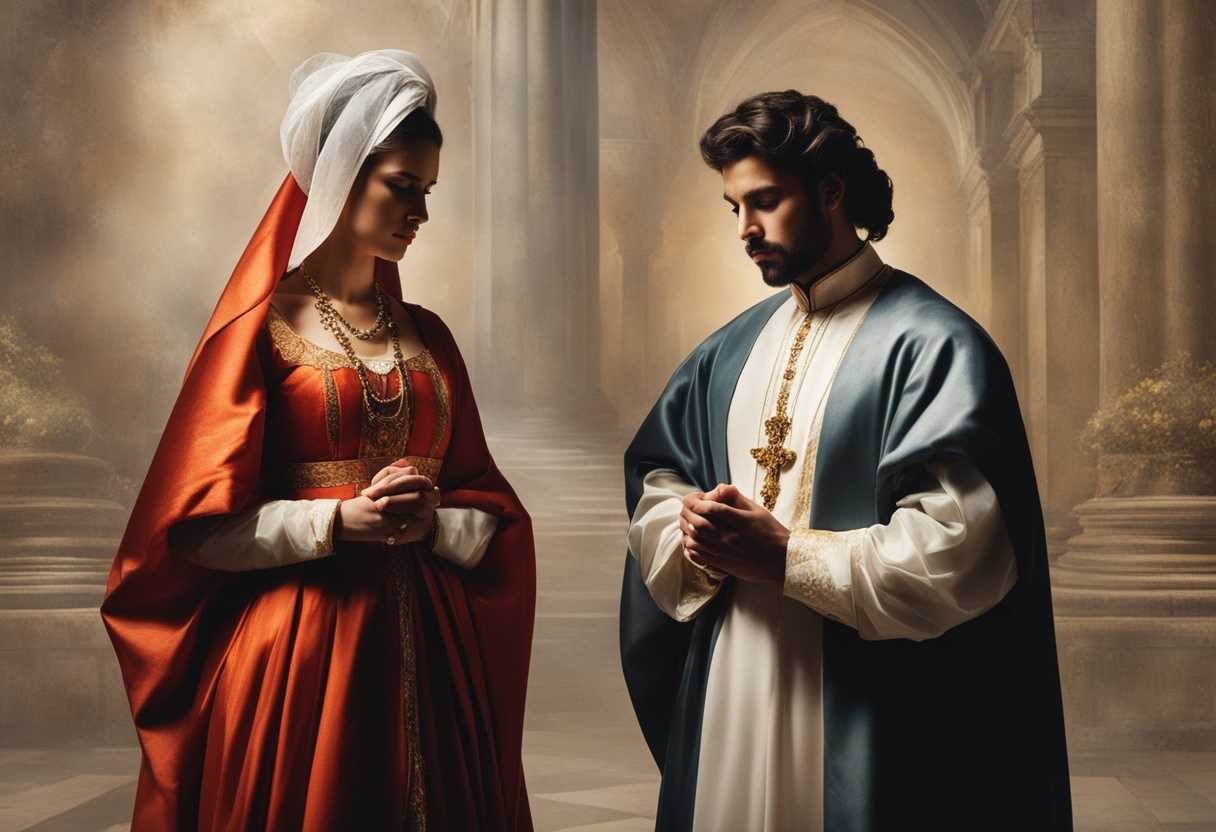
Setting the Scene for 1 Corinthians 11:2-16
In the bustling city of Corinth, a group of believers has gathered in a large, open courtyard surrounded by tall stone columns. The warm Mediterranean sun filters through the gaps in the columns, casting dappled light on the mosaic floor below. The air is filled with the sound of chatter and laughter as men and women from various backgrounds come together for a bible study class.
Among the group is Chloe, a prominent woman in the Corinthian church known for her leadership and wisdom. She has invited her friends Priscilla and Aquila, a couple who are skilled tentmakers and fervent followers of Christ. Also present is Timothy, a young disciple of Paul who has been entrusted with the task of overseeing the church in Corinth. As they settle into their seats, Paul’s letter to the Corinthians is read aloud, addressing the importance of maintaining order and respect in the church, particularly in matters of worship and gender roles.
The discussion is lively as the group delves into the teachings of Paul, reflecting on how they can apply his words to their own lives and community. As they ponder the significance of head coverings and cultural customs, they are reminded of the need for humility, unity, and mutual respect in their worship gatherings. The courtyard echoes with the voices of believers seeking to honor God in all they do, both in their outward expressions and in the attitudes of their hearts.
What is 1 Corinthians 11:2-16 about?
Paul addresses the issue of head coverings and gender roles in worship in this verse. He emphasizes the importance of maintaining a sense of order and hierarchy within the church community. Paul highlights the idea of divine authority and submission within the church by stating that the head of every man is Christ and the head of every woman is man.
The mention of head coverings signifies a symbol of authority and respect within the cultural context of that time. It is a way to visually demonstrate one’s acknowledgment of authority and distinction of roles within society. Believers can show honor and reverence to God and to one another by adhering to these customs.
When interpreting this verse, it is essential to consider the historical and cultural context in which it was written. It invites us to reflect on the significance of respecting authority and maintaining order within the church community. Furthermore, it encourages us to consider how our actions and attitudes in worship can reflect our understanding of divine authority and submission. This verse ultimately prompts us to contemplate the importance of humility, reverence, and respect within our worship practices.
Understanding what 1 Corinthians 11:2-16 really means
Structure for Commentary:
- Introduction to the Passage
- Contextual Background
- Key Phrases and Their Meanings
- Related Biblical Passages
- Relevance to Modern Readers
- Personal Reflection or Anecdote
- Paul addresses issues related to worship practices, particularly focusing on head coverings and the roles of men and women in the church in 1 Corinthians 11:2-16. This passage can be challenging to understand and apply, but it offers rich insights into early Christian community practices and theological principles.
Contextual Background
Paul wrote this letter to the church in Corinth, a diverse and often divided community. The Corinthians struggled with various issues, including how to conduct themselves during worship. Understanding the cultural and historical context of the Corinthian church helps us grasp the significance of Paul’s instructions. For the Corinthians, head coverings were more than a mere fashion choice; they symbolized respect, order, and divine hierarchy.
Key Phrases and Their Meanings
Paul begins by commending the Corinthians for maintaining traditions. He then delves into the topic of head coverings, using terms like “head” to signify authority and honor. The phrase “the head of every man is Christ, and the head of the woman is man” emphasizes a structure of relational order that reflects divine order. When Paul speaks of women covering their heads while praying or prophesying, he is addressing cultural norms that symbolized modesty and respect.
Related Biblical Passages
To gain a fuller understanding, consider Genesis 1:27, which states that both men and women are made in God’s image. This provides a foundation for equality and mutual respect. Similarly, in Galatians 3:28, Paul asserts that in Christ, there is neither male nor female, emphasizing spiritual equality. These passages help balance the hierarchical language in 1 Corinthians 11 and highlight the theological principle that all believers are valued equally in God’s eyes.
Relevance to Modern Readers
Today, this passage invites us to reflect on how cultural practices intersect with our faith. While head coverings may not hold the same significance in contemporary society, the underlying principles of respect, order, and honoring God remain relevant. It challenges us to consider how we show respect and honor in our worship practices and relationships.
Personal Reflection or Anecdote
I recall a story about a woman who decided to wear a headscarf during church services. Initially, she did it out of a sense of tradition, but over time, it became a personal symbol of her commitment to honoring God. Her story highlights that while cultural practices may evolve, the heart’s intention to honor and respect divine order remains crucial. Paul’s instructions in 1 Corinthians 11:2-16, though rooted in a specific cultural context, offer timeless principles about honor, respect, and divine order. Let’s reflect on how we can embody these values in ways that are meaningful and respectful in our own cultural settings as we navigate our contemporary practices. How do you express respect and honor in your worship and daily life? Consider this passage and seek to apply its principles today.
How can we honor God by respecting gender differences?
One way we can honor God by respecting gender differences is by understanding and embracing the unique roles and responsibilities that he has given to men and women. Paul highlights the importance of recognizing the order of authority that God has established, with men being the head of women in this passage. We demonstrate our obedience to God’s design for gender roles by acknowledging and respecting this distinction.
Additionally, honoring God through respecting gender differences involves valuing the innate qualities and characteristics that he has instilled in both men and women. Rather than seeking to diminish or ignore these differences, we can celebrate the diversity and complementary nature of masculinity and femininity. Embracing and honoring these differences can lead to a deeper appreciation for the ways in which God has created us uniquely and intentionally.
Finally, by respecting gender differences, we can show our reverence for God’s wisdom and sovereignty in creating male and female. Instead of conforming to societal norms that seek to eradicate distinctions between genders, we can uphold the beauty and significance of each gender as a reflection of God’s creativity and purpose. This acknowledgment and acceptance of gender differences can ultimately lead to a greater understanding and appreciation of God’s divine plan for humanity.
Application
Think about your family or your team at work – how important is respect and order for things to run smoothly? Embrace the wisdom from 1 Corinthians 11:2-16 like a roadmap to maintaining harmony. Honor the roles and relationships laid out, respecting each person’s unique contribution. By doing so, you’ll build a stronger, unified community. Will you step up and cultivate respect and unity around you?

Reverend Michael Johnson is an experienced Church Minister with a profound expertise in spirituality and guidance. With a serene presence and a compassionate heart, he has faithfully served his congregation for over 20 years, leading them on a spiritual journey towards inner peace and enlightenment. Reverend Johnson’s extensive knowledge of religious philosophies and profound understanding of human nature have made him a trusted confidant and mentor to many, as he seamlessly weaves his profound wisdom into life teachings. Reverend Johnson’s calming demeanor and empathetic nature continue to uplift and heal souls, nurturing a sense of unity and tranquility within his community.