
1 Corinthians 15:35-58 is about the transformation of physical bodies into spiritual bodies at the resurrection of the dead, emphasizing the victory over death through Christ’s resurrection and the imperishable nature of the new creation.
35 But someone will ask, “How are the dead raised? With what kind of body do they come?”
You foolish person! What you sow does not come to life unless it dies.
37 And what you sow is not the body that is to be, but a bare kernel, perhaps of wheat or of some other grain.
38 But God gives it a body as he has chosen, and to each kind of seed its own body.
39 For not all flesh is the same, but there is one kind for humans, another for animals, another for birds, and another for fish.
40 There are heavenly bodies and earthly bodies, but the glory of the heavenly is of one kind, and the glory of the earthly is of another.
41 There is one glory of the sun, and another glory of the moon, and another glory of the stars; for star differs from star in glory.
42 So is it with the resurrection of the dead. What is sown is perishable; what is raised is imperishable.
43 It is sown in dishonor; it is raised in glory. It is sown in weakness; it is raised in power.
44 It is sown a natural body; it is raised a spiritual body. If there is a natural body, there is also a spiritual body.
45 Thus it is written, “The first man Adam became a living being”; the last Adam became a life-giving spirit.
46 But it is not the spiritual that is first but the natural, and then the spiritual.
47 The first man was from the earth, a man of dust; the second man is from heaven.
48 As was the man of dust, so also are those who are of the dust, and as is the man of heaven, so also are those who are of heaven.
49 Just as we have borne the image of the man of dust, we shall also bear the image of the man of heaven.
50 I tell you this, brothers: flesh and blood cannot inherit the kingdom of God, nor does the perishable inherit the imperishable.
51 Behold! I tell you a mystery. We shall not all sleep, but we shall all be changed,
52 in a moment, in the twinkling of an eye, at the last trumpet. For the trumpet will sound, and the dead will be raised imperishable, and we shall be changed.
53 For this perishable body must put on the imperishable, and this mortal body must put on immortality.
54 “When the perishable puts on the imperishable, and the mortal puts on immortality, then shall come to pass the saying that is written: ‘Death is swallowed up in victory.’”
55 “O death, where is your victory? O death, where is your sting?”
56 The sting of death is sin, and the power of sin is the law.
57 But thanks be to God, who gives us the victory through our Lord Jesus Christ.
58 Therefore, my beloved brothers, be steadfast, immovable, always abounding in the work of the Lord, knowing that in the Lord your labor is not in vain.
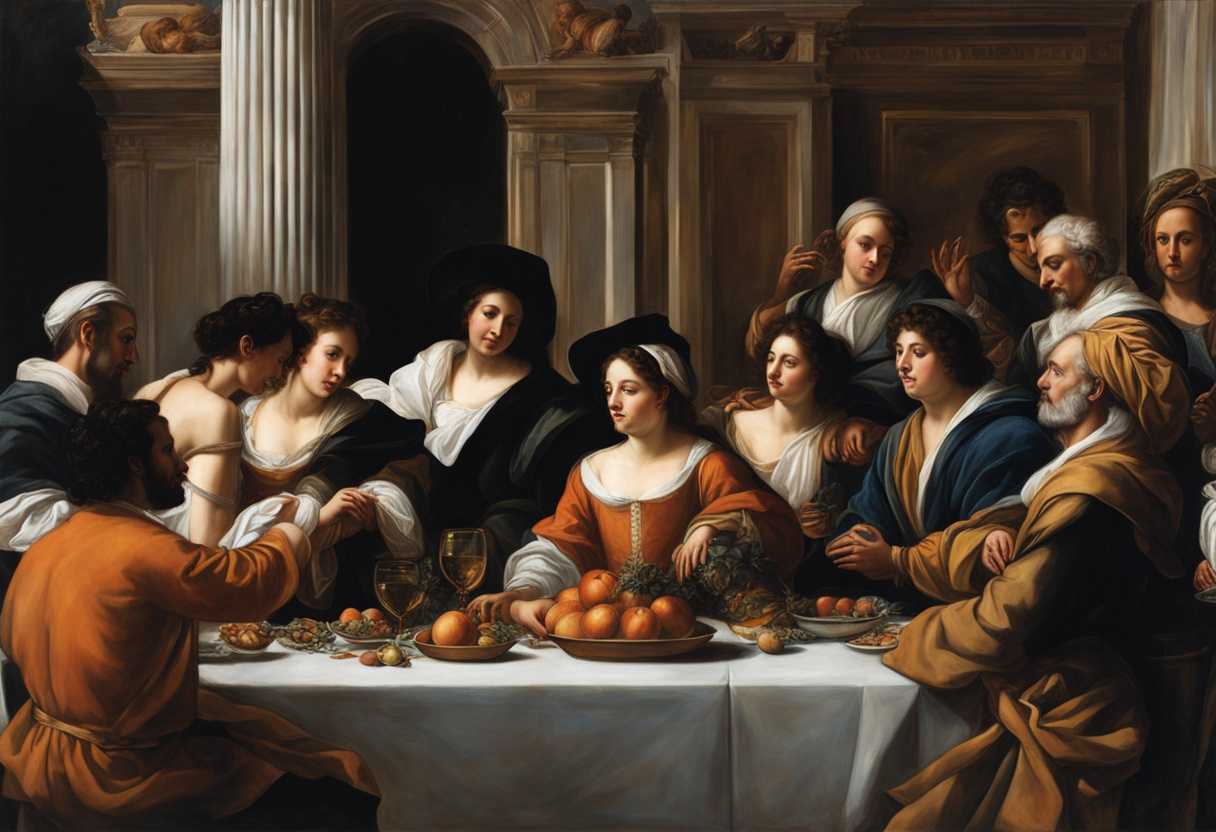
Setting the Scene for 1 Corinthians 15:35-58
The scene in 1 Corinthians 15:35-58 is set in a gathering of early Christians in the city of Corinth. The apostle Paul is addressing the group, which consists of both men and women from various backgrounds who have come together to learn about the teachings of Jesus Christ. The room is dimly lit by oil lamps, casting a warm glow on the faces of the attendees as they listen intently to Paul’s words.
As Paul speaks, he addresses the topic of the resurrection of the dead, a concept that was causing confusion and debate among the Corinthians. He uses vivid imagery to explain the transformation that will take place when believers are raised imperishable, immortal, and in glory. The room is filled with a mix of emotions – awe, wonder, and perhaps a hint of fear at the thought of the unknown.
Outside, the bustling city of Corinth carries on with its daily activities, unaware of the profound discussion happening within the walls of the meeting place. The air is filled with the sounds of merchants hawking their wares, children playing in the streets, and the distant rumble of chariots. But inside, the focus is on the eternal truths being shared by Paul, as the group grapples with the mystery and promise of life after death.
What is 1 Corinthians 15:35-58 about?
Imagine the idea of a perfect body that will never decay or diminish in its glory and power. This verse speaks to the promise of resurrection bodies that will be immortal and filled with the essence of spiritual perfection. Can you envision a state where your body is no longer subject to the limitations of earthly decay, but instead radiates with a powerful and spiritual light?
It is a beautiful concept to grasp that our future selves will be transformed into beings of utmost glory and strength, free from the constraints of the physical world. This verse inspires us to look forward to a state where our souls and bodies are in harmony, reflecting the divine nature of spiritual perfection. How does the thought of having an imperishable, glorious, powerful, and spiritual body affect your perception of the afterlife?
This verse reminds us of the ultimate promise of transformation and renewal, where our earthly bodies will be elevated to a state of eternal perfection. It invites us to contemplate the beauty and magnificence of our future resurrection bodies, filled with the essence of spiritual power and glory. Reflect on the hope and comfort that this promise brings, knowing that our imperishable bodies will be a testament to the divine plan for our ultimate restoration and redemption.
Understanding what 1 Corinthians 15:35-58 really means
This passage from 1 Corinthians 15:35-58 delves into the profound topic of the resurrection of the dead, a fundamental belief in Christianity. In response to inquiries about the nature of resurrection and the form of the resurrected body, Paul provides insights that challenge our understanding of life, death, and eternity.
One striking phrase in this passage is, “What you sow does not come to life unless it dies” (v. 36). This statement underscores the necessity of death as a precursor to resurrection, drawing a parallel to the natural process of a seed dying in the ground to give rise to new life. It prompts us to contemplate the transformative power inherent in the cycle of death and rebirth.
Moreover, the verse “The body that is sown is perishable, it is raised imperishable” (v. 42) highlights the remarkable metamorphosis from a mortal, decaying body to an immortal, glorified one. This transformation signifies the victory over death and the promise of eternal life through Christ’s resurrection, as echoed in “The last enemy to be destroyed is death” (v. 26).
In a broader biblical context, passages like John 12:24, Philippians 3:21, and Revelation 21:4 reinforce the themes of death leading to new life, the transformation of earthly bodies into glorious ones, and the ultimate eradication of suffering and death in the new creation. These interconnected verses paint a vivid picture of hope, renewal, and restoration.
The relevance of this passage resonates deeply with individuals today, offering solace and certainty in the face of loss and sorrow. It encourages believers to adopt an eternal perspective, prioritizing spiritual growth and anticipating the promise of resurrection. This foundational doctrine of resurrection not only shapes our faith but also guides our daily living with purpose and anticipation of the eternal glory that awaits.
Consider the analogy of a gardener planting seeds in the spring. Each seed must be buried in the soil, seemingly lifeless, yet with time, they sprout into vibrant plants surpassing their original form. Similarly, our earthly bodies undergo a necessary death to be transformed into something far more magnificent in the resurrection. This analogy can bring comfort to those mourning the departure of a loved one, reminding them that death is not the end but a gateway to a new, everlasting existence.
In conclusion, the passage from 1 Corinthians 15:35-58 assures us of the reality of resurrection and the wondrous transformation awaiting believers. It beckons us to embrace hope and gratitude, knowing that death has been vanquished through the redemptive work of Jesus Christ. By meditating on these profound truths, we can find strength and inspiration in our daily walk, eagerly anticipating the eternal splendor promised to us.
What happens to our souls after physical death?
According to the verse, our physical bodies will be sown in corruption but will be raised in incorruption. It suggests that our souls will experience a transformation after physical death, where we will leave our corruptible bodies behind and be raised in an incorruptible form. This transformation indicates a change in the state of our souls, moving from a temporary and mortal existence to an eternal and immortal one.
The verse also mentions that our bodies will be sown in dishonor but raised in glory. This suggests that after physical death, our souls will be elevated to a state of honor and glory. It implies that the essence of who we are, our souls, will experience a significant upgrade in status and condition, from a state of dishonor to one of glory and splendor. The verse ultimately conveys the idea that our souls will undergo a profound change after physical death, transitioning from a mortal and corruptible state to an immortal and incorruptible one. It suggests that there is a continuation of existence beyond the physical realm, where our souls will be transformed and elevated to a higher state of being, experiencing honor, glory, and eternal life.
Application
Every paycheck you earn and every meal you share with your family—picture those moments multiplied in eternity. 1 Corinthians 15:35-58 reminds us that our efforts have everlasting impact. Live each day like you’re building a legacy, knowing that your hard work for the Lord isn’t wasted. Let’s act with the conviction that our daily grind has divine meaning. Are you ready to make every moment count for something eternal?

Reverend Michael Johnson is an experienced Church Minister with a profound expertise in spirituality and guidance. With a serene presence and a compassionate heart, he has faithfully served his congregation for over 20 years, leading them on a spiritual journey towards inner peace and enlightenment. Reverend Johnson’s extensive knowledge of religious philosophies and profound understanding of human nature have made him a trusted confidant and mentor to many, as he seamlessly weaves his profound wisdom into life teachings. Reverend Johnson’s calming demeanor and empathetic nature continue to uplift and heal souls, nurturing a sense of unity and tranquility within his community.