
1 Corinthians 9:5 is about Paul defending his right to bring a believing wife along with him in his ministry travels, as other apostles and brothers of the Lord also do.
5 Do we not have the right to take along a believing wife, as do the other apostles and the brothers of the Lord and Cephas?
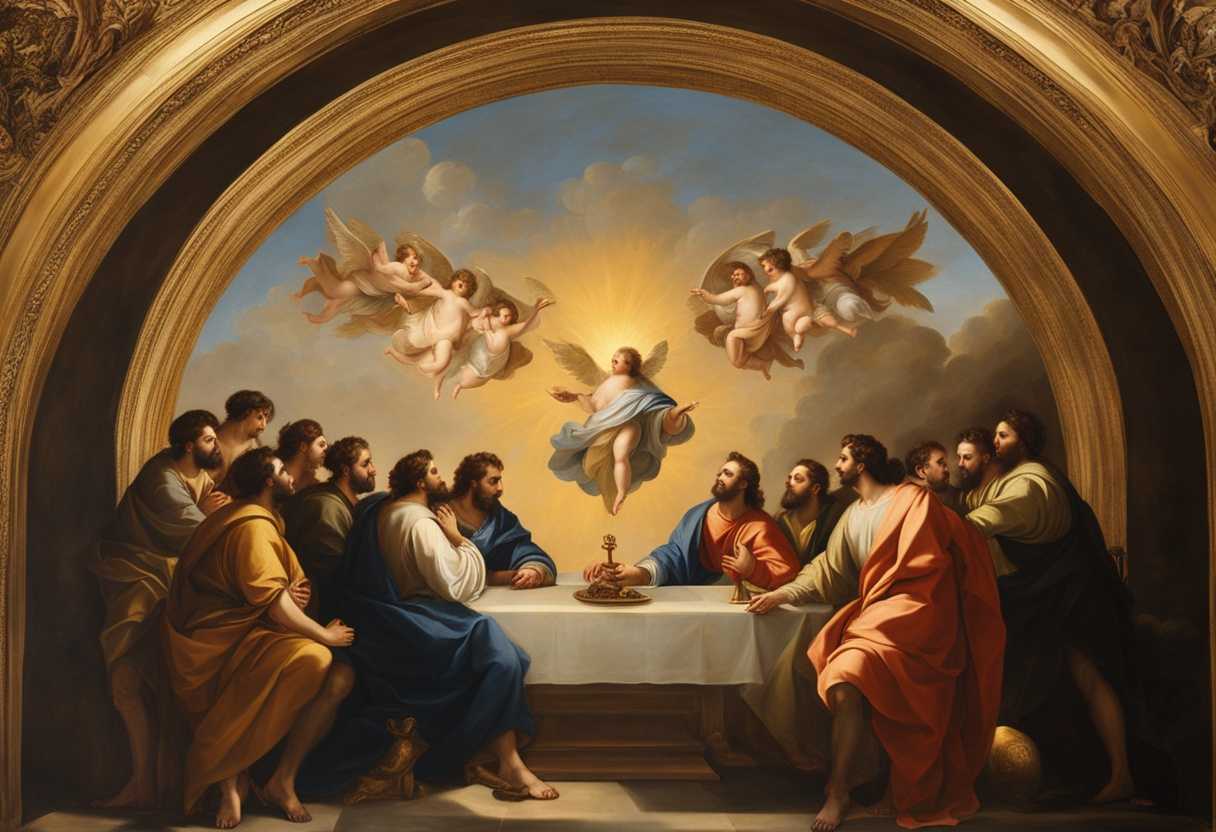
Setting the Scene for 1 Corinthians 9:5
In 1 Corinthians chapter 9, the apostle Paul is addressing the Corinthian church about his rights as an apostle and his decision to forego those rights for the sake of the gospel. The scene unfolds in a bustling marketplace in Corinth, where Paul is surrounded by a group of believers who have gathered to hear his teachings. The sun beats down on the cobblestone streets as merchants call out to passersby, offering their wares.
Among the crowd are familiar faces like Timothy, Silas, and Priscilla, who have been traveling with Paul on his missionary journeys. They have come to support him as he shares his message of grace and selflessness. The sound of laughter and conversation fills the air, blending with the clinking of coins and the aroma of spices from nearby stalls. Despite the distractions of the busy marketplace, Paul’s words captivate his audience, drawing them in with his passion and conviction. As he speaks about his willingness to give up his rights for the sake of the gospel, his companions nod in agreement, knowing that they too have made sacrifices for the greater good.
What is 1 Corinthians 9:5 about?
This verse highlights the Apostle Paul’s assertion of his right to marry and be supported by the church, like other apostles and brothers of the Lord and Cephas. Paul is emphasizing the legitimacy and importance of his role as a leader within the Christian community in this passage. Paul is challenging any potential criticism or doubt about his own rights and privileges within the church by pointing out that other spiritual leaders have the right to marry and receive support. Paul felt it necessary to defend his right to marry and receive support from the church. Was there a specific context or issue within the church at that time that prompted Paul to make this argument? By delving deeper into the historical and cultural background of this verse, we can better understand the significance of Paul’s defense and the broader implications of his message. Paul’s words serve as a reminder of the diverse perspectives and debates within the early Christian community, while also shedding light on his own personal beliefs and practices as a servant of God.
Understanding what 1 Corinthians 9:5 really means
To provide a comprehensive commentary on this verse, let’s structure our discussion into five main sections: Context, Key Phrases, Cross-References, Modern Relevance, and Personal Anecdote.
Context:
The context of this verse is crucial for understanding its implications. Paul is defending his rights as an apostle in 1 Corinthians 9. He is addressing the Corinthian church regarding the rights of apostles to receive material support. Paul uses this chapter to explain that, like other apostles, he has the right to be supported by the church, yet he chooses to forgo this right for the sake of the gospel. This sets the stage for understanding the specific rights he mentions in the verse.
Key Phrases:
The phrase “Do we not have the right to take along a believing wife” highlights the apostles’ right to marry and have their spouses accompany them in their ministry. This phrase underscores the humanity and normalcy of the apostles—they had personal lives and relationships just like anyone else. Other prominent figures in early Christianity, including Peter (Cephas), exercised this right, as do the other apostles and the brothers of the Lord.
Cross-References:
To further deepen our understanding, let’s look at other passages. Matthew 8:14 mentions that Peter had a mother-in-law, implying he was married. This supports Paul’s claim about apostles having families. Paul writes in 1 Timothy 3:2 that a church overseer should be “the husband of one wife,” indicating that church leaders often had families. These references affirm that Christian leaders having spouses was a common and accepted practice.
Modern Relevance:
Why is this relevant to us today? This verse speaks to the balance between ministry and personal life. It reminds us that spiritual leaders are also human, with personal needs and relationships. Acknowledging the right to a balanced life is crucial in an age where burnout is common among those in ministry. It also speaks to the inclusivity of family in ministry, suggesting that families can be integral to spiritual service.
Personal Anecdote:
I remember a pastor who shared that his wife and children were his greatest support in ministry. They often traveled with him, providing emotional and logistical support. This not only strengthened his ministry but also showcased a model of family unity and mutual support. Their presence was not a distraction but a testament to the holistic life God calls us to lead.
Reflecting on this verse, do you see how it humanizes our spiritual leaders and emphasizes the importance of family in ministry? How might this change your perspective on supporting your pastor and their family? We are reminded that the call to serve God encompasses all aspects of our lives, including our relationships and personal well-being.
How can we balance spiritual service and personal needs?
Balancing spiritual service and personal needs is crucial in maintaining a healthy and sustainable lifestyle. The verse reminds us that serving others, whether spiritually or otherwise, is important, but it is also essential to take care of our personal well-being. We are better equipped to serve others effectively and with a genuine heart by prioritizing self-care and tending to our own needs.
Finding a balance between spiritual service and personal needs involves setting boundaries and practicing self-discipline. It is not selfish to take care of ourselves; rather, it allows us to be more present and effective in our service to others. We replenish our energy and can then give more generously to those around us by nurturing ourselves spiritually, emotionally, mentally, and physically. It is a continuous process of evaluating our priorities and making intentional choices to maintain a harmonious equilibrium between our personal well-being and our service to others.
Application
Picture the relentless grind of modern life—work deadlines, family commitments, and endless responsibilities. Now, consider the spiritual leaders in our community who juggle this, just like you. They have families needing support and recognition too. Reach out and uplift the spouses of our ministers; your encouragement fuels their mission. Will you take a moment to honor the backbone of those serving our faith?

Reverend Michael Johnson is an experienced Church Minister with a profound expertise in spirituality and guidance. With a serene presence and a compassionate heart, he has faithfully served his congregation for over 20 years, leading them on a spiritual journey towards inner peace and enlightenment. Reverend Johnson’s extensive knowledge of religious philosophies and profound understanding of human nature have made him a trusted confidant and mentor to many, as he seamlessly weaves his profound wisdom into life teachings. Reverend Johnson’s calming demeanor and empathetic nature continue to uplift and heal souls, nurturing a sense of unity and tranquility within his community.