
1 Now when the queen of Sheba heard of the fame of Solomon concerning the name of the Lord, she came to test him with hard questions.
2 She came to Jerusalem with a very great retinue, with camels bearing spices and very much gold and precious stones. And when she came to Solomon, she told him all that was on her mind.
3 And Solomon answered all her questions; there was nothing hidden from the king that he could not explain to her.
4 And when the queen of Sheba had seen all the wisdom of Solomon, the house that he had built,
5 the food of his table, the seating of his officials, and the attendance of his servants, and their clothing, his cupbearers, and his burnt offerings that he offered at the house of the Lord, there was no more breath in her.
6 She said to the king, “The report was true that I heard in my own land of your words and of your wisdom,
7 So I did not believe the reports until I came and my own eyes had seen it. And behold, the half was not told me. Your wisdom and prosperity surpass the report that I heard.
8 Happy are your men! Happy are your servants, who continually stand before you and hear your wisdom!
9 Blessed be the Lord your God, who has delighted in you and set you on the throne of Israel! Because the Lord loved Israel forever, he has made you king, that you may execute justice and righteousness.
10 Then she gave the king 120 talents of gold, and a very great quantity of spices and precious stones. Never again came such an abundance of spices as these that the queen of Sheba gave to King Solomon.
11 Moreover, the fleet of Hiram, which brought gold from Ophir, brought from Ophir a very great amount of almug wood and precious stones.
12 The king also made of the almug wood supports for the house of the Lord and for the king’s house, lyres also and harps for the singers. No such almug wood has come or been seen to this day.
13 Now King Solomon gave to the queen of Sheba all she desired, whatever she asked, besides what was given her by the bounty of King Solomon. So she turned and went back to her own land with her servants.
14 Now the weight of gold that came to Solomon in one year was 666 talents of gold,
15 besides that which came from the explorers and from the business of the merchants, and from all the kings of the west and from the governors of the land.
16 King Solomon made 200 large shields of beaten gold; 600 shekels of gold went into each shield.
17 He also made three hundred shields of beaten gold; three minas of gold went into each shield. And the king put them in the house of the forest of Lebanon.
18 Moreover, the king made a great throne of ivory and overlaid it with the finest gold.
19 The throne had six steps, and the throne had a round top, and on each side of the seat were armrests and two lions standing beside the armrests,
20 This is the way of all the kingdoms of the earth.
21 All King Solomon’s drinking vessels were of gold, and all the vessels of the House of the Forest of Lebanon were of pure gold. None were of silver; silver was not considered as anything in the days of Solomon.
22 The king had a fleet of ships of Tarshish at sea with the fleet of Hiram. Once every three years the fleet of ships of Tarshish used to come bringing gold, silver, ivory, apes, and peacocks.
23 Thus King Solomon excelled all the kings of the earth in riches and in wisdom.
24 The whole earth sought the presence of Solomon to hear his wisdom, which God had put into his mind.
25 And they brought every man his present, vessels of silver and vessels of gold, and garments, and armor, and spices, horses, and mules, a rate year by year.
26 And Solomon gathered together chariots and horsemen. He had 1,400 chariots and 12,000 horsemen, whom he stationed in the chariot cities and with the king in Jerusalem.
27 Now the king made silver as common in Jerusalem as stone, and he made cedar as plentiful as the sycamore of the Shephelah.
28 And Solomon’s import of horses was from Egypt and Kue, and the king’s traders received them from Kue at a price.
29 A chariot could be imported from Egypt for 600 shekels of silver and a horse for 150, and so through the king’s traders they were exported to all the kings of the Hittites and the kings of Syria.
The True Meaning of 1 Kings 10
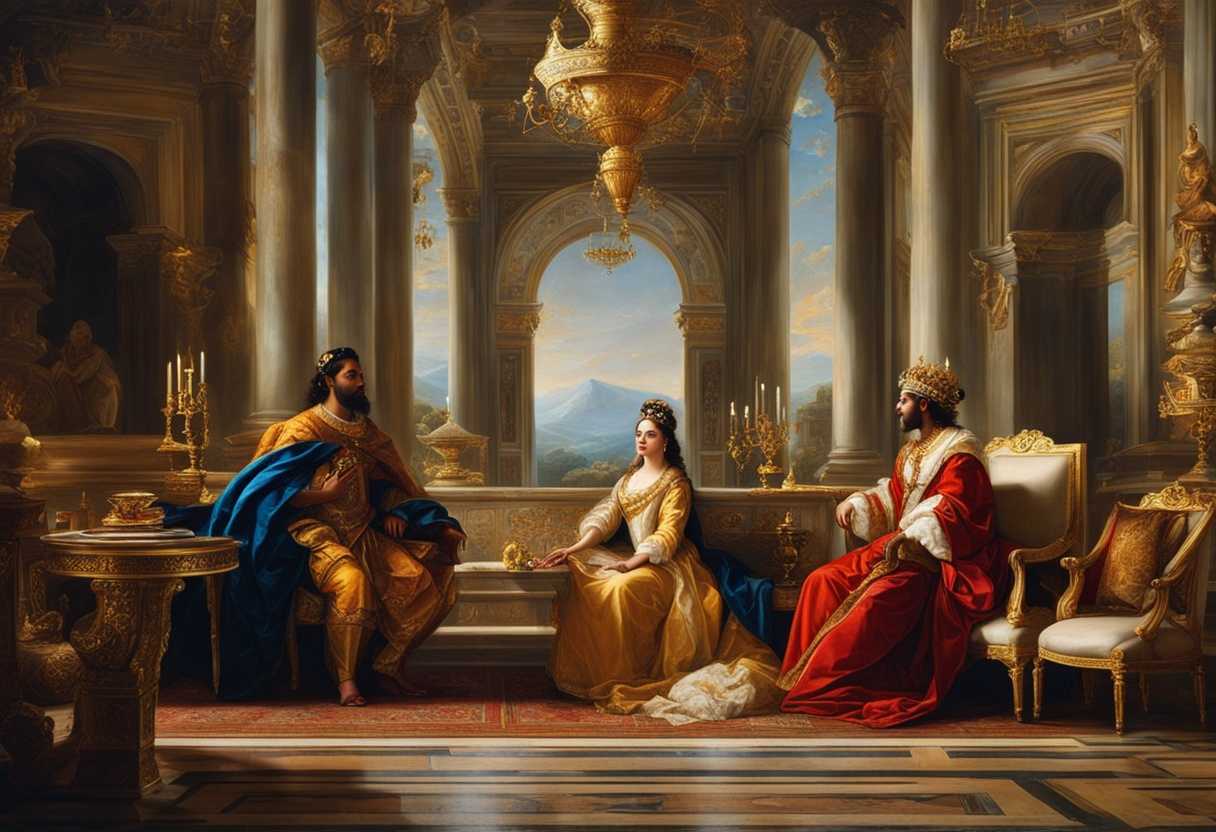
This chapter of 1 Kings provides an account of the visit of the Queen of Sheba to King Solomon. The author, believed to be the prophet Nathan or Ahijah, offers a glimpse into the immense wealth and wisdom of Solomon’s kingdom during its golden age.
The chapter begins by describing the Queen’s journey to Jerusalem, drawn by the reports of Solomon’s fame. She comes to test him with difficult questions, but is ultimately overwhelmed by his wisdom and the splendor of his court. This encounter echoes the words of Proverbs 8, where Wisdom herself calls out, “Blessed are those who keep my ways. The Queen pronounces a blessing upon Solomon and his people as she departs. This foreshadows the eventual decline of the kingdom, as Solomon’s later choices will lead him astray from the path of righteousness. The chapter serves as a high point, a calm before the storm, as the seeds of division and idolatry are already being sown within the kingdom.
1 Kings 10:1-5
The Queen of Sheba visits King Solomon in Jerusalem in 1 Kings 10:1-5, hearing of his wisdom and wanting to test him with difficult questions. This visit is significant as it illustrates the widespread fame of Solomon’s wisdom and wealth, even reaching distant lands like Sheba. The Queen’s journey to meet Solomon highlights the respect and admiration others had for him. When she arrives, she questions him on various topics, and he impresses her with his answers.
Solomon’s wisdom was a gift from God, as mentioned earlier in 1 Kings 4:29-34, where it is described how God gave Solomon wisdom and very great insight, as well as a breadth of understanding as measureless as the sand on the seashore. This wisdom enabled Solomon to govern his people justly and wisely, making fair judgments and decisions that showed his discernment and understanding.
The Queen of Sheba’s visit also serves to demonstrate the importance of seeking wisdom and knowledge. Solomon himself advises his readers in Proverbs 2:1-6 to seek wisdom and understanding as one would search for hidden treasures because the Lord gives wisdom and knowledge and understanding come from His mouth. The Queen’s journey to Solomon underscores the value placed on wisdom in the Bible and the rewards of seeking it earnestly.
Furthermore, the encounter between the Queen of Sheba and Solomon can be seen as a foreshadowing of the greater wisdom and wealth that Jesus Christ offers to all who seek Him. Jesus refers to the Queen of Sheba’s visit to Solomon in Matthew 12:42, saying that she came from the ends of the earth to hear Solomon’s wisdom, but something greater than Solomon is here. This points to Jesus as the ultimate source of wisdom and knowledge, surpassing even the great Solomon. The story of the Queen of Sheba’s visit to Solomon in 1 Kings 10:1-5 carries timeless lessons about the value of wisdom, the importance of seeking knowledge, and ultimately, points to Jesus as the embodiment of divine wisdom and understanding.
1 Kings 10:6-10
- Verse Breakdown:
- “She said to the king, ‘The report I heard in my own country about your achievements and your wisdom is true.’”
- “‘But I did not believe these things until I came and saw with my own eyes. Indeed, not even half was told me; in wisdom and wealth you have far exceeded the report I heard.’”
- “‘How happy your people must be! How happy your officials, who continually stand before you and hear your wisdom!’”
- “‘Praise be to the Lord your God, who has delighted in you and placed you on the throne of Israel. Because of the Lord’s eternal love for Israel, he has made you king to maintain justice and righteousness.’”
-
“And she gave the king 120 talents of gold, large quantities of spices, and precious stones. Never again were so many spices brought in as those the queen of Sheba gave to King Solomon.”
-
Commentary:
These verses describe the visit of the Queen of Sheba to King Solomon after hearing of his wisdom and wealth. The Queen expresses her amazement at the reports she heard, highlighting that the reality surpasses even the grandeur that was described to her. She acknowledges the wisdom and prosperity of Solomon, recognizing that his people and officials must be joyful to have such a wise and just king. The Queen attributes Solomon’s success not only to his own abilities but also to the Lord God, acknowledging His role in Solomon’s reign and his ability to maintain justice and righteousness.
The story of the Queen of Sheba’s visit to Solomon is significant as it not only showcases Solomon’s wisdom and wealth but also serves as an example of the importance of seeking wisdom and understanding from God. The Queen’s acknowledgment of God’s hand in Solomon’s reign emphasizes the biblical theme of acknowledging God as the source of all wisdom and prosperity. The verse in Proverbs 2:6 states, “For the Lord gives wisdom; from his mouth come knowledge and understanding.”” This aligns with the Queen of Sheba’s recognition of God’s role in Solomon’s wisdom and justice.
Additionally, the Queen of Sheba’s lavish gifts to Solomon symbolize the respect and honor she holds for him, reflecting the concept of honoring and respecting those in positions of authority. The advice in Romans 13:1 is to let everyone be subject to the governing authorities because there is no authority except that which God has established.” The Queen’s respect for Solomon also highlights the importance of acknowledging and appreciating the wisdom and righteousness in leaders, as long as their actions align with God’s principles.
Furthermore, the Queen of Sheba serves as a symbolic figure in the Bible, representing seekers of truth and wisdom. Her journey to Solomon demonstrates the value of seeking understanding and enlightenment from those who possess wisdom and knowledge. This aligns with Proverbs 4:7, which states, “The beginning of wisdom is this: Get wisdom. Though it cost all you have, get understanding.” The Queen’s journey and acknowledgment of Solomon’s wisdom serve as a reminder for individuals to seek and value wisdom in their own lives. The account of the Queen of Sheba’s visit to King Solomon in 1 Kings 10:6-10 highlights Solomon’s wisdom and prosperity and underscores the importance of acknowledging God as the source of all wisdom and justice. The Queen’s journey symbolizes the pursuit of truth and wisdom, emphasizing the value of seeking understanding and enlightenment from those who possess knowledge. This narrative provides timeless lessons on honoring and respecting wise and just leaders, seeking wisdom from God, and recognizing the divine source of all wisdom and prosperity.
1 Kings 10:11-13
We encounter a pivotal moment in the narrative of King Solomon’s reign in the book of 1 Kings, chapter 10, verses 11-13. Let’s break down this verse into important sections for a better understanding.
Verse 11 mentions that King Solomon also gave the merchant ships an array of goods, specifically almugwood and precious stones. The almugwood mentioned here is believed to be a rare and valuable wood, known for its aromatic fragrance and durability. Solomon’s generosity towards the merchant ships reflects his wealth and wisdom in managing trade and resources. This act also demonstrates his desire for international trade and diplomatic relations, which were significant in establishing the prosperity of his kingdom.
Furthermore, in verse 12, we see that the King received the queen of Sheba, who came to test him with difficult questions. The Queen of Sheba’s visit was a remarkable event as she traveled from a distant land to hear of Solomon’s wisdom. Her arrival signified Solomon’s renowned wisdom and his reputation that extended beyond the borders of Israel. The interaction between Solomon and the Queen of Sheba showcases the exchange of knowledge, wealth, and diplomacy between different nations, emphasizing the importance of wisdom and righteousness in governance.
Lastly, verse 13 highlights the immense wealth and wisdom of King Solomon. It mentions that King Solomon gave the Queen of Sheba everything she desired and asked for, surpassing her expectations. This act not only displayed Solomon’s wealth but also his generosity and willingness to share his blessings with others. Solomon’s abundance of wisdom and wealth was a direct result of God’s promises and his obedience to follow God’s commandments. His reign serves as an example of the blessings that come from seeking wisdom and righteousness before God. Solomon’s encounter with the Queen of Sheba echoes the themes of seeking wisdom, honoring God, and the importance of international relations in the broader context of the Bible. It also foreshadows Jesus’ reference to the Queen of Sheba in Matthew 12:42, where he compares himself to Solomon, emphasizing the importance of seeking wisdom and knowledge from Him. The narrative of Solomon and the Queen of Sheba serves as a reminder for believers to value wisdom, seek understanding, and to share blessings with others, ultimately glorifying God through our actions.
1 Kings 10:14-17
The verses in 1 Kings 10:14-17 highlight the immense wealth and prosperity of King Solomon during his reign. Let’s break down this section verse by verse for deeper reflection:
Verse 14 begins by mentioning the amount of gold that came to Solomon in one year, which was 666 talents of gold. This significant amount of gold illustrates the extent of wealth that was flowing into Solomon’s kingdom. This wealth not only displayed Solomon’s prosperity but also fulfilled the promise made to Solomon by God for his obedience. It serves as a testament that God rewards those who follow His ways with blessings beyond measure.
Verse 15 shifts the focus to the additional sources of wealth that contributed to Solomon’s riches. The verse mentions the merchants and traders who brought other precious stones and goods to Solomon. This demonstrates Solomon’s shrewdness in establishing trade relationships and alliances with neighboring nations, further enriching his kingdom. This also shows how Solomon’s wisdom extended into areas of economics and diplomacy, which was in line with the divine wisdom bestowed upon him. Solomon made 200 large shields of beaten gold in verse 16, using around 600 shekels of gold on each shield. These shields were placed in the House of the Forest of Lebanon. These shields were not just for display but were a symbol of Solomon’s military might and preparedness. They were a deterrent to potential enemies and a display of Solomon’s power and strength as a ruler. This act also signifies Solomon’s focus on protecting his kingdom and being prepared for any potential threats, showcasing a wise and strategic leader.
Verse 17 speaks of a great throne of ivory overlaid with pure gold, which was magnificently adorned. The throne was accompanied by six steps and had a golden footstool. This grand throne symbolizes Solomon’s regal status and power as a king. The opulence and grandeur of the throne were meant to inspire awe and respect from those who beheld it, solidifying Solomon’s reputation as a ruler of great wealth and splendor.
These verses in 1 Kings 10:14-17 not only paint a vivid picture of Solomon’s wealth and prosperity but also serve as a reminder of the fleeting nature of earthly riches. While material possessions can bring temporary comfort and power, true wealth in the eyes of God lies in wisdom, righteousness, and obedience to His commands. The story of Solomon’s riches also echoes the teachings of Jesus in the New Testament, emphasizing the importance of seeking treasures in heaven rather than on earth (Matthew 6:19-21). Reflecting on Solomon’s wealth in light of these timeless messages reminds us to prioritize spiritual riches and virtuous living above material abundance.
1 Kings 10:18-20
King Solomon made a great throne of ivory and overlaid it with the finest gold during his reign, as described in 1 Kings 10:18-20. The throne had six steps leading up to it, with a footstool of gold attached to the throne. Additionally, there were armrests on each side of the seat, with two lions standing beside the armrests. It was said that there was no other throne like it in any other kingdom.
This elaborate throne of King Solomon symbolizes the wealth, power, and grandeur of his kingdom. The use of ivory, which was a rare and luxurious material, along with the finest gold, represented the opulence of Solomon’s reign. The presence of lions at the throne’s sides symbolizes strength, majesty, and authority, all characteristics associated with King Solomon’s rule.
This description of King Solomon’s throne illustrates the concept of kingship and authority in the biblical narrative. The Bible often uses the concept of thrones and seats of authority to symbolize power and rule. For instance, in the Book of Revelation, Jesus sits on a throne as the ultimate authority and ruler of all (Revelation 4:2-3).
Furthermore, the excessive luxury and material wealth displayed in Solomon’s throne raise questions about the priorities and values of his kingdom. While Solomon was blessed by God with wisdom and wealth (1 Kings 3:11-13), his accumulation of wealth and possessions also led to his downfall as he turned away from God in his later years (1 Kings 11:1-10). The description of King Solomon’s throne in 1 Kings 10:18-20 visually represents his grandeur and power as a king. It also serves as a reminder of the transient nature of earthly wealth and the importance of staying faithful to God amidst worldly temptations.
1 Kings 10:21-25
King Solomon’s wealth and splendor, particularly focusing on the quantity of gold that came into his possession each year, are described in 1 Kings 10:21-25. Let’s break down this passage into important sections for a deeper understanding.
- “All King Solomon’s goblets were gold, and all the household articles in the Palace of the Forest of Lebanon were pure gold. Nothing was made of silver, because silver was considered of little value in Solomon’s time.”
This verse highlights the opulence and abundance of King Solomon’s reign. The mention of gold goblets and household articles made of pure gold illustrates the incredible wealth and luxury of his kingdom. The fact that silver was considered of little value in Solomon’s time serves to emphasize the exorbitant amount of gold in his possession. This extravagance can be seen as a reflection of the wealth and prosperity that God bestowed upon Solomon due to his wisdom and obedience.
- “The king made silver as common in Jerusalem as stones, and cedar as plentiful as sycamore-fig trees in the foothills.”
This verse further emphasizes the abundance and prosperity during Solomon’s reign. Silver, which was considered of little value, was so abundant that it became as common as stones in Jerusalem. Similarly, cedar, a valuable and sought-after wood, was as plentiful as sycamore-fig trees. This abundance is a testament to God’s faithfulness in fulfilling His promises to Solomon when he asked for wisdom to govern the people of Israel.
- “Solomon’s horses were imported from Egypt and from Kue—the royal merchants purchased them from Kue at the current price.”
The mention of Solomon’s horses imported from Egypt and Kue highlights his military might and wealth. Horses were valuable assets in ancient times, especially for warfare, and having a large number of horses imported from prestigious regions like Egypt added to Solomon’s status and power. The reference to royal merchants purchasing the horses at the current price underscores Solomon’s fair and just governance, ensuring that transactions were conducted ethically and transparently. Themes of abundance, wealth, wisdom, and divine favor are visible in reflecting on this passage. Solomon’s kingdom was a tangible representation of God’s blessings on the nation of Israel when they followed His commandments. Through Solomon’s story, we also glean lessons about the importance of seeking wisdom, the responsibility of leadership, and the blessings that come from obeying God’s laws.
This narrative of Solomon’s prosperity and abundance also brings to mind verses like Proverbs 10:22, which states, “The blessing of the Lord makes rich, and he adds no sorrow with it.” Solomon’s wealth was not just material riches but also a symbol of the spiritual blessings that come from aligning one’s life with God’s will. It serves as a reminder for us today to seek first the kingdom of God and His righteousness, knowing that all these material things will be added unto us (Matthew 6:33).
1 Kings 10:26-29
Several important sections to dissect are found in 1 Kings 10:26-29. Firstly, the verse notes that King Solomon accumulated chariots and horsemen, amassing a great number of them. The verse specifically mentions that Solomon had 1,400 chariots and 12,000 horsemen. These chariots and horsemen were acquired through trade and arrangements with the kings of the Hittites and Syria.
This accumulation of chariots and horsemen by Solomon symbolizes the wealth and power he had amassed during his reign. It reflects Solomon’s desire for military might and his efforts to establish a strong kingdom. However, the acquisition of a large army, particularly through chariots and horses, also conveys a subtle warning about reliance on military strength rather than on God. The Bible repeatedly emphasizes the importance of trusting in God for protection and not putting confidence in earthly possessions or might. Psalm 20:7 says, “Some trust in chariots and some in horses, but we trust in the name of the Lord our God.”
King Solomon’s wealth and power had reached unprecedented levels during his reign. This opulence is evident in the gifts he received, the Temple he built, and the luxury he surrounded himself with. However, the accumulation of chariots and horsemen serves as a reminder of the temptation that great prosperity can bring. Instead of relying solely on God’s wisdom and guidance, Solomon allowed his wealth to lead him into pursuits that may have compromised his devotion to God.
Furthermore, the mention of the specific numbers of chariots and horsemen underscores the meticulous record-keeping of the ancient Israelites. The precision in detailing these quantities highlights the importance of historical accuracy and attention to detail in documenting events and possessions. This commitment to precision is seen throughout the Bible in genealogies, measurements of structures like the Temple, and accounts of battles and conquests. The verses in 1 Kings 10:26-29 ultimately serve as a cautionary tale about the dangers of placing too much emphasis on earthly wealth and power. While Solomon’s reign was marked by prosperity and grandeur, it also illustrates the potential pitfalls of losing sight of one’s faith and dependence on God in the pursuit of material gain. Christians are reminded to seek first the kingdom of God and His righteousness, trusting that all these things will be added unto us (Matthew 6:33).
After 1 Kings 10
The Queen of Sheba had seen the wisdom and wealth of King Solomon, and she was amazed. She had come to test him with hard questions, and he had answered them all. The king’s wisdom and prosperity were beyond what she had heard. She said to the king as she prepared to depart, “The report I heard in my own country about your achievements and your wisdom is true.” But I did not believe these things until I came and saw with my own eyes. Indeed, not even half was told me; in wisdom and wealth you have far exceeded the report I heard.”
With that, the Queen of Sheba blessed the Lord, the God of Israel, who had established Solomon on the throne. She showered the king with gifts of gold, spices, and precious stones. Solomon gave the queen all she desired in return. Then she and her attendants returned to her own country.
The next chapter would reveal how Solomon’s great wealth and wisdom would ultimately lead to his downfall. For even the wisest of men can be tempted by the allure of earthly riches and pleasures, forgetting the true source of their blessings. The path ahead would test Solomon’s devotion to the Lord, and the consequences of his choices would echo through the generations to come.

Reverend Michael Johnson is an experienced Church Minister with a profound expertise in spirituality and guidance. With a serene presence and a compassionate heart, he has faithfully served his congregation for over 20 years, leading them on a spiritual journey towards inner peace and enlightenment. Reverend Johnson’s extensive knowledge of religious philosophies and profound understanding of human nature have made him a trusted confidant and mentor to many, as he seamlessly weaves his profound wisdom into life teachings. Reverend Johnson’s calming demeanor and empathetic nature continue to uplift and heal souls, nurturing a sense of unity and tranquility within his community.