
1 Kings 18:1-39 is about the great confrontation between the prophet Elijah and the prophets of Baal on Mount Carmel, illustrating the power and supremacy of the one true God over false idols and emphasizing the importance of faith and obedience.
1 After many days the word of the Lord came to Elijah, in the third year, saying, “Go, show yourself to Ahab, and I will send rain upon the earth.”
2 So Elijah went to show himself to Ahab. Now the famine was severe in Samaria.
3 And Ahab called Obadiah, who was over the household. (Now Obadiah feared the Lord greatly, )
4 And when Jezebel cut off the prophets of the Lord, Obadiah took a hundred prophets and hid them by fifties in a cave and fed them with bread and water.
5 And Ahab said to Obadiah, “Go through the land to all the springs of water and to all the valleys. Perhaps we may find grass and save the horses and mules alive, and not lose some of the animals.”
6 So they divided the land between them to pass through it. Ahab went in one direction by himself, and Obadiah went in another direction by himself.
7 And as Obadiah was on the way, behold, Elijah met him. And Obadiah recognized him and fell on his face and said, “Is it you, my lord Elijah?”
8 And he answered him, “I am the prophet of the Lord. But how have I sinned, that you would deliver your servant into the hand of Ahab, to kill me?
9 And he said, “What have I sinned, that you would give your servant into the hand of Ahab, to kill me?
10 As the Lord your God lives, there is no nation or kingdom where my lord has not sent to seek you. And when they would say, ‘He is not here,’ he would take an oath of the kingdom or nation, that they had not found you.
11 And now you say, ‘Go, tell your lord, “Behold, Elijah is here.”‘
12 And as soon as I have gone from you, the Spirit of the Lord will carry you I know not where. So, when I come and tell Ahab and he cannot find you, he will kill me, although I your servant have feared the Lord from my youth.
13 Has it not been told my lord what I did when Jezebel killed the prophets of the Lord, how I hid a hundred men of the Lord’s prophets by fifties in a cave and fed them with bread and water?
14 And now you say, ‘Go, tell your lord, “Behold, Elijah is here”‘; and he will kill me.”
15 And Elijah said, “As the Lord of hosts lives, before whom I stand, I will surely show myself to him today.”
16 So Obadiah went to meet Ahab, and told him. And Ahab went to meet Elijah.
17 When Ahab saw Elijah, Ahab said to him, “Is it you, you troubler of Israel?”
18 And he answered, “I have not troubled Israel, but you have, and your father’s house, because you have abandoned the commandments of the Lord and followed the Baals.
19 Now therefore send and gather all Israel to me at Mount Carmel, and the 450 prophets of Baal and the 400 prophets of Asherah, who eat at Jezebel’s table.”
20 So Ahab sent to all the people of Israel and gathered the prophets together at Mount Carmel.
21 And Elijah came near to all the people and said, “How long will you go limping between two different opinions? If the Lord is God, follow him; but if Baal, then follow him.” And the people did not answer him a word.
22 Then Elijah said to the people, “I, even I only, am left a prophet of the Lord, but Baal’s prophets are 450 men.
23 Let two bulls be given to us, and let them choose one bull for themselves and cut it in pieces and lay it on the wood, but put no fire to it. And I will prepare the other bull and lay it on the wood and put no fire to it.
24 And you call upon the name of your god, and I will call upon the name of the Lord, and the God who answers by fire, he is God.” And all the people answered, “It is well spoken.”
25 Then Elijah said to the prophets of Baal, “Choose for yourselves one bull and prepare it first, for you are many, and call upon the name of your god, but put no fire to it.”
26 And they took the bull that was given them, and they prepared it and called upon the name of Baal from morning until noon, saying, “O Baal, answer us!” But there was no voice, and no one answered. And they limped around the altar that they had made.
27 And at noon Elijah mocked them, saying, “Cry aloud, for he is a god. Either he is musing, or he is relieving himself, or he is on a journey, or perhaps he is asleep and must be awakened.”
28 And they cried aloud and cut themselves after their custom with swords and lances, until the blood gushed out upon them.
29 And as midday passed, they raved on until the time of the offering of the oblation, but there was no voice. No one answered; no one paid attention.
30 Then Elijah said to all the people, “Come near to me.” And all the people came near to him. And he repaired the altar of the Lord that had been thrown down.
31 Elijah took twelve stones, according to the number of the tribes of the sons of Jacob, to whom the word of the Lord came, saying, “Israel shall be your name,”
32 And with the stones he built an altar in the name of the Lord.
33 And he put the wood in order and cut the bull in pieces and laid it on the wood. And he said, “Fill four jars with water and pour it on the burnt offering and on the wood.”
34 And he said, “Fill four jars with water and pour it on the burnt offering and on the wood.”
35 And the water ran around the altar and filled the trench also with water.
36 And at the time of the offering of the oblation, Elijah the prophet came near and said, “O Lord, God of Abraham, Isaac, and Israel, let it be known this day that you are God in Israel, and that I am your servant, and that I have done all these things at your word.
37 Answer me, O Lord, answer me, that this people may know that you, O Lord, are God, and that you have turned their hearts back.”
38 Then the fire of the Lord fell and consumed the burnt offering and the wood and the stones and the dust, and licked up the water that was in the trench.
39 And when all the people saw it, they fell on their faces and said, “The Lord, he is God; the Lord, he is God.”
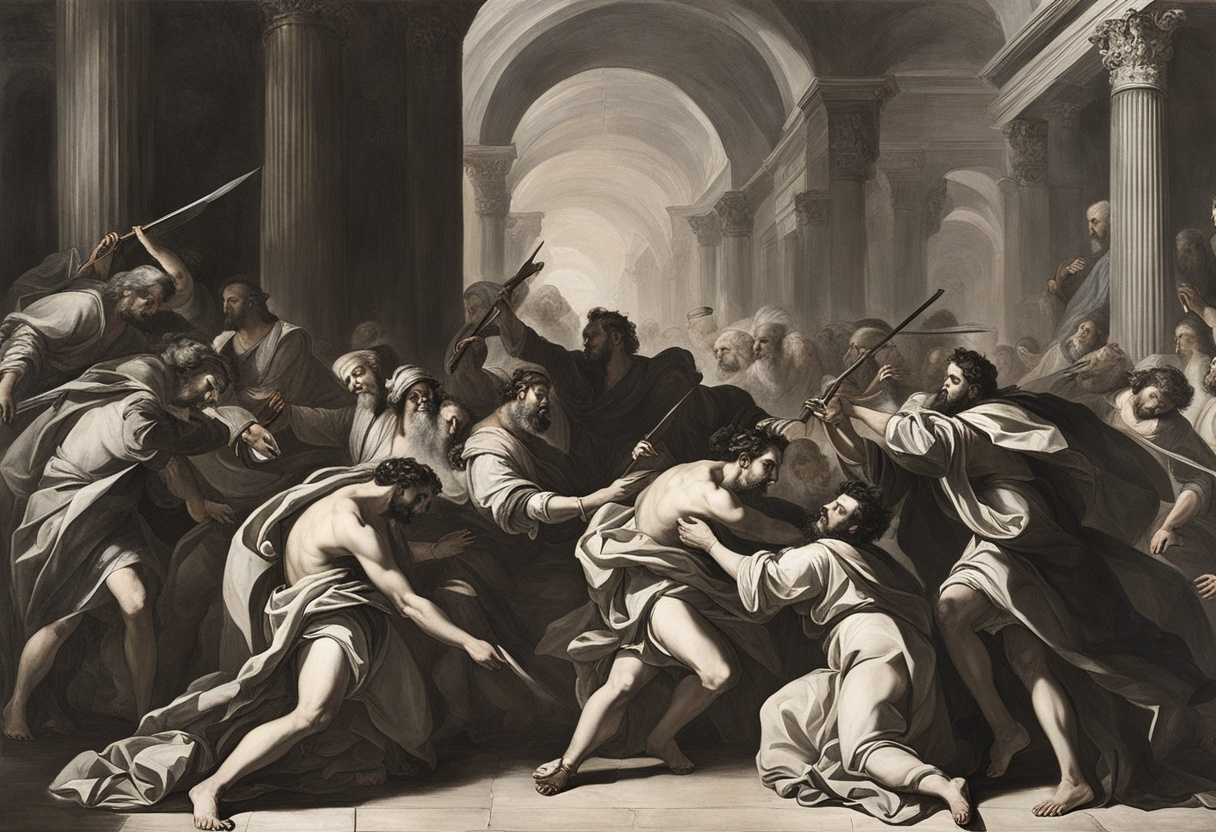
Setting the Scene for 1 Kings 18:1-39
The scene in 1 Kings chapter 18 is set on Mount Carmel, a prominent mountain in Israel overlooking the Mediterranean Sea. The main characters in this scene are the prophet Elijah and the prophets of Baal, along with a large crowd of Israelites. The events leading up to this dramatic confrontation began with a severe drought in the land, which Elijah had prophesied as a judgment from God due to the people’s idolatry.
Elijah challenges the prophets of Baal, who were followers of the false god Baal, to a showdown to prove the power of the one true God, Yahweh. The prophets of Baal set up an altar and call on Baal to send fire to consume their sacrifice, but nothing happens. Elijah then repairs the altar of the Lord, drenches it with water three times, and calls on God to send fire. In a spectacular display of power, God sends fire from heaven to consume the sacrifice, the wood, the stones, and even the water in the trench around the altar.
The scene on Mount Carmel is one of intense anticipation and suspense as the people witness the power of God displayed in a miraculous way. It is a pivotal moment where Elijah boldly confronts the false prophets and demonstrates the supremacy of Yahweh. The outcome of this showdown leads the people to repentance and reaffirm their faith in the one true God.
What is 1 Kings 18:1-39 about?
This verse portrays a powerful moment of faith and conviction from the prophet Elijah. Elijah boldly demonstrates his unwavering faith in the one true God by challenging the prophets of Baal. Through this challenge, he showcases not only his confidence in God’s power but also his trust in His faithfulness to answer prayers and reveal His glory. The narrative highlights the contrast between the false prophets of Baal and the genuine relationship Elijah has with God, emphasizing the importance of true faith and devotion. As we delve into this verse, Elijah possessed great depths of faith and displayed courage in standing up for his beliefs. It prompts us to reflect on our own faith and trust in God’s power in the face of challenges or doubts. Through Elijah’s example, we are encouraged to approach our own struggles with the same unwavering faith and confidence, knowing that God is always present and faithful to those who seek Him. How can we, like Elijah, boldly demonstrate our trust in God’s power and faithfulness in our own lives? What lessons can we learn from this powerful display of faith to strengthen our own relationship with God and stand firm in our beliefs?
Understanding what 1 Kings 18:1-39 really means
In the historical context of 1 Kings 18:1-39, we find ourselves amidst a tumultuous period in Israel’s history. King Ahab’s reign, influenced by Queen Jezebel, saw the proliferation of Baal worship among the Israelites. In this backdrop, the prophet Elijah emerges as a pivotal figure, tasked with steering the hearts of the people back to the one true God. The narrative reaches its climax in a gripping showdown on Mount Carmel, where Elijah confronts the prophets of Baal in a test of divine power.
One of the key themes that resonates through this passage is Elijah’s poignant question to the Israelites, “How long will you waver between two opinions?” This inquiry cuts to the core of spiritual indecision, urging a definitive choice between serving the Lord or Baal. It serves as a timeless reminder of the perils of vacillating in matters of faith and underscores the necessity of unwavering commitment.
Elijah’s bold challenge, “The God who answers by fire—he is God,” sets a tangible criterion for discerning the true deity. Fire, a symbol of God’s presence and power throughout Scripture, becomes the litmus test for authenticity. This demand for a visible demonstration of divine authority emphasizes the tangible manifestation of faith, beyond mere belief, in the face of skepticism and doubt.
Drawing parallels from related biblical passages such as Joshua 24:15, James 1:6-8, and Hebrews 12:29, we glean further insights into the themes of decisive faith and the consuming power of God. These verses echo the call for resolute allegiance to God and highlight the transformative impact of unwavering trust in His sovereignty.
The relevance of this narrative extends to contemporary struggles with spiritual indecision, skepticism regarding God’s power, and the call for public demonstration of faith. Just as the Israelites were challenged to choose, we are confronted with decisions that demand unwavering commitment to our beliefs, even in the face of adversity.
Consider the anecdote of a friend who, inspired by Elijah’s courage, chose a path aligned with his faith despite its challenges. His story mirrors the Israelites’ dilemma, emphasizing the peace and fulfillment that accompany resolute faith. In a world fraught with choices, his example serves as a beacon of courage and conviction.
Reflecting on the profound meaning behind Elijah’s words, we are prompted to examine our own faith journey. How long will we waver between conflicting ideologies? How do we discern the true God amidst the cacophony of voices vying for our allegiance? By embracing the call to decisive faith and witnessing God’s power in action, we align ourselves with the unwavering resolve exemplified in Elijah’s bold stand on Mount Carmel.
How can we fully trust and believe in God?
To fully trust and believe in God, we must first acknowledge His sovereignty and power as demonstrated in the events mentioned in this passage. The account illustrates God’s ability to manifest His presence and perform miracles in response to faith and obedience. We can be reassured of His faithfulness and trustworthiness in our own lives by reflecting on how God intervened in Elijah’s life and the Israelites’ circumstances.
Additionally, trusting and believing in God requires us to surrender our doubts and fears to Him, just as Elijah did when he stood boldly before the prophets of Baal. We can develop a deeper connection with God and experience the peace that surpasses all understanding by exhibiting unwavering faith and confidence in His promises. This passage serves as a reminder that when we put our faith in God wholeheartedly, He will undoubtedly show Himself strong on our behalf. Placing our complete reliance on God, knowing that He is always in control and working things out for our good, is the ultimate way to fully trust and believe in Him. We can cultivate a steadfast faith that enables us to overcome any challenge or adversity that comes our way by meditating on the truths revealed in this passage. Embracing the lessons learned from these verses empowers us to walk confidently in our faith journey, knowing that God is ever-present and faithful to fulfill His promises in our lives.
Application
Let’s take a lesson from Elijah’s unwavering faith on Mount Carmel. It’s time to confront our distractions and prioritize our relationship with the Lord. Are you ready to devote yourself wholeheartedly to serving God, leaving behind any idols that may be pulling you away from His path?

Reverend Michael Johnson is an experienced Church Minister with a profound expertise in spirituality and guidance. With a serene presence and a compassionate heart, he has faithfully served his congregation for over 20 years, leading them on a spiritual journey towards inner peace and enlightenment. Reverend Johnson’s extensive knowledge of religious philosophies and profound understanding of human nature have made him a trusted confidant and mentor to many, as he seamlessly weaves his profound wisdom into life teachings. Reverend Johnson’s calming demeanor and empathetic nature continue to uplift and heal souls, nurturing a sense of unity and tranquility within his community.