
1 Kings 19:1-13 is about the prophet Elijah feeling isolated and overwhelmed, seeking the presence of God in the quiet whisper amidst the chaos and noise of life.
1 Ahab told Jezebel all that Elijah had done, and how he had killed all the prophets with the sword.
2 Then Jezebel sent a messenger to Elijah, saying, “So may the gods do to me and more also, if I do not make your life as the life of one of them by this time tomorrow.”
3 Then he was afraid, and he arose and ran for his life and came to Beersheba, which belongs to Judah, and left his servant there.
4 But he himself went a day’s journey into the wilderness and came and sat down under a broom tree. And he asked that he might die, saying, “It is enough; now, O Lord, take away my life, for I am no better than my fathers.”
5 Then he lay down under the broom tree and fell asleep.
6 And he looked, and behold, there at his head was a cake baked on hot stones and a jar of water. And he ate and drank and lay down again.
7 And the angel of the Lord came again a second time and touched him and said, “Arise and eat, for the journey is too great for you.”
8 And he arose and ate and drank, and went in the strength of that food forty days and forty nights to Horeb, the mount of God.
9 There he came to a cave and lodged in it. And behold, the word of the Lord came to him, and he said to him, “What are you doing here, Elijah?”
10 He said, “I have been very jealous for the Lord, the God of hosts. For the people of Israel have forsaken your covenant, thrown down your altars, and killed your prophets with the sword, and I, even I only, am left, and they seek my life, to take it away.”
11 And he said, “Go out and stand on the mount before the Lord.” And behold, the Lord passed by, and a great and strong wind tore the mountains and broke in pieces the rocks before the Lord, but the Lord was not in the wind. And after the wind an earthquake, but the Lord was not in the earthquake.
12 And after the earthquake a fire, but the Lord was not in the fire. And after the fire the sound of a low whisper.
13 And when Elijah heard it, he wrapped his face in his cloak and went out and stood at the entrance of the cave.
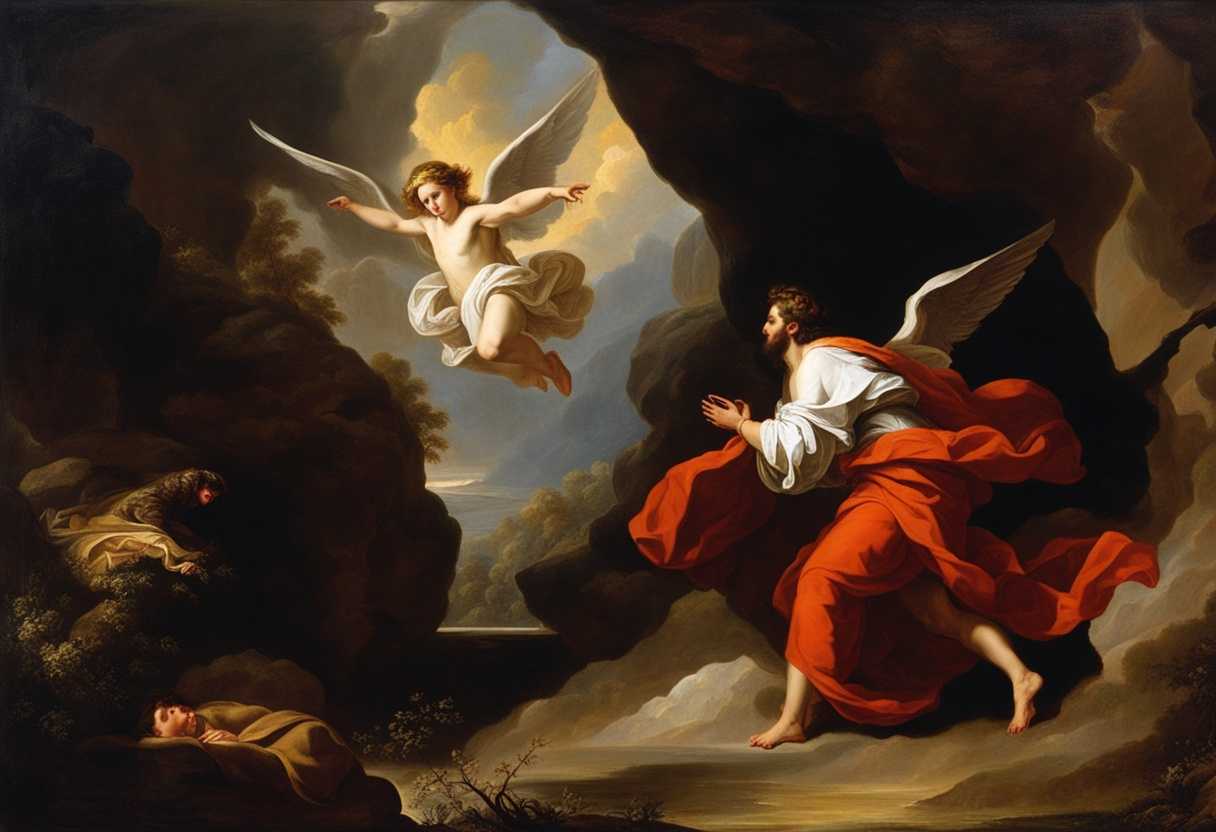
Setting the Scene for 1 Kings 19:1-13
In 1 Kings 19:1-13, we find the prophet Elijah in a moment of deep despair and exhaustion. The scene is set on Mount Horeb, also known as Mount Sinai, the same mountain where Moses received the Ten Commandments. Elijah had just experienced a great victory over the prophets of Baal, but now he was fleeing for his life from Queen Jezebel, who sought to kill him.
As Elijah reached the mountain, he found a cave to take shelter in. Inside the cave, he poured out his heart to God, expressing his weariness and feeling of being alone in his faithfulness to God. Suddenly, the Lord spoke to Elijah, asking him, “What are you doing here, Elijah?” The Lord then instructed Elijah to stand on the mountain as He passed by. A great wind, an earthquake, and a fire passed by, but the Lord was not in any of these powerful displays. Finally, Elijah heard a gentle whisper, and he knew it was the voice of God.
In this poignant moment on Mount Horeb, Elijah encountered the presence of God in a profound and personal way. The surroundings were awe-inspiring, with the rugged terrain of the mountain contrasting with the gentle whisper of God’s voice. Elijah’s journey to this place of solitude and divine encounter was marked by fear, exhaustion, and doubt, but ultimately it became a place of restoration and reassurance as he heard the still, small voice of God.
What is 1 Kings 19:1-13 about?
Elijah, a powerful prophet, feels overwhelmed and afraid in this verse. Despite his many triumphs, he faces a threatening situation with Queen Jezebel. Instead of confronting the problem head-on, Elijah decides to flee, seeking solace and reassurance. It is in this vulnerable moment, when he is at his lowest, that he encounters God not in grand displays of power like fire or earthquakes, but in a gentle whisper. This gentle whisper symbolizes God’s presence in the quiet, comforting us in our moments of fear and doubt, just as He did for Elijah.
The encounter between Elijah and God in the gentle whisper is a powerful reminder that God is always present, even in the midst of our struggles. It teaches us that we need to be attuned to the subtle ways in which God communicates with us, especially when we are feeling lost or overwhelmed. Just like Elijah, when we take the time to listen to that still, small voice of God, we can find reassurance and guidance even in the most challenging times. This verse invites us to reflect on our own encounters with God and to seek His presence in the quiet moments of our lives.
Understanding what 1 Kings 19:1-13 really means
In the passage of 1 Kings 19:1-13, we delve into the narrative of Elijah, a prominent prophet in the Old Testament. Fresh from a significant victory over the prophets of Baal on Mount Carmel, Elijah finds himself in a precarious situation as Queen Jezebel threatens his life, prompting him to flee into the wilderness, overwhelmed by desolation and solitude.
As we dissect key phrases from this passage, we encounter powerful imagery that unveils profound truths about God’s presence. The description of a mighty wind tearing mountains apart and shattering rocks, followed by an earthquake and a fire, all serve to highlight that God’s voice is not always in the grandiose and spectacular displays of power. Instead, it is in the gentle whisper that follows, reminding us to seek God in the quiet and subtle moments of life, where His presence is often most profoundly felt.
Drawing parallels to other biblical passages such as Psalm 46:10, Matthew 11:28-30, and Isaiah 30:15, we see a consistent theme of finding solace, rest, and strength in stillness and trust in God. These verses echo the importance of quietude and attentiveness to God’s voice amidst the chaos and noise of the world.
In today’s fast-paced society, where distractions abound and noise is constant, the message of Elijah’s encounter with God resonates deeply. It serves as a poignant reminder for us to pause, reflect, and listen intently for the subtle whispers of God in the midst of our busy lives. Just as Elijah found reassurance and guidance in the gentle whisper, we too can discover peace and direction when we make space for silence and contemplation.
Consider a scenario where a busy professional, overwhelmed by the demands of work, seeks solace in a moment of quiet contemplation in a park. In that serene setting, amidst the stillness, they experience a profound sense of clarity and peace, prompting them to reevaluate their priorities and reconnect with their spiritual life. This anecdote mirrors Elijah’s encounter with God, illustrating the transformative power of embracing moments of tranquility in the midst of life’s clamor.
In conclusion, the story of Elijah in 1 Kings 19:1-13 serves as a poignant reminder of the profound ways in which God speaks to us in the quiet and stillness of life. It urges us to cultivate a spirit of attentiveness and receptivity to God’s gentle whispers, guiding us towards strength, comfort, and assurance in our daily journey of faith.
How do we seek God’s voice in a chaotic world?
Seeking God’s voice in a chaotic world can be a daunting task. The passage illustrates that God’s voice is not always found in the loud, dramatic events that capture our attention, but often in the quiet and gentle whisper. This reminds us to silence the noise around us and seek solitude to hear God’s voice clearly. Turn inward, find stillness, and listen attentively for the whisper of God’s guidance amidst the chaos in times of turmoil and confusion.
The passage also teaches us the importance of patience and perseverance in seeking God’s voice. Elijah waited patiently for God to reveal Himself, showing us that we must trust in God’s timing and not grow weary in our pursuit of His presence. Finding God’s voice in the midst of the chaos and busyness of the world requires a dedicated effort of seeking Him with an open heart and a quiet spirit. We can navigate the noisy distractions of the world and tune our hearts to hear God’s gentle whisper by imitating Elijah’s persistence and faithfulness. Seeking God’s voice in a chaotic world ultimately necessitates a deliberate and intentional focus on our relationship with Him. We create space for God to speak to us in the midst of the clamor of the world by prioritizing moments of solitude and reflection. Through prayer, meditation, and attentiveness to His whispers, we can align our hearts with His will and find peace and clarity in the midst of chaos.
Application
When lost in the storm of life, be like Elijah finding refuge in the quiet cave of your soul, where God’s whispers bring clarity and strength. In the chaos of our modern world, may we too seek solace in the stillness, discovering our true purpose and direction. Take a moment of silence, connect with the divine within, and feel the peaceful guidance that surrounds you. Will you embrace this power and find peace in the midst of the noise?

Reverend Michael Johnson is an experienced Church Minister with a profound expertise in spirituality and guidance. With a serene presence and a compassionate heart, he has faithfully served his congregation for over 20 years, leading them on a spiritual journey towards inner peace and enlightenment. Reverend Johnson’s extensive knowledge of religious philosophies and profound understanding of human nature have made him a trusted confidant and mentor to many, as he seamlessly weaves his profound wisdom into life teachings. Reverend Johnson’s calming demeanor and empathetic nature continue to uplift and heal souls, nurturing a sense of unity and tranquility within his community.