
1 Kings 3:16-27 is about King Solomon’s wisdom and discernment being displayed through his judgment of two women claiming to be the mother of the same baby, revealing the true mother through his proposal to divide the baby in two, demonstrating the depth of a mother’s love and the importance of justice and discernment in leadership.
16 Then two prostitutes came to the king and stood before him.
17 And the one woman said, “Oh, my lord, this woman and I live in the same house, and I gave birth to a child while she was in the house.
18 It happened on the third day after I gave birth, that this woman also gave birth. And we were alone. There was no one else with us in the house; only we two were in the house.
19 And this woman’s son died in the night, because she lay on him.
20 Then she arose at midnight and took my son from beside me, while your servant slept, and laid him at her breast, and laid her dead son at my breast.
21 And when I rose in the morning to nurse my child, behold, he was dead. But when I looked at him closely in the morning, behold, he was not the child that I had borne.”
22 And the other woman said, “No, but the living child is mine, and the dead child is yours.” The first said, “No, but the dead child is yours, and the living child is mine.” So they spoke before the king.
23 Then the king said, “The one says, ‘This is my son that is alive, and your son is dead’; and the other says, ‘No, but your son is dead, and my son is the living one.’”
24 And the king said, “Bring me a sword.” So a sword was brought before the king.
25 And the king said, “Divide the living child in two, and give half to the one and half to the other.”
26 Then the woman whose son was alive said to the king, because her heart yearned for her son, “Oh, my lord, give her the living child, and by no means put him to death.” But the other said, “He shall be neither mine nor yours; divide him.”
27 Then the king answered and said, “Give the living child to the first woman, and by no means put him to death; she is his mother.”
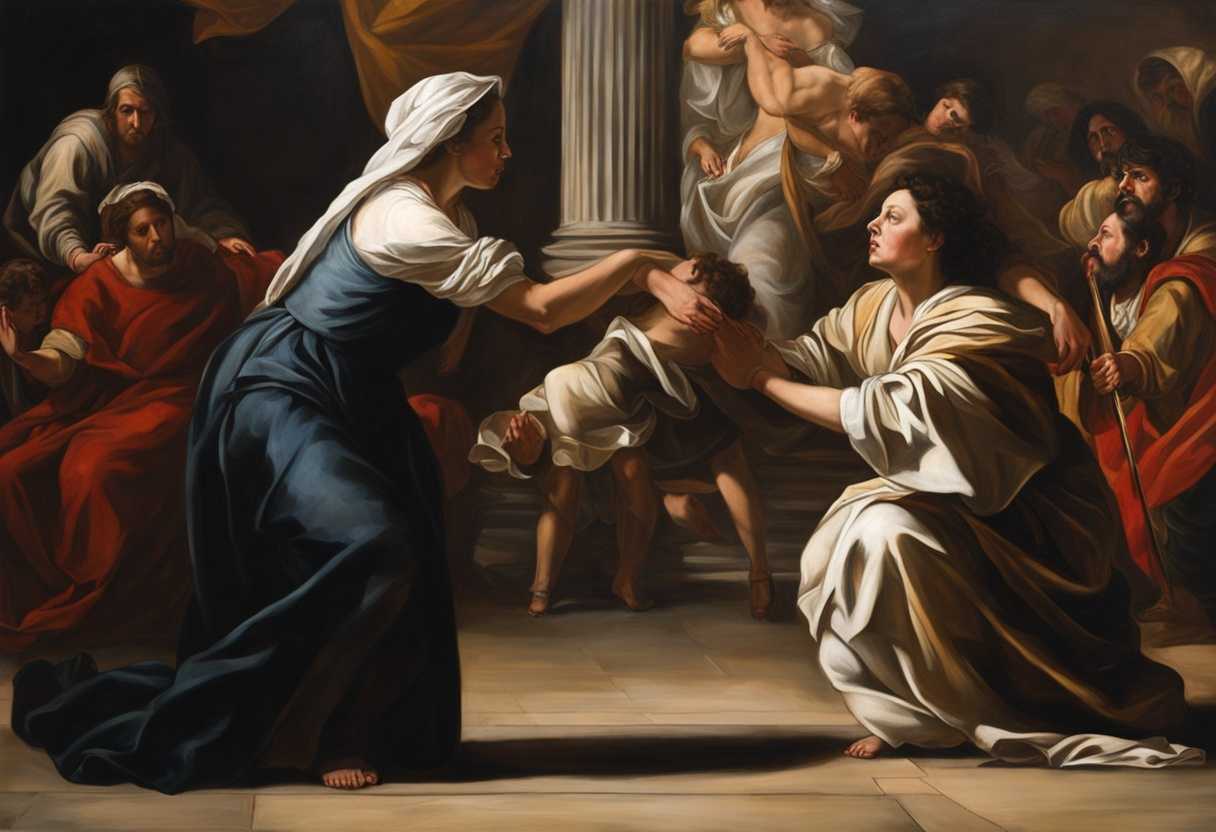
Setting the Scene for 1 Kings 3:16-27
In 1 Kings chapter 3, we find King Solomon ruling over Israel. The scene unfolds in the grandeur of his palace in Jerusalem. The room is adorned with rich tapestries, ornate furniture, and flickering oil lamps casting a warm glow. The air is scented with exotic perfumes, creating an atmosphere of opulence and power.
Among those present in the scene are two women, both mothers, who have come before King Solomon with a baby. The women are dressed in simple garments, their faces etched with worry and desperation. They stand before the throne, their eyes fixed on the wise king, seeking justice and resolution to their dispute.
The women recount their story to King Solomon – both claiming to be the mother of the same baby. The tension in the room is palpable as the king listens intently, his mind sharp and discerning. The outcome of this encounter will test Solomon’s wisdom and reveal the depth of his understanding of human nature.
What is 1 Kings 3:16-27 about?
King Solomon’s wisdom is iconic in this verse as two women come to him with a contentious claim over a baby. Both women assert that the baby is theirs, and King Solomon must discern the true mother. Through his clever judgment, he suggests cutting the baby in half, with each woman receiving an equal share. The true mother’s selfless love and instinctual care for her child shine through as she prioritizes the baby’s well-being over her own desires. This gut-wrenching moment reveals the depths of maternal love and Solomon’s profound wisdom in understanding human nature. We reflect on this story, pondering the complexities of human relationships and the profound depths of love and sacrifice. King Solomon’s wisdom teaches us the importance of empathy, discernment, and understanding in resolving conflicts. It prompts us to consider the selfless acts of love we witness around us daily and challenges us to approach situations with a compassionate heart and a discerning mind. How can we apply Solomon’s wisdom in our own lives, in our relationships, and in our interactions with others? How can we strive to uncover the truth, promote justice, and nurture empathy and understanding in our daily encounters? Let us aspire to draw inspiration from this powerful narrative and embody the wisdom and compassion displayed by King Solomon.
Understanding what 1 Kings 3:16-27 really means
The passage in 1 Kings 3:16-27 showcases King Solomon’s renowned wisdom in a compelling narrative where two women dispute the motherhood of a child. Solomon’s unconventional approach to justice, suggesting to split the child, reveals his deep understanding of human nature and his ability to discern the truth in a complex situation. The key phrase “Bring me a sword” symbolizes Solomon’s unique and insightful method of resolving the dispute, emphasizing his exceptional wisdom and capacity for discernment.
Solomon’s decisive declaration to give the living baby to the first woman, sparing the child’s life, and affirming her as the true mother, highlights his profound insight into the sacrificial love and selflessness of a genuine parent. This act not only showcases Solomon’s wisdom but also serves as a powerful illustration of justice tempered with compassion, a lesson that resonates across time and cultures. The passage underscores the divine origin of wisdom, echoing Proverbs 2:6, which emphasizes that true wisdom comes from the Lord, and James 1:5, which encourages believers to seek wisdom from God.
The timeless relevance of Solomon’s wisdom story lies in its reminder of the enduring value of discernment and the necessity of seeking divine guidance in navigating complex moral and ethical dilemmas. In a world filled with intricate challenges, the need for wisdom and understanding remains as critical today as it was in Solomon’s time. By reflecting on this narrative, individuals can glean insights into the importance of seeking wisdom in their own lives and the significance of making fair and just decisions guided by divine principles.
Consider a modern-day parallel where two business partners are embroiled in a dispute over a successful startup. A wise mediator, akin to Solomon, might propose a solution that tests the true intentions and commitment of each partner, revealing who genuinely prioritizes the company’s well-being. This anecdote illustrates how Solomon’s wisdom can inspire thoughtful resolutions in contemporary conflicts, emphasizing the enduring relevance of his example in fostering justice and compassion.
Reflect on how you can incorporate Solomon’s example of discernment and selflessness into your relationships and responsibilities. Are there areas in your life where seeking divine guidance could lead to fairer and more just outcomes? By internalizing the lessons from Solomon’s wisdom narrative, individuals can approach their own challenges with greater insight, empathy, and a commitment to justice tempered with compassion.
How can we seek wisdom to solve conflicts?
Seeking wisdom to solve conflicts involves approaching the situation with a humble and open heart, willing to listen and consider different perspectives. We can also seek guidance and insight from a higher source when facing conflicts in our own lives, just as King Solomon sought wisdom from God to resolve the dispute between the two mothers in 1 Kings 3:16-27. We can gain clarity and understanding that may lead to a peaceful resolution by seeking wisdom. Consider the bigger picture and the long-term consequences of our actions in times of conflict. Seeking wisdom allows us to see beyond the immediate emotions and frustrations of the situation, enabling us to make sound decisions that promote understanding and reconciliation. We can navigate conflicts with patience, empathy, and a desire for true justice by seeking wisdom. Acknowledging that we may not have all the answers and being willing to rely on a source of guidance greater than ourselves ultimately involves seeking wisdom to solve conflicts. We too can seek wisdom through prayer, reflection, and seeking counsel from trusted sources, just as King Solomon demonstrated wisdom and discernment in the biblical account. We can work towards resolutions that honor the values of peace, justice, and understanding by approaching conflicts with a mindset of seeking wisdom.
Application
In the vast kingdom of our daily choices and challenges, let us emulate Solomon’s wisdom. Let’s approach our dilemmas with calm hearts, attentive ears, and a readiness to seek divine guidance. Just as Solomon listened before ruling, let’s pause, pray, and act with humility in our own decisions. Are we ready to trust in something greater than ourselves and invite wisdom into every facet of our lives?

Reverend Michael Johnson is an experienced Church Minister with a profound expertise in spirituality and guidance. With a serene presence and a compassionate heart, he has faithfully served his congregation for over 20 years, leading them on a spiritual journey towards inner peace and enlightenment. Reverend Johnson’s extensive knowledge of religious philosophies and profound understanding of human nature have made him a trusted confidant and mentor to many, as he seamlessly weaves his profound wisdom into life teachings. Reverend Johnson’s calming demeanor and empathetic nature continue to uplift and heal souls, nurturing a sense of unity and tranquility within his community.