
1 Solomon was building his own house thirteen years, and he finished his entire house.
2 He built the House of the Forest of Lebanon. Its length was a hundred cubits and its breadth fifty cubits and its height thirty cubits, and it was built on four rows of cedar pillars, with cedar beams on the pillars.
3 It was paneled with cedar above the chambers that were on the forty-five pillars, fifteen in each row.
4 There were window frames in three rows, and window opposite window in three tiers.
5 All the doorways and windows had square frames, and window was opposite window in three tiers.
6 He made the Hall of Pillars fifty cubits long and thirty cubits wide, and a porch was in front of them, and pillars and a canopy in front of them.
7 And he made the Hall of the Throne where he was to pronounce judgment, even the Hall of Judgment. And it was finished with cedar from floor to rafters.
8 His house where he was to dwell, in the other court back of the hall, was of like workmanship. Solomon also made a house like this hall for Pharaoh’s daughter whom he had taken in marriage.
9 All these were made of costly stones, cut according to measure, sawed with saws, back and front, even from the foundation to the coping, and from the outside to the great court.
10 The foundation was of costly stones, huge stones, stones of eight and ten cubits.
11 Now Hiram made the pots, the shovels, and the basins. So Hiram finished all the work that he did for King Solomon on the house of the Lord:
12 The great court had three courses of cut stone all around, and a course of cedar beams; so had the inner court of the house of the Lord, and the vestibule of the house.
13 And King Solomon sent and brought Hiram from Tyre.
14 He was a widow’s son from the tribe of Naphtali, and his father was a man of Tyre, a worker in bronze. And he was full of wisdom, understanding, and skill for making any work in bronze. He came to King Solomon and did all his work.
15 He cast two pillars of bronze. Eighteen cubits was the height of one pillar, and a line of twelve cubits measured its circumference. It was hollow, and its thickness was four fingers. The second pillar was the same.
16 He also made two capitals of cast bronze to set on the tops of the pillars. The height of the one capital was five cubits, and the height of the other capital was five cubits.
17 There were lattices of checker work with wreaths of chain work for the capitals on the tops of the pillars, a lattice for the one capital and a lattice for the other capital.
18 So he made the pillars, and two rows around on the one network to cover the capitals that were on the top of the pomegranates. Thus he did for the other capital.
19 The capitals that were on the tops of the pillars in the vestibule were of lily-work, four cubits.
20 There were capitals on the two pillars, above the rounded projection next to the latticework. There were two hundred pomegranates in two rows all around, and so with the other capital.
21 And he set up the pillars at the vestibule of the temple. He set up the pillar on the south and called its name Jachin, and he set up the pillar on the north and called its name Boaz.
22 And on the tops of the pillars was lily-work. Thus the work of the pillars was finished.
23 Then he made the sea of cast metal. It was round, ten cubits from brim to brim, and five cubits high, and a line of thirty cubits measured its circumference.
24 And under its brim were gourds, for ten cubits, compassing the sea all around. The gourds were in two rows, cast with it when it was cast.
25 It stood on twelve oxen, three facing north, three facing west, three facing south, and three facing east. The sea was set on them, and all their rear parts were inward.
26 It was a handbreadth thick, and its brim was made like the brim of a cup, like the flower of a lily. It held two thousand baths.
27 He made ten stands of bronze. Each stand was four cubits long, four cubits wide, and three cubits high.
28 And the four wheels were underneath the panels. The axles of the wheels were of one piece with the panels, and the height of a wheel was a cubit and a half.
29 and on the panels that were set in the frames were lions, oxen, and cherubim. Upon the frames, both above and below the lions and oxen, there were wreaths of beveled work.
30 And each stand had four bronze wheels and axles of bronze, and at the four corners were supports for a basin. The supports were cast with wreaths at the side of each.
31 And its opening was within a crown that projected upward one cubit. Its opening was round, as a pedestal is made, a cubit and a half deep. And also on its opening there were engravings, and their borders were square, not round.
32 And the four wheels were underneath the panels. The axles of the wheels were of one piece with the panels, and the height of a wheel was a cubit and a half.
33 The work of the wheels was like the work of a chariot wheel. Their axles, their rims, their spokes, and their hubs were all cast.
34 There were four supports at the four corners of each stand. The supports were of one piece with the stands.
35 There were panels all around the wall and he carved cherubim, palm trees, and open flowers, and overlaid them with gold; and he spread gold on the cherubim and on the palm trees.
36 For on the plates of its stays and on its panels, he carved cherubim, lions, and palm trees, according to the space of each, with wreaths all around.
37 He made the ten stands of bronze. Each stand was four cubits long, four cubits wide, and three cubits high.
38 He made ten basins of bronze. Each basin held forty baths, each basin measured four cubits, and there was a basin for each of the ten stands.
39 He set the basin between the sea and the land of Egypt.
40 Hiram also made the pots, the shovels, and the basins. So Hiram finished all the work that he did for King Solomon on the house of the Lord:
41 The two pillars, the two bowls of the capitals that were on the tops of the pillars, and the two latticeworks to cover the two bowls of the capitals that were on the tops of the pillars;
42 the four hundred pomegranates for the two networks, two rows of pomegranates for each network to cover the two bowls of the capitals that were on the tops of the pillars;
43 And the ten stands, and the ten basins on the stands;
44 and the one sea, twelve oxen underneath it.
45 and the pots, the shovels, and the basins. All these vessels that Hiram made for King Solomon for the house of the Lord were of burnished bronze.
46 In the plain of the Jordan the king cast them, in the clay ground between Succoth and Zarethan.
47 Solomon left all the vessels unweighed, because there were so many of them; the weight of the bronze was not ascertained.
48 So Solomon made all the vessels that were in the house of the Lord: the golden altar, the golden table for the bread of the Presence,
49 and the lampstands of pure gold, five on the south side and five on the north, before the inner sanctuary; the flowers, the lamps, and the tongs, of gold;
50 the cups, snuffers, basins, dishes for incense, and fire pans, of pure gold; and the sockets of gold, for the doors of the innermost part of the house, the Most Holy Place, and for the doors of the nave of the temple.
51 Thus all the work that King Solomon did on the house of the Lord was finished. And Solomon brought in the things that David his father had dedicated, the silver, the gold, and the vessels, and stored them in the treasuries of the house of the Lord.
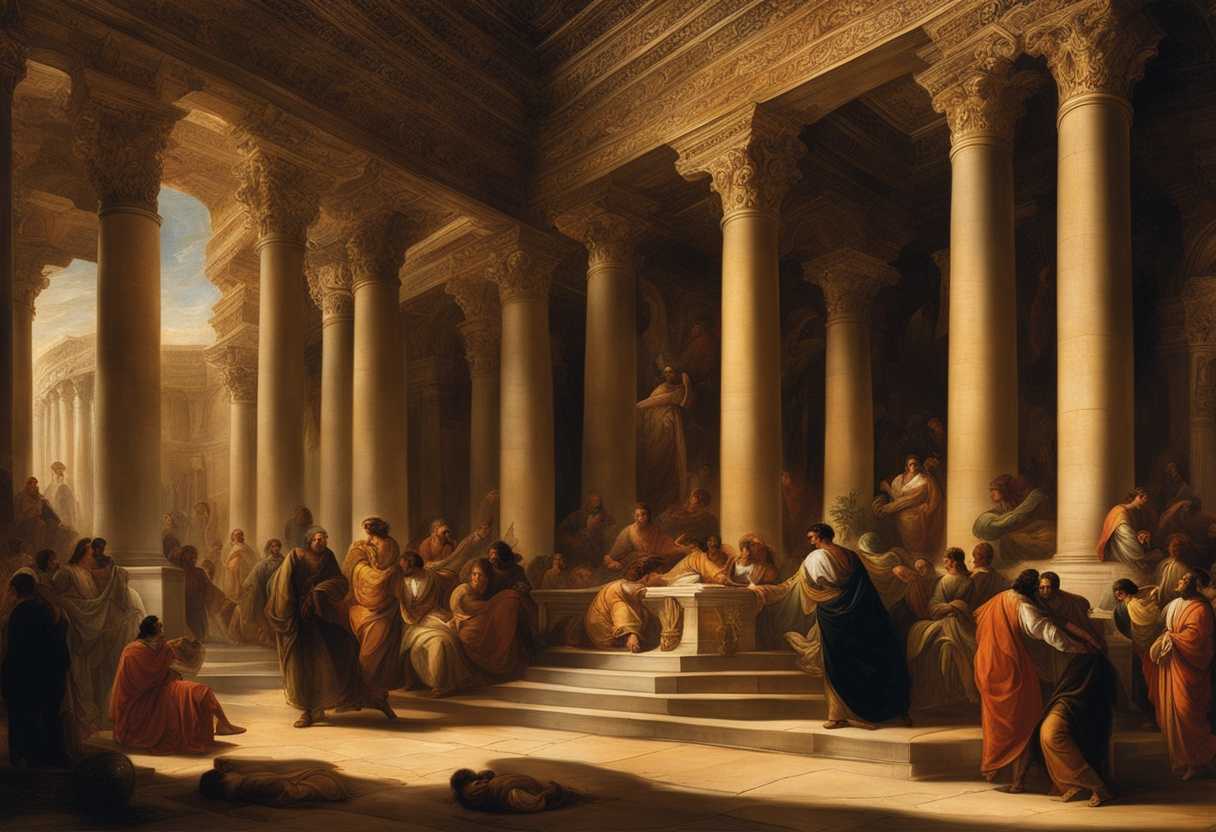
The True Meaning of 1 Kings 7
This chapter of 1 Kings was likely written by the prophet Jeremiah, who chronicled the reign of King Solomon and the construction of the temple in Jerusalem. Jeremiah was a prominent figure during this time, serving as a messenger of God and providing guidance to the Israelites. Skilled craftsmen brought Solomon’s vision to life by exploring the details of the temple’s construction in this chapter. We will also witness the dedication of the temple, a momentous occasion that solidified the Israelites’ relationship with their God.
The chapter’s descriptions echo the earlier accounts in 1 Kings 6, where we learned about the temple’s design and the materials used in its construction. The Israelites approached this sacred space with attention to detail and reverence, highlighting the specific features and furnishings that adorned this magnificent structure as we delve deeper. The temple’s completion marked a significant milestone in the history of the Israelite kingdom as we progress through the chapter, paving the way for the next phase of their spiritual and political journey.
1 Kings 7:1-12
-
The verses in 1 Kings 7:1-12 describe the construction of King Solomon’s palace complex after the completion of the Temple in Jerusalem. The focus is on Hiram, the king of Tyre, who sent craftsmen and materials to help build the palace for Solomon. The passage details the dimensions, materials, and craftsmanship involved in the construction of the buildings within the palace complex.
-
Hiram, the King of Tyre, provided craftsmen and materials for Solomon’s palace, highlighting the importance of collaboration and resources in achieving grand projects. Hiram’s assistance not only showcases international cooperation but also underscores the linkages between different kingdoms in the ancient world. It reminds us of the broader biblical theme of unity and working together towards common goals.
The detailed description of the construction of the palace complex emphasizes the opulence and grandeur associated with Solomon’s reign. It reflects the prosperity and splendor of Israel during this period. This narrative can serve as a reminder to readers about the fleeting nature of worldly riches and the importance of focusing on eternal values rather than material wealth. It also reflects on the wisdom and organizational skills of Solomon in managing such a monumental project. Hiram’s relationship with Solomon began when David, Solomon’s father, bonded with Hiram during his reign (2 Samuel 5:11) as we look deeper into the backstory. This historical context adds layers to the narrative, illustrating the continuity of alliances and friendships across generations. It also shows the importance of maintaining strong relationships with allies for the greater good and mutual benefit.
The attention to craftsmanship and detail in the construction process underlines the value of excellence and dedication in one’s work. This theme resonates throughout the Bible, emphasizing the importance of diligence, skill, and commitment in every task undertaken. It echoes the biblical exhortation in Colossians 3:23: “Whatever you do, work at it with all your heart, as working for the Lord, not for human masters.”
- Connection to other relevant verses:
- Proverbs 22:29: “Do you see someone skilled in their work? They will serve before kings; they will not serve before officials of low rank.” This verse aligns with the theme of craftsmanship and skill in the construction of Solomon’s palace.
- 1 Corinthians 3:10-15: This passage speaks about the importance of building on a foundation with care, using materials that will withstand testing. The construction of Solomon’s palace complex signifies the significance of building one’s life on a solid foundation of faith and excellence. 1 Kings 7:1-12 provides valuable insights into collaboration, craftsmanship, prosperity, and the pursuit of excellence in the context of King Solomon’s palace construction. It highlights the interconnectedness of kingdoms, the fleeting nature of material wealth, and the importance of diligence and skill in one’s work – all timeless messages that resonate with readers today.
1 Kings 7:13-22
- Section Breakdown:
- King Solomon sent for Hiram, a skilled craftsman from Tyre, whose mother was from the tribe of Naphtali and whose father was a Tyrian, to work on the bronze work for the temple.
- Hiram was highly skilled in working with bronze. He crafted two bronze pillars, each 18 cubits high and 12 cubits in circumference.
- On top of the pillars, Hiram made two capitals of molten bronze. Each capital was 5 cubits high and decorated with a network of pomegranates.
-
Hiram set the two pillars in the portico of the temple. The pillar on the south he named Jachin, and the one on the north he named Boaz.
-
Commentary:
- King Solomon commissions Hiram to work on the bronze work for the temple in this passage. Hiram’s mixed heritage is significant as it showcases how God can use people from different backgrounds and cultures to fulfill His purposes. This serves as a reminder that God’s work is for all people, regardless of their origins.
- The detailed description of the pillars and capitals emphasizes the grandeur and magnificence of Solomon’s temple. The meticulous craftsmanship required to create such ornate structures reflects the value placed on worshipping God with excellence and beauty. It shows that when we serve God, it should be done with the utmost care and skill.
- The symbolism behind the names of the two pillars is also significant. Jachin means “he establishes” and Boaz means “in Him is strength.” These names reflect the foundation and strength found in God. Our faith and reliance on God support us spiritually, just as these pillars support the temple physically. This mirrors the message in Psalm 62:2, “He only is my rock and my salvation; He is my defense; I shall not be greatly moved.”
- The placement of these pillars in the temple’s portico signifies their importance as they were the first structures encountered by those entering the sacred space. This reminds us of the significance of having strong foundations and being established in God as we approach Him in worship. It echoes the teaching in Matthew 7:24-25 about building our house (life) on the rock (God) so that it can withstand any storms that come. The account of Hiram and the bronze pillars in 1 Kings 7:13-22 illustrates the importance of skilled craftsmanship in worshiping God, the inclusion of people from diverse backgrounds in God’s work, and the symbolism of foundation and strength found in Him. It underscores the need for excellence in our service to God and the importance of relying on Him as our firm foundation.
1 Kings 7:23-26
- Section breakdown:
- Verse 23: “He made the Sea of cast metal, circular in shape, measuring ten cubits from rim to rim and five cubits high. It took a line of thirty cubits to measure around it.”
- Verse 24: “Below the rim, gourds encircled it—ten to a cubit. The gourds were cast in two rows in one piece with the Sea.”
- Verse 25: “The Sea stood on twelve bulls, three facing north, three facing west, three facing south and three facing east. The Sea rested on top of them, and their hindquarters were toward the center.”
-
Verse 26: “It was a handbreadth thick, and its rim was like the rim of a cup, like a lily blossom. It held two thousand baths.”
-
Commentary:
- The Sea of cast metal mentioned in these verses was a large basin located in the temple of Solomon. It was used for ceremonial washing and is often associated with purification and cleansing, symbolizing the purity required to approach God. The specific measurements and intricate details described here emphasize the precision and craftsmanship put into creating this essential element of the temple.
- The imagery of the gourds and bulls surrounding the Sea adds to the overall grandeur and symbolism of the temple. The bulls, placed strategically in the cardinal directions, could symbolize strength and stability, guarding the importance of the cleansing waters within the basin.
- The reference to the Sea holding two thousand baths highlights its capacity for water. This practical detail also serves as a reminder of the abundance and provision of God, as water was essential for life and ritual purification in the ancient world. This abundance mirrors God’s bountiful nature and care for His people.
- The description of the Sea’s rim resembling a lily blossom not only adds artistic beauty to the basin but also carries symbolic meaning. The lily is often associated with purity, renewal, and beauty in the Bible. This symbolic connection further emphasizes the importance of cleansing and spiritual purification associated with the temple rituals.
- Through these detailed descriptions of the construction of the temple, 1 Kings highlights the reverence and dedication that Solomon and his craftsmen had in creating a place of worship for God. It underscores the importance of offering our best to the Lord in all aspects of life, whether it be in constructing physical temples or living as temples of the Holy Spirit (1 Corinthians 6:19-20). The intricate details provided in 1 Kings 7:23-26 serve as a testament to the elaborate craftsmanship and symbolic significance of the temple elements, particularly the Sea of cast metal. These passages not only offer insights into the physical construction of the temple but also convey timeless messages about purity, provision, and devotion in serving God. We reflect on these verses, reminding us of the importance of approaching God with reverence, offering our best in worship, and seeking purification through His grace and forgiveness.
1 Kings 7:27-39
- Breakdown of the verse into important sections:
- Verse 27: “And he made ten bases of bronze; four cubits was the length of one base and four cubits its width and three cubits its height.”
- Verse 28: “The work of the bases was on this manner: they had borders, and the borders were between the ledges.”
- Verse 29: “And on the borders that were between the ledges were lions, oxen, and cherubim; and on the ledges there was a pedestal above, and beneath the lions and oxen were wreaths of hanging work.”
- Verse 30: “And every base had four bronze wheels and axles of bronze, and at the four corners were supports for a laver. The supports were cast, and there were wreaths at the side of each.”
- Verse 31: “And the mouth of it within the capital and above was a cubit; but the mouth was round after the work of the base, a cubit and a half; and also upon the mouth of it were engravings with their borders, foursquare, not round.”
- Verses 32-34: Further details about the construction of the bases, including the engravings and the panels.
-
Verses 35-39: Description of the vessels that were set on the bases, the pots, shovels, and bowls, all made of bronze. The construction of these vessels mirrors the craftsmanship of the bases.
-
The verses in 1 Kings 7 focus on the intricate craftsmanship and details surrounding the construction of the ten bases of bronze in Solomon’s temple. The bases were not merely functional but were also adorned with artistic elements that reflected the glory and grandeur of the temple. The inclusion of lions, oxen, and cherubim in the design of the bases aligns with the imagery commonly associated with the grandeur of the temple and the presence of God.
The detailed description of the construction highlights the meticulousness and dedication with which the temple was built. Every aspect of the bases, from their dimensions to the intricate engravings, was carefully planned and executed. This emphasis on craftsmanship and attention to detail serves as a reminder of the importance of offering our best to God in all that we do.
The mention of the vessels placed on the bases, such as the pots, shovels, and bowls, underscores the practical purpose of these intricate bases. These vessels were essential for the sacrificial rituals performed in the temple, representing the obedience and worship of the people. Every individual has a unique role to play in God’s kingdom, just as each element in the temple had a specific function.
Furthermore, these verses symbolize the unity and harmony in the temple construction. Different elements, such as the bases and vessels, worked together to fulfill a common purpose – the worship of God. This unity echoes the biblical theme of the body of Christ, where each member has a vital role to play in the overall functioning of the church (1 Corinthians 12:12-27). These verses from 1 Kings 7 overall serve as a testament to the importance of excellence in serving and worshiping God. They remind us that our offerings to God, whether tangible or intangible, should reflect our reverence and dedication to Him. God deserves our best, and when we present our talents and gifts with excellence, we honor and glorify Him.
1 Kings 7:40-47
The detailed description of the furnishing of King Solomon’s magnificent temple is presented in 1 Kings 7:40-47. Let’s break down this verse into important sections for a thorough analysis.
Starting with verse 40, it mentions the two pillars that King Solomon had commissioned for the temple, named Jachin and Boaz. These pillars were not only decorative but also had symbolic significance. Jachin means “he will establish” and Boaz means “in him is strength.” Together, they represented the idea of God’s establishment and strength being present in the temple. This symbolism emphasizes the importance of faith and reliance on God in all things.
Moving on to verses 41-42, we see a detailed description of the tops of the pillars adorned with lily work, pomegranates, and chains. These intricate decorations added to the grandeur of the temple and demonstrated the meticulous craftsmanship involved in its construction. This attention to detail reflects the idea of offering our best to God and honoring Him with excellence, which is a timeless message for believers in presenting their work and offerings to God with a spirit of excellence.
Next, in verses 43-45, we encounter the Sea, a large basin supported by twelve oxen, facing different directions, representing the twelve tribes of Israel. This Sea was used for the priests to ritually cleanse themselves, highlighting the importance of purity before approaching God. This symbolizes the need for spiritual cleansing and the significance of being consecrated before serving in God’s presence. This practice of purification is also seen in the New Testament when Jesus washed the feet of His disciples as a symbol of cleansing and humility (John 13:1-17). We learn about all the utensils that were crafted for the temple in the final section, verses 46-47. These items were made of pure gold because of the value and sacredness associated with the temple and its services. The mention of the golden altar and tables for the bread of the Presence reminds us of the significance of worship and the sustenance provided by God. Believers today are reminded of their reliance on God for their spiritual nourishment, as Jesus referred to Himself as the “bread of life” in John 6:35, just as the Israelites relied on the bread of the Presence for physical nourishment. The detailed description of King Solomon’s temple furnishing in 1 Kings 7:40-47 serves as a reminder of the importance of faith, excellence, purity, and reliance on God in worship and service. The symbolism and craftsmanship displayed in the temple reflect the reverence and honor due to God in all aspects of our lives, both in the Old Testament and for believers today.
1 Kings 7:48-51
- “Solomon also made all the furnishings that were in the Lord’s temple: the golden altar; the golden table on which was the Bread of the Presence; the lampstands of pure gold with their lamps, to burn in front of the inner sanctuary as prescribed; the gold floral work and lamps and tongs; the pure gold basins, wick trimmers, sprinkling bowls, dishes and censers; and the gold sockets for the doors of the innermost room, the Most Holy Place, and also for the doors of the main hall of the temple. Solomon, under God’s guidance, created a detailed account of the furnishings for the Lord’s temple in this passage from 1 Kings 7. These items were meticulously crafted and designed with the most precious materials, emphasizing the importance and grandeur of the temple. The dedication to craftsmanship and attention to detail reflect the reverence and honor Solomon held for the Lord’s dwelling place.
The mention of the golden altar, table of the Bread of the Presence, lampstands, and various other golden items highlights the opulence of the temple and its significance in the worship of the Israelites. These items were not only practical tools for the temple rituals but also symbolic representations of the presence of God among His people.
Solomon’s construction of these furnishings demonstrates his obedience to God’s instructions and his commitment to honoring God in all aspects of his reign. It serves as a reminder for believers to dedicate their best efforts and resources to worship and serve the Lord wholeheartedly, just as Solomon did in the building of the temple.
This passage also underscores the importance of reverence and respect in approaching God. The meticulous care taken in crafting these sacred items serves as a lesson for believers to approach God with humility, awe, and a sincere heart. It reminds us that our worship and service to God should be marked by excellence and a deep sense of devotion, mirroring Solomon’s commitment to glorify God in the temple.
Reference to Exodus 25:10-22, where God instructs Moses on the design and construction of the Ark of the Covenant, serves as a parallel to Solomon’s work. Both narratives highlight the importance of God’s presence among His people and the care taken in creating sacred objects for worship. This continuity in the importance of divine presence and reverence underscores the timeless message of honoring and worshiping God with excellence and obedience.
After 1 Kings 7
The Lord had blessed Solomon with great wisdom and wealth. He had built the magnificent temple in Jerusalem, a testament to the glory of God. Yet, as the chapter came to a close, a shadow loomed over the kingdom. For in the years to come, the people would be tested, their faith challenged, and the very foundations of the kingdom would be shaken. The next chapter would reveal the consequences of Solomon’s choices, and the people would be forced to confront the reality of their own hearts. I, as the reverend, knew it was my duty to guide the flock through the trials that lay ahead and to remind them that even in the darkest of times, the light of the Lord would never be extinguished.

Reverend Michael Johnson is an experienced Church Minister with a profound expertise in spirituality and guidance. With a serene presence and a compassionate heart, he has faithfully served his congregation for over 20 years, leading them on a spiritual journey towards inner peace and enlightenment. Reverend Johnson’s extensive knowledge of religious philosophies and profound understanding of human nature have made him a trusted confidant and mentor to many, as he seamlessly weaves his profound wisdom into life teachings. Reverend Johnson’s calming demeanor and empathetic nature continue to uplift and heal souls, nurturing a sense of unity and tranquility within his community.