
1 And when Solomon had finished building the house of the Lord and the king’s house and all that Solomon desired to build,
2 that the Lord appeared to Solomon a second time, as he had appeared to him at Gibeon.
3 And the Lord said to him, “I have heard your prayer and your plea, which you have made before me. I have consecrated this house that you have built, by putting my name there forever. My eyes and my heart will be there for all time.
4 And as for you, if you will walk before me, as David your father walked, with integrity of heart and uprightness, doing according to all that I have commanded you, and keeping my statutes and my rules,
5 then I will establish your royal throne over Israel forever, as I promised David your father, saying, ‘You shall not lack a man on the throne of Israel.’
6 But if you turn aside from following me, you or your children, and do not keep my commandments and my statutes that I have set before you, but go and serve other gods and worship them,
7 then I will cut off Israel from the land that I have given them, and the house that I have consecrated for my name I will cast out of my sight, and Israel will become a proverb and a byword among all peoples.
8 And this house will become a heap of ruins. Everyone passing by it will be astonished and will hiss, and they will say, ‘Why has the Lord done thus to this land and to this house?’
9 Then they will say, ‘Because they abandoned the Lord their God who brought their fathers out of the land of Egypt and laid hold on other gods and worshiped them and served them. Therefore the Lord has brought all this disaster on them.’
10 At the end of twenty years, in which Solomon had built the two houses, the house of the Lord and the king’s house,
11 (The king supplied Solomon with cedar and cypress timber.)
12 But Hiram went from Tyre to see the cities that Solomon had given him, and they did not please him.
13 And King Solomon drafted forced labor out of all Israel, and the draft numbered 30,000 men.
14 And Hiram sent to the king 120 talents of gold.
15 And this is the account of the forced labor that King Solomon drafted to build the house of the Lord and his own house and the Millo and the wall of Jerusalem and Hazor and Megiddo and Gezer.
16 (But Pharaoh king of Egypt had gone up and captured Gezer and burned it with fire, and had killed the Canaanites who lived in the city, and had given it as dowry to his daughter, Solomon’s wife.)
17 And Solomon rebuilt Gezer and Lower Beth-horon,
18 as well as Baalath and Tamar in the wilderness, in the land of Judah,
19 All the storage cities that Solomon had, cities for his chariots and cities for his horsemen, and whatever Solomon desired to build in Jerusalem, in Lebanon, and in all the land of his dominion.
20 All the people who were left of the Amorites, the Hittites, the Perizzites, the Hivites, and the Jebusites, who were not of the people of Israel—
21 their descendants who were left after them in the land, whom the people of Israel were unable to devote to destruction—these Solomon drafted to be slaves, and so they are to this day.
22 But of the people of Israel Solomon made no slaves. They were the soldiers, they were his officials, his commanders, his captains, his chariot commanders and his horsemen.
23 These were the chief officers who were over Solomon’s work: 550 who had charge of the people who carried on the work.
24 But Pharaoh’s daughter went up from the city of David to her own house that Solomon had built for her. Then he built the Millo.
25 Three times a year Solomon used to offer up burnt offerings and peace offerings on the altar that he built to the Lord, making offerings with it before the Lord. So he finished the house.
26 And King Solomon built a fleet of ships at Ezion-geber, which is near Eloth on the shore of the Red Sea, in the land of Edom.
27 And Hiram sent with the fleet his servants, seamen who were familiar with the sea, together with the servants of Solomon.
28 And they went to Ophir and brought from there gold, 420 talents, and they brought it to King Solomon.
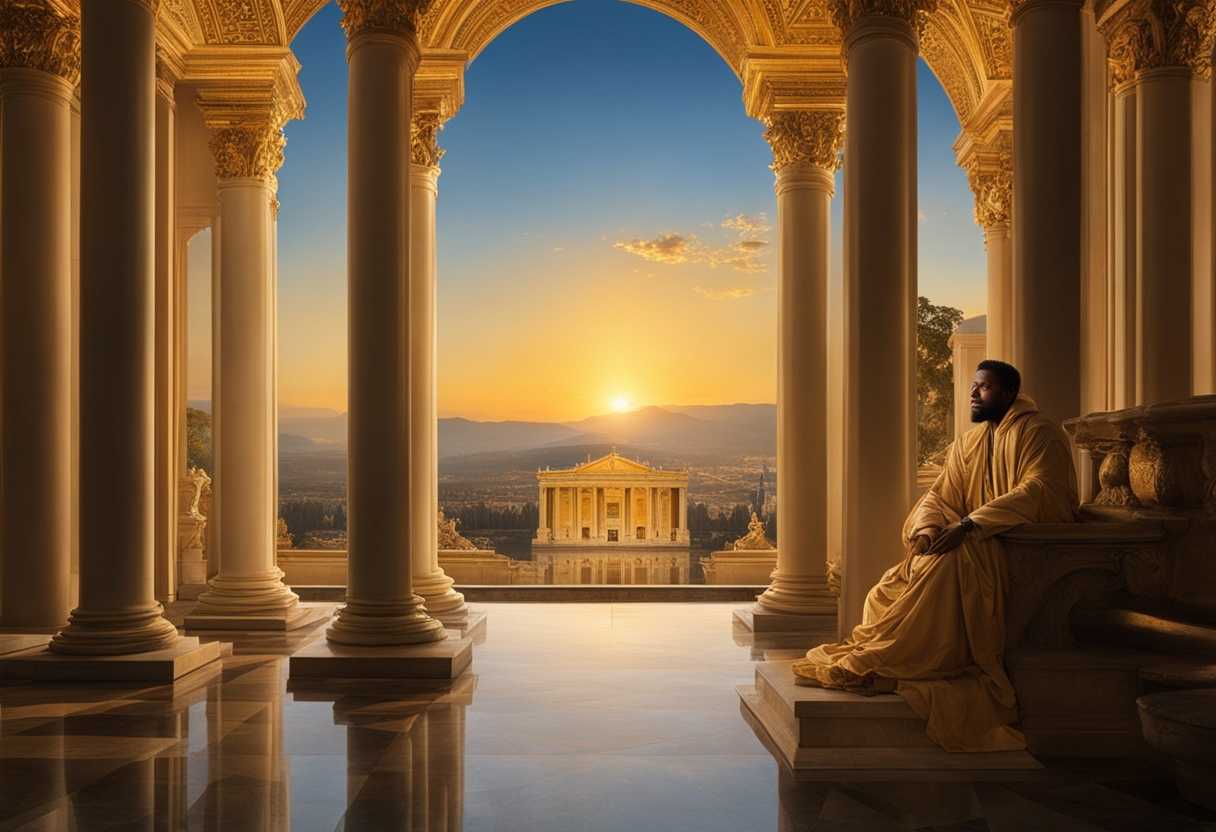
The True Meaning of 1 Kings 9
This chapter of 1 Kings provides insight into the later years of King Solomon’s reign over the united kingdom of Israel. God appears to Solomon a second time, reaffirming the covenant and issuing both promises and warnings, as the author, likely a scribe or prophet close to the royal court, recounts.
The chapter opens with God’s response to Solomon’s prayer at the dedication of the temple in Jerusalem. God declares that he has heard Solomon’s plea and will establish his throne forever, provided that Solomon and his descendants remain faithful to the Lord. However, the passage also foreshadows the eventual division of the kingdom, cautioning that disobedience will result in the exile of the people from the land.
Throughout the chapter, we see echoes of God’s earlier covenants with Abraham, Moses, and David. The Lord’s commitment to the Davidic dynasty is reiterated, just as his warnings about the consequences of unfaithfulness resonate with the themes of Deuteronomy. We will witness the unfolding of these divine promises and threats, shaping the trajectory of Israel’s history as we move forward.
1 Kings 9:1-9
- Verse Breakdown:
- 1 Kings 9:1-2: “When Solomon had finished building the temple of the Lord and the royal palace, and had achieved all he had desired to do, the Lord appeared to him a second time, as he had appeared to him at Gibeon.”
- 1 Kings 9:3-5: “The Lord said to him: ‘I have heard the prayer and plea you have made before me; I have consecrated this temple, which you have built, by putting my Name there forever. My eyes and my heart will always be there. If you walk before me faithfully with integrity of heart and uprightness, do all I command, observe my decrees and laws, I will establish your royal throne over Israel forever.’”
-
1 Kings 9:6-9: “But if you or your descendants turn away from me and do not observe the commands and decrees I have given you and go off to serve other gods and worship them, then I will cut off Israel from the land I have given them and will reject this temple I have consecrated for my Name. Israel will then become a byword and an object of ridicule among all peoples. This temple will become a heap of rubble.”
-
Solomon’s great achievement in building the temple of the Lord and his own palace culminates in the first two verses. The appearance of the Lord to Solomon for the second time signifies the importance of this moment. It shows that God acknowledges and rewards Solomon’s dedication and effort in building a place of worship for Him. This event underscores the significance of honoring God with our best and how He responds to our acts of faith and obedience.
-
The following verses highlight the covenant God establishes with Solomon. God reiterates His promise to bless Solomon and his descendants if they remain faithful to Him, walking in integrity and obedience like David did. This reaffirms the principle of obedience and faithfulness in maintaining a close relationship with God. The mention of David’s faithfulness serves as a reminder of the importance of following God wholeheartedly.
-
However, the subsequent verses also provide a stark warning about the consequences of turning away from God. The conditional nature of the covenant is laid bare, indicating that disobedience and worship of other gods will lead to severe repercussions, including the exile of Israel and the ruin of the temple. This serves as a cautionary tale about the dangers of idolatry and the importance of staying true to God’s commands. It underscores the concept of divine discipline and the accountability we have in our relationship with God.
-
Relevance of Other Verses:
- Proverbs 3:5-6 emphasizes the theme of trust and obedience to God, which is vital in maintaining a relationship with Him, similar to the requirement outlined in God’s covenant with Solomon.
- Deuteronomy 8:19-20 contains warnings about forgetting the Lord and following other gods, echoing the consequences mentioned in 1 Kings 9 if Israel turns away from God.
- Psalm 119:1-8 reflects the idea of walking in God’s ways and obeying His commandments, which aligns with the conditions set forth in the covenant with Solomon.
1 Kings 9:10-14
The verses in 1 Kings 9:10-14 discuss the events that occurred after King Solomon finished building the house of the Lord, the royal palace, and all that he desired to build. These verses detail how King Solomon gave twenty cities in the land of Galilee to Hiram, the king of Tyre, as a gift to thank him for the assistance he provided in supplying cedar and cypress wood for the construction projects.
Firstly, it is important to note the significance of the completion of the temple and royal palace. These grand structures symbolized the fulfillment of God’s promise to David regarding the building of a house for the Lord (2 Samuel 7). The construction of the temple represented a physical dwelling place for God among His people, a central place for worship and sacrifice as prescribed in the Mosaic Law.
The act of King Solomon giving twenty cities in the land of Galilee to King Hiram of Tyre highlights the strategic alliances and diplomatic relationships that were common during this time. King Hiram had been a key ally to Solomon, providing not only materials but also skilled labor for the construction projects. Solomon was not only showing gratitude but also solidifying a strong bond between their kingdoms by giving these cities to Hiram. This act of generosity and political savvy was aimed at maintaining peace and fostering good relations with neighboring nations.
Furthermore, these verses serve as a reminder of the importance of honoring commitments and showing gratitude for the help and support received. Believers are called to show kindness, generosity, and appreciation towards others as a reflection of God’s love and grace. Jesus himself emphasized the principle of giving and generosity in Luke 6:38, “Give, and it will be given to you. A good measure, pressed down, shaken together and running over, will be poured into your lap. For with the measure you use, it will be measured to you. 1 Kings 9:10-14 recounts a historical event during King Solomon’s reign and conveys timeless messages about honoring commitments, showing gratitude, and the importance of maintaining positive relationships with others. It demonstrates the significance of wise leadership, diplomacy, and the impact of generosity in building and maintaining alliances.
1 Kings 9:15-19
King Solomon imposed forced labor on the remnants of the Canaanite people left in the land after the conquest under Joshua’s leadership, as discussed in 1 Kings 9:15-19. Solomon used these people for forced labor to complete various building projects, including the construction of the Temple, his own palace, the terraces, walls of Jerusalem, Hazor, Megiddo, and Gezer.
This section raises ethical and moral questions about the use of forced labor, as it goes against the principles of treating others with kindness and respect. While Solomon’s reign was known for its wisdom and grandeur, it was also marked by the heavy burden placed on the people who were forced into labor. This highlights how even great leaders can sometimes stray from God’s ways and exploit others for their own gain.
The presence of forced labor in Solomon’s reign also serves as a cautionary tale about the dangers of compromising one’s values and principles in pursuit of power or wealth. Despite his initial wisdom and favor with God, Solomon’s later years were tainted by his accumulation of wives, wealth, and military power, leading to his downfall and the eventual division of the kingdom after his death. This section in the broader context of the Bible serves as a reminder of the importance of justice, compassion, and fairness in how we treat others. It echoes themes found throughout the Bible about God’s concern for the oppressed and marginalized, and the call for leaders to govern with righteousness and humility. Verses such as Proverbs 14:31 (“Whoever oppresses the poor shows contempt for their Maker, but whoever is kind to the needy honors God”) reinforce the idea that God values how we treat others, especially those who are vulnerable or in need of help.
1 Kings 9:20-23
Solomon left the Canaanite inhabitants in the land of Israel after finishing building the Temple of the Lord, the royal palace, and various other structures, as discussed in 1 Kings 9:20-23. These Canaanites were remnants of the people whom the Israelites were originally commanded to drive out completely to avoid being influenced by their idolatrous practices and to prevent intermarriage which would lead them away from the worship of the one true God.
Solomon, despite his wisdom, failed to completely follow through on God’s command to remove all the Canaanites from the land. Instead, he used some of them as forced labor to support his building projects, thereby compromising the exclusivity of worship to the God of Israel. This act of allowing the Canaanites to remain in the land eventually led to their influence infecting the Israelites with idolatry, leading them away from God.
This passage serves as a cautionary tale about the dangers of compromise and disobedience to God’s commands. It highlights the consequences of not fully obeying God’s laws and the impact it can have on future generations. Despite Solomon’s great wisdom, his decision to keep the Canaanites around eventually contributed to the downfall of Israel and the division of the kingdom after his reign.
This account also echoes the broader theme found throughout the Bible of the importance of obedience and faithfulness to God’s commands. God commanded the Israelites in Deuteronomy 7:2-4 to completely destroy the Canaanite nations and not make covenants with them or intermarry. This was to ensure the purity of worship and the preservation of their faith. Solomon’s actions in this passage serve as a stark reminder of the consequences that can arise from compromising on God’s instructions.
1 Kings 9:24-28
Azariah, the son of Nathan, is the focus in 1 Kings 9:24-28 as one of King Solomon’s chief officials. This passage details the organization of the workforce that King Solomon had for various monumental construction projects such as the temple of the Lord, his own palace, the supporting terraces, the wall of Jerusalem, Hazor, Megiddo, and Gezer. Azariah was responsible for overseeing the labor force that worked on these projects.
Azariah’s role as Solomon’s chief official is significant as it highlights the importance of leadership and delegation in the successful completion of massive undertakings. Solomon’s wisdom in appointing capable leaders like Azariah is evident here, showing that even the most wise and wealthy ruler needs a competent team to bring his visions to fruition. This serves as a reminder to leaders of the importance of surrounding themselves with trustworthy and capable individuals to achieve success.
Furthermore, the mention of the cities Hazor, Megiddo, and Gezer in this passage is notable due to their historical and biblical significance. These cities were major strategic locations in ancient Israel and were key to controlling important trade routes. The fact that Solomon was involved in fortifying these cities emphasizes his desire to secure his kingdom and protect it from potential invaders. It also showcases his strategic vision and commitment to ensuring the safety and prosperity of his people, which is a trait of a good and wise ruler.
This passage also echoes 1 Kings 5:13-18, where Solomon conscripted laborers from all Israel to work on the temple and his palace, demonstrating his ability to mobilize resources for large-scale construction projects. Additionally, it is a testament to Solomon’s commitment to honoring God through the building of the temple, as fulfilling this task was a central part of his reign and legacy. 1 Kings 9:24-28 highlights the importance of competent leadership, strategic planning, and diligence in carrying out monumental projects in Solomon’s kingdom’s organizational structure. It offers timeless lessons on effective leadership, the value of teamwork, and the significance of honoring God through our actions and endeavors.
After 1 Kings 9
The Lord had fulfilled his promise to David and established Solomon’s kingdom. But the true test of Solomon’s reign was yet to come. The Lord warned Solomon that his obedience would determine the fate of his dynasty as the chapter drew to a close. If Solomon and his descendants remained faithful, the throne would be theirs forever. But if they turned away, the kingdom would be torn from their grasp. The stage was set for the next chapter, where Solomon’s wisdom and devotion would be put to the ultimate test.

Reverend Michael Johnson is an experienced Church Minister with a profound expertise in spirituality and guidance. With a serene presence and a compassionate heart, he has faithfully served his congregation for over 20 years, leading them on a spiritual journey towards inner peace and enlightenment. Reverend Johnson’s extensive knowledge of religious philosophies and profound understanding of human nature have made him a trusted confidant and mentor to many, as he seamlessly weaves his profound wisdom into life teachings. Reverend Johnson’s calming demeanor and empathetic nature continue to uplift and heal souls, nurturing a sense of unity and tranquility within his community.