
1 There was a certain man of Ramathaim-zophim of the hill country of Ephraim whose name was Elkanah the son of Jeroham, son of Elihu, son of Tohu, son of Zuph, an Ephrathite.
2 He had two wives. The name of the one was Hannah, and the name of the other, Peninnah. And Peninnah had children, but Hannah had no children.
3 Now this man used to go up year by year from his city to worship and to sacrifice to the Lord of hosts at Shiloh, where the two sons of Eli, Hophni and Phinehas, were priests of the Lord.
4 On the day when Elkanah sacrificed, he would give portions to Peninnah his wife and to all her sons and daughters.
5 But to Hannah he gave a double portion, because he loved her, though the Lord had closed her womb.
6 And her rival used to provoke her grievously to irritate her, because the Lord had closed her womb.
7 So it went on year by year. As often as she went up to the house of the Lord, she used to provoke her. So Hannah wept and would not eat.
8 And Elkanah, her husband, said to her, “Hannah, why do you weep? And why do you not eat? And why is your heart sad? Am I not more to you than ten sons?”
9 After they had eaten and drunk in Shiloh, Hannah rose. Now Eli the priest was sitting on the seat beside the doorpost of the temple of the Lord.
10 She was deeply distressed and prayed to the Lord and wept bitterly.
11 And she vowed a vow and said, “O Lord of hosts, if you will indeed look on the affliction of your servant and remember me and not forget your servant, but will give to your servant a son, then I will give him to the Lord all the days of his life, and no razor shall touch his head.”
12 As she continued praying before the Lord, Eli observed her mouth.
13 Hannah was speaking in her heart; only her lips moved, and her voice was not heard. Therefore Eli took her to be a drunken woman.
14 And Eli said to her, “How long will you go on being drunk? Put your wine away from you.”
15 But Hannah answered, “No, my lord, I am a woman troubled in spirit. I have drunk neither wine nor strong drink, but I have been pouring out my soul before the Lord.
16 Do not regard your servant as a worthless woman, for all along I have been speaking out of my great anxiety and vexation.”
17 Then Eli answered, “Go in peace, and the God of Israel grant your petition that you have made to him.”
18 And she said, “Let your servant find favor in your eyes.” Then the woman went her way and ate, and her face was no longer sad.
19 They rose early in the morning and worshiped before the Lord; then they went back to their house at Ramah. And Elkanah knew Hannah his wife, and the Lord remembered her.
20 And in due time Hannah conceived and bore a son, and she called his name Samuel, for she said, “I have asked for him from the Lord.”
21 The man Elkanah and all his house went up to offer to the Lord the yearly sacrifice and to pay his vow.
22 But Hannah did not go up, for she said to her husband, “As soon as the child is weaned, I will bring him, so that he may appear in the presence of the Lord and dwell there forever.”
23 And Elkanah her husband said to her, “Do what seems best to you; wait until you have weaned him; only, may the Lord establish his word.” So the woman remained and nursed her son until she weaned him.
24 And when she had weaned him, she took him up with her, along with a three-year-old bull, an ephah of flour, and a skin of wine, and she brought him to the house of the Lord at Shiloh. And the child was young.
25 Then they slaughtered the bull, and they brought the child to Eli.
26 And she said, “Oh, my lord! As you live, my lord, I am the woman who was standing here in your presence, praying to the Lord.
27 For this child I prayed, and the Lord has granted me my petition that I made to him.
28 Therefore I have lent him to the Lord. As long as he lives, he is lent to the Lord.” And he worshiped the Lord there.
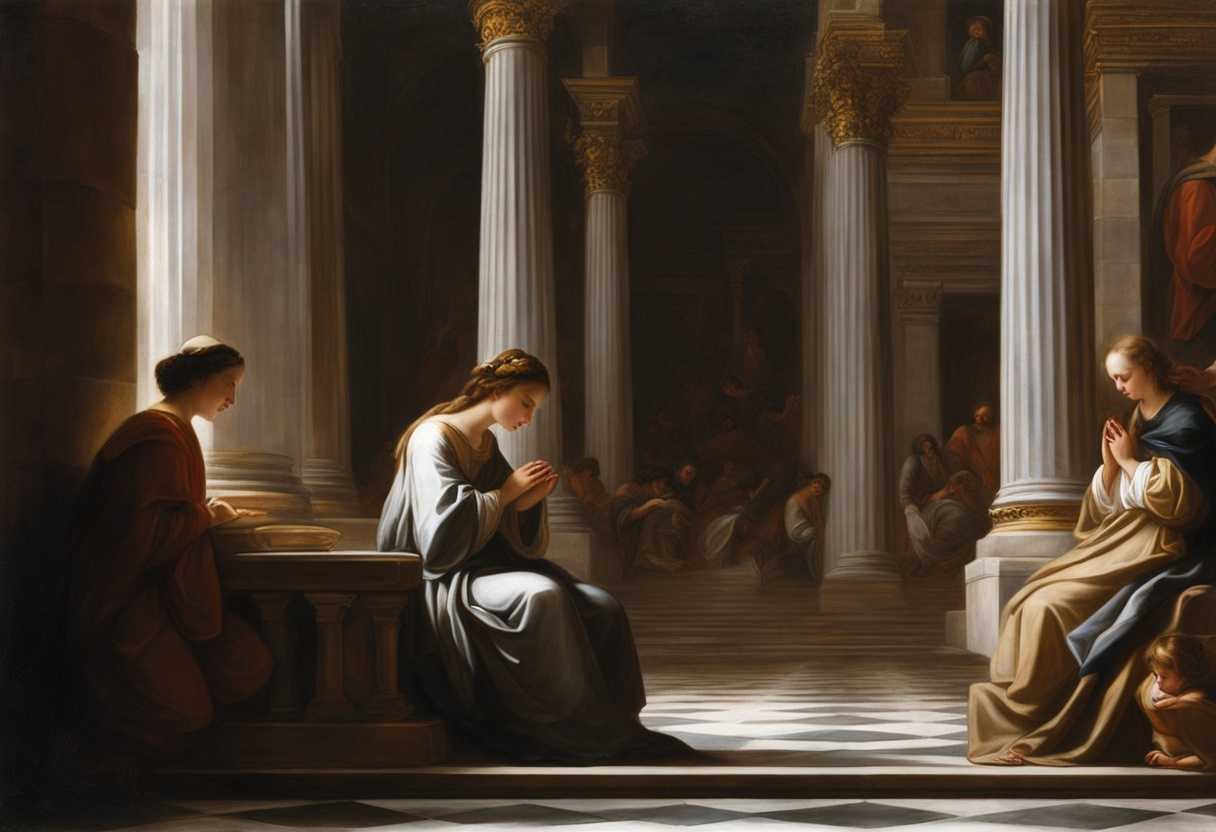
The True Meaning of 1 Samuel 1
The book of 1 Samuel was written by the prophet Samuel, who played a crucial role in the transition from the era of the judges to the establishment of the monarchy in ancient Israel. Hannah, a devout woman who faces the challenge of childlessness, a common struggle in the biblical narrative, is introduced in this chapter. As we delve into this passage, we will witness Hannah’s fervent prayer, the birth of her son Samuel, and the profound impact this child will have on the course of Israel’s history.
Hannah’s story is a testament to the power of faith and the transformative nature of God’s intervention. Her heartfelt plea for a child, as recorded in 1 Samuel 1:11, echoes the cries of many women in the Bible, such as Sarah in Genesis 18:10-14 and Rachel in Genesis 30:1-2. These narratives remind us that even in the face of seemingly insurmountable obstacles, God’s plan often unfolds in unexpected ways, bringing hope and redemption to those who trust in Him.
The birth of Samuel, as described in 1 Samuel 1:19-20, marks a significant turning point in the history of Israel. This child, dedicated to the Lord from the womb, will grow to become a prophet, judge, and kingmaker, playing a pivotal role in the establishment of the monarchy under Saul and David. His life and ministry will shape the course of Israel’s future, as we will see in the subsequent chapters of this book.
1 Samuel 1:1-8
The story of a man named Elkanah who lived in Ramathaim-zophim in the hill country of Ephraim is introduced to us in 1 Samuel 1:1-8. Elkanah had two wives, Hannah and Peninnah. Peninnah had children, but Hannah was barren and unable to have children. This detail sets the stage for the emotional struggle that Hannah experiences throughout this passage.
Elkanah would go up to the tabernacle in Shiloh every year to worship and sacrifice to the Lord Almighty, and he would provide portions for Peninnah and her children. Even though Elkanah loved Hannah, her barrenness caused her deep distress, especially because Peninnah would provoke and taunt her about her inability to have children. This situation highlights the pain and shame that Hannah felt in a society where a woman’s worth was often measured by her ability to bear children.
Hannah’s distress and sadness are palpable in these verses as she is reduced to tears and unable to eat. Elkanah, despite his love for her, was not able to fully understand her pain, which is evident when he questions her, “Why are you crying? Why aren’t you eating? Why are you so downhearted?” This lack of understanding from a loved one adds to Hannah’s burden and isolation in her struggle with infertility.
Hannah’s story is one of resilience and faith in the midst of deep suffering. Despite her pain and the harsh treatment from Peninnah, Hannah turns to the Lord in prayer. She pours out her heart before God, making a vow that if He gives her a son, she will dedicate him to the Lord for his entire life, as a Nazirite. This act of surrender and devotion demonstrates Hannah’s deep faith and trust in God’s ability to intervene in her situation. As we delve into the narrative of Hannah in these verses, we witness the power of prayer, the weight of emotional burdens, and the importance of faith in the face of trials. Hannah’s story serves as a reminder that God sees our pain and hears our prayers, even in our most desperate moments. Through her example, we are encouraged to pour out our hearts before the Lord, trusting in His faithfulness and sovereignty over our lives.
This passage sets the stage for the miraculous birth of Samuel, who would become a significant figure in Israel’s history as a prophet and judge. It also foreshadows themes of redemption and God’s ability to bring hope out of despair, which resonate throughout the biblical narrative. Hannah’s story reminds us that even in our darkest moments, God is at work behind the scenes, orchestrating His plans for our good and His glory.
1 Samuel 1:9-18
Hannah, the wife of Elkanah, goes to the Tabernacle to pour out her heart to the Lord in prayer in 1 Samuel 1:9-18. This section is emotionally charged as Hannah’s deep desire for a child is laid bare before God. The text describes her as deeply distressed, weeping bitterly, and praying in anguish. This raw and heartfelt prayer showcases Hannah’s faith and dependence on God despite her difficult circumstances.
Hannah’s prayer is an example of complete surrender and trust in God’s sovereignty. She makes a vow to the Lord that if He grants her a male child, she will dedicate him to the service of the Lord all the days of his life. This vow shows Hannah’s willingness to sacrifice her greatest desire for the sake of God’s purposes. It also reflects the importance of keeping promises made to God, even in challenging circumstances.
The priest Eli initially mistakes Hannah’s fervent prayer for drunkenness, showcasing his lack of discernment. However, once Hannah explains her situation, Eli blesses her and acknowledges her faith. This interaction demonstrates the importance of not being quick to judge others based on appearances and the value of compassion and understanding in our interactions with one another.
Hannah’s story in 1 Samuel 1 is a powerful testament to God’s faithfulness and his ability to fulfill the desires of our hearts in His perfect timing. Despite years of barrenness and societal pressure, Hannah remains steadfast in her faith and eventually conceives and gives birth to Samuel, who becomes a great prophet and leader in Israel. Hannah’s story highlights the theme of God’s provision and the blessings that come from trusting in Him wholeheartedly.
This passage in 1 Samuel 1 sets the stage for God’s miraculous work in Hannah’s life and foreshadows the significant role that Samuel will play in Israel’s history. It also emphasizes the power of prayer and the importance of pouring out our deepest desires and struggles before the Lord. Hannah’s faith and persistence in prayer serve as an inspiration for believers to seek God earnestly and trust in His plans, even when faced with seemingly insurmountable challenges.
When we consider Hannah’s prayer in light of other verses in the Bible, we see parallels to the persistence and faith exhibited by characters like Abraham and the widow in Luke 18:1-8. These examples remind us of the importance of persevering in prayer and trusting in God’s faithfulness, even when circumstances seem dire. Hannah’s story is a reminder that God hears the cries of His people and is faithful to answer according to His will.
1 Samuel 1:19-20
Hannah, a devout woman who had been barren, experiences a pivotal moment in her life in 1 Samuel 1:19-20. This passage narrates how Hannah finally conceives and gives birth to a son after years of fervent prayer and supplication to the Lord. The specific section reads: “Early the next morning they arose and worshiped before the Lord and then went back to their home at Ramah. Elkanah made love to his wife Hannah, and the Lord remembered her. So in the course of time Hannah became pregnant and gave birth to a son. She named him Samuel, saying, ‘Because I asked the Lord for him.’”
The significance of this passage lies in several key themes. Firstly, it emphasizes the power of prayer and faith. Hannah’s unwavering trust in God’s faithfulness eventually leads to her miraculous conception. This serves as a timeless reminder that God hears the cries of His people and responds to their prayers in His perfect timing. It showcases how God can turn seemingly impossible situations into moments of divine intervention and blessing. Samuel’s naming holds symbolic meaning. The name “Samuel” means “name of God” or “heard by God,” reflecting Hannah’s acknowledgment of God’s response to her prayers. Samuel will go on to become one of the most significant prophets and leaders in Israelite history, playing a crucial role in anointing both Saul and David as kings. His life exemplifies obedience to God and prophetic ministry, illustrating the profound impact one individual can have when they are devoted to serving the Lord.
This passage also sets the stage for the rest of the book of 1 Samuel, as it introduces the central figure of Samuel and highlights God’s sovereignty in raising up leaders for His people. It lays the foundation for the transition from the period of the judges to the establishment of the monarchy in Israel. The birth of Samuel marks the beginning of a new era for Israel, characterized by prophetic guidance and divine leadership. The story of Hannah and Samuel parallels the theme of barrenness and blessing found throughout the Bible in a broader context. It echoes the narratives of Sarah, Rebekah, Rachel, and Elizabeth, all of whom experienced miraculous conceptions after periods of barrenness. These instances serve as reminders of God’s power to bring forth life and fulfillment in the midst of barrenness and despair. They point to the ultimate fulfillment of God’s promises through the birth of Jesus Christ, who brings salvation and hope to all who believe. Themes of faith, prayer, divine intervention, and the fulfillment of God’s promises are encapsulated in 1 Samuel 1:19-20. It serves as a foundational moment in the lives of Hannah and Samuel, setting the stage for the unfolding of God’s redemptive plan for His people. God encourages us as readers to trust in His faithfulness, knowing that He hears our prayers and works all things together for our good.
1 Samuel 1:21-28
Hannah fulfills her vow to dedicate her son Samuel to the service of the Lord in 1 Samuel 1:21-28. This section is significant as it marks the beginning of Samuel’s life, who would go on to be a pivotal figure in Israel’s history as a prophet and judge. The depth of Hannah’s faith and her willingness to fulfill her promise to the Lord by entrusting her precious child to His service is a powerful demonstration of devotion and trust in God.
Hannah’s prayer and vow to the Lord in earlier verses (1 Samuel 1:11) underscore her deep desire for a child and her commitment to give him back to the Lord if her prayer was answered. This vow is reminiscent of the idea of giving one’s best to God, as seen in the story of Abraham offering Isaac in Genesis 22. This act of surrendering her son shows Hannah’s willingness to put God above her own desires and foreshadows Samuel’s future role as a dedicated servant of God.
After Samuel is weaned, Hannah fulfills her vow by bringing him to the house of the Lord in Shiloh, presenting him to Eli the priest. This act of dedication symbolizes Samuel’s separation for sacred service and sets him apart for God’s purposes. This moment is a reminder of the importance of honoring our commitments to God, even when it requires sacrifice or letting go of something precious to us.
Eli, as the high priest at that time, plays a significant role in Samuel’s life. While Eli himself had his shortcomings as depicted later in the story, he becomes a mentor figure to Samuel, guiding him in his growth both physically and spiritually. Eli’s influence on Samuel’s upbringing sets the stage for Samuel’s early encounters with God and his eventual calling as a prophet.
The repetition of the phrase “and the child was young” in verse 24 emphasizes Samuel’s tender age at the time of his dedication. This detail highlights the fact that Samuel’s journey of serving the Lord began from a very young age, demonstrating that age is not a limiting factor when it comes to being used by God. This echoes the words of Paul in 1 Timothy 4:12, encouraging believers to set an example in speech, conduct, love, faith, and purity regardless of their age. Hannah’s faithfulness, Samuel’s consecration to the Lord, Eli’s role in Samuel’s upbringing, and the early beginnings of Samuel’s prophetic ministry are showcased in 1 Samuel 1:21-28. This passage serves as a poignant reminder of the importance of keeping our promises to God, the significance of dedicating our children to the Lord, and the notion that God can work through individuals of any age who are willing to serve Him wholeheartedly.
After 1 Samuel 1
The young Samuel had grown in the Lord’s presence, and his words had not fallen to the ground. The people of Israel recognized the Lord was with him, and his prophecies came to pass. The nation looked to Samuel for guidance as his influence grew, for they knew the Lord spoke through him. Yet, the people’s hearts still yearned for a king to rule over them. The stage was set for a new chapter in Israel’s history, one that would test their faith and the leadership of the prophet Samuel.

Reverend Michael Johnson is an experienced Church Minister with a profound expertise in spirituality and guidance. With a serene presence and a compassionate heart, he has faithfully served his congregation for over 20 years, leading them on a spiritual journey towards inner peace and enlightenment. Reverend Johnson’s extensive knowledge of religious philosophies and profound understanding of human nature have made him a trusted confidant and mentor to many, as he seamlessly weaves his profound wisdom into life teachings. Reverend Johnson’s calming demeanor and empathetic nature continue to uplift and heal souls, nurturing a sense of unity and tranquility within his community.