
1 Samuel 11:1-11 is about the unity and strength that can be achieved when people come together under strong leadership to defend and protect their community from external threats.
1 Then Nahash the Ammonite went up and besieged Jabesh-gilead, and all the men of Jabesh said to Nahash, “Make a treaty with us, and we will serve you.”
2 But Nahash the Ammonite said to them, “On this condition I will make a treaty with you, that I gouge out all your right eyes, and thus bring disgrace on all Israel.”
3 And the elders of Jabesh said to him, “Give us seven days’ respite that we may send messengers through all the territory of Israel. Then, if there is no one to save us, we will give ourselves up to you.”
4 When the messengers came to Gibeah of Saul, they reported the matter in the ears of the people, and all the people wept aloud.
5 Now, behold, Saul was coming from the field behind the oxen. And Saul said, “What is wrong with the people, that they are weeping?” So they told him the news of the men of Jabesh.
6 And the Spirit of God rushed upon Saul when he heard these words, and his anger was greatly kindled.
7 And he took a yoke of oxen and cut them in pieces and sent them throughout all the territory of Israel by the hand of messengers, saying, “Whoever does not come out after Saul and Samuel, so shall it be done to his oxen.” Then the dread of the Lord fell upon the people, and they came out as one man.
8 And he mustered them at Bezek, and the people of Israel were three hundred thousand, and the men of Judah thirty thousand.
9 And they said to the messengers who had come, “Thus shall you say to the men of Jabesh-gilead: ‘Tomorrow, by the time the sun is hot, you shall have salvation.’” Then the messengers came and told the men of Jabesh, and they were glad.
10 Therefore the men of Jabesh said, “Tomorrow we will give ourselves up to you, and you may do to us whatever seems good to you.”
11 And the next day Saul put the people in three companies. And they came into the midst of the camp in the morning watch and struck down the Ammonites until the heat of the day. And those who survived were scattered, so that no two of them were left together.
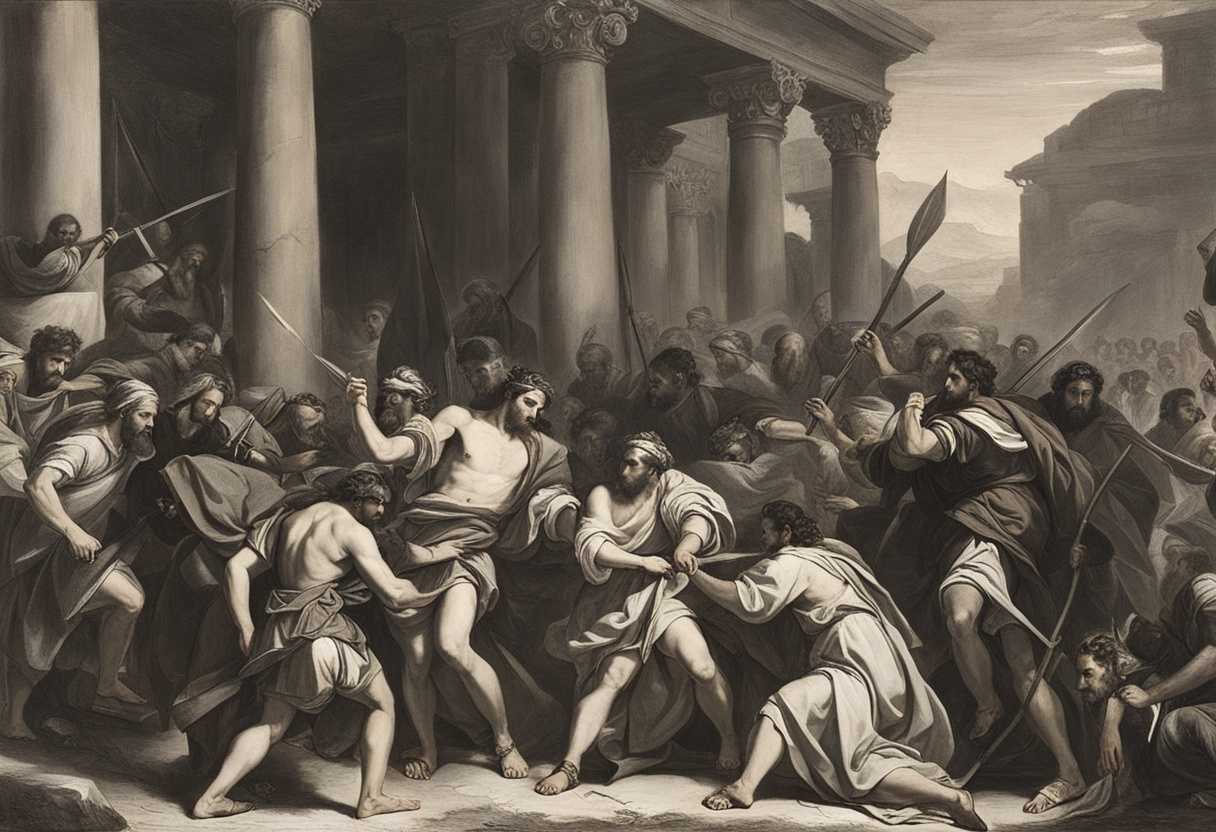
Setting the Scene for 1 Samuel 11:1-11
In 1 Samuel chapter 11, we find the scene set in the city of Jabesh Gilead, a town located east of the Jordan River. The city is in a state of distress as it is being besieged by the Ammonites, a neighboring enemy tribe. The Ammonites have threatened to gouge out the right eye of every man in Jabesh Gilead as a sign of their dominance and humiliation.
The leaders of Jabesh Gilead, desperate for help, send messengers throughout the land to seek aid. The news reaches King Saul, who is in the region of Gibeah at the time. Upon hearing of the plight of the people of Jabesh Gilead, Saul is moved with compassion and quickly gathers an army of Israelites to come to their rescue.
As Saul and his army march towards Jabesh Gilead, the tension and fear in the city are palpable. The fate of the people hangs in the balance as they await the arrival of their deliverance. The scene is one of anticipation, courage, and the hope of salvation as the forces of good prepare to confront the forces of evil in a decisive battle.
What is 1 Samuel 11:1-11 about?
Saul steps up as a leader and fulfills his role as king of Israel by rescuing the people of Jabesh Gilead from the oppressive Ammonites in this verse. This act not only demonstrates Saul’s courage and military prowess but also showcases his commitment to protecting and caring for his people. Saul’s swift action in aiding the people of Jabesh Gilead highlights his sense of responsibility and justice as a ruler.
Think about the qualities of a good leader that are displayed in this verse. What can we learn from Saul’s actions about the importance of standing up for others and using our power for the greater good? How does this story of Saul resonate with instances of leadership and bravery in our own lives or in the world around us? Let’s reflect on how we can follow Saul’s example by being compassionate, decisive, and courageous leaders in our own communities.
Understanding what 1 Samuel 11:1-11 really means
The passage in 1 Samuel 11:1-11 recounts the Ammonite siege of Jabesh-Gilead and Saul’s subsequent rescue of the city. This event takes place early in Saul’s reign as the first king of Israel, showcasing his initial success and the unity of Israel under his leadership. The phrase “Nahash the Ammonite went up and besieged Jabesh-Gilead” sets the stage for the conflict, highlighting the threat posed by the Ammonites and the dire situation faced by the people of Jabesh-Gilead. The desperate plea of the people to “Make a treaty with us, and we will be subject to you” underscores their urgency and the severity of their circumstances.
Nahash’s cruel demand to gouge out the right eye of every resident reveals the brutality and humiliation he intends to inflict, emphasizing the ruthless nature of the enemy. However, the turning point comes with the Spirit of God empowering Saul, signifying divine intervention and sanctioning Saul’s leadership. Saul’s decisive promise of deliverance, “Tomorrow, by the time the sun is hot, you will be rescued,” instills hope and showcases his leadership qualities in a time of crisis. This narrative not only illustrates the historical events but also conveys deeper meanings about faith, leadership, and divine intervention.
The relevance of this passage extends to contemporary life, emphasizing the timeless themes of leadership, unity, and trust in divine guidance. It prompts individuals to reflect on the importance of trusting in God’s provision and coming together in unity during challenging times. Drawing parallels to modern scenarios, one can envision a community facing a crisis where a leader, driven by faith and a sense of duty, unites the people for a successful rescue effort. This anecdote mirrors Saul’s leadership and the collective action of the Israelites, underscoring the power of unity and faith in overcoming adversity.
In conclusion, the story of Saul’s rescue of Jabesh-Gilead serves as a poignant reminder of the significance of strong, faith-driven leadership and the resilience found in unity. It encourages readers to place their trust in divine guidance and to collaborate in solidarity during times of crisis. Just as Saul’s actions brought deliverance to Jabesh-Gilead, this passage inspires individuals to seek unity, trust in God’s provision, and stand together in the face of challenges.
How can we respond to threatening situations with faith?
We can respond with faith in threatening situations by remembering that God is in control of all circumstances. We can turn to God in prayer, seeking His guidance and protection, just as the people of Jabesh-gilead turned to Saul for help in the face of adversity. We can find strength and courage to face whatever challenges come our way by acknowledging our dependence on Him and trusting in His plan.
It is important to remember that God is faithful and promises to always be with us, even in the midst of threatening situations. We can move forward with confidence by keeping our focus on Him and believing in His power and goodness, knowing that He is fighting on our behalf. We can approach threatening situations with a sense of peace and assurance as we stand firm in our faith, knowing that God’s strength is greater than any obstacle we may encounter.
Application
Embrace the call for courage and unity from 1 Samuel 11:1-11, just like how you show up for your colleagues at work or support your family in times of need. Let’s band together like Saul did for the Israelites, facing obstacles head-on with unwavering strength. Let this ancient tale ignite a fire within you to stand tall and united, no matter the challenges that come our way. Will you answer this summons and join hands with your brethren in times of trial?

Reverend Michael Johnson is an experienced Church Minister with a profound expertise in spirituality and guidance. With a serene presence and a compassionate heart, he has faithfully served his congregation for over 20 years, leading them on a spiritual journey towards inner peace and enlightenment. Reverend Johnson’s extensive knowledge of religious philosophies and profound understanding of human nature have made him a trusted confidant and mentor to many, as he seamlessly weaves his profound wisdom into life teachings. Reverend Johnson’s calming demeanor and empathetic nature continue to uplift and heal souls, nurturing a sense of unity and tranquility within his community.