
1 Samuel 20:1-42 is about the deep friendship and loyalty between David and Jonathan, highlighting the importance of true companionship and faithfulness in times of trouble.
1 Then David fled from Naioth in Ramah and came and said before Jonathan, “What have I done? What is my guilt? And what is my sin before your father, that he seeks my life?”
2 he said to him, “Far be it from you! You shall not die. Behold, my father does nothing either great or small without disclosing it to me. And why should my father hide this from me? It is not so.”
3 Then David took an oath again, and said, “Your father knows well that I have found favor in your eyes, and he thinks, ‘Do not let Jonathan know this, lest he be grieved.’ But truly, as the Lord lives and as your soul lives, there is but a step between me and death.”
4 Then Jonathan said to David, “Whatever you say, I will do for you.”
5 David said to Jonathan, “Behold, tomorrow is the new moon, and I should not fail to sit at table with the king. But let me go, that I may hide myself in the field till the third day at evening.
6 If your father misses me at all, then say, ‘David earnestly asked leave of me to run to Bethlehem his city, for there is a yearly sacrifice there for all the clan.’
7 If he says, ‘Good!’ it will be well with your servant, but if he is angry, then know that harm is determined by him.
8 Therefore deal kindly with your servant, for you have brought your servant into a covenant of the Lord with you. But if there is guilt in me, kill me yourself, for why should you bring me to your father?”
9 And Jonathan said, “Far be it from you! If I knew that it was determined by my father that harm should come to you, would I not tell you?”
10 Then David said to Jonathan, “Who will tell me if your father answers you roughly?”
11 Jonathan said to David, “Come, let us go out into the field.” So they both went out into the field.
12 And Jonathan said to David, “The Lord, the God of Israel, be witness! When I have sounded out my father, about this time tomorrow, or the third day, behold, if he is well disposed toward David, shall I not then send and disclose it to you?
13 But should it please my father to do you harm, the Lord do so to Jonathan and more also if I do not disclose it to you and send you away, that you may go in safety. May the Lord be with you, as he has been with my father.
14 If I am still alive, show me the steadfast love of the Lord, that I may not die;
15 but do not cut off your steadfast love from my house forever, when the Lord cuts off every one of the enemies of David from the face of the earth.
16 So Jonathan made a covenant with the house of David, saying, “May the Lord take vengeance on David’s enemies.”
17 And Jonathan made David swear again by his love for him, for he loved him as he loved his own soul.
18 Then Jonathan said to David, “Tomorrow is the new moon, and you will be missed, because your seat will be empty.
19 And on the third day I will shoot three arrows to the side of it, as though I shot at a mark.
20 I will shoot three arrows to the side of it, as though I shot at a mark.
21 And behold, I will send the boy, saying, ‘Go, find the arrows.’ If I say to the boy, ‘Look, the arrows are on this side of you, take them,’ then you are to come, for, as the Lord lives, it is safe for you and there is no danger.
22 But if I say to the youth, ‘Look, the arrows are beyond you,’ then go, for the Lord has sent you away.
23 And as for the matter of which you and I have spoken, behold, the Lord is between you and me forever.”
24 So David hid himself in the field. And when the new moon came, the king sat down to eat food.
25 And the king sat on his seat, as at other times, on the seat by the wall. Jonathan sat opposite, and Abner sat by Saul’s side, but David’s place was empty.
26 Nevertheless, Saul did not say anything that day, for he thought, “Something has happened to him. He is not clean; surely he is not clean.”
27 But on the second day, the day after the new moon, David’s place was empty. And Saul said to Jonathan his son, “Why has not the son of Jesse come to the meal, either yesterday or today?”
28 Then Jonathan answered Saul, “David earnestly asked leave of me to go to Bethlehem.
29 He said, ‘Let me go, for our clan holds a sacrifice in the city, and my brother has commanded me to be there. So now, if I have found favor in your eyes, let me get away and see my brothers.’ For this reason he has not come to the king’s table.”
30 Then Saul’s anger was kindled against Jonathan, and he said to him, “You son of a perverse, rebellious woman, do I not know that you have chosen the son of Jesse to your own shame, and to the shame of your mother’s nakedness?
31 For as long as the son of Jesse lives on the earth, neither you nor your kingdom shall be established. Therefore send and bring him to me, for he shall surely die.”
32 And Jonathan answered Saul his father, “Why should he be put to death? What has he done?”
33 But Saul hurled his spear at him to strike him. So Jonathan knew that his father was determined to put David to death.
34 Jonathan rose from the table in fierce anger and ate no food the second day of the month, for he was grieved for David, because his father had disgraced him.
35 In the morning Jonathan went out into the field to the appointment with David, and with him a little boy.
36 And he said to his servant, “Run, find the arrows that I shoot.” As the boy ran, he shot an arrow beyond him.
37 And when the boy had come to the place of the arrow that Jonathan had shot, Jonathan called after the boy and said, “Is not the arrow beyond you?”
38 And Jonathan called after the boy, “Hurry! Be quick! Do not stay!” So Jonathan’s boy gathered up the arrows and came to his master.
39 But the boy knew nothing. Only Jonathan and David knew the matter.
40 Then Jonathan gave his weapons to his boy and said to him, “Go and carry them to the city.”
41 And as soon as the boy had gone, David rose from beside the stone heap and fell on his face to the ground and bowed three times. And they kissed one another and wept with one another, David weeping the most.
42 Then Jonathan said to David, “Go in peace, because we have sworn both of us in the name of the Lord, saying, ‘The Lord shall be between me and you, and between my offspring and your offspring, forever.’” And he rose and departed, and Jonathan went into the city.
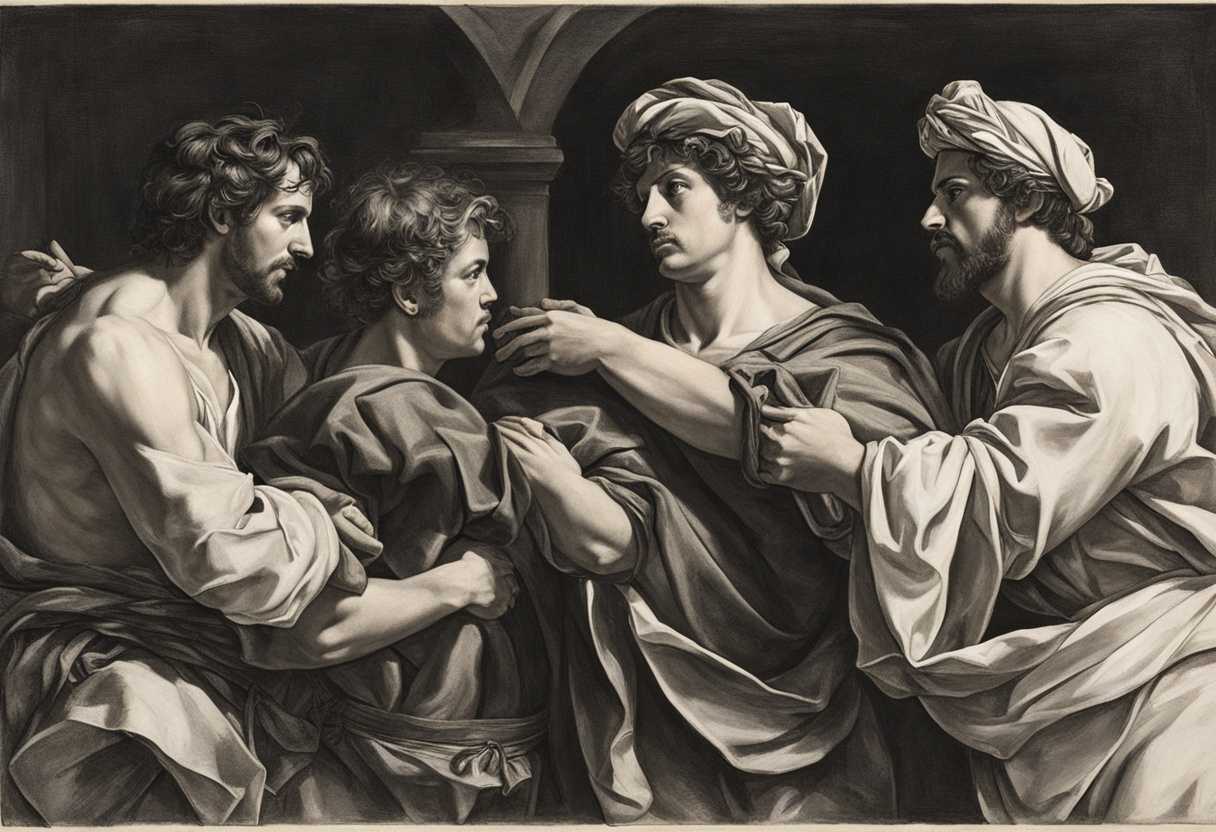
Setting the Scene for 1 Samuel 20:1-42
In 1 Samuel chapter 20, we find Jonathan, the son of King Saul, meeting with his dear friend David in a field. The scene is set against the backdrop of a beautiful countryside, with rolling hills and lush greenery surrounding them. Jonathan and David had formed a deep bond, with Jonathan even risking his own life to protect David from his father’s wrath.
As they meet in the field, Jonathan is torn between his loyalty to his father, King Saul, and his friendship with David. David, who had been anointed by Samuel to be the future king of Israel, is aware of the danger he faces from Saul’s jealousy and paranoia. Jonathan and David devise a plan to test Saul’s intentions towards David, with Jonathan promising to inform David of his father’s true feelings.
The tension is palpable as Jonathan and David navigate the complexities of their relationships with each other and with King Saul. The field serves as a sanctuary for their meeting, a place where they can speak freely and strategize without fear of being overheard. As the scene unfolds, we witness the depth of their friendship and the courage they display in the face of adversity.
What is 1 Samuel 20:1-42 about?
This verse showcases the depth of true friendship and loyalty through the actions of Jonathan, who risks his own safety to help David escape from Saul’s wrath. Jonathan’s unwavering support for David in his time of need demonstrates the qualities of selflessness, trust, and sacrifice that are characteristic of true friendship. Jonathan exemplifies the importance of standing by those we care about, even in the face of difficult circumstances, by defying his own father, King Saul. We reflect on this verse, inviting us to consider the nature of our own friendships and relationships. Do we show the same level of loyalty and support to our friends when they are facing challenges? Are we willing to go above and beyond for those we hold dear, even if it means risking our own comfort or safety? Jonathan’s actions serve as a powerful reminder of the value of true friendship and the impact that our choices and actions can have on those around us. Let us follow Jonathan’s example of true friendship by striving to cultivate relationships based on trust, selflessness, and unwavering loyalty.
Understanding what 1 Samuel 20:1-42 really means
Introduction
Understanding 1 Samuel 20:1-42 requires examining its context, main characters, and underlying themes. This chapter details the deep friendship and loyalty between David and Jonathan, juxtaposed against the backdrop of King Saul’s growing animosity towards David. Let’s break down the elements of this passage to uncover its profound significance and how it remains remarkably relevant today.
Context and Characters
Firstly, the context: David is the anointed future king of Israel, but Saul, the current king, sees him as a threat. Jonathan, Saul’s son, is caught in the middle but remains steadfastly loyal to David, recognizing God’s plan. The tension in this chapter is palpable as David seeks confirmation of Saul’s intentions, relying on Jonathan to mediate and provide the truth.
Key Themes
One of the significant themes here is loyalty and friendship. Jonathan’s willingness to defy his father for the sake of his friend David is a powerful testament to true friendship. Jonathan assures David in verses, “I’ll do whatever you want me to do for you,” showing a profound commitment that transcends personal risk. This mirrors Proverbs 17:17, “A friend loves at all times, and a brother is born for a time of adversity.”
Biblical Cross-References
Jonathan’s loyalty can also be compared to the loyalty of Ruth to Naomi in Ruth 1:16-17, where Ruth promises, “Where you go I will go, and where you stay I will stay.” Both stories exemplify sacrificial love and faithfulness, highlighting the importance of standing by loved ones regardless of the cost. This passage challenges us to consider the depth of our commitments to friends and family in today’s society, where relationships can often be superficial. Are we willing to support others even when it’s inconvenient or risky? Jonathan’s actions invite us to reflect on our own loyalties and the strength of our character. A young woman named Sarah stood by her friend Jane through a grueling battle with cancer, as a modern example. When Jane’s family couldn’t cope, Sarah took her to every appointment, stayed overnight at the hospital, and provided unwavering support. Like Jonathan, Sarah’s actions were driven by love and loyalty, illustrating that true friendship involves sacrifice and steadfastness. 1 Samuel 20:1-42 is a powerful narrative about loyalty, divine purpose, and moral integrity. Jonathan’s unwavering support for David, despite the potential consequences, serves as a timeless reminder of the value of true friendship. Reflect on this passage and ask yourself: How can I be a Jonathan to someone in my life? How can I embody such loyalty and love in my relationships? This introspection can lead us to nurture deeper, more meaningful connections in our lives, anchored in the values exemplified by Jonathan and David.
Can you recognize and honor true friendships in your life?
True friendships in our lives can be recognized by the loyalty and support they provide, even in difficult circumstances. Jonathan showed his deep friendship and loyalty to David by risking his own life to protect him from his father King Saul’s wrath. This selfless act exemplifies the essence of true friendship, where one is willing to go to great lengths for the well-being of the other.
Furthermore, true friendships are characterized by honesty and transparency. Jonathan and David had an open and honest relationship, where they could freely express their thoughts and feelings to one another. This level of trust and communication is a key component of a genuine and lasting friendship. True friendships shine brightly, offering unwavering support and comfort in times of trial and adversity. Jonathan’s unwavering commitment to David, even when it meant going against his own family, illustrates the depth of their friendship. Recognizing and honoring such true friendships in our lives is a blessing that should be cherished and nurtured.
Application
Think about how you lean on colleagues at work or rely on family in tough times. Jonathan risked everything to help David, much like a coworker going the extra mile or a sibling offering a shoulder. Are you ready to be that rock for someone else? Can you give unwavering support and loyalty to those who need it most?

Reverend Michael Johnson is an experienced Church Minister with a profound expertise in spirituality and guidance. With a serene presence and a compassionate heart, he has faithfully served his congregation for over 20 years, leading them on a spiritual journey towards inner peace and enlightenment. Reverend Johnson’s extensive knowledge of religious philosophies and profound understanding of human nature have made him a trusted confidant and mentor to many, as he seamlessly weaves his profound wisdom into life teachings. Reverend Johnson’s calming demeanor and empathetic nature continue to uplift and heal souls, nurturing a sense of unity and tranquility within his community.