
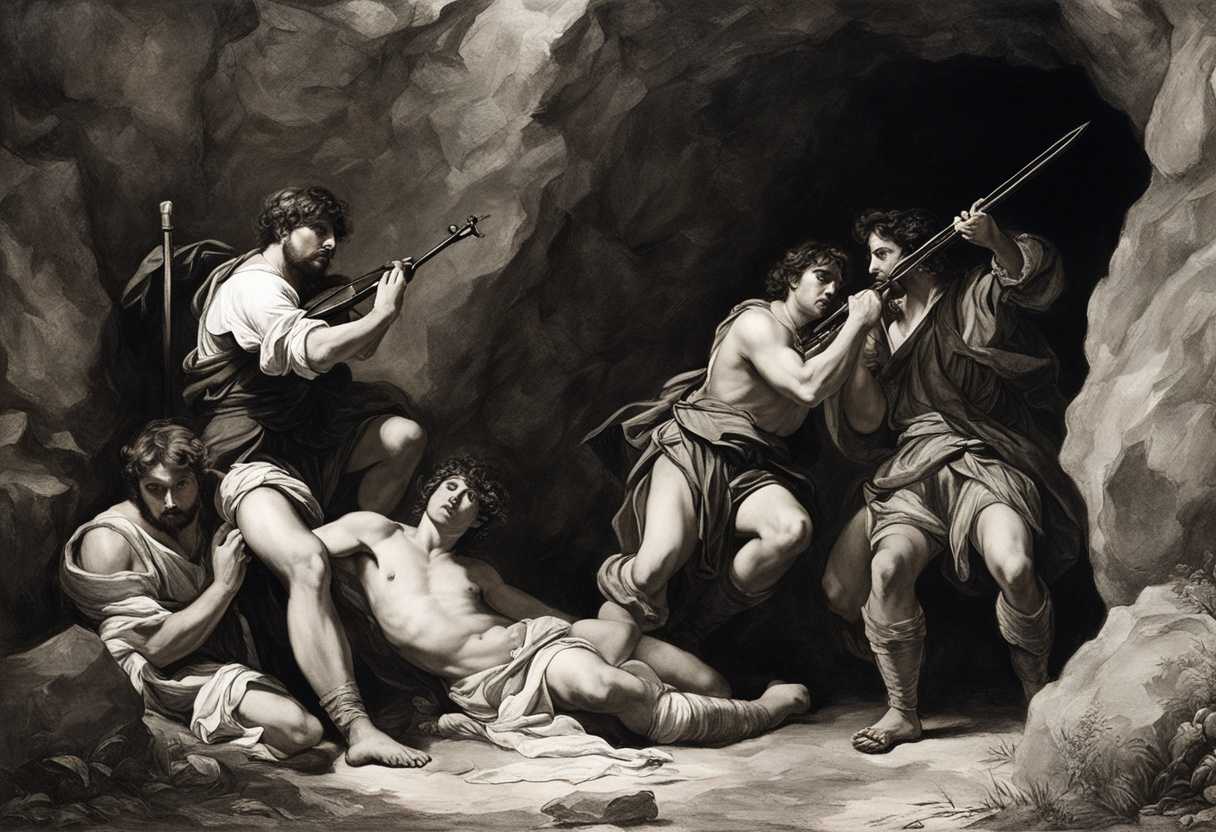
1 David departed from there and escaped to the cave of Adullam.
2 And everyone who was in distress, and everyone who was in debt, and everyone who was bitter in soul, gathered to him. And he became commander over them. And there were with him about four hundred men.
3 And David went from there to Mizpeh of Moab. And he said to the king of Moab, “Please let my father and my mother stay with you, till I know what God will do for me.”
4 And he left them with the king of Moab, and they stayed with him all the time that David was in the stronghold.
5 Then the prophet Gad said to David, “Do not remain in the stronghold; depart, and go into the land of Judah.” So David departed and went into the forest of Hereth.
6 Now Saul heard that David was discovered, and the men who were with him. Saul was sitting at Gibeah under the tamarisk tree on the height with his spear in his hand, and all his servants were standing about him.
7 And Saul said to his servants who stood about him, “Hear now, people of Benjamin; will the son of Jesse give every one of you fields and vineyards, will he make you all commanders of thousands and commanders of hundreds,
8 that all of you have conspired against me? There is none who discloses to me when my son makes a covenant with the son of Jesse. And there is none of you who is sorry for me or discloses to me that my son has stirred up my servant against me, to lie in wait, as at this day.”
9 Then answered Doeg the Edomite, who stood by the servants of Saul, “I saw the son of Jesse coming to Nob, to Ahimelech the son of Ahitub,
10 And he inquired of the Lord for him and gave him provisions. He also gave him the sword of Goliath the Philistine.
11 Then the king sent to summon Ahimelech the priest, the son of Ahitub, and all his father’s house, the priests who were at Nob, and all of them came to the king.
12 And Saul said, “Hear now, son of Ahitub.” And he answered, “Here I am, my lord.”
13 And Saul said to him, “Why have you conspired against me, you and the son of Jesse, in that you have given him bread and a sword and have inquired of God for him, so that he has risen against me, to lie in wait, as at this day?”
14 Then Ahimelech answered the king, “And who among all your servants is so faithful as David, who is the king’s son-in-law, and captain over your bodyguard, and honored in your house?
15 Did I then begin to inquire of God for him? No! Far be it from me. Let not the king impute anything to his servant or to all the house of my father, for your servant has known nothing of all this, much or little.”
16 And the king said, “You shall surely die, Ahimelech, you and all your father’s house.”
17 And the king said to the guard who stood about him, “Turn and kill the priests of the Lord, because their hand also is with David, and they knew that he fled and did not disclose it to me.” But the servants of the king would not put out their hand to strike the priests of the Lord.
18 Then the king said to Doeg, “You turn and strike the priests.” And Doeg the Edomite turned and struck down the priests, and he killed on that day eighty-five persons who wore the linen ephod.
19 And Nob, the city of the priests, he put to the sword; both man and woman, child and infant, ox, donkey and sheep, he put to the sword.
20 But one of the sons of Ahimelech the son of Ahitub, named Abiathar, escaped and fled after David.
21 And Abiathar told David that Saul had killed the priests of the Lord.
22 And David said to Abiathar, “I knew on that day, when Doeg the Edomite was there, that he would surely tell Saul. I have occasioned the death of all the persons of your father’s house.
23 Stay with me; do not be afraid, for he who seeks my life seeks your life. With me you shall be in safekeeping.”
The True Meaning of 1 Samuel 22
The book of 1 Samuel was written by the prophet Samuel, who played a crucial role in the transition from the era of judges to the establishment of the monarchy in ancient Israel. Events that would have a profound impact on the lives of King Saul and the young David, who would eventually succeed him as the king of Israel, unfold in this particular chapter. Saul’s growing paranoia and jealousy towards David drive his actions, leading to a series of tragic events as we delve into this chapter. The chapter also highlights the loyalty and courage of David’s followers, who stand by him even in the face of Saul’s relentless pursuit. Additionally, we will encounter the pivotal role of the priest Ahimelech, whose fate becomes intertwined with David’s journey.
Throughout this passage, we will find echoes of other biblical narratives, such as the ongoing conflict between Saul and David, as well as the importance of maintaining one’s faith and trust in God, even in the midst of adversity. We are reminded of the complexities of human nature and the consequences of our choices, both good and bad, as we navigate through these events.
1 Samuel 22:1-2
David left Gath and escaped to the cave of Adullam in 1 Samuel 22:1-2. When his brothers and his father’s household heard about it, they went down to him there. All those who were in distress or in debt or discontented gathered around him, and he became their commander. About four hundred men were with him.”
This passage marks a significant point in the life of David, who was on the run from King Saul, who was seeking to kill him. After being pursued by Saul and seeking refuge in Gath (a Philistine city), David understood the danger he was in as a member of Israel’s enemies. Therefore, David flees to the cave of Adullam. The cave of Adullam provided both physical shelter and a place for David to gather his thoughts and seek God’s guidance during this tumultuous time.
When David’s family hears about his whereabouts, they come to him, demonstrating a familial support system that remained devoted to him, even during his most challenging times. This familial support serves as a reminder of the importance of family bonds and loyalty, even when facing adversity.
Furthermore, the group that begins to gather around David in the cave of Adullam is telling of the individuals who were drawn to him during this time. They were described as those in distress, in debt, or discontented, which portrays a motley crew of individuals facing various forms of hardship and discontentment. David, in this moment, becomes a leader to this group of four hundred men, providing guidance, protection, and a sense of purpose to those who followed him.
This passage holds timeless lessons about the nature of leadership, loyalty, and faith. David’s ability to lead even in the midst of his own trials showcases his strength of character and his unwavering trust in God. The gathering of those in distress around him highlights the importance of finding strength and community in times of trouble, as well as the idea that God often uses the broken and downtrodden for His purposes. Jesus, who also attracted those in need and provided them with hope and direction, parallels David’s leadership in the New Testament. Jesus welcomed sinners, outcasts, and the marginalized, demonstrating that God’s Kingdom is inclusive and open to all who seek Him. David’s leadership in the cave of Adullam foreshadows the type of leader Jesus would be, one who brings together the lost and broken to form a community of faith and love.
1 Samuel 22:3-5
A poignant scene unfolds in the life of David, the future king of Israel, in 1 Samuel 22:3-5. The verse reads: “And David went from there to Mizpah of Moab; and he said to the king of Moab, ‘Please let my father and mother come here with you, till I know what God will do for me.’ So he brought them before the king of Moab, and they dwelt with him all the time that David was in the stronghold. Now the prophet Gad said to David, ‘Do not stay in the stronghold; depart, and go to the land of Judah.’ So David departed and went into the forest of Hereth.”
This passage reveals David’s vulnerability and uncertainty during a tumultuous period in his life. Fleeing from King Saul’s relentless pursuit, David seeks refuge for his parents with the king of Moab, his distant relatives. This demonstrates David’s concern for his family’s safety, even amidst his own challenges. It is a reminder that, even in times of trouble, we should not neglect our responsibilities towards our loved ones.
Furthermore, the mention of the prophet Gad instructing David to leave the stronghold and go to the land of Judah underscores the importance of seeking God’s guidance in our lives. David, known for his strong faith and reliance on God, heeds the prophet’s advice and moves to the forest of Hereth. This decision to follow God’s direction instead of relying solely on his own plans reveals David’s obedience and trust in God’s providence, setting an example for us to prioritize seeking God’s will above all else.
This passage also highlights the theme of exile and refuge, echoing the experiences of other biblical figures like Moses, who fled from Egypt, and later the Israelites in exile in Babylon. It speaks to the universal human experience of seeking shelter and protection in times of danger or uncertainty. David’s time in the stronghold and eventual migration to Judah serves as a metaphor for the challenges we face in life and the importance of finding our true refuge in God.
Throughout the Bible, we see how individuals, like David, navigated through periods of exile, persecution, and uncertainty with faith and reliance on God. This narrative in 1 Samuel 22:3-5 reminds us of the timeless message of trust, obedience, and seeking God’s guidance even in the midst of adversity. It encourages us to prioritize our relationship with God above all else and to trust in His unfailing love and protection, just like David did.
1 Samuel 22:6-10
David finds refuge in the cave of Adullam in 1 Samuel 22:6-10, marking a significant event in his life. Saul, who was king at the time and deeply threatened by David’s rising popularity and favor with the people, was seated with his spear in hand in this portion of the verse, showing signs of his paranoia and jealousy. This depicted Saul’s descent into madness and his increasing desperation to eliminate David, whom he perceived as a threat to his reign.
David, on the other hand, fled to the cave seeking shelter and safety from Saul’s relentless pursuit. He was in a vulnerable position, as he was being hunted by the very king he had faithfully served. David’s faith and trust in God were tested in this dire situation. Despite the danger he was in, David continued to rely on the Lord for protection and guidance, ultimately displaying his unwavering faith in God’s sovereignty and providence.
The image of David’s loyalty to God amidst adversity serves as a timeless lesson in faith and obedience. Even in the face of imminent danger, David did not waver in his trust in God’s plan for his life. This unwavering faith and reliance on God’s protection are echoed throughout the Bible, reminding us of the importance of trusting in the Lord, even in the most challenging circumstances.
Furthermore, this passage also sheds light on the theme of persecution and the trials faced by the righteous. David, a man after God’s own heart, faced unjust persecution from Saul, highlighting the reality that the faithful may encounter opposition and hardship in their journey of faith. Despite the challenges, David’s story encourages believers to remain steadfast in their faith and to seek refuge in God during times of trouble, knowing that His protection and deliverance are always available to those who trust in Him. We can see parallels with the experiences of other biblical figures who faced persecution for their faith by connecting this passage to other parts of the Bible. Joseph, Moses, and Daniel are a few examples of individuals who endured trials and tribulations but remained faithful to God, ultimately experiencing His deliverance and faithfulness. These stories serve as inspiration for believers to hold fast to their faith in God, knowing that He is a refuge and stronghold in times of trouble.
1 Samuel 22:11-15
Doeg the Edomite emerges as a manipulative and deceptive character in 1 Samuel 22:11-15. This passage describes how Doeg, an Edomite, who was in the service of King Saul, reported to the king that Ahimelech the priest had helped David by giving him provisions and the sword of Goliath. Doeg’s actions lead to an irrational and extreme response from King Saul, who orders the execution of Ahimelech and his entire family, which included 85 priests.
This passage is a tragic example of how jealousy, pride, and the thirst for power can lead to destructive consequences. King Saul’s insecurity and fear of losing his throne to David blinded him to the fact that innocent lives were at stake. The unjust massacre of the priests illustrates the depths of depravity that human beings are capable of when consumed by envy and desperation.
Ahimelech’s story is a poignant reminder of the cost of standing up for what is right in the face of tyranny. Ahimelech, as a priest, chose to help David, believing he was doing the right thing by providing aid to a fellow believer. His actions were based on compassion and faith, yet they led to his tragic end. Ahimelech’s story serves as a testament to the sacrifices made by believers who choose to follow God’s commandments and show kindness even when faced with great risks.
The character of Doeg serves as a cautionary tale about the danger of aligning oneself with wickedness for personal gain. Doeg’s betrayal and deceit had far-reaching consequences that resulted in the deaths of many innocent people. His role in this passage highlights the destructive power of gossip, manipulation, and treachery, and how they can be used as tools to sow discord and division. This passage serves as a reminder of the importance of integrity, righteousness, and mercy in the broader context of the Bible. It underscores the eternal truth that God sees and judges the intentions of our hearts, and that ultimately, justice will prevail. Psalm 52 provides further insight into the character of Doeg, condemning his deceit and predicting his eventual downfall at the hands of God. 1 Samuel 22:11-15 warns us about the dangers of allowing jealousy and fear to drive our actions and encourages us to seek righteousness, even in the face of adversity. It reminds us that our choices have consequences and that God’s justice will ultimately prevail, regardless of the actions of those who seek to do harm.
1 Samuel 22:16-19
The king said in 1 Samuel 22:16-19, “You shall surely die, Ahimelech, you and all your father’s house!”‘ Then the king said to the guards who stood about him, ‘Turn and kill the priests of the Lord, because their hand also is with David, and because they knew when he fled and did not tell it to me.’ But the servants of the king would not put out their hand to strike the priests of the Lord. And the king said to Doeg, ‘You turn and kill the priests!’ So Doeg the Edomite turned and struck the priests, and killed on that day eighty-five men who wore a linen ephod.”
This passage depicts a tragic event where King Saul orders the murder of the priests of the Lord, including Ahimelech, who was confronted by Saul for helping David. King Saul, being consumed by jealousy and fear of losing his throne to David, makes the extreme decision to wipe out anyone who he perceives as a threat to his reign, even if they are innocent servants of the Lord.
The ruthlessness of King Saul’s actions in ordering the slaughter of the priests highlights the depths of his sin and his departure from God’s ways. The priests, who were meant to serve God and minister to the people, fell victim to Saul’s paranoia and cruelty. This heinous act also shows the corrupting influence of jealousy and fear, leading a once anointed king to commit atrocities against God’s chosen people.
This event serves as a stark reminder of the consequences of allowing envy and insecurity to take root in one’s heart, leading to actions that are contrary to God’s will. It also underscores the importance of remaining faithful to God even in the face of persecution and opposition. The priests’ refusal to betray David, despite knowing the risks involved, demonstrates their commitment to righteousness and loyalty to God above all else.
The role of Doeg the Edomite in carrying out this massacre is significant in illustrating how those who are willing to do evil deeds for personal gain can cause great harm and devastation. Doeg’s willingness to obey King Saul’s command, even though it meant killing innocent priests, exposes the depths of his wickedness and lack of regard for the sanctity of life. This tragic event foreshadows the ongoing power struggles, betrayals, and violence that will unfold throughout the history of Israel in the broader context of the Bible. It serves as a cautionary tale about the destructive consequences of allowing sin to reign unchecked and the importance of remaining steadfast in one’s faith in the face of adversity, drawing parallels to other stories where obedience to God is tested, such as the story of Abraham and Isaac in Genesis 22. Righteousness will prevail over evil, and God will ultimately judge those who commit such atrocities, as highlighted in this passage.
1 Samuel 22:20-23
Abiathar, one of the sons of Ahimelek son of Ahitub, escaped and fled to David, as the passage in 1 Samuel 22:20-23 reads. He told David that Saul had killed the priests of the Lord. Then David said to Abiathar, ‘That day, when Doeg the Edomite was there, I knew he would be sure to tell Saul. I am responsible for the death of your whole family. Stay with me; don’t be afraid. The man who wants to kill you is trying to kill me too. You will be safe with me.’”
This passage signifies a pivotal moment in David’s life as he is now marked as an outlaw, constantly pursued by King Saul. Ahimelek and other priests were brutally murdered by King Saul due to their assistance of David. Abiathar, the son of Ahimelek, managed to escape and seeks refuge with David. The fact that Abiathar survived showed God’s hand of protection upon him and foreshadows his future role as a loyal priest and advisor to David. David, feeling guilty for indirectly causing the deaths of Abiathar’s family, offers him protection and reassurance that he would be safe under his care.
This passage is a powerful illustration of David’s compassion and sense of responsibility towards others, even in the midst of his own adversity. Despite the danger that sheltering Abiathar might bring upon himself, David selflessly offers him protection. This act highlights the character of David as a man after God’s own heart, showing mercy and justice to the oppressed. This verse also showcases the theme of loyalty and fidelity, as Abiathar chooses to align himself with David, the anointed of the Lord, rather than with Saul, who has turned against God’s chosen one.
Furthermore, the mention of Doeg the Edomite serves as a reminder of the consequences of sin and the harm that can be brought about by malicious individuals. Doeg’s actions led to the slaughter of innocent priests, highlighting the destructive nature of lies and betrayal. This serves as a cautionary tale about the importance of honesty, integrity, and the repercussions of one’s choices. Saul’s actions in this event set the stage for the ongoing conflict between David and Saul in the broader context of the Bible. It also foreshadows David’s eventual rise to kingship and the establishment of a new dynasty through his line. Additionally, the protection and guidance that Abiathar receives from David foreshadows the enduring covenant relationship that David would have with the Lord.
After 1 Samuel 22
The chapter concluded with the tragic events that unfolded in Nob, the city of the priests. Saul, consumed by his jealousy and fear of David, ordered the execution of the entire priestly community, accusing them of aiding his rival. Ahimelech, the high priest, and eighty-five other priests were slaughtered, a horrific act that sent shockwaves through the land. This senseless violence not only claimed innocent lives but also severed the vital connection between the people and their spiritual leaders. The stage was set for the next chapter as the sun set on this day of sorrow, where the consequences of Saul’s actions would continue to unfold, testing the faith and resilience of all who witnessed these tragic events.

Reverend Michael Johnson is an experienced Church Minister with a profound expertise in spirituality and guidance. With a serene presence and a compassionate heart, he has faithfully served his congregation for over 20 years, leading them on a spiritual journey towards inner peace and enlightenment. Reverend Johnson’s extensive knowledge of religious philosophies and profound understanding of human nature have made him a trusted confidant and mentor to many, as he seamlessly weaves his profound wisdom into life teachings. Reverend Johnson’s calming demeanor and empathetic nature continue to uplift and heal souls, nurturing a sense of unity and tranquility within his community.