
2 Corinthians 8:1-9 is about Paul encouraging the Corinthians to excel in the grace of giving generously and sacrificially, drawing inspiration from the selflessness of Jesus Christ who, though rich, became poor for the sake of humanity’s salvation.
1 We want you to know, brothers, about the grace of God that has been given among the churches of Macedonia,
2 for in a severe test of affliction, their abundance of joy and their extreme poverty have overflowed in a wealth of generosity on their part.
3 For they gave according to their means, as I can testify, and beyond their means, of their own accord,
4 begging us earnestly for the favor of taking part in the relief of the saints—
5 and this, not as we expected, but they gave themselves first to the Lord and then by the will of God to us.
6 So we urged Titus that as he had started, so he should complete among you this act of grace.
7 But as you excel in everything—in faith, in speech, in knowledge, in all earnestness, and in our love for you—see that you excel in this act of grace also.
8 I say this not as a command, but to prove by the earnestness of others that your love also is genuine.
9 For you know the grace of our Lord Jesus Christ, that though he was rich, yet for your sake he became poor, so that you by his poverty might become rich.
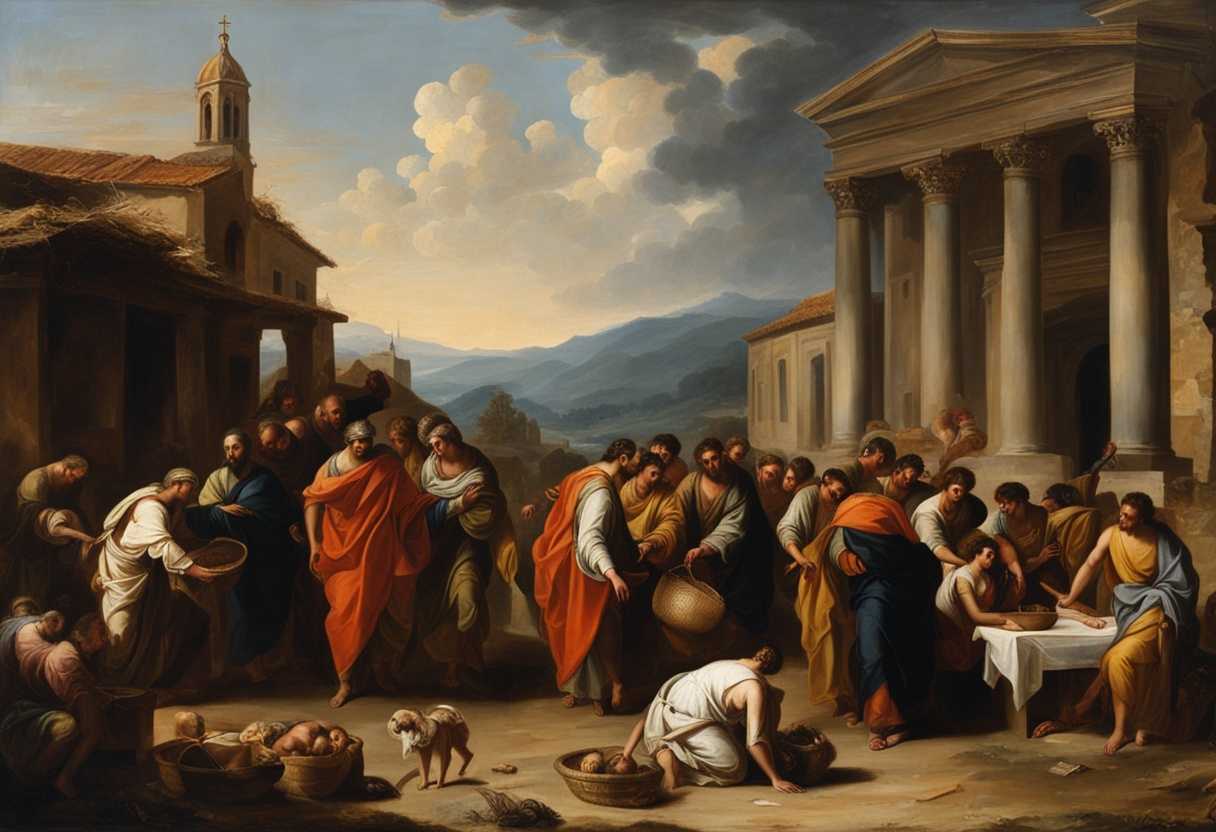
Setting the Scene for 2 Corinthians 8:1-9
In 2 Corinthians chapter 8, the scene is set in the city of Corinth, where the apostle Paul is writing a letter to the Corinthian church. Paul is addressing the Corinthians about the generosity of the churches in Macedonia, specifically how they have given beyond their means to support the needs of others. The names mentioned in this scene include Paul, the Corinthians, and the churches in Macedonia.
The surroundings are likely a bustling city with a mix of cultures and backgrounds. Paul is likely writing this letter from a quiet place, perhaps a room in a house or a quiet corner of the city where he can focus on conveying his message. The Corinthians, who are receiving this letter, are a diverse group of people who have come together to form a Christian community in the midst of a city known for its commerce and trade.
As Paul writes about the generosity of the churches in Macedonia, he is encouraging the Corinthians to also excel in the grace of giving. The scene is filled with a sense of unity and purpose as Paul urges the Corinthians to follow the example of the Macedonian churches in their generosity and willingness to support others in need.
What is 2 Corinthians 8:1-9 about?
This verse reminds us of the selfless and unconditional love that Christ demonstrated through his life and teachings. The verse challenges us to reflect on our own actions and motivations by highlighting the importance of generosity. Are we giving freely and abundantly, without expecting anything in return? Are we willing to make sacrifices for the well-being of others, just as Christ did for all of humanity?
The verse serves as a powerful reminder that generosity is not just about giving material possessions, but also about giving our time, attention, and compassion to those in need. It calls us to assess the depth of our love and generosity towards others and encourages us to emulate Christ’s example of unconditional love and service. How can we embody Christ’s spirit of generosity in our own lives? How can we extend a helping hand to those around us, sacrificially giving of ourselves for the greater good? This verse ultimately challenges us to examine the true meaning of generosity and encourages us to be channels of love and kindness in a world that often prioritizes selfishness and personal gain. Christ’s example inspires us to give generously and sacrificially, spreading love and compassion wherever we go.
Understanding what 2 Corinthians 8:1-9 really means
In 2 Corinthians 8:1-9, Paul highlights the exemplary generosity of the Macedonian churches, despite their own poverty. The context of this passage is crucial, as Paul is urging the Corinthians to emulate the Macedonians’ spirit of giving. The phrase “Grace of God” in verse 1 underscores the divine influence that enabled the Macedonians to give generously, even in the midst of their severe trials. Their overflowing joy and rich generosity, as mentioned in verse 2, demonstrate that giving is not limited by one’s circumstances but is a source of joy and blessing.
The Macedonians’ voluntary and wholehearted giving, as emphasized by the phrase “Entirely on their own” in verse 3, reveals that true generosity stems from a willing heart. Their act of giving was not coerced but a reflection of their commitment to the Lord, as seen in the phrase “First gave themselves to the Lord” in verse 5. Paul’s exhortation for the Corinthians to “excel in this grace of giving” in verse 7 challenges believers to go beyond mere obligation and embrace a lifestyle of generous giving.
The passage culminates in verse 9, where Paul points to the ultimate example of sacrificial giving in Jesus Christ. By relinquishing His heavenly riches to become human and provide salvation, Christ exemplified selflessness and love. This verse serves as a powerful reminder of the profound impact of generosity and selflessness in the Christian faith.
Drawing parallels to modern times, the message of 2 Corinthians 8:1-9 remains relevant. In a world where many face financial hardships, the call to give generously, trusting in God’s provision, resonates deeply. The importance of voluntary giving, driven by a commitment to God and a desire to bless others, is a timeless principle that transcends cultural and temporal boundaries.
An anecdote of a struggling family choosing to support a local charity despite their own financial challenges mirrors the Macedonians’ sacrificial giving. Their decision not only blesses others but also strengthens their faith and reliance on God’s provision. This anecdote illustrates the transformative power of generosity and the joy that comes from selflessly giving to those in need.
In conclusion, 2 Corinthians 8:1-9 challenges believers to embrace a lifestyle of generosity, following the example set by the Macedonians and ultimately by Christ Himself. It encourages us to give joyfully, sacrificially, and with a heart committed to God, trusting in His provision and experiencing the blessings that come from selfless giving.
How can we show genuine love and generosity?
We can show genuine love and generosity by imitating the example set in the passage of 2 Corinthians 8:1-9. This passage speaks about the churches in Macedonia, who despite their own poverty, gave generously out of their abundance of joy in the Lord. This teaches us that true generosity comes from a heart that is genuinely moved by love and compassion for others, even when it requires sacrifice on our part. We demonstrate a deep-seated care and concern for the well-being of others by being willing to give not only financially but also of our time, energy, and resources to help those in need. We are called to follow Jesus Christ’s example and show love and generosity in all aspects of our lives, just as he demonstrated the ultimate act of love and generosity by sacrificing himself for our salvation.
When we give out of a sincere desire to help and uplift others, without expecting anything in return, we mirror the selfless love and generosity that God has shown towards us. It is through our actions of kindness, compassion, and generosity that we can truly reflect the love of Christ to the world and make a positive impact in the lives of those around us.
Application
Think about the churches in Macedonia—like a busy parent working overtime. They gave not just from their surplus, but even when it hurt. Can you do the same? Let your sacrifices at work and home reflect your love and faith. Isn’t a life lived for others the truest legacy we can leave?

Reverend Michael Johnson is an experienced Church Minister with a profound expertise in spirituality and guidance. With a serene presence and a compassionate heart, he has faithfully served his congregation for over 20 years, leading them on a spiritual journey towards inner peace and enlightenment. Reverend Johnson’s extensive knowledge of religious philosophies and profound understanding of human nature have made him a trusted confidant and mentor to many, as he seamlessly weaves his profound wisdom into life teachings. Reverend Johnson’s calming demeanor and empathetic nature continue to uplift and heal souls, nurturing a sense of unity and tranquility within his community.