
2 Maccabees 12:26-31 is about the brave act of Judas Maccabeus and his men in making atonement for their fallen comrades by offering prayers and sacrifices for the dead.
26 And so he made atonement for the dead, that they might be delivered from their sin.
27 But Judas Maccabeus, with about nine others, got away to the wilderness, and kept himself and his companions alive in the mountains as wild animals do.
28 But when he was already at the point of death, he said thus: “It is better to fall into the hands of God than into the hands of men, and to hope in the great mercy of God, than in the mercy of men.”
29 And when he had finished speaking these words, a certain Jew came forward in the sight of all to offer sacrifice on the altar in Modein, according to the king’s command.
30 Then Judas and his brothers saw that evils had increased and that the forces were encamped in their territory. They also learned what the king had commanded to do to the people to cause their final destruction.
31 The Jews who were with him, and the priests, and the elders, rejoiced, because the enemy had been crushed by him.
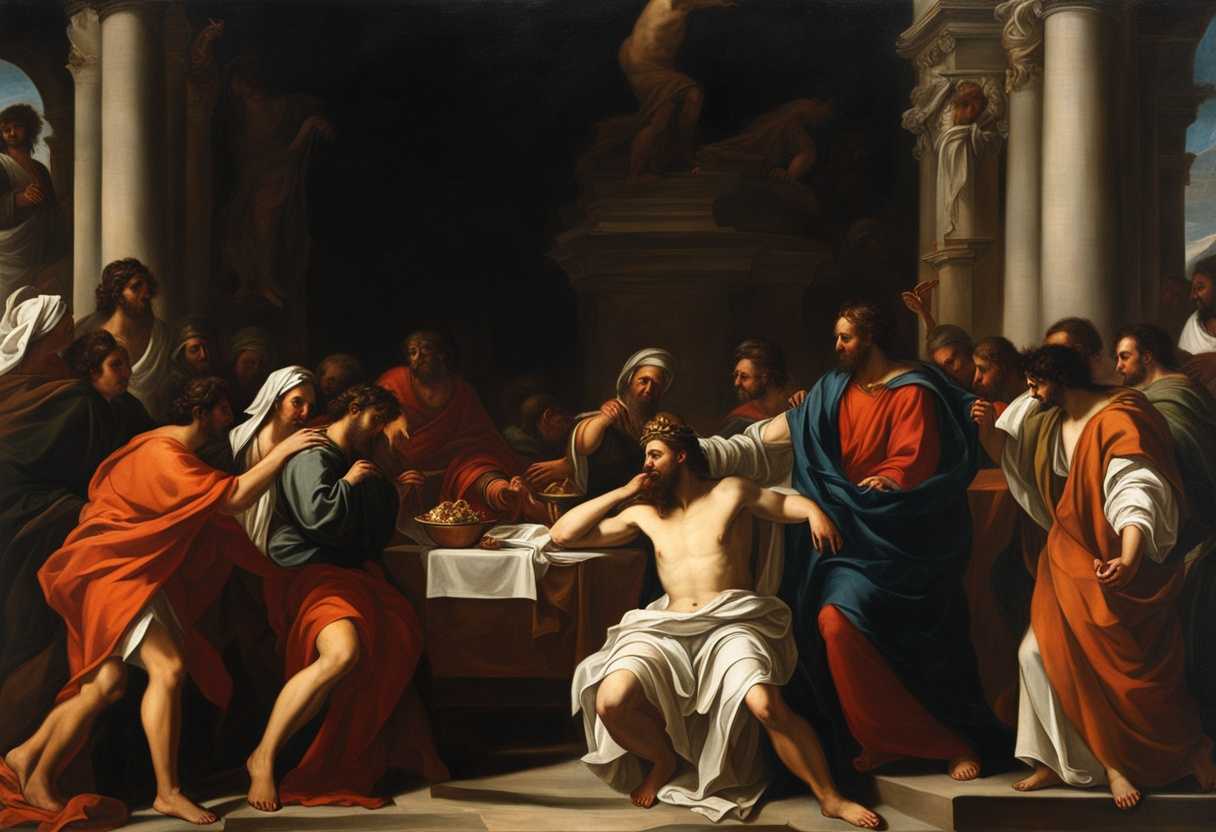
Setting the Scene for 2 Maccabees 12:26-31
The scene in 2 Maccabees 12:26-31 takes place during the time of Judas Maccabeus, a Jewish leader who led a revolt against the Seleucid Empire in the 2nd century BCE. In this particular passage, Judas and his men find the bodies of some fallen Jewish soldiers on the battlefield. They discover that these soldiers had been wearing pagan amulets, which was against Jewish law.
Judas and his men then realize that these soldiers had died as a punishment for their sins, and they decide to pray for the souls of the deceased. Judas also collects money from his men to make a sin offering on behalf of the fallen soldiers, believing that this act would help atone for their sins and ensure their resurrection.
The scene is set in a somber and reflective atmosphere, with the bodies of the fallen soldiers lying on the battlefield. Judas Maccabeus, known for his military prowess and religious zeal, is surrounded by his loyal men as they come to terms with the fate of their fallen comrades. The landscape is likely marked by the signs of battle, with the sounds of war still echoing in the distance, serving as a stark reminder of the ongoing struggle for the Jewish people’s freedom and religious identity.
What is 2 Maccabees 12:26-31 about?
Praying for the dead to be freed from sin is highlighted as a significant and meaningful practice in this verse. This act is deeply rooted in the Jewish tradition, where prayers are offered for the souls of the departed to find peace and purification. Individuals believe they can assist in the process of releasing the deceased from any burdens or wrongdoings they may have carried in their earthly life by interceding through prayers.
Have you ever pondered the idea of offering prayers for the deceased? What significance does this practice hold within your understanding of spirituality and connection to others beyond the physical realm? Through the act of praying for the dead to be freed from sin, there is a profound sense of compassion and empathy extended towards those who have passed on, emphasizing the continued bond and care that transcends life and death. It beckons us to reflect on the power of prayer in not only comforting the living but also in aiding the souls of the departed on their journey towards spiritual peace and liberation.
Understanding what 2 Maccabees 12:26-31 really means
During the tumultuous period of the Maccabean Revolt, Judas Maccabeus and his men stood as beacons of hope and resilience against the oppressive Seleucid Empire. The phrase “Judas and his men” resonates with the power of unity and collective effort, reminding us of the strength found in community when facing adversity. Together, they not only destroyed the garrison but also purified the temple, symbolizing a profound victory of faith and righteousness over tyranny and impurity. This act of purification underscores the importance of spiritual renewal and the dedication to maintaining holiness in our lives, echoing themes of restoration and renewal found in other biblical passages.
In parallel to 2 Maccabees 12:26-31, 1 Maccabees 4:36-61 describes the rededication of the Temple, emphasizing the significance of reclaiming spiritual purity and devotion to God. The verse from Psalm 18:39 further echoes divine assistance and strength in times of battle, mirroring the support Judas and his men received in their struggle. Similarly, Hebrews 11:33-34 highlights the power of faith in conquering challenges, illustrating the timeless truth that faith can lead to victory over seemingly insurmountable odds.
The relevance of this passage extends to our lives today, reminding us of the enduring principles of faith, perseverance, and unity. Just as Judas and his men drew strength from their faith to achieve victory, we too can find courage in our beliefs during difficult times. The unity displayed by the Jewish fighters serves as a poignant reminder of the strength found in working together towards a common goal, emphasizing the importance of community and collaboration in overcoming obstacles.
Consider a modern-day scenario where a community faces a daunting challenge, akin to rebuilding after a natural disaster. Through faith, unity, and perseverance, they rally together to restore what was lost, embodying the spirit of Judas and his men. This anecdote illustrates the transformative power of collective effort and faith in overcoming adversity, showcasing the resilience and determination that can arise when individuals come together for a shared purpose.
As we reflect on 2 Maccabees 12:26-31, let us draw inspiration from the unwavering faith and unity displayed by Judas and his men. May this passage encourage us to lean on our faith, foster unity within our communities, and seek spiritual renewal in our lives. Just as they achieved victory through their steadfast belief and collaboration, so too can we navigate life’s challenges with God’s guidance and the support of those around us.
How can we reconcile faith with practical actions?
These verses from 2 Maccabees remind us of the importance of both faith and practical actions in our lives. Faith can guide us to do what is right and just, but it must also be accompanied by concrete actions. Our faith spurs us to take active steps to honor and remember those who have passed away, showing the value of prayers and sacrifices for the dead in these verses.
It is through our practical actions that we demonstrate the sincerity of our faith. We bring our faith to life in a tangible way by performing good deeds, showing kindness to others, and living in accordance with our beliefs. Our actions can be a reflection of our faith and a way to show our commitment to following the teachings of our faith tradition. Faith and actions go hand in hand in this passage; they are not separate entities but interconnected aspects of our spiritual lives. We can live out our beliefs in a meaningful and impactful way by combining faith with practical actions, enriching our own lives and the lives of those around us.
Application
Embrace the power of intercession in 2 Maccabees 12:26-31 and step into the role of providing spiritual support for those who have left this world. Just like Judas Maccabeus and his men, be a beacon of compassion for the departed souls, guiding them through their spiritual journey. Will you take the courageous step to offer prayers for the deceased, knowing that your intercessions can offer comfort and assistance to their souls in need?

Reverend Michael Johnson is an experienced Church Minister with a profound expertise in spirituality and guidance. With a serene presence and a compassionate heart, he has faithfully served his congregation for over 20 years, leading them on a spiritual journey towards inner peace and enlightenment. Reverend Johnson’s extensive knowledge of religious philosophies and profound understanding of human nature have made him a trusted confidant and mentor to many, as he seamlessly weaves his profound wisdom into life teachings. Reverend Johnson’s calming demeanor and empathetic nature continue to uplift and heal souls, nurturing a sense of unity and tranquility within his community.