
1 And David said, “Is there still anyone left of the house of Saul, that I may show him kindness for Jonathan’s sake?”
2 And there was a servant of the house of Saul whose name was Ziba. And they called him to David. And the king said to him, “Are you Ziba?” And he said, “I am your servant.”
3 And the king said, “Is there not still someone of the house of Saul, that I may show the kindness of God to him?” Ziba said to the king, “There is still a son of Jonathan; he is crippled in his feet.”
4 And the king said, “Where is he?” And Ziba said to the king, “He is in the house of Machir the son of Ammiel, at Lo-debar.”
5 Then King David sent and brought him from the house of Machir the son of Ammiel, at Lo-debar.
6 And Mephibosheth the son of Jonathan, son of Saul, came to David and fell on his face and paid homage. And David said, “Mephibosheth!” And he answered, “Behold, I am your servant.”
7 And David said to him, “Do not fear, for I will show you kindness for the sake of your father Jonathan, and I will restore to you all the land of Saul your father, and you shall eat at my table always.”
8 And he paid homage and said, “What is your servant, that you should show regard for a dead dog such as I?”
9 Then the king called Ziba, Saul’s servant, and said to him, “All that belonged to Saul and to all his house I have given to your master’s grandson.
10 And you and your sons and your servants shall till the land for him and shall bring in the produce, that your master’s grandson may have bread to eat. But Mephibosheth your master’s grandson shall always eat at my table.” Now Ziba had fifteen sons and twenty servants.
11 Then Ziba said to the king, “According to all that my lord the king commands his servant, so will your servant do.” So Mephibosheth ate at David’s table, like one of the king’s sons.
12 And Mephibosheth had a young son, whose name was Mica. And all who lived in Ziba’s house became Mephibosheth’s servants.
13 So Mephibosheth lived in Jerusalem, for he ate always at the king’s table. Now he was lame in both his feet.
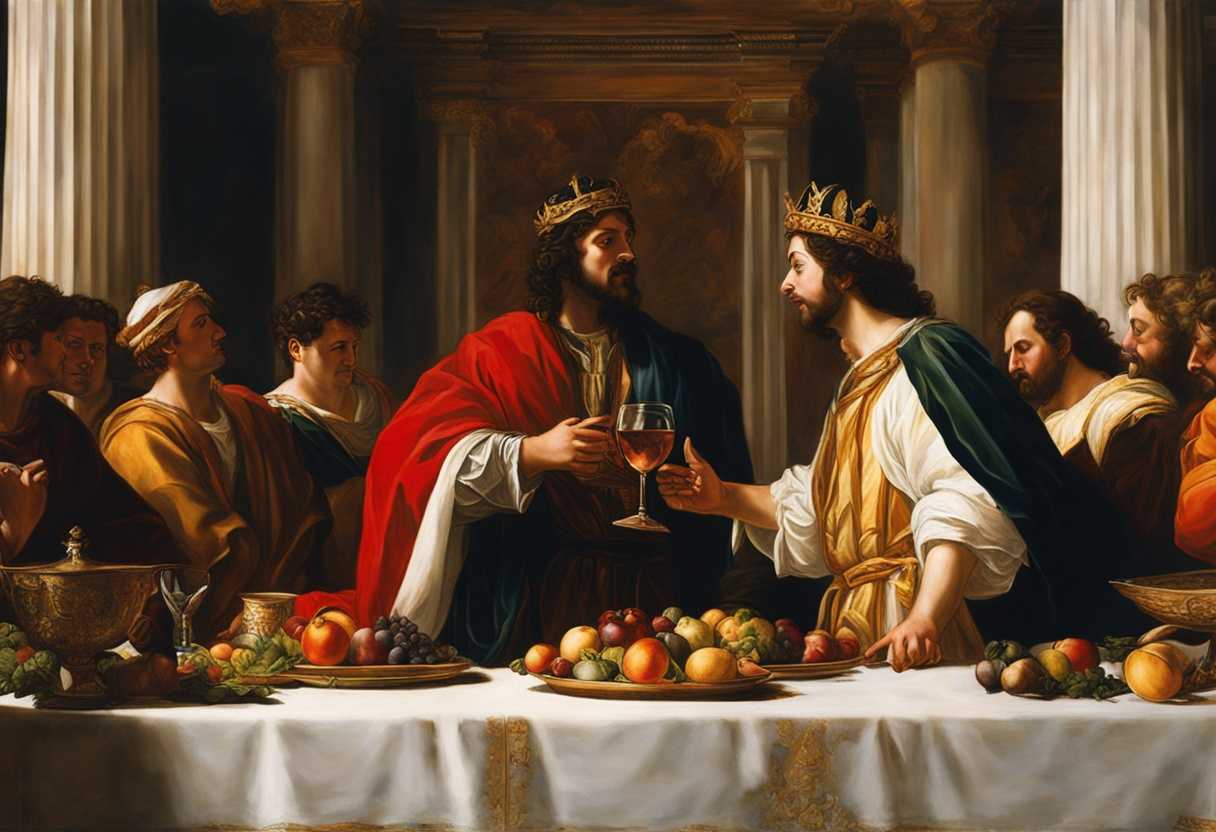
The True Meaning of 2 Samuel 9
The book of 2 Samuel was written by the prophet Nathan and the scribe Gad, who were close companions of King David. They provide a detailed account of David’s reign as the second king of Israel, chronicling his rise to power and the challenges he faced. King David performs a remarkable act of kindness and compassion in this chapter. Despite the tumultuous events of the past, David remembers his promise to his dear friend Jonathan and seeks to honor it by extending grace to Jonathan’s son, Mephibosheth. As we delve into this passage, David reflects the heart of a leader who values loyalty, forgiveness, and the fulfillment of his word.
The chapter begins with David inquiring about any remaining members of Saul’s household, to whom he might show kindness. This sets the stage for a remarkable encounter between the king and Mephibosheth, a figure who has been largely forgotten and living in obscurity. David’s decision to restore Mephibosheth’s inheritance and welcome him into the royal household demonstrates the transformative power of grace and the importance of keeping one’s promises, even in the face of past conflicts.
2 Samuel 9:1-4
The beginning of a beautiful story that exemplifies characteristics such as kindness, grace, and the importance of showing mercy to others is seen in 2 Samuel 9:1-4. It starts with David inquiring if there was anyone left of the house of Saul to whom he could show kindness for the sake of his friendship with Jonathan. This displays David’s desire to extend grace and honor the memory of his dear friend Jonathan, who was Saul’s son.
David’s question about the house of Saul is significant because of the complex history between David and Saul. Saul, the first king of Israel, initially viewed David as a threat and tried to kill him several times out of jealousy and fear that David would take his throne. Despite this, David continued to show respect for Saul as God’s anointed king and saw Jonathan, Saul’s son, as a close friend and kindred spirit. David’s desire to show kindness to someone from Saul’s house reflects his compassionate and forgiving heart, which aligns with God’s teachings on forgiveness and reconciliation. This act of David seeking to show kindness also highlights the importance of looking beyond past grievances and extending grace to others, echoing themes of forgiveness and reconciliation found throughout the Bible.
When David discovers that there is a son of Jonathan named Mephibosheth still alive, though he is crippled in both feet, David sends for him to be brought to the palace. Mephibosheth’s physical condition is of note because it would have made him vulnerable and disadvantaged in a society where physical strength and ability were highly valued. Despite this, David welcomes him into his presence, showing that true worth and honor come from God, not from physical abilities or appearances. This act by David reflects God’s heart for the marginalized and vulnerable in society, as seen in verses like Psalm 82:3-4, which calls for defending the weak and the fatherless, upholding the cause of the poor and the oppressed.
The story of Mephibosheth is a beautiful illustration of God’s grace and provision. Mephibosheth, as a descendant of Saul, could have been seen as an enemy of David and a threat to his throne. Instead, David shows him kindness and generosity, declaring that Mephibosheth would eat at his table regularly, just like one of the king’s sons. This act of inclusion and acceptance elevates Mephibosheth from a position of weakness and vulnerability to one of honor and privilege. It displays the transformative power of grace and the importance of treating others with love and respect, regardless of their background or circumstances. This concept is echoed in verses such as Ephesians 2:8-9, which speaks about being saved by grace and not by our own works, highlighting God’s unmerited favor towards us. The account of David and Mephibosheth in 2 Samuel 9 serves as a powerful reminder of the importance of kindness, forgiveness, and the transformative impact of God’s grace in our lives. David’s actions towards Mephibosheth display a model of how we should treat others with compassion and love, regardless of their past or present circumstances, reflecting God’s heart for reconciliation and restoration in all relationships.
2 Samuel 9:5-8
David seeks to show kindness to the son of his dear friend, Jonathan, in an encounter between David and Mephibosheth in 2 Samuel 9:5-8. The passage begins with David asking for the whereabouts of the house of Saul, showing his intent to fulfill a promise he made to Jonathan to show kindness to his descendants. This act of kindness is significant as it exemplifies David’s commitment to honor his covenant with Jonathan, even though it would have been easier for him to overlook this promise.
When Mephibosheth is brought before David, he falls on his face in reverence and fear, as he expected retribution due to his lineage. Mephibosheth, however, was not at fault for the actions of his grandfather Saul. His fear is indicative of the stigma and consequences that often follow descendants of those who have fallen from favor. David, though being the king, shows compassion and reassures Mephibosheth, telling him not to fear because he intends to show him kindness for the sake of his father, Jonathan.
David not only promises to restore to Mephibosheth all the land that belonged to Saul and provide for him from that day forward, but also welcomes Mephibosheth to eat continually at his table, just like one of his own sons. This act of including Mephibosheth in his family is a reflection of David’s heart for mercy and compassion. It is a powerful demonstration of grace and love extended to someone who may have expected judgment and rejection instead.
The kindness shown by David towards Mephibosheth in 2 Samuel 9 carries a profound message of redemption, grace, and the fulfillment of promises. It speaks to the overarching theme of God’s faithfulness and mercy towards those who may feel unworthy or forgotten. This story echoes the broader Biblical narrative of how God is always ready to extend His grace to all, regardless of their past or background. Just as David showed kindness to Mephibosheth, we are reminded of God’s unmerited favor and love towards us, inviting us into His family and providing for us from His abundance.
This account in 2 Samuel 9 also echoes the concept of restoration and reconciliation, themes that run throughout the Bible. It foreshadows the ultimate act of redemption through Jesus Christ, where all are offered a place at the table of God through His sacrifice. The narrative of David and Mephibosheth serves as a beautiful illustration of God’s desire to restore and bless His people, ultimately pointing to the redemptive work of Christ on the cross.
2 Samuel 9:9-13
King David shows a beautiful gesture of kindness and grace towards Mephibosheth in 2 Samuel 9:9-13. Mephibosheth was the son of Jonathan and the grandson of King Saul. He was crippled in both feet and lived in Lo-debar, a place that symbolized a state of desolation and obscurity. David, being a man after God’s own heart, sought to show kindness for Jonathan’s sake. Here, David displays a remarkable act of compassion and a fulfillment of his promise to Jonathan to show lovingkindness to his descendants. King David offers to provide for Mephibosheth by restoring to him all the land that belonged to Saul, his grandfather, in verse 9. This act was not merely out of duty or obligation; it was a gesture of grace and mercy, demonstrating David’s noble character. David’s action here mirrors the love and kindness that God shows to us, His children, despite our brokenness and unworthiness. It reflects the principle of forgiveness and restoration that runs throughout the Bible.
Moving on to verse 10, Mephibosheth responds to David’s kindness with humility and gratitude. He expresses deep astonishment and disbelief that he, a descendant of Saul – the king David had been anointed to replace – would receive such favor. Mephibosheth refers to himself as a dead dog, emphasizing his unworthiness to receive such blessings. This humility highlights the Biblical teaching on the importance of humility before God and others. It echoes Jesus’s teachings in the New Testament about the value of a humble heart and the exaltation of the lowly (Matthew 23:12). David further demonstrates his benevolence in verses 11 and 12 by assigning servants to work the land for Mephibosheth so that he would be provided for and cared for. David’s actions reveal his desire to not only bless him with material possessions but also to ensure he is taken care of daily. This reflects the Biblical emphasis on caring for the less fortunate and the vulnerable in society (James 1:27).
Finally, in verse 13, we see that Mephibosheth lived in Jerusalem, close to the king, and ate at his table like one of the king’s sons. This act of inclusion and acceptance into the king’s family speaks volumes about the depth of David’s love and mercy. It reflects the New Testament message of adoption into the family of God through Christ (Galatians 4:4-7), where believers are no longer considered strangers but fellow heirs with Christ. 2 Samuel 9:9-13 teaches us valuable lessons about kindness, compassion, humility, and the transformative power of grace. It reminds us of God’s unconditional love for us, His desire to restore and bless us despite our brokenness, and the importance of extending that same love and mercy to others. This passage points us to the ultimate example of grace and mercy in Jesus Christ, who came to seek and save the lost (Luke 19:10).
After 2 Samuel 9
The king had shown great kindness to the house of Saul. He had sought out any remaining members of Saul’s family, that he might show them the kindness of God. And so it was that Mephibosheth, the son of Jonathan, was brought before the king. The king welcomed him and restored to him all the land that had belonged to his grandfather Saul. Mephibosheth would now dine at the king’s table, as one of the king’s own sons.
Yet, the story does not end there. For the king’s kindness would soon be tested, as dark clouds gathered on the horizon. The enemies of the kingdom were stirring, and the king would need to call upon all his wisdom and strength to defend his people. The next chapter would reveal the true measure of the king’s resolve, as he faced the greatest challenge of his reign.

Reverend Michael Johnson is an experienced Church Minister with a profound expertise in spirituality and guidance. With a serene presence and a compassionate heart, he has faithfully served his congregation for over 20 years, leading them on a spiritual journey towards inner peace and enlightenment. Reverend Johnson’s extensive knowledge of religious philosophies and profound understanding of human nature have made him a trusted confidant and mentor to many, as he seamlessly weaves his profound wisdom into life teachings. Reverend Johnson’s calming demeanor and empathetic nature continue to uplift and heal souls, nurturing a sense of unity and tranquility within his community.