
2 Samuel 9:9-13 is about King David showing kindness and generosity by restoring Mephibosheth’s inheritance and providing for him, symbolizing God’s grace and redemption for those who may feel unworthy or marginalized.
9 Then the king called Ziba, Saul’s servant, and said to him, “All that belonged to Saul and to all his house I have given to your master’s grandson.
10 And you and your sons and your servants shall till the land for him and shall bring in the produce, that your master’s grandson may have bread to eat. But Mephibosheth your master’s grandson shall always eat at my table.” Now Ziba had fifteen sons and twenty servants.
11 Then Ziba said to the king, “According to all that my lord the king commands his servant, so will your servant do.” So Mephibosheth ate at David’s table, like one of the king’s sons.
12 And Mephibosheth had a young son, whose name was Mica. And all who lived in Ziba’s house became Mephibosheth’s servants.
13 So Mephibosheth lived in Jerusalem, for he ate always at the king’s table. Now he was lame in both his feet.
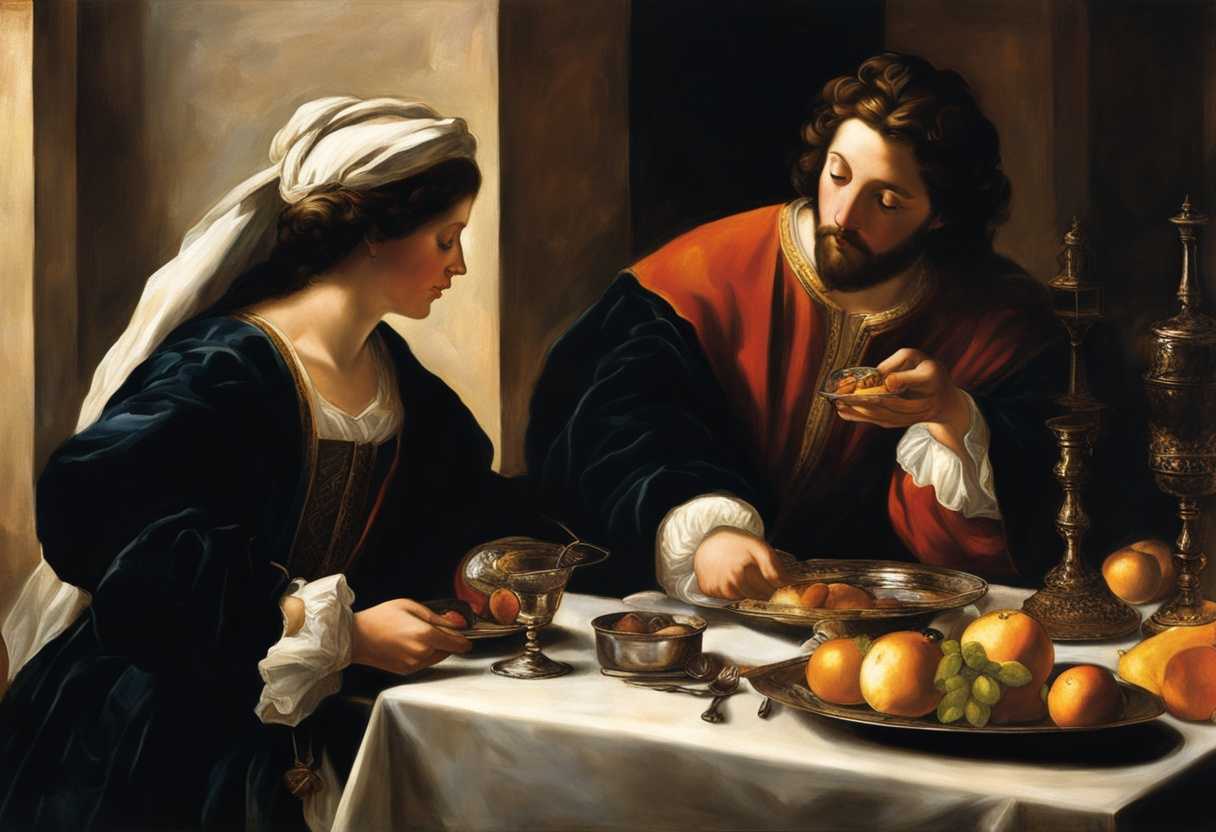
Setting the Scene for 2 Samuel 9:9-13
In 2 Samuel chapter 9, we find King David seeking to show kindness to anyone left of the house of Saul for the sake of his friend Jonathan. Mephibosheth, the son of Jonathan and grandson of Saul, is brought before King David. Mephibosheth had been living in Lo-debar, a place of obscurity and poverty, due to being crippled in both feet from a young age.
As Mephibosheth stands before King David, likely feeling a mix of fear and uncertainty, David extends unexpected grace and kindness towards him. David not only restores to Mephibosheth all the land that belonged to Saul but also invites him to dine at the king’s table regularly, treating him as one of his own sons. This act of kindness and generosity from King David towards Mephibosheth is a beautiful display of grace and mercy, showing how David honored the covenant he had with Jonathan.
The scene is set in the grand palace of King David, with opulent decorations adorning the walls and luxurious furnishings filling the room. King David, with his regal presence, sits on his throne, surrounded by his courtiers and advisors. Mephibosheth, with a mix of trepidation and hope in his eyes, is brought before the king, his heart likely racing at the thought of meeting the powerful ruler. The atmosphere is tense yet filled with the possibility of redemption and restoration as David extends his hand in kindness towards the crippled grandson of his dear friend Jonathan.
What is 2 Samuel 9:9-13 about?
David shows a beautiful display of kindness and generosity towards Mephibosheth, the son of his dear friend Jonathan in this verse. Despite the historical enmity between the houses of Saul and David, David still chooses to show compassion and honor to Mephibosheth by restoring his inheritance and inviting him to share in meals at his own table. This act not only demonstrates David’s respect for the memory of Jonathan but also embodies the values of mercy, forgiveness, and empathy that are at the core of a noble character.
The significance of this gesture goes beyond mere material restoration; it is a symbolic portrayal of reconciliation and healing in the midst of past conflicts and grievances. David sets an example of how personal animosities can be overcome through acts of grace and benevolence by extending a hand of kindness to Mephibosheth. This verse reminds us of the power of compassion to bridge divides, restore dignity, and foster unity among individuals and communities. Reflecting on David’s actions towards Mephibosheth challenges us to consider how we can also cultivate a spirit of generosity and inclusivity in our own relationships and interactions with others. How can we emulate David’s example of showing kindness and compassion towards those who may be marginalized or in need of support? How can we embody the values of forgiveness and reconciliation in our daily interactions with others, even in the face of past conflicts or misunderstandings? We seek to ponder these questions as we cultivate a culture of kindness and empathy in our own lives.
Understanding what 2 Samuel 9:9-13 really means
In 2 Samuel 9:9-13, we witness a beautiful display of kindness and loyalty as King David fulfills a covenant made with Jonathan by showing generosity to Mephibosheth, the son of Jonathan and grandson of Saul. David’s actions exemplify the importance of honoring commitments and extending compassion to those in need. The phrase “All that belonged to Saul and to all his house I have given to your master’s grandson” showcases David’s commitment to restoring Mephibosheth’s inheritance, highlighting the value of generosity and restoration in relationships.
Moreover, when David declares, “You and your sons and your servants shall till the land for him,” he not only provides for Mephibosheth’s needs but also ensures ongoing support and care despite Mephibosheth’s physical limitations. This act of provision reflects the principle of caring for the vulnerable and marginalized members of society, reminding us of our responsibility to uplift and empower those in need.
The statement “Mephibosheth ate at David’s table, like one of the king’s sons” symbolizes the deep honor and acceptance David extends to Mephibosheth, treating him as family. This gesture of inclusion challenges us to embrace a spirit of inclusivity and hospitality towards others, regardless of their background or circumstances. It prompts us to consider how we can extend similar acts of kindness and acceptance in our own interactions with those around us.
Drawing parallels to other biblical passages, such as the covenant between David and Jonathan in 1 Samuel 20:14-17, and Jesus’ teaching in Luke 14:13-14 about inviting the marginalized to banquets, we see a consistent theme of honoring commitments and showing compassion to those in need. Romans 12:10 further reinforces this idea by urging us to “Be devoted to one another in love. Honor one another above yourselves,” mirroring David’s actions towards Mephibosheth.
In applying the lessons from this passage to our lives today, we are encouraged to reflect on the promises and commitments we have made and consider how we can honor them with integrity and compassion. We are challenged to look for opportunities to extend kindness and support to those who may be struggling or marginalized in our communities, embodying the values of generosity and inclusivity that David exemplified towards Mephibosheth.
Imagine a scenario where a successful individual discovers a friend’s child in need and decides to provide not only financial assistance but also mentorship and inclusion in family gatherings. This modern-day parallel illustrates the transformative power of kindness and loyalty, inspiring us to emulate David’s example by extending care and support to those around us. Let us embrace the call to honor commitments, show compassion to the marginalized, and treat others with the same respect and dignity we desire for ourselves.
How can we demonstrate kindness and mercy to others?
To demonstrate kindness and mercy to others, we can take cues from the actions of King David towards Mephibosheth in this verse. We can start by seeking out those who may be marginalized or in need of help, just as David searched for Jonathan’s son Mephibosheth. Showing kindness and mercy includes considering those who may not have a voice or advocate for themselves in society and reaching out to them with compassion.
Additionally, we can show kindness by providing for others and meeting their needs. We can extend help in practical ways to those around us, just as King David gave Mephibosheth a place at his table and ensured that he was taken care of. This can include offering a listening ear, sharing resources, or advocating for justice on behalf of others who may be overlooked or disadvantaged.
Furthermore, displaying mercy involves forgiving others and showing grace, even when it may not be expected or deserved. We can emulate the mercy that God has shown us by extending forgiveness and understanding towards those who have wronged us. This can create opportunities for reconciliation and healing in relationships, reflecting the love and forgiveness that we have received from God.
Application
Let’s be like David in 2 Samuel and show kindness and generosity to those around us. Just as David showed compassion to Mephibosheth, let’s extend grace to those in our modern world who may be overlooked or in need. Let’s be the light in our workplaces and families, radiating love and kindness. Will you join me in making a difference by showing kindness to someone today?

Reverend Michael Johnson is an experienced Church Minister with a profound expertise in spirituality and guidance. With a serene presence and a compassionate heart, he has faithfully served his congregation for over 20 years, leading them on a spiritual journey towards inner peace and enlightenment. Reverend Johnson’s extensive knowledge of religious philosophies and profound understanding of human nature have made him a trusted confidant and mentor to many, as he seamlessly weaves his profound wisdom into life teachings. Reverend Johnson’s calming demeanor and empathetic nature continue to uplift and heal souls, nurturing a sense of unity and tranquility within his community.