
Acts 13:13-25 is about Paul’s sermon in Pisidian Antioch, in which he recounts the history of Israel, highlighting God’s faithfulness and the fulfillment of His promise to send a Savior through the lineage of David.
13 Now Paul and his companions set sail from Paphos and came to Perga in Pamphylia. And John left them and returned to Jerusalem,
14 but they went on from Perga and came to Antioch in Pisidia. And on the Sabbath day they went into the synagogue and sat down.
15 And after the reading from the Law and the Prophets, the rulers of the synagogue sent a message to them, saying, “Brothers, if you have any word of encouragement for the people, say it.”
16 So Paul stood up, and motioning with his hand said: “Men of Israel and you who fear God, listen.
17 The God of this people Israel chose our fathers and made the people great during their stay in the land of Egypt, and with uplifted arm he led them out of it.
18 And for about forty years he put up with them in the wilderness.
19 And after destroying seven nations in the land of Canaan, he gave them their land as an inheritance.
20 All this took about 450 years. And after that he gave them judges until Samuel the prophet.
21 Then they asked for a king, and God gave them Saul the son of Kish, a man of the tribe of Benjamin, for forty years.
22 And when he had removed him, he raised up David to be their king, of whom he testified and said, ‘I have found in David the son of Jesse a man after my heart, who will do all my will.’
23 Of this man’s offspring God has brought to Israel a Savior, Jesus, as he promised.
24 Before his coming, John had proclaimed a baptism of repentance to all the people of Israel.
25 And as John was finishing his course, he said, ‘What do you suppose that I am? I am not he. No, but behold, after me one is coming, the sandals of whose feet I am not worthy to untie.’
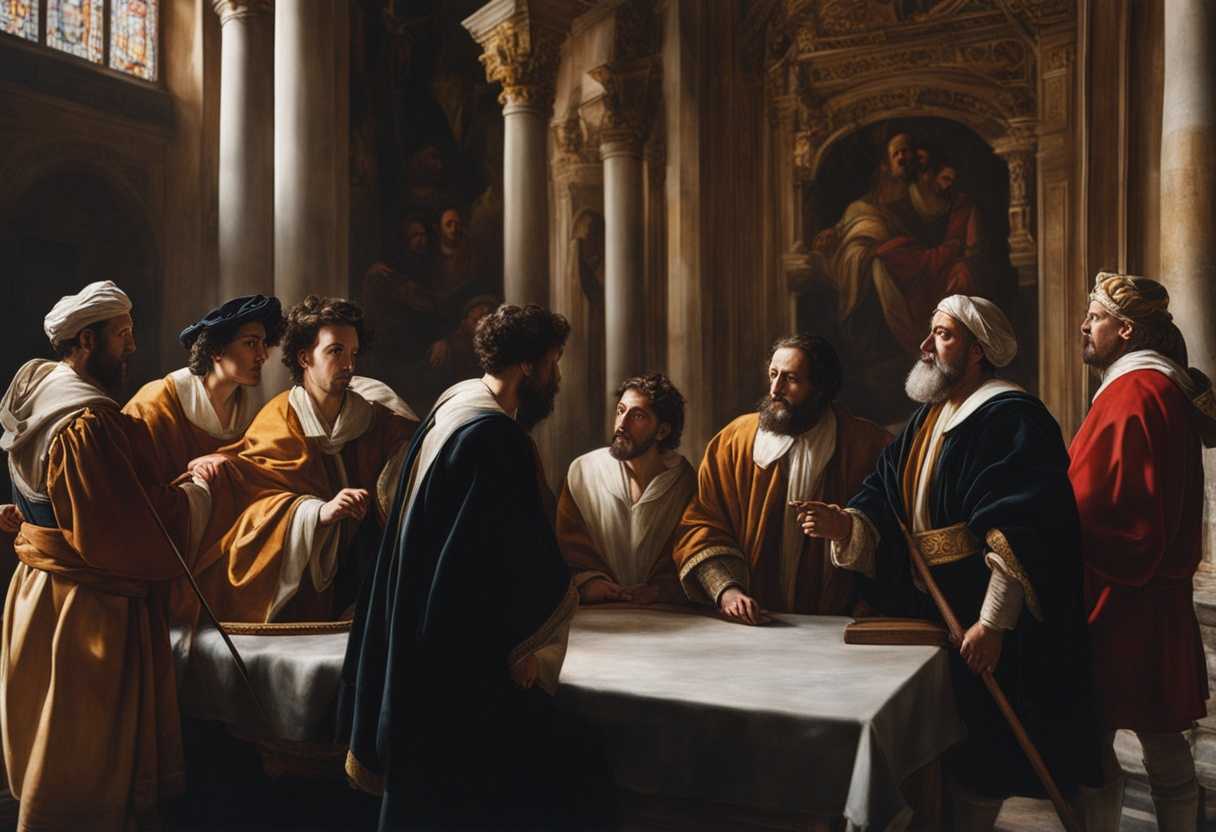
Setting the Scene for Acts 13:13-25
In Acts chapter 13, we find the apostle Paul and his companions on their first missionary journey. The scene unfolds as they arrive in Perga, a city in Pamphylia. Paul, along with Barnabas and John Mark, had set sail from Paphos and landed in Perga. However, at this point, John Mark decides to leave them and return to Jerusalem. This departure may have caused some tension or disappointment among the group, but they continued on their journey nonetheless.
As they explore Perga, they come across a synagogue where they are invited to speak. Paul, being a learned Pharisee and a zealous follower of Christ, seizes the opportunity to address the Jewish community. In his speech, he recounts the history of Israel, starting from their time in Egypt to the establishment of King David. Paul skillfully weaves in the message of Jesus as the promised Savior, connecting the dots between the Old Testament prophecies and the fulfillment in Christ. The surroundings are likely a simple synagogue setting, with attentive listeners eager to hear what Paul has to say about their faith and the Messiah.
The atmosphere is charged with anticipation and curiosity as Paul passionately delivers his message, drawing parallels between the scriptures and the life of Jesus. The audience is a mix of Jews and God-fearing Gentiles, all seeking spiritual truth and understanding. Paul’s words resonate deeply with some, stirring their hearts and minds, while others may be skeptical or resistant to this new interpretation of their faith. The scene is set for a profound moment of revelation and transformation as Paul continues to preach the gospel with conviction and clarity.
What is Acts 13:13-25 about?
Let’s imagine ourselves in Antioch, listening to Paul as he passionately speaks about Israel’s past and the fulfillment of prophecy through Jesus. Paul’s preaching in Antioch is not merely a historical retelling but a powerful declaration of God’s faithfulness and plan for salvation. Paul is showing the continuity of God’s plan throughout history by connecting the dots between Israel’s journey and Jesus’ role as the promised Savior. Let’s ponder the significance of Jesus as the fulfillment of prophecy as we reflect on this verse. How does Paul’s message in Antioch remind us of God’s sovereign plan and ultimate promise of redemption? Paul emphasizes the importance of recognizing and accepting God’s gift of salvation by pointing to Jesus as the Savior. This verse challenges us to see Jesus not just as a historical figure but as the pivotal point in God’s plan for humanity’s redemption. Let’s take this message to heart and embrace Jesus as our Savior with gratitude and faith.
Understanding what Acts 13:13-25 really means
In Acts 13:13-25, we find Paul and his companions embarking on a missionary journey, spreading the Gospel message far and wide. As they arrive in Pisidian Antioch and attend a synagogue service, Paul seizes the opportunity to address the gathered crowd. His message is not merely a recounting of Israel’s history but a powerful declaration pointing to Jesus as the long-awaited Savior promised by God.
“Men of Israel and you who fear God, listen,” Paul’s opening phrase sets the tone for inclusivity in his message. By addressing both Jews and God-fearing Gentiles, he emphasizes that the Gospel is for all who seek God. The narrative unfolds with a reminder of God’s sovereign choice in selecting Israel’s forefathers and raising up David as their king. David’s significance lies not only in his reign but as a foreshadowing figure pointing to the ultimate King, Jesus.
The crux of Paul’s message culminates in the proclamation that Jesus, from David’s lineage, is the promised Savior brought to Israel by God. This declaration ties back to God’s covenant with David, promising an eternal kingdom through his descendants. The prophecies in Isaiah further reinforce the lineage of the Messiah, while Luke’s account of the angel Gabriel’s announcement to Mary solidifies Jesus’ Davidic lineage and eternal reign.
Today, the passage resonates with profound relevance. It serves as a testament to God’s faithfulness in fulfilling His promises, offering a beacon of hope in a world fraught with broken commitments. Moreover, the inclusivity of the Gospel message underscores the unity it brings, transcending cultural and societal barriers. Jesus, as the promised Savior, continues to offer hope and salvation to all, a message that remains as vital today as it was in ancient times.
To illustrate the impact of Jesus’ arrival as the promised Savior, envision a community eagerly anticipating a leader who embodies change and hope. Generations pass, promises are made, and finally, the awaited leader arrives, fulfilling every pledge. His presence ushers in joy, unity, and a renewed sense of purpose. Similarly, Jesus’ advent as the promised Savior brings fulfillment, hope, and unity to all who embrace Him.
In conclusion, Acts 13:13-25 serves as a poignant reminder of God’s unwavering faithfulness and the fulfillment of His promises through Jesus Christ. It beckons us to embrace the inclusive nature of the Gospel and the hope it offers in our lives today. By delving into the historical context and related scriptures, we gain a deeper appreciation of God’s intricate plan and its enduring significance in our daily walk of faith.
What is the significance of John the Baptist’s role?
John the Baptist plays a significant role as a precursor to Jesus Christ, preparing the way for His ministry. John’s preaching and baptism prepared the hearts of the people for the coming of the Messiah. He called for repentance and pointed to Jesus as the one to come after him, the Savior who would bring salvation to the world. This highlights the importance of John the Baptist in God’s plan of redemption, as he had a vital role in announcing the arrival of Jesus and paving the way for His ministry.
John’s humility and dedication to his mission are also noteworthy. Despite his own popularity and following, John always directed people’s attention to Jesus, recognizing Him as the central figure in God’s plan. He understood the temporary nature of his role and willingly decreased so that Jesus could increase. This selfless devotion to pointing others to Jesus exemplifies John’s obedience to God’s will and his commitment to fulfilling his purpose in God’s kingdom. John the Baptist’s role serves as a powerful example for believers to humbly fulfill their God-given calling and point others to Jesus as the ultimate source of salvation.
Application
Reflect on the boldness and passion of Paul as he fearlessly shared the Gospel. Like him, how will you respond to your own calling in life? Will you have the courage to step out in faith and make an impact? Trust in God’s power to work through you. Take that step of faith today to advance God’s Kingdom. Are you ready to embrace the challenge?

Reverend Michael Johnson is an experienced Church Minister with a profound expertise in spirituality and guidance. With a serene presence and a compassionate heart, he has faithfully served his congregation for over 20 years, leading them on a spiritual journey towards inner peace and enlightenment. Reverend Johnson’s extensive knowledge of religious philosophies and profound understanding of human nature have made him a trusted confidant and mentor to many, as he seamlessly weaves his profound wisdom into life teachings. Reverend Johnson’s calming demeanor and empathetic nature continue to uplift and heal souls, nurturing a sense of unity and tranquility within his community.