
Acts 3:1-8 is about Peter and John encountering a man who was lame from birth at the temple gate called Beautiful, showcasing the transformative power of faith and demonstrating that through belief in Jesus Christ, healing and restoration can occur in the most unexpected of ways.
1 Now Peter and John were going up to the temple at the hour of prayer, the ninth hour.
2 And a man lame from birth was being carried, whom they laid daily at the gate of the temple that is called the Beautiful Gate to ask alms of those entering the temple.
3 Seeing Peter and John about to go into the temple, he asked to receive alms.
4 And Peter directed his gaze at him, as did John, and said, “Look at us.”
5 And he fixed his attention on them, expecting to receive something from them.
6 But Peter said, “I have no silver and gold, but what I do have I give to you. In the name of Jesus Christ of Nazareth, rise up and walk!”
7 And he took him by the right hand and raised him up, and immediately his feet and ankles were made strong.
8 And leaping up, he stood and began to walk, and entered the temple with them, walking and leaping and praising God.
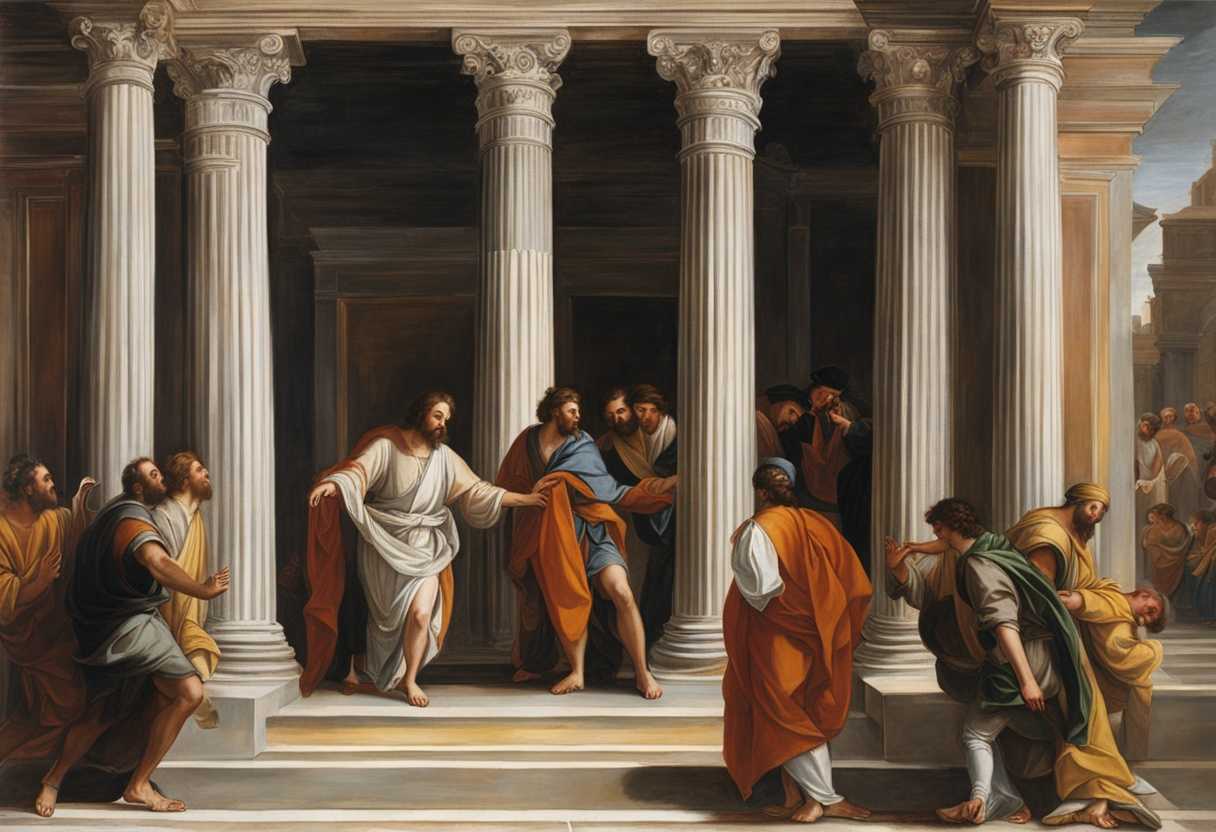
Setting the Scene for Acts 3:1-8
In Acts chapter 3, we find Peter and John heading to the temple in Jerusalem for the afternoon prayer. The scene is bustling with people coming and going, offering sacrifices, and engaging in prayer and worship. As they approach the temple gate called Beautiful, they encounter a man who has been lame from birth. This man is a familiar sight to many who frequent the temple, as he is often carried and placed at the gate to ask for alms from those entering the temple.
Peter and John, filled with the Holy Spirit, stop in front of the man and engage with him. The man looks up at them, expecting to receive some money, but instead, Peter fixes his gaze on him and says, “Silver or gold I do not have, but what I do have I give you. In the name of Jesus Christ of Nazareth, walk.” With these words, Peter reaches out his hand and helps the man up, instantly healing him. The man, who had never walked before, is now leaping and praising God, causing a commotion among the onlookers at the temple gate. This miraculous event serves as a powerful testimony to the transformative power of Jesus Christ and draws many to witness the work of God in their midst.
What is Acts 3:1-8 about?
Isn’t it incredible how Peter, filled with the Holy Spirit, was able to heal a man who had been unable to walk since birth? The image of the lame beggar being miraculously restored by Peter’s words and faith is a powerful testament to the limitless power of God and His compassion for His children. This miraculous healing not only physically restored the beggar but also served as a sign of the transformative power of the Gospel. God can work through His followers to bring about healing and restoration in the lives of others, as seen in this verse. It serves as a reminder that no matter how broken or helpless we may feel, God’s power is able to bring about transformation and wholeness. We too can be vessels of God’s love and compassion in the world around us, just as Peter brought healing to the lame beggar. Let us trust that God can work miracles through us for the glory of His kingdom by being open to the leading of the Holy Spirit and willing to step out in faith.
Understanding what Acts 3:1-8 really means
Structure for Commentary:
- Introduction and Context
- Detailed Analysis of Key Phrases
- Related Biblical Passages
- Relevance to Contemporary Life
- Anecdote for Illustration
- Peter and John head to the temple for prayer in Acts 3:1-8. They encounter a man who has been lame from birth, asking for alms. Instead of giving money, Peter heals him in the name of Jesus Christ, and the man leaps up and praises God. This passage is a powerful testament to the transformative power of faith and the miracles that can happen through belief in Jesus.
Detailed Analysis of Key Phrases:
“Peter said, ‘Silver or gold I do not have, but what I do have I give you.’” This phrase emphasizes that spiritual wealth far exceeds material wealth. Peter and John couldn’t offer money, but they provided something of infinitely greater value—healing and spiritual renewal. Walk in the name of Jesus Christ of Nazareth.” The invocation of Jesus’ name signifies the source of their power. It’s not their own, but through Jesus that the miracle is performed. This highlights the centrality of Jesus in the early church’s ministry and in the life of believers.
Related Biblical Passages:
James 2:5 reminds us, “Has not God chosen those who are poor in the eyes of the world to be rich in faith and to inherit the kingdom he promised those who love him?” This aligns with Peter’s act of offering spiritual richness over material wealth. Additionally, John 14:12 records Jesus saying, “Whoever believes in me will do the works I have been doing, and they will do even greater things than these, because I am going to the Father.” This is a foretelling of the miracles the apostles would perform. We often equate success and help with material wealth in today’s world. However, Acts 3 challenges us to reconsider what true richness is. Spiritual health, community, and faith can provide deeper fulfillment. It encourages us to look beyond material solutions and seek spiritual growth and healing.
Anecdote for Illustration:
I recall a time when our church community was struggling financially. We couldn’t offer much in terms of monetary support, but we dedicated time to prayer and community service. One day, a member shared how these acts of love and support helped him overcome a period of deep depression. He said, “The prayers and emotional support were worth more than any amount of money.” Much like the lame man, he found healing in spiritual wealth.
Conclusion and Call to Reflect:
Acts 3:1-8 is a profound reminder of the power of faith and the miracles that can occur through Jesus Christ. It calls us to prioritize spiritual over material wealth and to serve others with the gifts we have been given. Reflect on your own life—how can you offer spiritual richness to those around you? Can you, like Peter and John, provide healing and hope through your faith?
How can we effectively show love and compassion to others?
We can effectively show love and compassion to others by being attentive and responsive to their needs, just as the passage in Acts 3 illustrates. Peter and John encountered a man who was lame from birth begging for alms in the story. Instead of merely giving him money and passing by, they took the time to engage with him, showing care and compassion. They not only acknowledged his physical need but also extended a helping hand to lift him up and bring about a lasting change in his life. We can show love and compassion by offering genuine help and support to those in need. Peter and John took action to address the root cause of the man’s suffering by healing him through the power of Jesus Christ, not just sympathizing with his situation. We can make a real difference in the lives of others and demonstrate the love and mercy that Jesus embodied during his ministry on earth by being proactive in our expressions of care and kindness.
Furthermore, showing love and compassion involves going beyond what is expected or convenient. Peter and John could have easily ignored the man begging at the temple gate, but they chose to step out of their way, risking potential backlash from the religious authorities, to extend a helping hand. Likewise, we can demonstrate love and compassion by being willing to inconvenience ourselves, make sacrifices, and advocate for those who are marginalized or overlooked in society.
Application
Imagine you’re at work and a colleague is struggling, or at home and a loved one feels lost. Acts 3:1-8 teaches us the power of faith and transformation through Jesus. Step up like Peter and John; be that vessel of hope. Someone near you needs that healing touch. Will you be their beacon of hope today?

Reverend Michael Johnson is an experienced Church Minister with a profound expertise in spirituality and guidance. With a serene presence and a compassionate heart, he has faithfully served his congregation for over 20 years, leading them on a spiritual journey towards inner peace and enlightenment. Reverend Johnson’s extensive knowledge of religious philosophies and profound understanding of human nature have made him a trusted confidant and mentor to many, as he seamlessly weaves his profound wisdom into life teachings. Reverend Johnson’s calming demeanor and empathetic nature continue to uplift and heal souls, nurturing a sense of unity and tranquility within his community.