
Acts 8:26-38 is about Philip encountering the Ethiopian eunuch and leading him to understand the scriptures, demonstrating how God’s message is for all people regardless of their background or status.
26 Now an angel of the Lord said to Philip, “Rise and go toward the south to the road that goes down from Jerusalem to Gaza.” This is a desert place.
27 And he rose and went. And there was an Ethiopian, a eunuch, a court official of Candace, queen of the Ethiopians, who was in charge of all her treasure. He had come to Jerusalem to worship
28 And he was returning, seated in his chariot, and he was reading the prophet Isaiah.
And the Spirit said to Philip, “Go over and join this chariot.”
30 So Philip ran to him and heard him reading Isaiah the prophet and asked, “Do you understand what you are reading?”
31 And he said, “How can I, unless someone guides me?” And he invited Philip to come up and sit with him.
32 Now the passage of the Scripture that he was reading was this: “Like a sheep he was led to the slaughter and like a lamb before its shearer is silent, so he opens not his mouth.
33 In his humiliation justice was denied him. Who can describe his generation? For his life is taken away from the earth.
34 And the eunuch said to Philip, “About whom, I ask you, does the prophet say this, about himself or about someone else?”
35 Then Philip opened his mouth, and beginning with this Scripture he told him the good news about Jesus.
36 And as they were going along the road they came to some water, and the eunuch said, “See, here is water! What prevents me from being baptized?”
37 And Philip said, “If you believe with all your heart, you may.” And he replied, “I believe that Jesus Christ is the Son of God.”
38 And he commanded the chariot to stop, and they both went down into the water, Philip and the eunuch, and he baptized him.
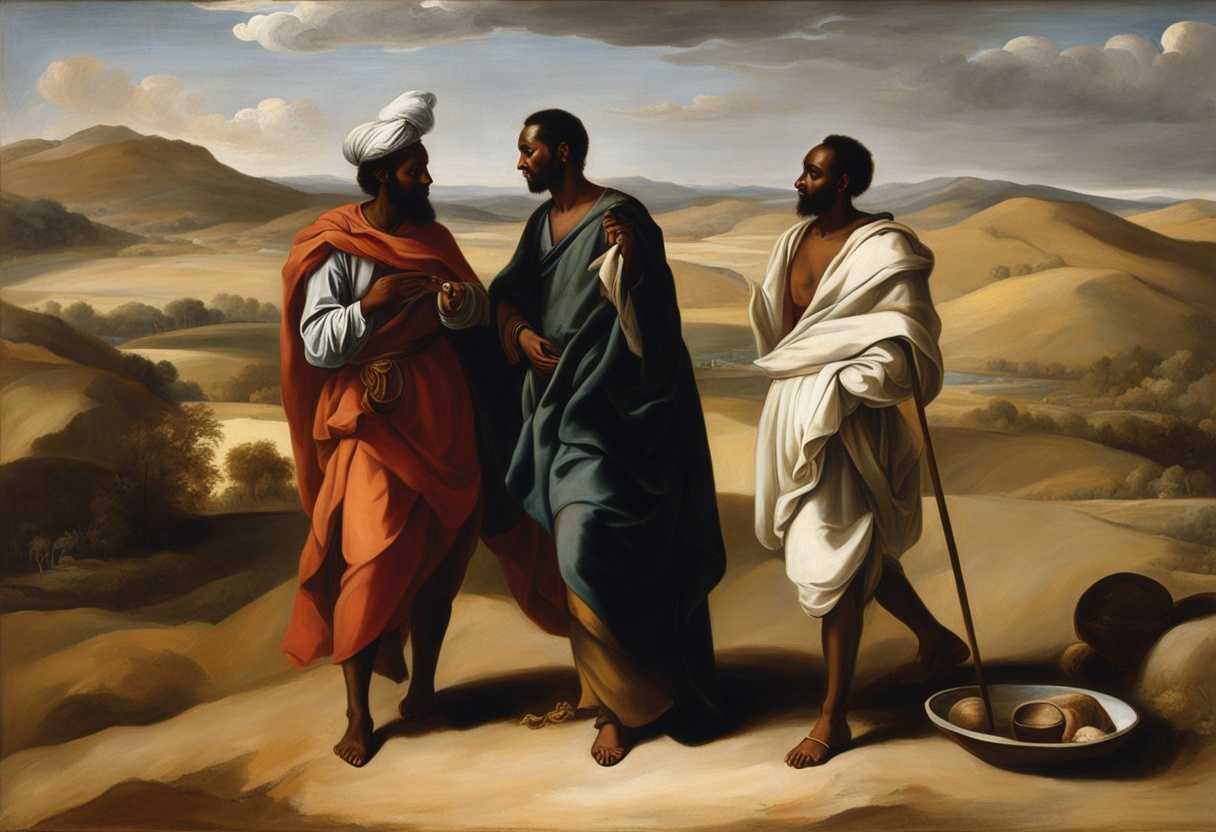
Setting the Scene for Acts 8:26-38
In Acts chapter 8, we find Philip, one of the seven chosen to serve the early Christian community, being directed by an angel of the Lord to go south to the road that goes down from Jerusalem to Gaza. As Philip obediently follows the angel’s instructions, he encounters an Ethiopian eunuch who is returning from Jerusalem where he had gone to worship.
The Ethiopian eunuch is sitting in his chariot, reading aloud from the book of Isaiah. He is a high official in charge of all the treasury of the Kandake (Candace), the queen of the Ethiopians. The eunuch is a seeker of God, trying to understand the scriptures he is reading. Philip, prompted by the Holy Spirit, approaches the chariot and engages the eunuch in conversation about the passage he is reading. This leads to Philip explaining the good news of Jesus Christ to him, and ultimately baptizing him in a nearby body of water.
The scene is set on a dusty road leading from Jerusalem to Gaza, with the hot sun beating down on the travelers. The landscape is arid, with occasional patches of greenery and rocky outcrops. The chariot of the Ethiopian eunuch is ornate and grand, drawn by horses and accompanied by a small entourage. Philip, a man filled with the Holy Spirit, approaches the chariot with a sense of divine purpose, ready to share the gospel with the eunuch and witness the transformative power of God’s word in his life.
What is Acts 8:26-38 about?
Philip, a follower of Jesus, baptizes an Ethiopian eunuch after sharing with him the prophecy from the book of Isaiah that foretold the coming of Jesus in this verse. This event is significant because it exemplifies the power of sharing the message of Christ with others and how it can lead to transformations and acceptance of faith.
It is fascinating to see how Philip, prompted by the Holy Spirit, is able to explain the scripture to the Ethiopian eunuch, who then comes to believe in Jesus and expresses his desire to be baptized. This verse teaches us about the importance of spreading the gospel and how it can transcend cultural and social boundaries, as seen in the interaction between Philip, a Jew, and the Ethiopian eunuch, a non-Jewish individual. It highlights the inclusive nature of Christianity and how the message of Jesus is meant for all people, regardless of their background or circumstances. Let us reflect on this verse and ponder our role in sharing the good news of Jesus with others. How can we follow Philip’s example in explaining the scripture to those who may not yet understand it? How can we be open to the leading of the Holy Spirit in guiding us to those who are seeking to know more about Jesus? Philip’s boldness and willingness to share his faith can inspire us, as our actions may also witness the transformative power of God’s love in the lives of those around us.
Understanding what Acts 8:26-38 really means
The passage in Acts 8:26-38 recounts the encounter between Philip and the Ethiopian eunuch, illustrating divine guidance, the significance of understanding scripture, and the transformative power of faith. Philip’s obedience to the angel’s instruction to go south to the desert road exemplifies unwavering faith and willingness to follow God’s leading without hesitation. This narrative prompts us to reflect on our own receptiveness to divine guidance in our lives and our readiness to step out in faith when called upon.
When Philip asks the eunuch if he understands what he is reading, it underscores the importance of not merely reading scripture but comprehending its deeper meanings. This interaction highlights Philip’s role as a teacher and guide, emphasizing the value of sharing knowledge and insights with others to deepen their understanding of God’s word. It challenges us to consider how we engage with scripture and whether we actively seek to grasp its significance in our lives and in the lives of those around us.
The eunuch’s immediate response to the opportunity for baptism upon encountering water signifies his eagerness and readiness to embrace faith. His question, “What can stand in the way of my being baptized?” underscores the simplicity and accessibility of embracing faith and committing to a life of discipleship. This prompts us to reflect on our own readiness to respond to God’s call and to take decisive steps in our spiritual journey without hesitation or delay.
In today’s context, the story of Philip and the Ethiopian eunuch serves as a poignant reminder of the importance of evangelism and the role each of us can play in sharing the message of faith with others. It challenges us to consider how we can be vessels of God’s love and truth in a world that is often in need of spiritual guidance and understanding. The eunuch’s eagerness to be baptized serves as a powerful example of the transformative impact of faith and the profound change that can occur when we wholeheartedly embrace God’s calling in our lives.
Imagine a scenario in our modern world where someone is struggling to grasp a complex concept or find clarity in a challenging situation. Just as Philip guided the eunuch through the scripture, we too can step in to offer support, wisdom, and guidance to those in need. This anecdote reminds us of the profound impact we can have on others by sharing our faith, knowledge, and understanding, helping them navigate their spiritual journey with clarity and purpose.
In conclusion, the story of Philip and the Ethiopian eunuch resonates with timeless truths about faith, understanding scripture, and the transformative power of embracing God’s word. It encourages us to be open to divine guidance, to deepen our understanding of scripture, and to actively engage in sharing our faith with others. May we heed the lessons from this narrative and be inspired to walk in faith, share God’s love, and guide others on their spiritual path with compassion and wisdom.
How can we be open to God’s guidance?
To be open to God’s guidance, we can first cultivate a heart that is willing to listen and follow His voice. We too can create space in our lives for prayer, reflection, and quietude so that we can hear God’s direction clearly, just as Philip was receptive to the Spirit’s prompting to go to the desert road. We demonstrate an openness to receive His guidance and allow Him to lead us on the path He has prepared for us by surrendering our own plans and desires to His will.
Additionally, we can seek to be sensitive to the opportunities and people that God places in our lives. Philip was attentive to the Ethiopian eunuch and his reading of Scripture, which led to a divine appointment where he could share the Gospel and baptize the eunuch. We can step into situations where God is calling us to be His hands and feet by being aware of the divine appointments and doors that He opens for us, allowing His guidance to manifest through our actions and words.
Finally, staying rooted in God’s Word and prayer equips us to discern His guidance more effectively. We can rely on the truths of the Bible to inform our decisions and actions, just as Philip explained the Scriptures to the eunuch and pointed him to Jesus. We position ourselves to align our thoughts and actions with God’s will by being immersed in Scripture and spending dedicated time in prayer, enabling us to walk in His guidance each day.
Application
Embrace Philip’s example in Acts 8:26-38 by being receptive to divine guidance and spreading the message of Christ to all. Open your heart to the prompting of the Spirit, just as Philip did with the Ethiopian eunuch. It’s time to step into your role as an instrument of God’s grace in this fast-paced world. Will you join the ranks of those who fearlessly carry the torch of faith to the ends of the earth?

Reverend Michael Johnson is an experienced Church Minister with a profound expertise in spirituality and guidance. With a serene presence and a compassionate heart, he has faithfully served his congregation for over 20 years, leading them on a spiritual journey towards inner peace and enlightenment. Reverend Johnson’s extensive knowledge of religious philosophies and profound understanding of human nature have made him a trusted confidant and mentor to many, as he seamlessly weaves his profound wisdom into life teachings. Reverend Johnson’s calming demeanor and empathetic nature continue to uplift and heal souls, nurturing a sense of unity and tranquility within his community.