
1 Now the Lord said to Abram, “Go from your country and your kindred and your father’s house to the land that I will show you.
2 And I will make of you a great nation, and I will bless you and make your name great, so that you will be a blessing.
3 I will bless those who bless you, and him who dishonors you I will curse, and in you all the families of the earth shall be blessed.”
4 So Abram went, as the Lord had told him, and Lot went with him. Abram was seventy-five years old when he departed from Haran.
5 Then Abram took Sarai his wife and Lot his brother’s son, and all their possessions that they had gathered, and the people that they had acquired in Haran, and they set out to go to the land of Canaan.
6 Abram passed through the land to the place at Shechem, to the oak of Moreh. At that time the Canaanites were in the land.
7 Then the Lord appeared to Abram and said, “To your offspring I will give this land.” So he built there an altar to the Lord, who had appeared to him.
8 From there he moved to the hill country on the east of Bethel and pitched his tent, with Bethel on the west and Ai on the east. And there he built an altar to the Lord and called upon the name of the Lord.
9 And Abram journeyed on, still going toward the Negeb.
Now there was a famine in the land.
11 When he was about to enter Egypt, he said to Sarai his wife, “I know that you are a woman beautiful in appearance,
12 When the Egyptians see you, they will say, ‘This is his wife.’ Then they will kill me, but they will let you live.
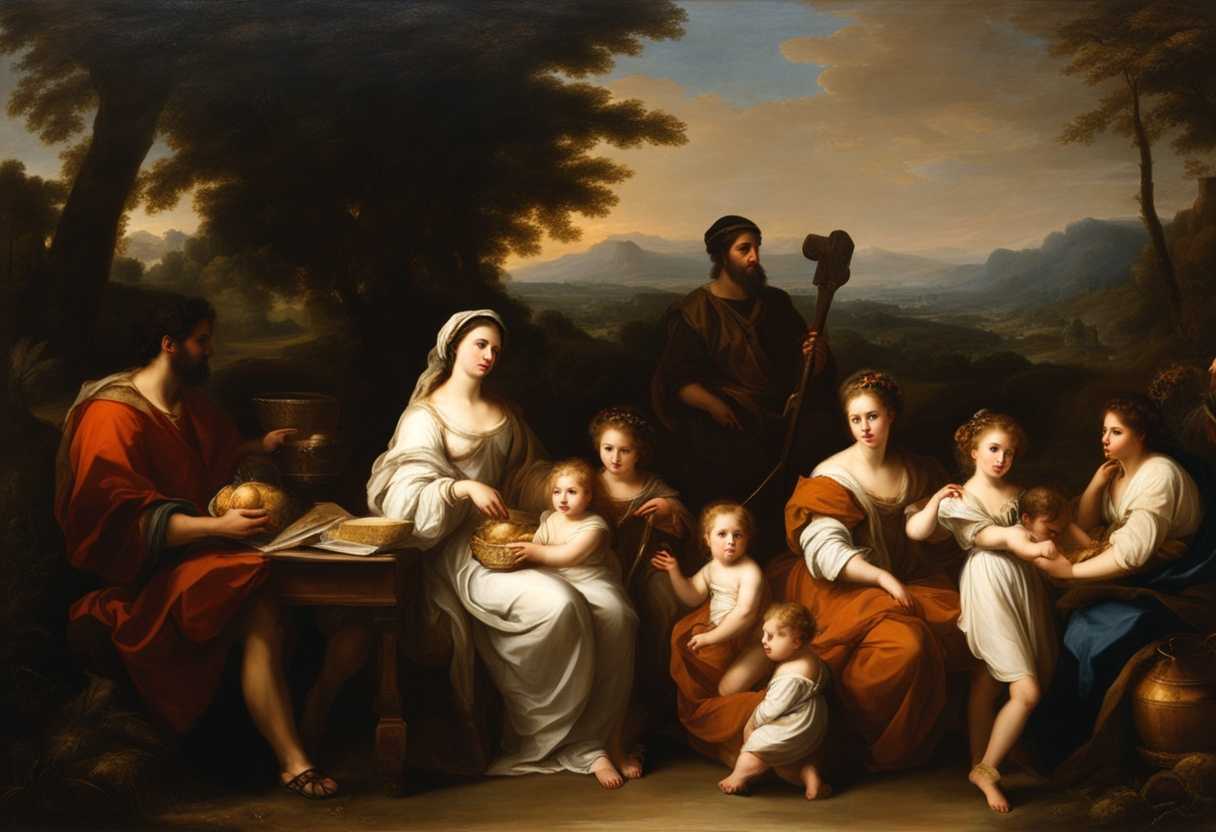
Setting the Scene for Genesis 12:1-12
In Genesis chapter 12, we find Abram, later known as Abraham, in the land of Haran. He is living there with his wife Sarai, his nephew Lot, and their household. The scene is set in a bustling city, with people going about their daily activities, merchants selling their goods, and animals being herded through the streets. The city is filled with the sounds of voices haggling, animals braying, and the clinking of coins.
Abram receives a call from God to leave his homeland and go to a land that God will show him. This is a pivotal moment in Abram’s life, as he is being asked to leave behind everything he knows and step out in faith. The decision to obey God’s command is not an easy one, as it means leaving behind the comfort and security of his home, family, and familiar surroundings. However, Abram trusts in God’s promise that he will be blessed and become a great nation.
As Abram prepares to embark on this journey of faith, he gathers his family and belongings, including his flocks and herds, and sets out on the long and arduous journey to the land of Canaan. The scene is filled with a sense of anticipation and uncertainty, as Abram and his family step out into the unknown, trusting in God’s guidance and provision.
What is Genesis 12:1-12 about?
God is calling Abram to step out in faith and leave behind everything familiar to him – his country, his family, his home in this verse. This act of leaving is a symbol of surrendering one’s own plans and trusting in God’s promises. It can be daunting to leave everything behind and step into the unknown, but God promises to bless Abram for his obedience.
Imagine the courage it takes to leave your comfort zone and follow a calling that seems uncertain. Abram’s faith in God’s promise of blessing is a reminder to us that sometimes we need to take a leap of faith and trust that God will guide us. Just like Abram, we may not know what the future holds, but we can be assured that God’s plans for us are good and purposeful. This verse challenges us to reflect on our own willingness to trust in God’s promises and step boldly into the unknown, knowing that He is faithful to bless those who follow Him with a humble heart.
Understanding what Genesis 12:1-12 really means
We find ourselves peering into a pivotal moment in biblical history in Genesis 12:1-2. Let’s explore these verses in a structured way to uncover their deeper meanings and implications.
Firstly, the call of Abram, as this passage is often referred, highlights a fundamental act of divine initiative. The phrase “Leave your country, your people and your father’s household” speaks to a profound act of obedience that God demands of Abram. Here, God is not just asking Abram to move physically but to leave behind his cultural identity, familial ties, and security. It’s a call to radical trust and submission to God’s plan, which we, as followers, might also hear in various ways in our own spiritual journeys.
God’s promises to Abram, encapsulated in the words “I will make you into a great nation,” and “I will bless you,” serve as the cornerstone of the Abrahamic covenant. This covenant is not merely a contractual agreement but a dynamic relationship initiated by God with humanity. For us today, this echoes the personal relationship God seeks with each of us, promising us blessings not necessarily of material wealth but of a spiritual and communal nature.
Connecting this passage with Galatians 3:29, “If you belong to Christ, then you are Abraham’s seed, and heirs according to the promise,” we see the extension and fulfillment of this promise in the New Testament. Through faith in Christ, believers are grafted into this covenant, inheriting the spiritual blessings promised to Abram, which cross the boundaries of time and culture.
Why is this relevant to us today? Many face modern challenges of identity and belonging amid a rapidly changing global culture. Abram’s journey reminds us that our most fundamental identity and security lie not in our nations or biological families but in our relationship with God.
An anecdote that beautifully illustrates this comes from a congregant, who, after years of struggling with a sense of belonging due to his mixed heritage, found solace and identity in his spiritual lineage as part of God’s family, much like Abram. It was a powerful reminder that our primary identity is as children of God, above all else. Genesis 12:1-2 challenges each of us to consider our priorities and the foundation of our identity, not just a historical account but a timeless narrative. Abram’s obedience and the promises God offers beckon us to re-evaluate our own paths and the extent of our trust in God’s grand narrative for our lives. What might God be calling you to leave behind, and what promises does He hold for your future?
How can we trust God’s guidance over our comfort?
We can trust God’s guidance over our comfort by understanding that He has a plan and a purpose for our lives that may require us to step out of our comfort zones. God called Abraham to leave his homeland and go to a place that God would show him in the referenced verses. This was not an easy decision for Abraham, as it meant leaving behind everything familiar to him, but he trusted in God’s guidance and obeyed.
Sometimes God’s guidance may lead us to uncomfortable or unfamiliar places, but if we trust in His wisdom and sovereignty, we can be confident that He is leading us to where we need to be. While stepping out of our comfort zones may be challenging, it is often in these moments that we experience the most growth and blessings. We show our faith and trust in His plans for us by choosing to follow God’s guidance, even when it goes against our natural desire for comfort.
Application
Imagine standing at the crossroads of your life, much like Abram at the brink of an unknown journey. Think of your career as a sprawling map, your family and relationships as your trusty compass. God is nudging you to chart a new course, to venture into unexplored territories where the outcomes are not visible but the promise of fulfillment is real. It takes courage to leave the familiar behind and embrace the uncertainty of God’s plan. Are you ready to trust that guidance, to take that leap of faith, knowing that each step forward is a step toward your divine purpose? Will you set sail on this grand adventure, even without seeing the shore?

Reverend Michael Johnson is an experienced Church Minister with a profound expertise in spirituality and guidance. With a serene presence and a compassionate heart, he has faithfully served his congregation for over 20 years, leading them on a spiritual journey towards inner peace and enlightenment. Reverend Johnson’s extensive knowledge of religious philosophies and profound understanding of human nature have made him a trusted confidant and mentor to many, as he seamlessly weaves his profound wisdom into life teachings. Reverend Johnson’s calming demeanor and empathetic nature continue to uplift and heal souls, nurturing a sense of unity and tranquility within his community.