
34 So he said, “I am Abraham’s servant.
35 The Lord has greatly blessed my master, and he has become great. He has given him flocks and herds, silver and gold, male servants and female servants, camels and donkeys.
36 And Sarah my master’s wife bore a son to my master when she was old, and to him he has given all that he has.
37 My master made me swear, saying, ‘You shall not take a wife for my son from the daughters of the Canaanites, in whose land I dwell,
38 but you shall go to my father’s house and to my clan and take a wife for my son.’
42 “I came today to the spring and said, ‘O Lord, the God of my master Abraham, if now you are prospering the way that I go,”
43 Behold, I am standing by the spring of water. Let the virgin who comes out to draw water, to whom I shall say, “Please give me a little water from your jar to drink,”
44 and she shall say to me, “Drink, and I will draw for your camels also,” let her be the woman whom the Lord has appointed for my master’s son.’
45 “Before I had finished speaking in my heart, behold, Rebekah came out with her water jar on her shoulder, and she went down to the spring and drew water. I said to her, ‘Please let me drink.’”
46 She quickly let down her jar from her shoulder and said, ‘Drink, and I will give your camels drink also.’ So I drank, and she gave the camels drink also.
47 Then I asked her, ‘Whose daughter are you?’ She said, ‘The daughter of Bethuel, Nahor’s son, whom Milcah bore to him.’ So I put the ring on her nose and the bracelets on her arms.
48 Then I bowed my head and worshiped the Lord and blessed the Lord, the God of my master Abraham, who had led me by the right way to take the daughter of my master’s kinsman for his son.
49 Now then, if you are going to show steadfast love and faithfulness to my master, tell me; and if not, tell me, that I may turn to the right hand or to the left.”
58 And they called Rebekah and said to her, “Will you go with this man?” She said, “I will go.”
59 So they sent away Rebekah their sister and her nurse, and Abraham’s servant and his men.
60 And they blessed Rebekah and said to her,
“Our sister, may you become
thousands of ten thousands,
and may your offspring possess
the gate of those who hate him!”
61 Then Rebekah and her young women arose and rode on the camels and followed the man. Thus the servant took Rebekah and went his way.
62 Now Isaac had returned from Beer-lahai-roi and was dwelling in the Negeb.
63 And Isaac went out to meditate in the field toward evening. And he lifted up his eyes and saw, and behold, there were camels coming.
64 And Rebekah lifted up her eyes, and when she saw Isaac, she dismounted from the camel.
65 and said to the servant, “Who is that man, walking in the field to meet us?” The servant said, “It is my master.” So she took her veil and covered herself.
66 And the servant told Isaac all the things that he had done.
67 Then Isaac brought her into the tent of Sarah his mother and took Rebekah, and she became his wife, and he loved her. So Isaac was comforted after his mother’s death.
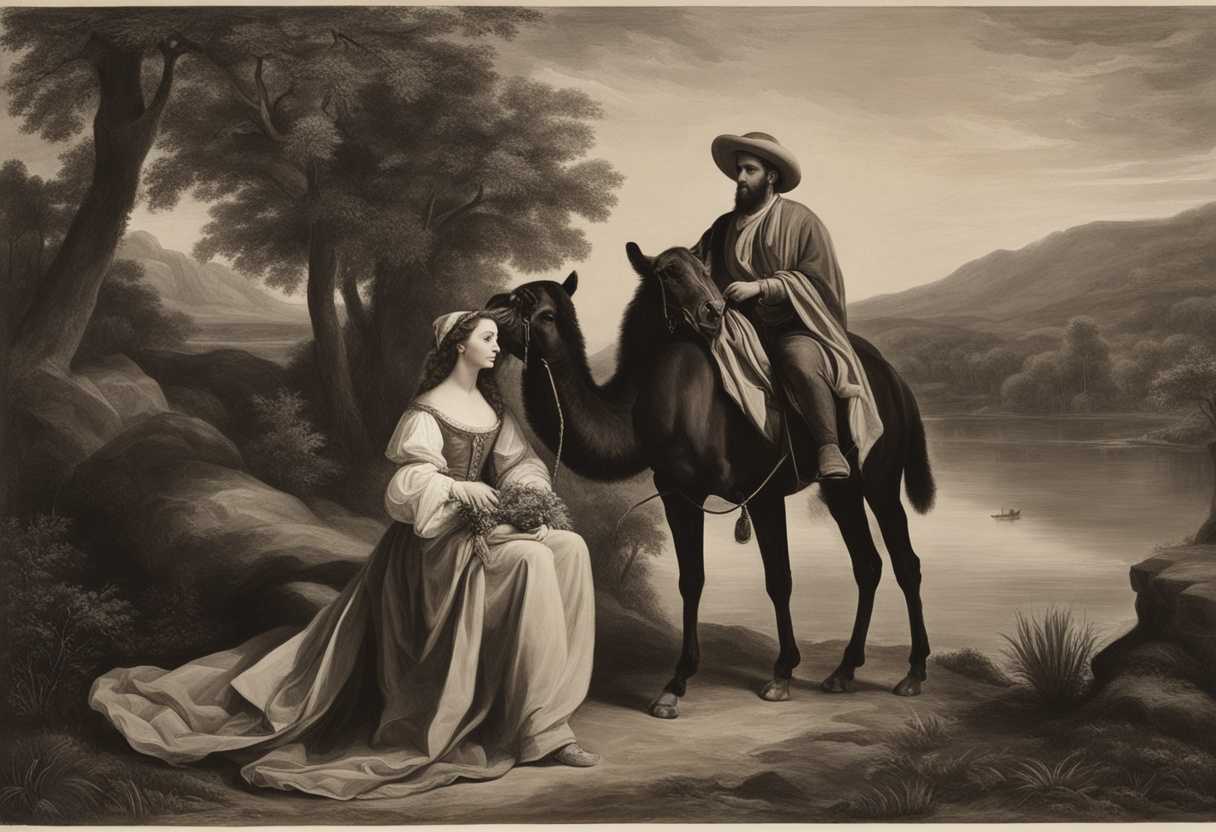
Setting the Scene for Genesis 24:34-38, 42-49, 58-67
In Genesis 24, we find the scene where Abraham’s servant is on a mission to find a wife for Isaac. The servant has traveled a great distance to the city of Nahor, where Abraham’s relatives reside. As he arrives at the well outside the city, he prays to God for a sign to identify the woman who is meant to be Isaac’s wife. Before he even finishes his prayer, a young woman named Rebekah appears at the well. She not only offers the servant a drink but also volunteers to water his camels, showing her kindness and generosity.
The servant is amazed by this divine encounter and asks Rebekah about her family. Learning that she is the granddaughter of Abraham’s brother, Nahor, the servant is overjoyed and thanks God for leading him to the right woman. He presents gifts to Rebekah and her family, and after receiving their blessing, he brings Rebekah back to Canaan to meet Isaac. The scene is filled with anticipation and excitement as Rebekah embarks on this journey to meet her future husband, Isaac, who is waiting in the field. The love story unfolds as Isaac and Rebekah are united in marriage, symbolizing God’s faithfulness in fulfilling His promises to Abraham and his descendants.
What is Genesis 24:34-38, 42-49, 58-67 about?
This verse highlights the idea of divine guidance and intervention in our lives. It shows how God orchestrates events and influences our paths to fulfill a greater purpose. Just like how Abraham’s servant was led by God to find a suitable wife for Isaac in Rebekah, it reminds us that there is a higher power at work in our lives, guiding us towards the right direction and people at the right time.
Have you ever experienced a moment where things seemed to fall into place perfectly, almost like it was meant to be? This story of how Rebekah was chosen as Isaac’s wife is a powerful reminder that God’s hand is at work, even in the smallest details of our lives. It teaches us to trust in the journey and have faith that God is leading us towards our purpose and relationships that are in alignment with His plan. This verse prompts us to be open to seeing God’s guidance in our own lives as we reflect on it. It encourages us to trust in His plan and timing, knowing that He has a perfect match for us just like Rebekah was for Isaac. So, let us remain faithful and open to God’s leading, trusting that He will bring the right people and opportunities into our lives at the appointed time.
Understanding what Genesis 24:34-38, 42-49, 58-67 really means
Commentary Structure:
1. Introduction and Context
2. Detailed Breakdown of Key Phrases
3. Relation to Other Biblical Passages
4. Relevance to Modern Life
5. Anecdotal Reflection
6. Conclusion and Call to Reflection
**1. We encounter one of the Bible’s most compelling narratives involving faith, obedience, and divine guidance in Genesis 24. This passage centers around Abraham’s servant’s quest to find a wife for Isaac, showcasing the interplay between human loyalty and divine intervention. Abraham entrusts his servant with this pivotal mission, emphasizing both the practical and spiritual dimensions of seeking God’s will.
2. Detailed Breakdown of Key Phrases
“Put your hand under my thigh” is an ancient oath-taking gesture of utmost seriousness. This act signifies the gravity of the mission and the servant’s obligation to fulfill it faithfully (v.34-38). The phrase, “the LORD, before whom I have walked, will send his angel with you and make your journey a success,” reflects Abraham’s unwavering faith that God’s providence will guide the servant (v.40). This reinforces the interconnectedness of faith and action. The servant recounts his mission’s purpose to Rebekah’s family.42-49), his meticulous narration underscores the divine orchestration evident throughout his journey. “Give me success today, and show kindness to my master Abraham” (v.42) is his prayer, a model of seeking divine favor for just and righteous intentions.
3. Relation to Other Biblical Passages
This narrative parallels with other biblical accounts of divine guidance and chosen partners, such as Ruth’s story in the Book of Ruth. Jesus’ teachings in Matthew 6:33 echo the theme of prioritizing divine direction over human concerns, urging people to seek first his kingdom and his righteousness, with the promise that all these things will be given as well. Furthermore, Proverbs 3:5-6 advises, “Trust in the LORD with all your heart and lean not on your own understanding; in all your ways submit to him, and he will make your paths straight.”
4. Relevance to Modern Life
This passage resonates powerfully with contemporary issues of decision-making, trust, and the search for God-given purpose. The narrative invites us to trust in divine timing and guidance in a culture that often prioritizes quick fixes and independent plans. It stresses the importance of faithful prayer and aligns our daily decisions and long-term goals with God’s will.
**5. Jenny, a young woman seeking direction for her career, is considered in this anecdotal reflection. Like Abraham’s servant, she faced an overwhelming task but chose to lay her concerns before God. She sought divine guidance through prayer, much like the servant did. Slowly, her path became clear through mentors, unexpected opportunities, and moments of confirmation that echoed the narrative’s theme of providence. Jenny’s journey illustrates the timeless principle that trusting God’s plan brings peace and ultimate success.
6. Conclusion and Call to Reflection
Reflect on your challenges and direction in life. Are you, like Abraham’s servant, seeking divine guidance earnestly? Are your decisions rooted in prayer and trust in God’s plan? This passage encourages us to foster a relationship with God that influences all aspects of our lives. Take a moment to earnestly bring your concerns before God, trusting that He is guiding your path, just as He was guiding the servant in his mission.
How can we discern God’s guidance in relationships?
Observing the characteristics of the individuals involved in relationships helps us discern God’s guidance. Just as Abraham’s servant prayed for a specific sign to identify the right woman for Isaac, we too can seek clarity through prayer and reflection on the qualities we desire in a partner. We can recognize when a relationship is in line with God’s plan for us by aligning these qualities with His values and seeking His guidance.
Additionally, we can discern God’s guidance in relationships by looking for His providential hand at work. God orchestrated events in the story of Isaac and Rebekah in a way that confirmed His will for their union. Likewise, we can pay attention to the circumstances and signs that align with God’s plan for our relationships, trusting that He will guide us in the right direction.
Furthermore, seeking counsel from wise and mature believers can help us discern God’s guidance in relationships. Just as the servant sought input from Rebekah’s family members before taking her as a wife for Isaac, we can benefit from the wisdom and guidance of trusted mentors or spiritual leaders who can provide insight and perspective on our relationships. Their discernment and advice can help us navigate potential pitfalls and confirm God’s leading in our partnerships.
Application
Reflect on Rebekah’s story from Genesis 24. Just as she embraced God’s plan with faith and action, your life is filled with moments where you can do the same. At work or with family, are you ready to step up and follow God’s calling? Seize these opportunities with commitment and faith. Will you answer God’s call with the same readiness as Rebekah?

Reverend Michael Johnson is an experienced Church Minister with a profound expertise in spirituality and guidance. With a serene presence and a compassionate heart, he has faithfully served his congregation for over 20 years, leading them on a spiritual journey towards inner peace and enlightenment. Reverend Johnson’s extensive knowledge of religious philosophies and profound understanding of human nature have made him a trusted confidant and mentor to many, as he seamlessly weaves his profound wisdom into life teachings. Reverend Johnson’s calming demeanor and empathetic nature continue to uplift and heal souls, nurturing a sense of unity and tranquility within his community.