
16 Now Laban had two daughters. The name of the older was Leah, and the name of the younger was Rachel.
17 Leah’s eyes were weak, but Rachel was beautiful in form and appearance.
18 Jacob loved Rachel. And he said, “I will serve you seven years for your younger daughter Rachel.”
19 Laban said, “It is better that I give her to you than that I should give her to any other man; stay with me.”
20 So Jacob served seven years for Rachel, and they seemed to him but a few days because of the love he had for her.
21 Then Jacob said to Laban, “Give me my wife that I may go in to her, for my time is completed.”
22 So Laban gathered together all the people of the place and made a feast.
23 But in the evening he took his daughter Leah and brought her to Jacob, and he went in to her.
24 Laban gave his female servant Bilhah to his daughter Rachel to be her servant.
25 And in the morning, behold, it was Leah! And Jacob said to Laban, “What is this you have done to me? Did I not serve with you for Rachel? Why then have you deceived me?”
26 Laban said, “It is not so done in our country, to give the younger before the firstborn.
27 Complete the week of this one, and we will give you the other also in return for the service which you shall serve with me for another seven years.”
28 Jacob did so, and completed her week. Then Laban gave him his daughter Rachel to be his wife.
29 Laban gave his female servant Bilhah to his daughter Rachel to be her servant.
30 So Jacob went in to Rachel also, and he loved Rachel more than Leah, and served Laban for another seven years.
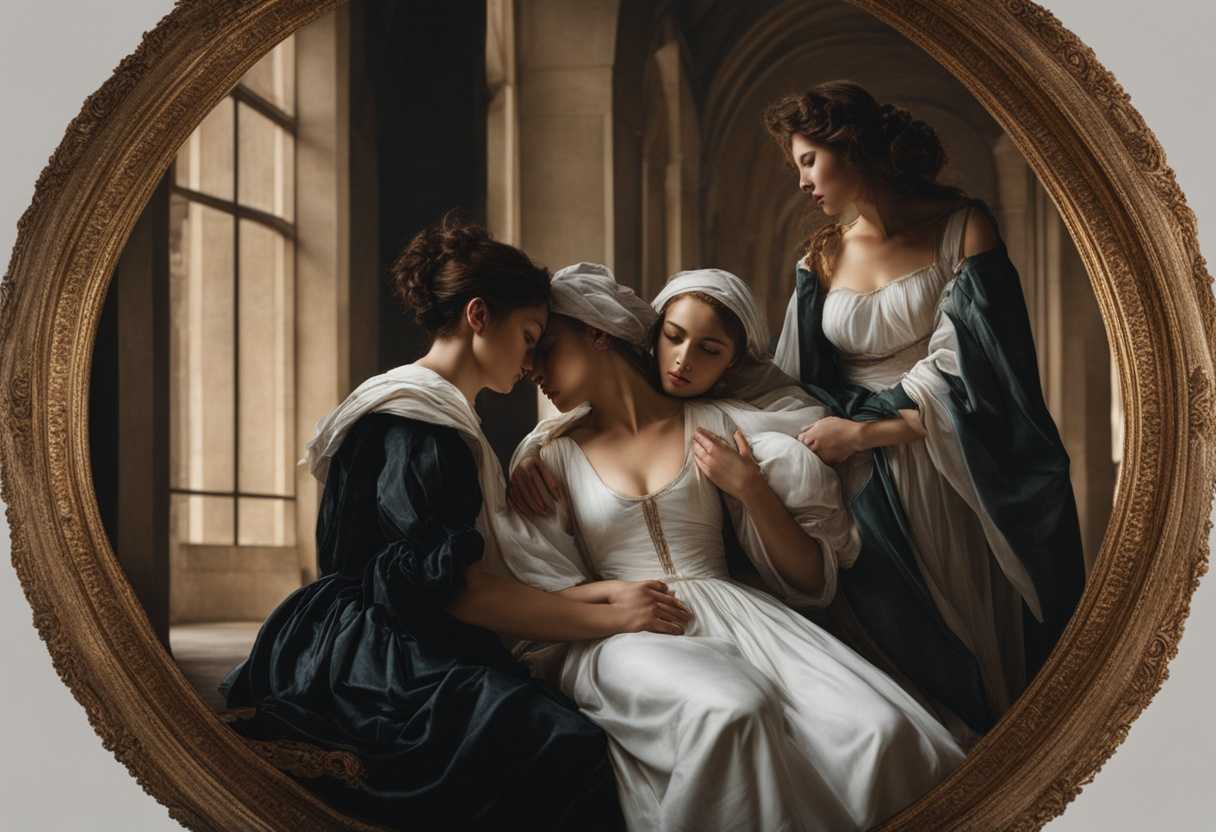
Setting the Scene for Genesis 29:16-30
In Genesis 29:16-30, we find Jacob arriving in the land of Haran. Jacob, the son of Isaac and grandson of Abraham, had left his home in Beersheba to escape the wrath of his brother Esau, whom he had deceived to receive his father’s blessing. Upon reaching Haran, Jacob encounters a well where shepherds are gathered with their flocks. Among them is Rachel, the daughter of Laban, who is tending her father’s sheep.
As Jacob approaches the well, he is struck by Rachel’s beauty and is immediately drawn to her. Rachel, in turn, is taken by Jacob’s strength and kindness. Jacob learns that Rachel is Laban’s daughter, his mother Rebekah’s brother, and he is overjoyed to have found family in this foreign land. Laban himself soon appears, and Jacob, eager to win Rachel’s hand in marriage, strikes a deal with Laban to work for him for seven years in exchange for Rachel’s hand.
The scene is set at the well in Haran, with the sun casting a warm glow over the arid landscape. The sound of sheep bleating and the laughter of shepherds fill the air as Jacob and Rachel share their first moments together. Laban, a shrewd businessman, watches the interaction with keen interest, already formulating his plans. The stage is set for a tale of love, deception, and redemption to unfold in this ancient land.
What is Genesis 29:16-30 about?
Jacob, who marries Leah and Rachel, two sisters, and goes on to have children with them and their maidservants, is seen in this verse. This verse highlights the complex relationships and dynamics within Jacob’s family and the cultural practices of the time. As we delve into this verse, we may wonder about the implications of polygamy and the role of women in ancient societies. We can also reflect on the importance of familial lineage and the desire for offspring in that context. Additionally, we can think about the challenges and conflicts that may arise in a family with multiple spouses and children. This verse prompts us to consider how attitudes towards marriage, family, and gender roles have evolved over time, offering us a glimpse into the historical and cultural norms of the time. It also invites us to reflect on the complexities and nuances of human relationships and the ways in which they shape our understanding of family and society.
Understanding what Genesis 29:16-30 really means
Structure for Commentary:
- Introduction and Context
- Detailed Breakdown of Key Passages
- Connection to Other Biblical Texts
- Relevance to Contemporary Life
- Anecdotal Illustration
- Reflective Questions and Conclusion
Commentary
-
Introduction and Context
The passage in question, Genesis 29:16-30, recounts the story of Jacob, Rachel, and Leah. After fleeing from Esau, Jacob finds refuge with his uncle Laban. He agrees to work seven years for Rachel, whom he loves. However, Laban deceives him by giving him Leah instead. Eventually, Jacob works an additional seven years for Rachel, leading to deep layers of familial and emotional complexity. This narrative provides a rich tapestry of themes such as love, deception, hard work, and God’s unseen plans. -
Detailed Breakdown of Key Passages
Let’s first look at two key phrases: “Laban had two daughters; the name of the older was Leah, and the name of the younger was Rachel.” This sets up the central conflict in the story, emphasizing the importance of family dynamics. Next, consider the phrase, “So Jacob served seven years to get Rachel, but they seemed like only a few days to him because of his love for her.” This powerful depiction of love shines through, showing how true affection can make time feel insignificant.
Laban’s deception, “he took his daughter Leah and brought her to Jacob,” serves as a pivotal moment. The tricks Laban plays make us question the nature of human integrity and honesty. The eventual acceptance by Jacob to labor for another seven years shows his perseverance and dedication, even when life turns out much harsher than expected.
-
Connection to Other Biblical Texts
This tale echoes throughout other parts of the Bible. For instance, Galatians 6:7 reminds us, “Do not be deceived: God cannot be mocked. A man reaps what he sows.” Laban’s deceit leads to complex family dynamics, and later, Jacob’s own sons would deceive him regarding Joseph. The message is clear: deception begets deception. Meanwhile, the enduring love Jacob has for Rachel has parallels in 1 Corinthians 13:7, which describes love as bearing all things, believing all things, hoping all things, and enduring all things. -
Relevance to Contemporary Life
One might wonder how an ancient story of deception and love relates to today’s world. Consider the concepts of patience in love and integrity in our dealings with others. Jacob’s willingness to work an additional seven years out of love can seem almost otherworldly in a fast-paced society driven by instant gratification. This is a lesson in the virtues of patience and true commitment. Laban’s deceit highlights the repercussions of dishonest behavior, serving as a reminder for us to conduct our lives with integrity. -
Anecdotal Illustration
To illustrate, imagine a young couple deeply in love. The engagement period is long due to financial and personal constraints, yet their love remains steadfast. Despite the challenges, they find joy in each other’s company, taking the time as an opportunity to strengthen their relationship. This mirrors Jacob’s seven-year wait. We might also consider workplace situations where a person climbs the ladder honestly, only to face betrayal. Much like Jacob, their continued hard work and integrity will ultimately be seen and rewarded. -
Consider these questions as you ponder this story: How far are you willing to go for something or someone you truly love? How do you handle deceit and betrayal in your life? Are you more like Jacob in your dedication or more like Laban in your dealings? Genesis 29:16-30 offers layers of reflection about love, patience, deceit, and integrity in a profound narrative. Jacob’s journey lays bare the complexities of human relationships and divine providence, encouraging us to live a life marked by authentic love and honest actions. Let’s bear in mind the lessons from Jacob’s saga as we navigate our relationships and challenges, seeking to embody the patience and dedication he exemplified.
What is the role of patience in relationships?
Patience plays a crucial role in relationships, as seen in the story of Jacob and Rachel in Genesis 29:16-30. Jacob works for seven years to earn the right to marry Rachel, whom he loves deeply in this narrative. However, due to a trick played by Laban, Rachel’s father, Jacob ends up marrying Leah, Rachel’s older sister, instead. Despite feeling betrayed and disappointed, Jacob patiently waits another seven years to finally marry Rachel, demonstrating his enduring love and dedication to her. Patience is essential in relationships for navigating challenges, misunderstandings, and unexpected events. It allows us to remain steadfast and committed to our loved ones even in difficult times. Individuals can show understanding, forgiveness, and resilience, strengthening the bond between partners and fostering a deeper connection based on love and trust by practicing patience. Jacob’s patience in waiting for Rachel despite the obstacles in his path serves as a powerful example of how enduring love and steadfast commitment can overcome adversity in relationships.
Application
Think about Leah’s story. She was searching for love and acceptance, just like we often do in our busy lives. But she found true worth not in people, but in God. In the chaos of work deadlines and family demands, are you looking for validation in the wrong places? Hit pause and think: Will you find your real worth in God’s unwavering love, or keep chasing fleeting approval?

Reverend Michael Johnson is an experienced Church Minister with a profound expertise in spirituality and guidance. With a serene presence and a compassionate heart, he has faithfully served his congregation for over 20 years, leading them on a spiritual journey towards inner peace and enlightenment. Reverend Johnson’s extensive knowledge of religious philosophies and profound understanding of human nature have made him a trusted confidant and mentor to many, as he seamlessly weaves his profound wisdom into life teachings. Reverend Johnson’s calming demeanor and empathetic nature continue to uplift and heal souls, nurturing a sense of unity and tranquility within his community.