
22 The same night he arose and took his two wives, his two female servants, and his eleven children, and crossed the ford of the Jabbok.
23 The same night he arose and took his two wives, his two female servants, and his eleven children, and crossed the ford of the Jabbok.
24 And Jacob was left alone. And a man wrestled with him until the breaking of the day.
25 When the man saw that he did not prevail against Jacob, he touched his hip socket, and Jacob’s hip was put out of joint as he wrestled with him.
26 Then he said, “Let me go, for the day has broken.” But Jacob said, “I will not let you go unless you bless me.”
27 And he said to him, “What is your name?” And he said, “Jacob.”
28 Then he said, “Your name shall no longer be called Jacob, but Israel, for you have striven with God and with men, and have prevailed.”
Then Jacob asked him, “Please tell me your name.” But he said, “Why is it that you ask my name?” And there he blessed him.
30 So Jacob called the name of the place Peniel, saying, “For I have seen God face to face, and yet my life has been delivered.”
31 The sun rose upon him as he passed Penuel, limping because of his hip.
32 Therefore to this day the people of Israel do not eat the sinew of the thigh that is on the hip socket, because he touched the socket of Jacob’s hip on the sinew of the thigh.
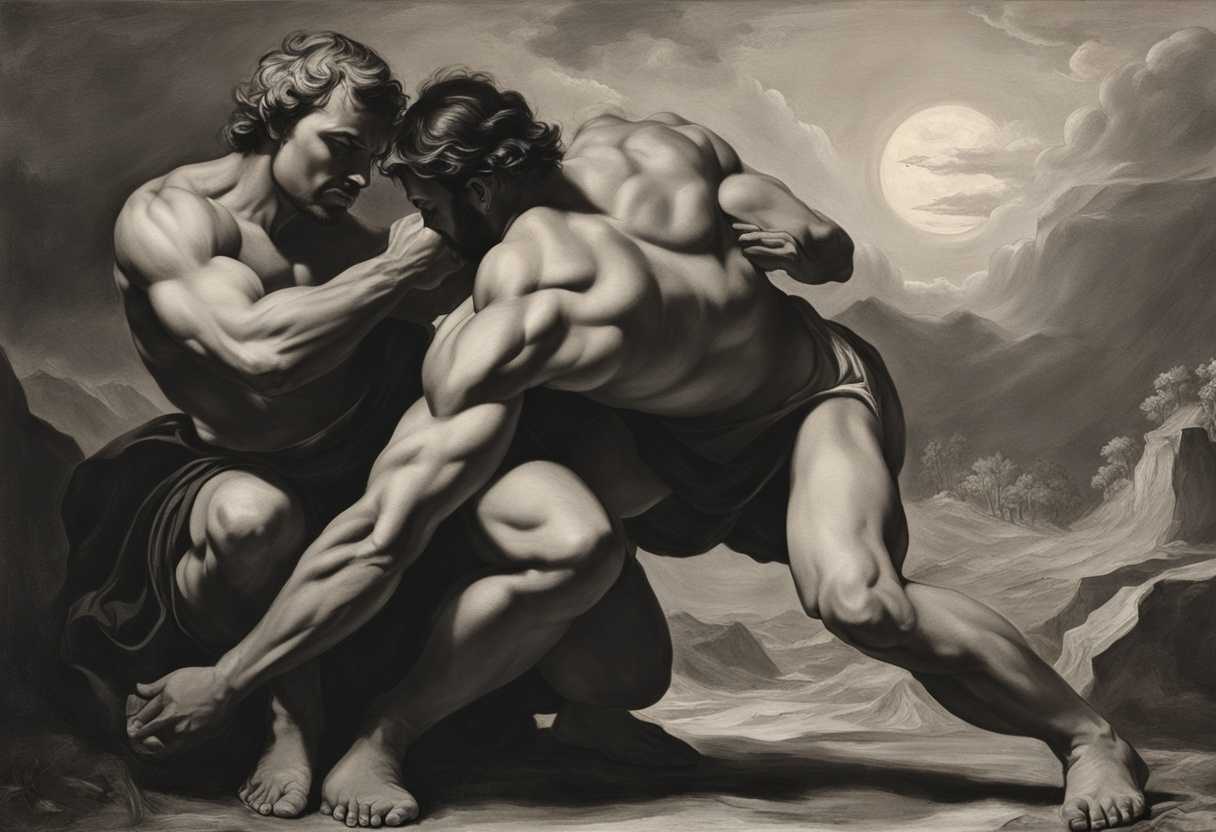
Setting the Scene for Genesis 32:22-32
In Genesis 32:22-32, we find Jacob, the son of Isaac and grandson of Abraham, preparing to meet his estranged brother Esau. Jacob had fled from his brother years earlier after deceiving him and taking his birthright and blessing. Now, as he returns to his homeland with his family and possessions, Jacob is filled with fear and uncertainty about how Esau will receive him.
As Jacob sends his family and belongings ahead of him across the Jabbok River, he remains alone on the other side. It is here, in the solitude of the night, that a mysterious figure appears and wrestles with Jacob until daybreak. This intense struggle symbolizes Jacob’s inner turmoil and his desire for reconciliation and forgiveness. Despite the pain and exhaustion, Jacob refuses to let go until he receives a blessing from his opponent.
The scene is set in the darkness of the night, with the sound of the rushing river in the background. The air is filled with tension and anticipation as Jacob grapples with his past and his uncertain future. Through this dramatic encounter, Jacob is transformed, both physically and spiritually, receiving a new name, Israel, which signifies his struggle and eventual triumph.
What is Genesis 32:22-32 about?
This verse captures a powerful moment where Jacob physically wrestles with God and ends up receiving a blessing and a new name, Israel. The act of wrestling with God symbolizes the struggles and challenges we face in life, but also the perseverance and determination to overcome them. It shows that even in our toughest moments, we can find blessings and transformation.
Through this story, we learn that growth often comes from struggle and hardship. Just like Jacob, we may find ourselves wrestling with difficult circumstances or even with our own beliefs. But it is through these struggles that we can emerge stronger and more resilient, just as Jacob did when he became Israel.
So, when faced with challenges in our own lives, we can look to this verse as a reminder that perseverance and faith can lead to transformation and blessings. It prompts us to reflect on our own struggles and the potential for growth that they hold. Just as Jacob’s story inspires us to keep pushing forward, let it also remind us that every struggle we face is an opportunity for us to grow and evolve into something greater.
Understanding what Genesis 32:22-32 really means
Genesis 32:22-32 recounts a profound and transformative event in the life of Jacob, one of the patriarchs of the Bible. This passage describes Jacob’s mysterious nighttime struggle with a divine being at the river Jabbok, a moment that culminated in his renaming as Israel. The narrative presents several key themes—identity, struggle, and blessing—that hold profound insights for contemporary believers.
First, let’s consider the setting and the action: Jacob is alone, preparing to meet his estranged brother Esau, with whom he has had a contentious relationship. What we witness here is not just a physical struggle but a deeply spiritual one. This overnight encounter becomes a pivotal point in Jacob’s life. What’s your pivotal moment? Have you wrestled with situations in your life where you felt alone, perhaps struggling with an internal or external adversary?
The renaming of Jacob to Israel, meaning “he struggles with God,” serves as a powerful symbol of transformation. It suggests that wrestling with profound challenges, and even with God, is integral to our spiritual growth. Jacob’s identity was forever changed; he became the father of the nations of Israel. Struggles in our lives can lead to a renewal of purpose and identity. Have you experienced a moment that reshaped who you are or how you perceive your role in God’s plan? The passage emphasizes blessings hard-won through struggle. Jacob, though he emerges victorious, is wounded—walking away with a limp. This imagery is a poignant reminder that our spiritual endeavors might leave us changed in fundamental ways, often bearing scars from our experiences. Consider how enduring trials has equipped you with wisdom, humility, or resilience.
This passage parallels other biblical instances where God’s servants undergo significant transformations—think of Paul on the road to Damascus or Peter’s vision on the rooftop in Joppa. Each narrative underscores a truth central to the Christian experience: encounters with the divine profoundly change us, challenging our perceptions and expectations.
To conclude, Genesis 32:22-32 is not just a story from the distant past; it mirrors our own life experiences where we wrestle with our fears, failures, hopes, and aspirations, often feeling as though we are in the dark, grappling with unknown forces. It’s comforting yet challenging to know that these struggles are not in vain but are pathways to blessing and deeper understanding. So, as we reflect on this passage, let us ask ourselves where we are in our own Jabbok experience and how we are letting it mold us into the image of who we are meant to be in Christ. How will you respond to your moments of wrestling?
What does it mean to wrestle with God?
To wrestle with God in this context refers to Jacob physically engaging in a struggle with a divine being, whom he later realizes is God. During this intense encounter, Jacob does not give up despite the struggle, symbolizing his determination and willingness to persevere in seeking a blessing from God. The act of wrestling with God can symbolize a struggle with faith, a search for guidance or understanding, or a desire for a transformative encounter with the divine. The wrestling match serves as a pivotal moment in Jacob’s life in this story from Genesis, where he receives a new name, Israel, which means “he struggles with God.”” This renaming signifies a change in Jacob’s identity and his relationship with God. It illustrates the complex and multifaceted nature of spirituality, where encounters with the divine may involve challenges, doubts, and a constant striving for deeper connection and understanding. Wrestling with God embodies the idea of engaging in a spiritual struggle or seeking divine intervention, even when faced with hardship or uncertainty. It conveys a message of endurance, perseverance, and the transformative power that can come from confronting and grappling with the mysteries and challenges of faith.
Application
Dear friend, picture yourself like Jacob at the banks of the Jabbok River, grappling with life’s challenges, big and small. Every job challenge, every family hurdle is a moment where you’re wrestling with your own transformative journey. It’s in these struggles that you have a chance to redefine who you are and emerge stronger, just like Jacob who walked away as Israel, touched and changed forever. I encourage you to dive into the depths of your beliefs, to wrestle with your uncertainties and fears. Isn’t it time to step into the arena, confront your spiritual journey, and find your new name? Will you rise to meet your true self?

Reverend Michael Johnson is an experienced Church Minister with a profound expertise in spirituality and guidance. With a serene presence and a compassionate heart, he has faithfully served his congregation for over 20 years, leading them on a spiritual journey towards inner peace and enlightenment. Reverend Johnson’s extensive knowledge of religious philosophies and profound understanding of human nature have made him a trusted confidant and mentor to many, as he seamlessly weaves his profound wisdom into life teachings. Reverend Johnson’s calming demeanor and empathetic nature continue to uplift and heal souls, nurturing a sense of unity and tranquility within his community.