
1 God said to Jacob, “Arise, go up to Bethel and dwell there. Make an altar there to the God who appeared to you when you fled from your brother Esau.”
2 So Jacob said to his household and to all who were with him, “Put away the foreign gods that are among you and purify yourselves and change your garments.
3 Then let us arise and go up to Bethel, so that I may make there an altar to the God who answers me in the day of my distress and has been with me wherever I have gone.”
4 So they gave to Jacob all the foreign gods that they had, and the rings that were in their ears. Jacob hid them under the terebinth tree that was near Shechem.
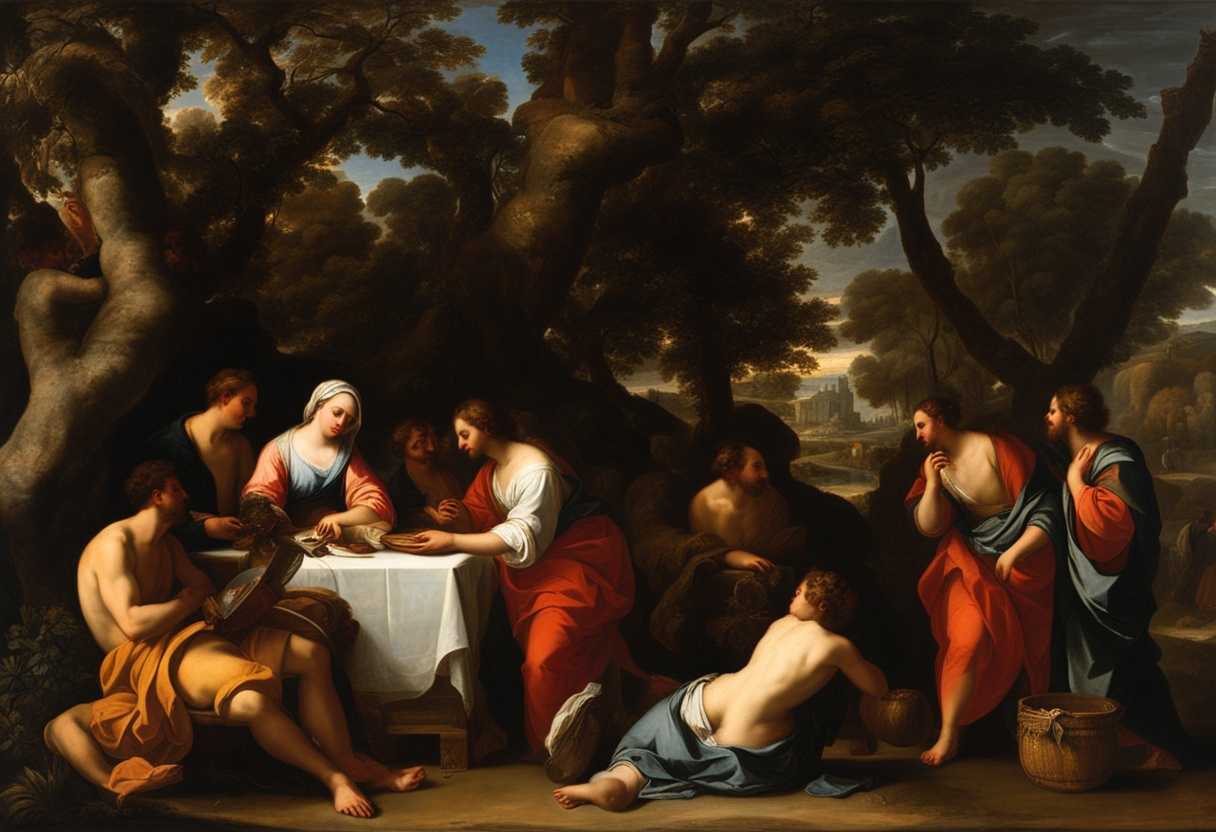
Setting the Scene for Genesis 35:1-4
In Genesis 35:1-4, we find Jacob and his household preparing to journey to Bethel. After the tumultuous events involving the rape of his daughter Dinah and the subsequent revenge taken by his sons, Jacob receives a directive from God to go to Bethel and build an altar there. Jacob gathers his entire household, including his wives Leah and Rachel, his children, and all their servants, to embark on this significant journey.
The scene is set in the early morning as the sun begins to rise, casting a warm glow over the camp. The tents are being dismantled, and the animals are being readied for travel. There is a sense of anticipation and reverence among the group as they prepare to meet with God at Bethel. Jacob, now known as Israel, takes charge, instructing his family to cleanse themselves and rid themselves of any idols or foreign gods in their possession before they set out on this sacred journey. The atmosphere is charged with a mix of solemnity and hope as they make their way towards Bethel, the place where Jacob first encountered God years before.
What is Genesis 35:1-4 about?
Ah, what a powerful verse from the Book of Genesis! This passage speaks to the importance of spiritual renewal and reconnection with one’s faith. Jacob’s decision to return to Bethel, the place where he first encountered God, signifies his desire to once again seek the presence of the divine in his life. Jacob demonstrates his commitment to living a life that is aligned with his beliefs and values by building an altar and purifying his household.
Have you ever experienced a moment in your life where you felt the need to return to your spiritual roots and rekindle your connection with something greater than yourself? Just like Jacob, we all face times when we may feel disconnected or lost, but the key is to follow his example and take deliberate steps to realign ourselves with our faith. Building an altar and purifying his household symbolize Jacob’s desire to create a sacred space for God in his life and to ensure that his family is also living in accordance with their beliefs. It serves as a reminder for us to continually seek spiritual growth and renewal, even in the midst of life’s challenges and distractions.
Understanding what Genesis 35:1-4 really means
Structure for Commentary
- Introduction
- Context of the Passage
- Key Phrases and Their Meanings
- Cross-References and Synergy with Other Bible Verses
- Relevance to Contemporary Life
- Personal Anecdote
- Conclusion and Call to Action
Commentary
Introduction
Genesis 35:1-4 captures a significant moment in Jacob’s life as he receives divine instruction to return to Bethel and prepare himself and his household for worship. This passage provides rich insights into themes of renewal, obedience, and the act of purifying oneself before God.
Context of the Passage
To understand these verses, it’s essential to know the immediate context. Prior to this, Jacob had left Laban’s household and reconciled with his brother Esau. He then settled in Shechem, where familial and social turmoil ensued. This divine command to go to Bethel is more than a geographical relocation; it’s a spiritual pilgrimage. Bethel represents a place of significant past encounters with God (Genesis 28:10-22), a spiritual anchor in Jacob’s life.
Key Phrases and Their Meanings
- “Go up to Bethel and settle there”: This phrase is God’s direct command to Jacob, instructing him to leave his current situation and return to a place of spiritual significance. God is calling Jacob to recommit.
- “Get rid of the foreign gods you have with you”: This directive emphasizes the need for purification and the importance of dedicating oneself wholly to God. It reinforces the first commandment—no other gods before Him (Exodus 20:3).
- “Purify yourselves and change your clothes”: Symbolic acts of external cleansing often represent internal purification. God wants Jacob’s family to be holy and visually set apart (Leviticus 11:44).
Cross-References and Synergy with Other Bible Verses
This passage resonates with several other biblical directives for purification and renewal. For instance, in Joshua 24:14-15, Joshua commands the Israelites to throw away foreign gods and serve the Lord. Similarly, in 2 Corinthians 7:1, Paul urges believers to purify themselves from everything that contaminates body and spirit. These verses collectively stress the ongoing process of sanctification in a believer’s life.
Relevance to Contemporary Life
Why is this relevant today? Modern-day “foreign gods” such as money, power, and technology are easily accumulated in our fast-paced, often secular-dominated world. This passage encourages us to take inventory of our lives, to shed distractions, and recommit to our spiritual practices. It calls for intentional living, where one’s lifestyle aligns with divine principles.
Personal Anecdote
I recall a time when our congregation decided to declutter the church. It wasn’t just physical clutter we addressed but emotional and spiritual baggage too. We collectively observed a period of cleansing, where each member was encouraged to examine their lives and eliminate barriers to their relationship with God. The result was a revitalized community, more attuned to spiritual growth and communal worship.
Conclusion and Call to Action
This passage invites us to reflect deeply on our relationships with God and make actionable changes. Are there “foreign gods” in your life that need discarding? Jacob’s act of obedience and purification serves as a compelling model. Let’s take this opportunity to renew our commitments and draw closer to God. May we find our own ‘Bethel,’ a place where we profoundly feel and experience God’s presence, as we prepare our hearts and homes.
What idols do we need to remove from our lives?
We need to remove the idols that distract us from our true faith and devotion to God in our lives. These idols can come in many forms, such as material possessions, relationships, or even our own desires and ambitions that take precedence over God’s will. Just like how Jacob instructed his household to get rid of all the foreign gods and purify themselves, we must also cleanse our hearts and minds of anything that hinders our relationship with God.
Idols can easily consume our thoughts, time, and energy, leading us away from God’s plans and purposes for our lives. Neglecting our spiritual growth and failing to live according to God’s will may result from focusing on these idols. Therefore, it is crucial for us to identify and remove these idols from our lives so that we can wholeheartedly follow and serve God.
God desires our complete devotion and trust in Him. We can fully dedicate ourselves to God and experience His blessings, guidance, and presence in our lives by removing the idols that vie for our attention and allegiance. Just as Jacob’s household experienced God’s protection and favor after removing the foreign gods, we too can receive God’s abundant grace and blessings when we choose to prioritize Him above all else.
Application
Think of your life like a cluttered desk at work or a messy house. To truly succeed, to truly feel peace, you need to clear away the distractions. Cast off anything that keeps you from God, the way you’d toss out junk mail or old toys. Cleanse your heart and soul, as you would clean your own home. Now is the time for a fresh start, a new beginning with God’s presence. Will you take the first step to declutter your life and renew your faith?

Reverend Michael Johnson is an experienced Church Minister with a profound expertise in spirituality and guidance. With a serene presence and a compassionate heart, he has faithfully served his congregation for over 20 years, leading them on a spiritual journey towards inner peace and enlightenment. Reverend Johnson’s extensive knowledge of religious philosophies and profound understanding of human nature have made him a trusted confidant and mentor to many, as he seamlessly weaves his profound wisdom into life teachings. Reverend Johnson’s calming demeanor and empathetic nature continue to uplift and heal souls, nurturing a sense of unity and tranquility within his community.