
2 These are the generations of Jacob.
2 These are the generations of Jacob. Joseph, being seventeen years old, was pasturing the flock with his brothers. He was a boy with the sons of Bilhah and Zilpah, his father’s wives. And Joseph brought a bad report of them to their father.
3 Now Israel loved Joseph more than any other of his sons, because he was the son of his old age. And he made him a robe of many colors.
4 But when his brothers saw that their father loved him more than all his brothers, they hated him and could not speak peacefully to him.
5 Now Joseph had a dream, and when he told it to his brothers they hated him even more.
6 He said to them, “Hear this dream that I have dreamed:
7 For behold, we were binding sheaves in the field, and behold, my sheaf arose and stood upright.
8 His brothers said to him, “Are you indeed to reign over us? Or are you indeed to rule over us?” So they hated him even more for his dreams and for his words.
9 Then he dreamed another dream and told it to his brothers and said, “Behold, I have dreamed another dream. Behold, the sun, the moon, and eleven stars were bowing down to me.”
10 But when he told it to his father and to his brothers, his father rebuked him and said to him, “What is this dream that you have dreamed? Shall I and your mother and your brothers indeed come to bow ourselves to the ground before you?”
11 And his brothers were jealous of him, but his father kept the saying in mind.
12 Now his brothers went to pasture their father’s flock near Shechem.
13 And Israel said to Joseph, “Are not your brothers pasturing the flock at Shechem? Come, I will send you to them.” And he said to him, “Here I am.”
14 So he said to him, “Go now, see if it is well with your brothers and with the flock, and bring me word.” So he sent him from the Valley of Hebron, and he came to Shechem.
15 And a man found him wandering in the fields. And the man asked him, “What are you seeking?”
16 And he said, “I am seeking my brothers. Please tell me where they are pasturing the flock.”
17 And the man said, “They have gone away, for I heard them say, ‘Let us go to Dothan.’” So Joseph went after his brothers and found them at Dothan.
18 They saw him from afar, and before he came near to them, they conspired against him to kill him.
19 They said to one another, “Here comes this dreamer.
20 Come now, let us kill him and throw him into one of the pits. Then we will say that a fierce animal has devoured him, and we will see what will become of his dreams.”
21 But when Reuben heard it, he rescued him out of their hands, saying, “Let us not take his life.”
22 And Reuben said to them, “Shed no blood; throw him into this pit here in the wilderness, but do not lay a hand on him”—that he might rescue him out of their hand to restore him to his father.
23 So when Joseph came to his brothers, they stripped him of his robe, the robe of many colors that he wore.
24 Then they took him and threw him into a pit. The pit was empty; there was no water in it.
25 Then they sat down to eat. And looking up they saw a caravan of Ishmaelites coming from Gilead, with their camels bearing gum, balm, and myrrh, on their way to carry it down to Egypt.
26 Then Judah said to his brothers, “What profit is it if we kill our brother and conceal his blood?
27 Come, let us sell him to the Ishmaelites, and let not our hand be upon him, for he is our brother, our own flesh.” And his brothers listened to him.
28 Then Midianite traders passed by. And they drew Joseph up and lifted him out of the pit, and sold him to the Ishmaelites for twenty shekels of silver. They took Joseph to Egypt.
29 When Reuben returned to the pit and saw that Joseph was not in the pit, he tore his clothes
30 Then he returned to his brothers and said, “The boy is gone, and I, where shall I go?”
31 Then they took Joseph’s robe and slaughtered a goat and dipped the robe in the blood.
32 And they sent the robe of many colors and brought it to their father and said, “This we have found; please identify whether it is your son’s robe or not.”
33 And he identified it and said, “It is my son’s robe. A fierce animal has devoured him. Joseph is without doubt torn to pieces.”
34 Then Jacob tore his garments and put sackcloth on his loins and mourned for his son many days.
35 All his sons and all his daughters rose up to comfort him, but he refused to be comforted and said, “No, I shall go down to Sheol to my son, mourning.” Thus his father wept for him.
36 Meanwhile the Midianites had sold him in Egypt to Potiphar, an officer of Pharaoh, the captain of the guard.
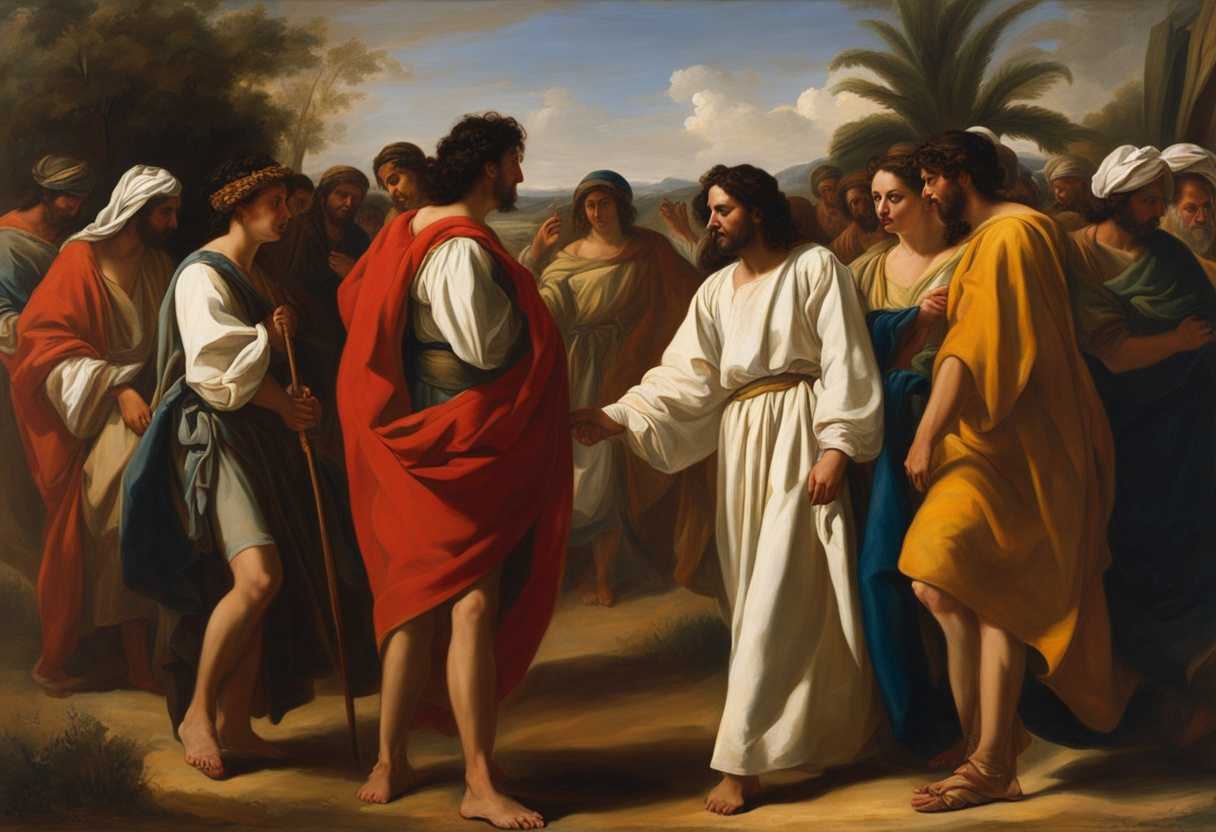
Setting the Scene for Genesis 37:1-36
In Genesis chapter 37, we find Joseph, the son of Jacob, in the land of Canaan. Joseph’s brothers, including Reuben, Simeon, Levi, Judah, Dan, Naphtali, Gad, Asher, Issachar, Zebulun, and Benjamin, are tending to their father’s flocks in Shechem. Jacob, who is also known as Israel, sends Joseph to check on his brothers and the flocks.
As Joseph approaches his brothers in Dothan, they see him from a distance and plot to kill him out of jealousy. Reuben intervenes, suggesting they throw him into a pit instead. So, when Joseph arrives, his brothers strip him of his coat of many colors, the one given to him by their father, and throw him into a pit. Later, they sell him to a passing caravan of Ishmaelites who take him to Egypt as a slave.
The scene is set in the rolling hills of Canaan, with the sun casting long shadows as Joseph walks towards his brothers. The landscape is dotted with sheep grazing peacefully, and the air is filled with the sounds of their bleating. The tension among the brothers is palpable as they see Joseph approaching, their envy and resentment simmering beneath the surface. This pivotal moment sets the stage for the dramatic events that will unfold in Joseph’s life, ultimately leading him to Egypt and fulfilling God’s plan for him.
What is Genesis 37:1-36 about?
This verse from the Bible relates the story of Joseph, whose own brothers plotted against him and sold him into slavery out of jealousy. Despite facing unimaginable hardships and difficulties along the way, including being falsely accused and imprisoned, Joseph remained steadfast in his faith and trust in God. God used Joseph’s suffering for good by raising him to a position of power and authority, ultimately saving his family and the entire nation of Egypt from a severe famine.
Reflecting on this verse prompts us to consider the concept of divine providence and how God can work through even the most challenging and unjust circumstances to bring about His greater plan. It challenges us to trust in God’s sovereignty and to remain resilient in the face of adversity, knowing that He can turn our trials into triumphs. This verse ultimately serves as a powerful reminder of the importance of faith, perseverance, and the belief that God can bring beauty out of brokenness.
Understanding what Genesis 37:1-36 really means
Structure for Commentary
- Introduction to the Context
- Character Focus: Joseph
- Themes of Jealousy and Betrayal
- God’s Sovereignty and Purpose
- New Testament Connections
- Modern-Day Relevance
- Personal Reflection and Anecdote
Commentary
- Introduction to the Context
The narrative of Genesis 37 introduces us to Joseph and sets off a deeply transformative journey that affects not just his life but also the lives of his family and an entire nation. The chapter begins with Joseph’s early life and his relationships with his father, Jacob, and his brothers. To understand this story, you must grasp the deeply rooted family dynamics and cultural context.
- Character Focus: Joseph
Joseph is portrayed as a favored son, illustrated by the “coat of many colors.” His father’s favoritism makes him a target for his brothers’ jealousy. Joseph’s dreams further escalate tensions, as they depict him in a position of future supremacy over his family. Joseph’s naivety and perhaps, his lack of wisdom in sharing these dreams, adds to the complexity of his character and the unfolding drama.
- Themes of Jealousy and Betrayal
Jealousy stands out as a poignant theme. Joseph’s brothers exhibit a destructive jealousy that leads them to plot against him. This culminates in Joseph being sold to Ishmaelite traders and taken to Egypt. The brothers’ act of dipping Joseph’s coat in goat’s blood to deceive Jacob is a harrowing example of betrayal within one’s own family. This draws a parallel to Proverbs 27:4, “Wrath is cruel, anger is overwhelming, but who can stand before jealousy?”
- God’s Sovereignty and Purpose
This chapter hints at God’s overarching sovereignty, even in circumstances of human betrayal. Despite the immediate feelings of hopelessness in Joseph’s situation, his story is a testament to God’s redemptive plan. It’s a reminder of Romans 8:28, “And we know that in all things God works for the good of those who love him, who have been called according to his purpose.” God uses even the treacherous acts of Joseph’s brothers to bring about His greater plan for Israel.
- New Testament Connections
Joseph’s betrayal by those closest to him foreshadows the experience of Christ. Jesus was also betrayed, not by strangers, but by one of His own disciples, Judas. Just as Joseph rises to a position that eventually saves his family during a famine, Jesus’s resurrection provides salvation. This parallel deepens our understanding of how God’s plan is meticulously and compassionately interwoven through scripture.
- Modern-Day Relevance
Today, this story resonates in various personal experiences. Families can often be the arena where jealousy and rivalry rear their heads, sometimes leading to actions that deeply wound. This narrative encourages self-examination. Are there seeds of jealousy or unresolved conflicts in our relationships? Are we allowing God to work through our brokenness to bring about healing and purpose?
- Personal Reflection and Anecdote
A reflection on this passage brought to mind a story I encountered about two brothers in my congregation. Rivalry and competition had driven a wedge between them for years. It wasn’t until they both experienced a personal loss that they began to mend their relationship. They saw God’s guiding hand in turning their sorrow into a deeper, more loving bond during their reconciliation. Similarly, Joseph’s story invites us to trust in God’s plan even in the darkest times and believe in the possibility of redemption and reconciliation. This chapter in closing meditates profoundly on human relationships, divine sovereignty, and the hidden threads of God’s redemptive purposes that run through our lives. Reflect on your own life. Are there areas where jealousy and rivalry overshadow love and unity? Can you see God’s hand guiding you even through the betrayals and hardships?
How can we respond with love in the face of jealousy?
When faced with jealousy, responding with love means showing understanding and empathy towards the person experiencing those negative feelings. It is important to acknowledge their emotions and validate their experiences, even if we may not fully understand or agree with them. We can try to alleviate the pain and hurt that jealousy can cause and promote healing and reconciliation in relationships by responding with love.
Additionally, responding with love in the face of jealousy involves practicing forgiveness and offering grace to those who may have wronged us or harbored jealousy towards us. Instead of retaliating or holding onto bitterness, choosing to extend kindness and compassion can lead to a deeper sense of connection and understanding between individuals. We can foster a sense of unity and promote healing in the midst of conflict and discord by approaching jealousy with a spirit of love and compassion.
Application
Imagine your workplace or home, relationships tested by jealousy or resentment. It’s time to pause and reflect. Do you harbor envy or grudges? Choose forgiveness and kindness, like Joseph did. Trust in a bigger plan, even when facing hardships. Extend a helping hand, show compassion to those around you. Are you ready to make a difference today?

Reverend Michael Johnson is an experienced Church Minister with a profound expertise in spirituality and guidance. With a serene presence and a compassionate heart, he has faithfully served his congregation for over 20 years, leading them on a spiritual journey towards inner peace and enlightenment. Reverend Johnson’s extensive knowledge of religious philosophies and profound understanding of human nature have made him a trusted confidant and mentor to many, as he seamlessly weaves his profound wisdom into life teachings. Reverend Johnson’s calming demeanor and empathetic nature continue to uplift and heal souls, nurturing a sense of unity and tranquility within his community.