
Genesis 39-41 is about Joseph’s journey from being sold into slavery to becoming a powerful ruler in Egypt, showcasing how God can turn trials into triumphs through faith and resilience.
1 Now Joseph had been brought down to Egypt, and Potiphar, an officer of Pharaoh, the captain of the guard, an Egyptian, had bought him from the Ishmaelites who had brought him down there.
2 The Lord was with Joseph, and he became a successful man, and he was in the house of his Egyptian master.
3 When his master saw that the Lord was with him and that the Lord caused all that he did to succeed in his hands.
4 So Joseph found favor in his sight and attended him, and he made him overseer of his house and put him in charge of all that he had.
5 And from the time that he made him overseer in his house and over all that he had, the Lord blessed the Egyptian’s house for Joseph’s sake; the blessing of the Lord was on all that he had, in house and field.
6 So he left all that he had in Joseph’s charge, and because of him he had no concern about anything but the food he ate. And Joseph was handsome in form and appearance.
7 And after a time his master’s wife cast her eyes on Joseph and said, “Lie with me.”
8 But he refused and said to his master’s wife, “Behold, because of me my master has no concern about anything in the house, and he has put everything that he has in my charge.
9 There is no one greater in this house than I am, nor has he kept back anything from me except you, because you are his wife. How then can I do this great wickedness and sin against God?”
10 And as she spoke to Joseph day after day, he would not listen to her, to lie beside her or to be with her.
11 But one day, when he went into the house to do his work and none of the men of the house was there in the house,
12 she caught him by his garment, saying, “Lie with me.” But he left his garment in her hand and fled and got out of the house.
13 And as soon as she saw that he had left his garment in her hand and had fled out of the house,
14 she called to the men of her household and said to them, “See, he has brought among us a Hebrew to laugh at us. He came in to me to lie with me, and I cried out with a loud voice.
15 And as soon as she saw that he had left his garment in her hand and had fled out of the house,
16 And she laid up his garment by her until his master came home,
17 And she told him the same story, saying, “The Hebrew servant, whom you have brought among us, came in to me to laugh at me.
18 But as soon as I lifted up my voice and cried, he left his garment beside me and fled outside.
19 As soon as his master heard the words that his wife spoke to him, “This is the way your servant treated me,” his anger was kindled.
20 And Joseph’s master took him and put him into the prison, the place where the king’s prisoners were confined, and he was there in prison.
21 But the Lord was with Joseph and showed him steadfast love and gave him favor in the sight of the keeper of the prison.
22 And the keeper of the prison put Joseph in charge of all the prisoners who were in the prison. Whatever was done there, he was the one who did it.
23 The keeper of the prison paid no attention to anything that was in Joseph’s charge, because the Lord was with him. And whatever he did, the Lord made it succeed.
1 Some time after this, the cupbearer of the king of Egypt and his baker committed an offense against their lord the king of Egypt.
2 And Pharaoh was angry with his two officers, the chief cupbearer and the chief baker.
3 And he put them in custody in the house of the captain of the guard, in the prison where Joseph was confined.
4 And the captain of the guard appointed Joseph to be with them, and he attended them.
5 And one night they both dreamed—the cupbearer and the baker of the king of Egypt, who were confined in the prison—each his own dream, and each dream with its own interpretation.
6 When Joseph came to them in the morning, he saw that they were troubled.
7 So he asked Pharaoh’s officers who were with him in custody in his master’s house, “Why are your faces downcast today?”
8 They said to him, “We have had dreams, and there is no one to interpret them.” And Joseph said to them, “Do not interpretations belong to God? Please tell them to me.”
9 So the chief cupbearer told his dream to Joseph and said to him, “In my dream there was a vine before me,
10 and in the vine were three branches. It was as though it budded, its blossoms shot forth, and its clusters brought forth ripe grapes.
11 Pharaoh’s cup was in my hand, and I took the grapes and pressed them into Pharaoh’s cup and placed the cup in Pharaoh’s hand.”
12 Then Joseph said to him, “This is its interpretation: the three branches are three days.
13 In three days Pharaoh will lift up your head and restore you to your office, and you shall place Pharaoh’s cup in his hand as formerly, when you were his cupbearer.
14 Only remember me, when it is well with you, and please do me the kindness to mention me to Pharaoh, and so get me out of this house.
15 For I was indeed stolen out of the land of the Hebrews, and here also I have done nothing that they should put me into the pit.”
16 When the chief baker saw that the interpretation was favorable, he said to Joseph, “I also had a dream: there were three cake baskets on my head,
17 In the uppermost basket there were all sorts of baked food for Pharaoh, but the birds were eating it out of the basket on my head.”
18 And Joseph answered and said, “This is its interpretation: the three baskets are three days.
19 Yet within three days Pharaoh will lift up your head—from you!—and hang you on a tree. And the birds will eat the flesh from you.”
20 On the third day, which was Pharaoh’s birthday, he made a feast for all his servants and lifted up the head of the chief cupbearer and the head of the chief baker among his servants.
21 He restored the chief cupbearer to his position, and he placed the cup in Pharaoh’s hand.
22 But he hanged the chief baker, as Joseph had interpreted to them.
23 Yet the chief cupbearer did not remember Joseph, but forgot him.
1 After two whole years, Pharaoh dreamed that he was standing by the Nile.
2 And behold, there came up out of the Nile seven cows, attractive and plump, and they fed in the reed grass.
3 And behold, seven other cows, ugly and thin, came up out of the Nile after them, and stood by the other cows on the bank of the Nile.
4 So the ugly and thin cows ate up the seven attractive and plump cows. Then Pharaoh awoke.
5 And he fell asleep and dreamed a second time. And behold, seven ears of grain, plump and good, were growing on one stalk.
6 And behold, seven ears, withered, thin, and blighted by the east wind, sprouted after them.
7 And the seven plump ears and the seven full ears were blighted by the east wind.
8 So in the morning his spirit was troubled, and he sent and called for all the magicians of Egypt and all its wise men. Pharaoh told them his dreams, but there was none who could interpret them to Pharaoh.
9 Then the chief cupbearer said to Pharaoh, “I remember my offenses today.
10 Pharaoh was angry with his servants and put me in custody in the captain of the guard’s house, me and the chief baker.
11 So we sent a message to Joseph, saying, “Please give us food. For why should we die before your eyes? For our money is gone.”
12 And there was with us a young man, a Hebrew, servant to the captain of the guard. And we told him, and he interpreted our dreams to us, giving an interpretation to each man according to his dream.
13 And there was no one who could interpret them to Pharaoh.
14 Then Pharaoh sent and called Joseph, and they quickly brought him out of the pit. And when he had shaved himself and changed his clothes, he came in before Pharaoh.
15 And Pharaoh said to Joseph, “I have had a dream, and there is no one who can interpret it. I have heard it said of you that when you hear a dream you can interpret it.”
16 Joseph answered Pharaoh, “It is not in me; God will give Pharaoh a favorable answer.”
17 So Pharaoh said to Joseph, “Behold, in my dream I was standing on the banks of the Nile.
18 Behold, in my dream I was standing on the banks of the Nile.
19 Seven other cows came up after them, poor and very ugly and thin, such as I had never seen in all the land of Egypt.
20 And the lean and ugly cows ate up the first seven plump cows,
21 And when they had eaten them up, the appearance of the cows that came up first was still ugly, as at the beginning.
22 And I saw in my dream, and behold, seven ears, full and good, were growing on one stalk.
23 And behold, seven ears, withered, thin, and blighted by the east wind, sprouted after them,
24 And the thin ears swallowed up the seven plump, full ears. Then Pharaoh awoke, and behold, it was a dream.
25 Then Joseph said to Pharaoh, “The dreams of Pharaoh are one; God has revealed to Pharaoh what he is about to do.
26 The seven good cows are seven years, and the seven good ears are seven years; the dreams are one.
27 The seven lean and ugly cows that came up after them are seven years, and the seven empty ears blighted by the east wind are also seven years of famine.
28 It is as I told Pharaoh; God has shown to Pharaoh what he is about to do.
29 Seven years of great abundance are coming throughout the land of Egypt,
30 but after them there will arise seven years of famine, and all the plenty will be forgotten in the land of Egypt. The famine will consume the land,
31 and the plenty will be forgotten in the land of Egypt.
32 And the doubling of Pharaoh’s dream means that the thing is fixed by God, and God will shortly bring it about.
33 Now therefore let Pharaoh select a discerning and wise man, and set him over the land of Egypt.
34 Let Pharaoh proceed to appoint overseers over the land and take one-fifth of the produce of the land of Egypt during the seven plentiful years.
35 They should gather all the food of these good years that are coming and store up grain under the authority of Pharaoh for food in the cities, and let them keep it.
36 And that food shall be a reserve for the land against the seven years of famine that are to occur in the land of Egypt, so that the land may not perish through the famine.”
37 This proposal pleased Pharaoh and all his servants.
38 And Pharaoh said to his servants, “Can we find a man like this, in whom is the Spirit of God?”
39 Then Pharaoh said to Joseph, “Since God has shown you all this, there is none so discerning and wise as you are.
40 You shall be over my house, and all my people shall order themselves as you command. Only as regards the throne will I be greater than you.”
41 So Pharaoh said to Joseph, “See, I have set you over all the land of Egypt.”
42 Then Pharaoh took his signet ring from his hand and put it on Joseph’s hand, and clothed him in garments of fine linen and put a gold chain about his neck.
43 And he made him ride in his second chariot. And they called out before him, “Bow the knee!” Thus he set him over all the land of Egypt.
44 Moreover, Pharaoh said to Joseph, “I am Pharaoh, and without your consent no one shall lift up hand or foot in all the land of Egypt.”
45 And Pharaoh called Joseph’s name Zaphenath-paneah. And he gave him in marriage Asenath, the daughter of Potiphera priest of On. So Joseph went out over the land of Egypt.
46 Joseph was thirty years old when he entered the service of Pharaoh king of Egypt. And Joseph went out from the presence of Pharaoh and went through all the land of Egypt.
47 During the seven plentiful years the earth produced abundantly.
48 And he gathered up all the food of the seven years that the land of Egypt produced, and stored up the food in the cities. He put in every city the food from the fields around it.
49 Joseph stored up grain in great abundance, like the sand of the sea, until he ceased to measure it, for it could not be measured.
50 Before the year of famine came, two sons were born to Joseph.
51 Joseph called the name of the firstborn Manasseh. “For,” he said, “God has made me forget all my hardship and all my father’s house.”
52 The name of the second he called Ephraim, “For God has made me fruitful in the land of my affliction.”
53 The seven years of plenty that occurred in the land of Egypt came to an end.
54 Then the seven years of famine began to come, as Joseph had said. There was famine in all lands, but in all the land of Egypt there was bread.
55 When all the land of Egypt was famished, the people cried to Pharaoh for bread. Pharaoh said to all the Egyptians, “Go to Joseph. What he says to you, do.”
56 So when the famine had spread over all the land, Joseph opened all the storehouses and sold to the Egyptians, for the famine was severe in the land of Egypt.
57 Moreover, all the earth came to Egypt to Joseph to buy grain, because the famine was severe over all the earth.
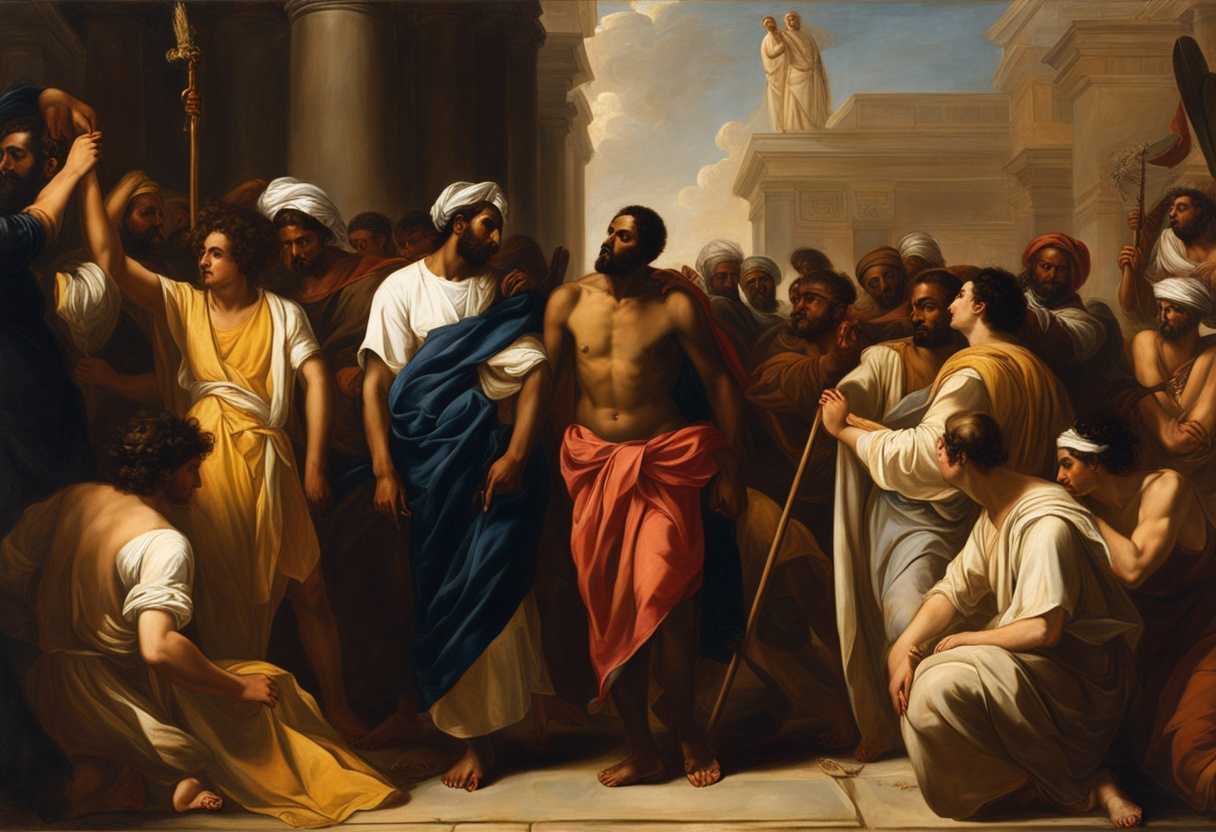
Setting the Scene for Genesis 39-41
In the scene from Genesis 39-41, we find Joseph, a young Hebrew man, who has been sold into slavery in Egypt by his jealous brothers. He is now a servant in the household of Potiphar, the captain of Pharaoh’s guard. Despite his circumstances, Joseph remains faithful and diligent in his work, and soon gains favor with Potiphar. However, this favor leads to trouble when Potiphar’s wife falsely accuses Joseph of trying to seduce her, resulting in Joseph being thrown into prison.
In prison, Joseph interprets the dreams of two fellow inmates, the cupbearer and the baker of the king of Egypt. His interpretations come true, but he asks the cupbearer to remember him when he is restored to his position in Pharaoh’s court. However, the cupbearer forgets about Joseph for two years until Pharaoh himself has a troubling dream that none of his wise men can interpret. It is then that the cupbearer remembers Joseph’s gift of dream interpretation, and Joseph is brought before Pharaoh.
The scene is set in the grand palace of Pharaoh, with Joseph standing before the ruler of Egypt. The room is filled with courtiers and advisors, all eager to see if this Hebrew slave can truly interpret Pharaoh’s dream. The tension is palpable as Joseph listens to the dream and then confidently reveals its meaning, predicting seven years of abundance followed by seven years of famine. Pharaoh is impressed by Joseph’s wisdom and appoints him as second-in-command over all of Egypt, setting the stage for Joseph to eventually be reunited with his family and fulfill his destiny.
What is Genesis 39-41 about?
Isn’t it amazing how Joseph’s story in the Bible demonstrates a powerful testament to God’s faithfulness and sovereignty? Here we see Joseph, a young man sold into slavery by his own brothers, rising to a position of great power and influence in Egypt. Despite all the hardships and challenges he faced along the way, Joseph never lost faith in God and remained steadfast in his beliefs.
Through Joseph’s journey, we are reminded that even in the darkest moments of our lives, God is still working behind the scenes, orchestrating events for our ultimate good. His story serves as a poignant example of how God can turn the tables and bring beauty out of ashes, elevating us to places we never thought possible. So, next time you find yourself in a tough situation, remember Joseph’s story and trust in God’s faithfulness and sovereignty to guide you through.
Understanding what Genesis 39-41 really means
Genesis 39-41 recounts the remarkable journey of Joseph, from being sold into slavery by his brothers to rising to prominence in Egypt through God’s providence. Throughout these chapters, we witness themes of faith, integrity, and the unwavering presence of God in Joseph’s life, even in the midst of trials and tribulations. The repeated phrase, “The Lord was with Joseph,” serves as a powerful reminder of God’s constant favor and presence, reassuring readers of His faithfulness in all circumstances.
In Genesis 39:21, we see a poignant declaration that despite Joseph’s unjust imprisonment, the Lord showed him steadfast love. This highlights God’s unwavering support and serves as a testament to His enduring love for His people. Similarly, Pharaoh’s recognition of Joseph’s wisdom in Genesis 41:38 underscores the impact of living a life guided by God’s Spirit, encouraging believers to seek divine wisdom in their own lives.
Related biblical passages such as Romans 8:28 and James 1:2-4 further complement Joseph’s story by affirming that God works for the good of those who love Him and that trials produce perseverance and growth in faith. These verses echo the enduring message of Joseph’s narrative, emphasizing the transformative power of trusting in God’s plan even in the face of adversity.
Joseph’s story remains relevant to people today, offering hope and encouragement to those facing hardships and injustices. It serves as a reminder that God is always at work, even in the darkest moments, and that maintaining integrity and faith can lead to unexpected blessings and opportunities. Just as Joseph’s faithfulness led to his eventual rise to power, individuals are encouraged to trust in God’s timing and purpose for their lives.
Consider the modern-day parallels to Joseph’s journey, where individuals facing setbacks and challenges find unexpected success and fulfillment through their unwavering faith and perseverance. By using difficult times as opportunities for growth and development, like Joseph did in his own trials, people can navigate adversity with hope and trust in God’s ultimate plan.
In conclusion, Joseph’s story in Genesis 39-41 serves as a powerful testament to God’s faithfulness, the importance of integrity, and the transformative power of perseverance. It inspires believers to trust in God’s providence, remain steadfast in their faith during trials, and believe that God can turn any situation for good, just as He did for Joseph.
What does it mean to trust in God’s timing?
Trusting in God’s timing means having faith that everything will unfold according to His plan and in His perfect timing. It involves believing that God knows the best time for things to happen and having the patience and confidence that His timing is always right. We can find peace and assurance that God will work all things together for our good by surrendering control and trusting in Him. Joseph’s faith and trust in God’s timing ultimately led to his promotion and the fulfillment of God’s plan for him in the story of Joseph in Genesis 39-41. Despite facing trials and challenges along the way, Joseph remained faithful and obedient to God, trusting that His timing would bring about the fulfillment of the dreams and promises he had been given. Through patience and perseverance, Joseph saw how God’s timing was perfect in every aspect of his life, leading him to a position of great influence and honor.
When we put our trust in God’s timing, we acknowledge that He knows what is best for us and that His timing is always perfect. It requires us to let go of our own desires and plans, and instead, rely on God’s wisdom and sovereignty. We can experience peace, hope, and assurance that God will bring about His purposes in our lives at the right moment by believing in the faithfulness of His timing.
Application
Let’s draw strength from Joseph’s unwavering faith and resilience in tough times. Like him, let’s trust in the journey laid out for us. Embrace the challenges with faith and courage, knowing that we are never alone. How will you step up and trust in the path uniquely designed for you?

Reverend Michael Johnson is an experienced Church Minister with a profound expertise in spirituality and guidance. With a serene presence and a compassionate heart, he has faithfully served his congregation for over 20 years, leading them on a spiritual journey towards inner peace and enlightenment. Reverend Johnson’s extensive knowledge of religious philosophies and profound understanding of human nature have made him a trusted confidant and mentor to many, as he seamlessly weaves his profound wisdom into life teachings. Reverend Johnson’s calming demeanor and empathetic nature continue to uplift and heal souls, nurturing a sense of unity and tranquility within his community.