
1 Then the Lord said to Noah, “Go into the ark, you and all your household, for I have seen that you are righteous before me in this generation.
2 Take with you seven pairs of all clean animals, the male and his mate, and a pair of the animals that are not clean, the male and his mate,
3 And of the birds of the heavens seven pairs, male and female, to keep their offspring alive on the face of all the earth.
4 For in seven days I will send rain on the earth forty days and forty nights, and every living thing that I have made I will blot out from the face of the ground.”
5 And Noah did all that the Lord had commanded him.
6 Noah was six hundred years old when the flood of waters came upon the earth.
7 And Noah and his sons and his wife and his sons’ wives with him went into the ark to escape the waters of the flood.
8 Of clean animals, and of animals that are not clean, and of birds, and of everything that creeps on the ground,
9 two and two, male and female, went into the ark with Noah, as God had commanded Noah.
10 And after seven days the waters of the flood came upon the earth.
11 In the six hundredth year of Noah’s life, in the second month, on the seventeenth day of the month, on that day all the fountains of the great deep burst forth, and the windows of the heavens were opened.
12 And rain fell upon the earth forty days and forty nights.
13 On the very same day Noah and his sons, Shem and Ham and Japheth, and Noah’s wife and the three wives of his sons with them entered the ark,
14 they and every beast, according to its kind, and all the livestock according to their kinds, and every creeping thing that creeps on the earth, according to its kind, and every bird, according to its kind, every winged creature.
15 They went into the ark with Noah, two and two of all flesh in which there was the breath of life.
16 And those that entered, male and female of all flesh, went in as God had commanded him. And the Lord shut him in.
17 The flood continued forty days on the earth. The waters increased and bore up the ark, and it rose high above the earth.
18 The waters prevailed and increased greatly on the earth, and the ark floated on the face of the waters.
19 And the waters prevailed so mightily on the earth that all the high mountains under the whole heaven were covered.
20 The waters prevailed above the mountains, covering them fifteen cubits deep.
21 And all flesh died that moved on the earth, birds, livestock, beasts, all swarming creatures that swarm on the earth, and all mankind.
22 Everything on the dry land in whose nostrils was the breath of life died.
23 He blotted out every living thing that was on the face of the ground, man and animals and creeping things and birds of the heavens. They were blotted out from the earth. Only Noah was left, and those who were with him in the ark.
24 And the waters prevailed on the earth 150 days.
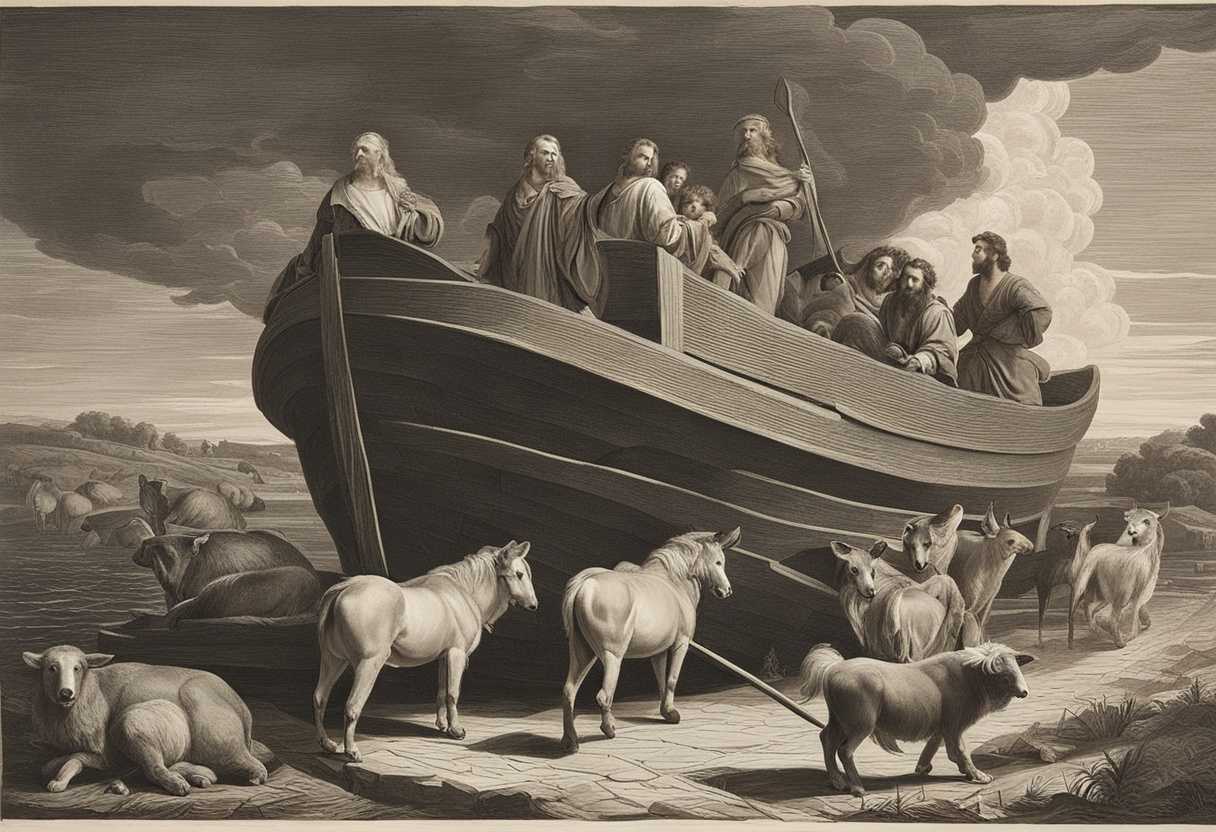
Setting the Scene for Genesis 7:1-24
In Genesis chapter 7, we find ourselves in the midst of a pivotal moment in biblical history – the great flood. The scene is set with Noah, a righteous man in the eyes of God, along with his wife, three sons (Shem, Ham, and Japheth), and their wives. They have been chosen by God to build an ark to save themselves and a remnant of all living creatures from the impending deluge that will wipe out the earth due to its corruption and violence.
As the rain begins to fall and the waters start to rise, Noah and his family, along with pairs of every kind of animal, gather inside the massive ark they have spent years constructing. The atmosphere is tense yet filled with a sense of purpose and obedience to God’s command. The sound of the rain pounding on the roof of the ark echoes through the chambers as the floodwaters continue to rise, sealing off any escape for those outside.
Inside the ark, the smell of hay, wood, and animals mingles in the air, while the dim light filtering through the small windows casts a somber yet hopeful glow on the faces of Noah and his family. As the world outside is consumed by water, the ark becomes a symbol of salvation and protection, a refuge in the midst of a catastrophic event that will ultimately pave the way for a new beginning for humanity and all living creatures.
What is Genesis 7:1-24 about?
This verse from the story of Noah’s ark in the Bible symbolizes obedience, trust, and divine protection. God’s command to Noah to gather his family and animals and enter the ark is a test of faith and a demonstration of complete submission to God’s will. It shows the importance of following God’s instructions even when they may not make sense or seem challenging.
Imagine being in Noah’s shoes, tasked with building a huge ark and then being told to enter it with your loved ones and animals while a catastrophic flood is about to happen. It requires a deep trust in God’s plan and a willingness to obey without question. This verse teaches us the importance of faith, obedience, and the reassurance that God’s protection is always with us, especially in times of difficulty and uncertainty.
Understanding what Genesis 7:1-24 really means
Genesis chapter 7 vividly narrates the onset of the Flood, marking a pivotal moment not only in biblical history but in God’s interaction with humanity. This chapter intricately reflects themes of judgment, salvation, and divine sovereignty, which bear profound implications for contemporary believers.
The core message of Genesis 7 centers on Noah’s obedience in the face of a catastrophic global judgment. Noah was commanded by God to enter the ark with his family and pairs of all living creatures because he was found righteous in God’s sight. Here, a critical phrase to focus on is “found righteous.” This indicates that Noah’s relationship with God was based on righteous living in a context where moral decay was rampant. This obedience and faithfulness set him apart, enabling him and his household to be spared from the deluge that wiped out all earthly existence. It mirrors the biblical passage in Ezekiel 14:14, where Noah is listed among the righteous who could deliver only themselves by their righteousness.
For contemporary readers, Noah’s example is a powerful reminder of the significance of living a righteous life amidst a morally complex society. Noah’s story calls us to steadfast faithfulness and integrity in today’s world, where ethical lines are often blurred, adhering to divine principles even when they contradict societal norms.
Furthermore, one must consider the methodical nature in which Noah built and entered the ark—another aspect of his obedience. This represents meticulous adherence to God’s instructions, a lesson on the importance of obeying God’s word in its entirety. How often does modern society encourage shortcuts or compromises even in spiritual matters? Noah’s example teaches the blessing and protection inherent in following God’s directives fully.
An anecdote to illustrate Noah’s relevance today might involve a business leader faced with unethical practices in the workplace. Choosing to stand firm in integrity, despite potential loss or ridicule, can be likened to Noah building the ark—an act of faith and obedience visible to and often scorned by onlookers. Yet, such integrity leads to ultimate preservation and blessing, just as Noah experienced salvation through the ark. Genesis 7 is not just a historical account; it is a directive for living faithfully under God’s sovereign rule. It challenges readers to consider their own response to God’s call in their lives, encourages them to persevere in righteousness, and reminds them of the ultimate deliverance that comes from living a life aligned with divine will. How are you building your ‘ark’ in obedience to God as you reflect on Noah’s story, and how does this set you apart in a world often flooded with moral compromise?
How do we discern between righteous and wicked actions?
Righteous actions in the context of the verse align with God’s commands and reflect His character, while wicked actions go against His will and promote evil. Righteousness involves obedience, faithfulness, and moral purity, while wickedness encompasses disobedience, unfaithfulness, and immorality. We can discern whether an action is righteous or wicked by evaluating it in light of God’s Word and His standards of righteousness using this standard. Noah exemplifies righteousness in the verse through his obedience in building the ark according to God’s instructions, his faith in God’s promise of protection and salvation, and his moral integrity in living a blameless life amidst a corrupt and sinful generation. Wickedness, on the other hand, is demonstrated by the sinful behavior and disregard for God’s commands exhibited by the people of Noah’s time, which ultimately led to their destruction in the flood. The contrast between the righteous actions of Noah and the wicked actions of the rest of humanity serves as a clear distinction between those who follow God’s ways and those who choose to rebel against Him. Righteous and wicked actions bring about outcomes that reveal their consequences. Righteousness often leads to blessing, protection, and salvation, while wickedness results in judgment, punishment, and destruction. Noah’s righteous actions secure his salvation and preservation amidst the devastation, serving as a stark reminder of the consequences of living in rebellion against God in the verse where God’s judgment on the wickedness of humanity through the flood is depicted. We can strive to live in a way that honors God and receives His favor and blessing by discerning between righteous and wicked actions based on their alignment with God’s will and their outcomes.
Application
Consider your life as a blueprint, a divine design sketched by a perfect hand. In the bustling construction site of your days—amidst the chaos and clutter—there’s a call to follow a plan as Noah did when he built his ark. Like him, you have the chance to construct your existence with faith, securing not just your survival but thriving amidst life’s floods. Are you ready to pick up the tools of trust and obedience, to build according to the divine design? Will you heed the call and step into the ark of opportunity that awaits? What masterpiece will your life be if you listen and follow with all your heart?

Reverend Michael Johnson is an experienced Church Minister with a profound expertise in spirituality and guidance. With a serene presence and a compassionate heart, he has faithfully served his congregation for over 20 years, leading them on a spiritual journey towards inner peace and enlightenment. Reverend Johnson’s extensive knowledge of religious philosophies and profound understanding of human nature have made him a trusted confidant and mentor to many, as he seamlessly weaves his profound wisdom into life teachings. Reverend Johnson’s calming demeanor and empathetic nature continue to uplift and heal souls, nurturing a sense of unity and tranquility within his community.