
Hebrews 10:1-14 is about how the sacrificial system of the Old Testament was only a shadow of the ultimate sacrifice of Jesus Christ, who offered himself once for all to bring eternal redemption and sanctification to believers.
10 For since the law has but a shadow of the good things to come instead of the true form of these realities, it can never, by the same sacrifices that are continually offered every year, make perfect those who draw near.
2 Otherwise, would they not have ceased to be offered, since the worshipers, having once been cleansed, would no longer have any consciousness of sins?
3 But in these sacrifices there is a reminder of sins every year.
4 For it is impossible for the blood of bulls and goats to take away sins.
5 Consequently, when Christ came into the world, he said, “Sacrifices and offerings you have not desired, but a body have you prepared for me;
6 In burnt offerings and sin offerings you have taken no pleasure.
7 Then I said, ‘Behold, I have come to do your will, O God, as it is written of me in the scroll of the book.’
When he said above, “You have neither desired nor taken pleasure in sacrifices and offerings and burnt offerings and sin offerings” (these are offered according to the law),
9 then he added, “Behold, I have come to do your will.” He does away with the first in order to establish the second.
10 And by that will we have been sanctified through the offering of the body of Jesus Christ once for all.
11 And every priest stands daily at his service, offering repeatedly the same sacrifices, which can never take away sins.
12 But when Christ had offered for all time a single sacrifice for sins, he sat down at the right hand of God,
13 waiting from that time until his enemies should be made a footstool for his feet.
14 For by a single offering he has perfected for all time those who are being sanctified.
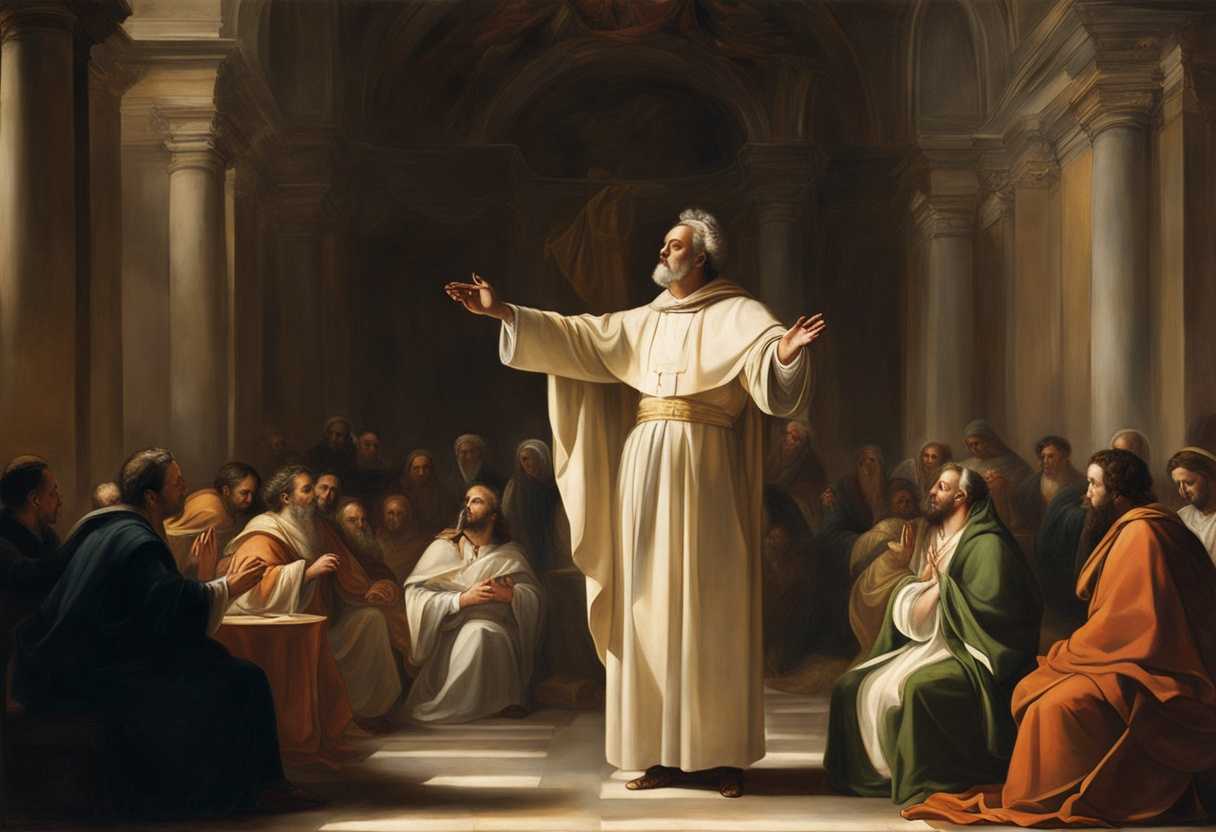
Setting the Scene for Hebrews 10:1-14
The scene in Hebrews chapter 10 is set in the heavenly realm, where Jesus Christ is depicted as the ultimate high priest who offered himself as a perfect sacrifice for the sins of humanity. The author of Hebrews contrasts the temporary and imperfect sacrifices of the Old Testament priests with the once-for-all sacrifice of Jesus. The setting is one of divine justice and mercy, where Jesus willingly offers himself as the atoning sacrifice to reconcile humanity with God.
In this scene, we see Jesus, the Son of God, standing before the Father in the heavenly sanctuary. Surrounding them are angels and the spirits of the righteous who have been made perfect through the sacrifice of Jesus. The atmosphere is one of awe and reverence, as the significance of Jesus’ sacrifice is fully realized. The scene serves as a powerful reminder of the eternal redemption and forgiveness that believers have through faith in Christ.
As the author of Hebrews paints this vivid picture, the readers are encouraged to hold fast to their faith and draw near to God with confidence, knowing that Jesus has opened the way for them to have a personal relationship with the Father. The scene in Hebrews chapter 10 serves as a powerful reminder of the central message of the gospel – that through the sacrifice of Jesus, we have been sanctified once and for all.
What is Hebrews 10:1-14 about?
This verse speaks to the profound and eternal impact of Christ’s sacrifice on the lives of believers. The phrase “once for all” emphasizes the completeness and finality of Christ’s sacrifice on the cross. Through this sacrifice, believers receive not only forgiveness of sins but also an eternal redemption that can never be undone. This redemption allows us to be set apart and sanctified, made holy and righteous in the eyes of God.
Have you ever pondered the incredible depth of love and grace that Christ showed through His sacrifice? How does knowing that His sacrifice offers not just forgiveness, but eternal redemption and sanctification, impact your understanding of your own worth and identity as a believer? Christ has freely given us the immeasurable gift of salvation, so let us reflect on this verse and be filled with gratitude. We should live out our lives in response to this great love, striving to honor Him in all that we do.
Understanding what Hebrews 10:1-14 really means
In Hebrews 10:1-14, the author delves into the inadequacy of the old sacrificial system under the Mosaic Law and contrasts it with the sufficiency of Christ’s ultimate sacrifice on the cross. The passage highlights how the law served as a mere shadow of the good things to come, pointing towards the ultimate reality found in Jesus Christ. Just as shadows are not the substance itself but a representation of it, the rituals and sacrifices of the Old Testament pointed forward to the perfect sacrifice of Jesus.
The author emphasizes the futility of the repeated sacrifices offered year after year, unable to truly cleanse or perfect those who participated in them. This repetition underscored the ongoing nature of sin and the inability of these sacrifices to provide a permanent solution. Hebrews 9:9-10 further elucidates how these external regulations could not bring about the inner transformation needed for true reconciliation with God.
However, in stark contrast to the temporary and incomplete nature of the old system, Christ’s sacrifice stands out as a once-for-all offering that accomplished what the previous sacrifices could not. The imagery of Christ sitting down at the right hand of God signifies the completion and finality of His redemptive work. Psalm 110:1 reinforces this idea, portraying the Messiah in a position of authority and victory after His sacrificial act.
For believers today, this passage holds profound significance as it underscores the sufficiency of Christ’s sacrifice for the forgiveness of sins. It brings a sense of freedom and assurance, knowing that through Christ, they are fully forgiven and reconciled to God. Romans 8:1 echoes this sentiment by proclaiming that there is no condemnation for those who are in Christ Jesus, emphasizing the security found in Him.
Consider a person burdened by guilt and shame, struggling to find peace and forgiveness. Through grasping the completeness of Christ’s sacrifice and accepting His grace, they experience a transformative shift. This newfound understanding not only brings peace but also instills a renewed sense of purpose and freedom, allowing them to live in the fullness of God’s love and grace.
In conclusion, Hebrews 10:1-14 illuminates the transition from the shadows of the old covenant to the substance found in Christ. It highlights the insufficiency of the old sacrificial system and the all-sufficiency of Christ’s sacrifice. As believers, we are called to rest in the assurance of Christ’s finished work, living out our faith with confidence and gratitude, knowing that in Him, we find true redemption and freedom.
How can we approach God with a pure conscience?
We can approach God with a pure conscience by recognizing the sacrifice that Jesus made for us. The verse demonstrates that the Old Testament sacrifices were not enough to cleanse our consciences from sin. It tells us that it is through Christ’s sacrifice that we are made holy once and for all. We can approach God confidently by believing in the efficacy of Jesus’ sacrifice, knowing that our sins have been forgiven and we are viewed as pure in His sight. We can maintain a pure conscience before God by living a life of faith and obedience. This involves repenting from sin, seeking forgiveness, and striving to follow God’s commands. We can ensure that our consciences remain clear and free from guilt by continually seeking God’s will and relying on His grace. Through a life of faith and trust in God, we can approach Him with confidence and purity of heart, knowing that we are justified by our faith in Christ’s sacrifice.
Application
Reader, ponder on the message of Hebrews 10:1-14. Jesus sacrificed for us – grasp this grace. Turn from sin and grasp redemption. Let’s walk a path worthy of this love. Will you embrace this calling and live it out?

Reverend Michael Johnson is an experienced Church Minister with a profound expertise in spirituality and guidance. With a serene presence and a compassionate heart, he has faithfully served his congregation for over 20 years, leading them on a spiritual journey towards inner peace and enlightenment. Reverend Johnson’s extensive knowledge of religious philosophies and profound understanding of human nature have made him a trusted confidant and mentor to many, as he seamlessly weaves his profound wisdom into life teachings. Reverend Johnson’s calming demeanor and empathetic nature continue to uplift and heal souls, nurturing a sense of unity and tranquility within his community.