
John 12:12-14 is about Jesus entering Jerusalem triumphantly as the prophesied Messiah, demonstrating his fulfillment of Old Testament prophecies and reinforcing his role as the King of Israel.
12 The next day the large crowd that had come to the feast heard that Jesus was coming to Jerusalem.
12 So they took branches of palm trees and went out to meet him, crying out, “Hosanna! Blessed is he who comes in the name of the Lord, even the King of Israel!”
14 And Jesus found a young donkey and sat on it, just as it is written,
Setting the Scene for John 12:12-14
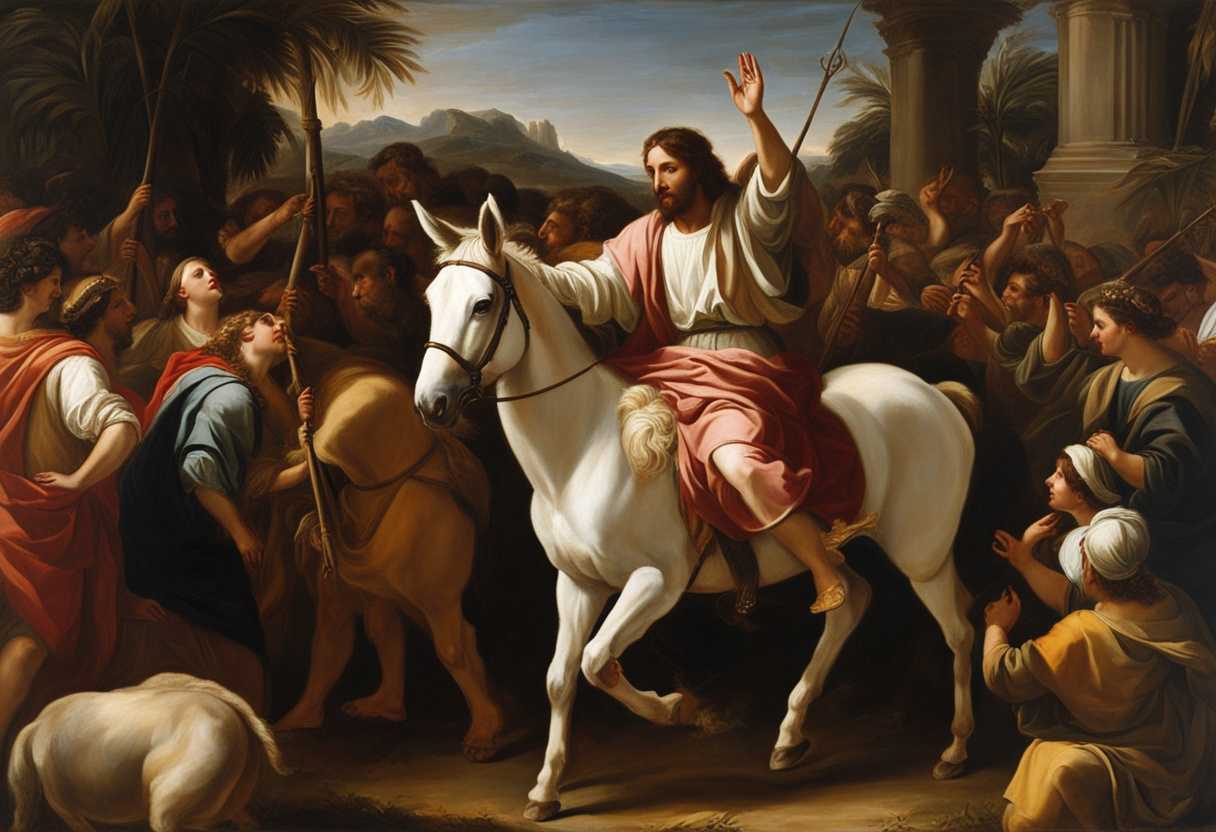
As the sun began to set over the city of Jerusalem, a buzz of excitement filled the air. The streets were lined with people who had come to celebrate the Passover festival. Among the crowd were Jesus of Nazareth and his disciples, who had traveled to Jerusalem to observe the holy feast. The disciples had been with Jesus for some time now, witnessing his miracles and teachings, and they were eager to see what would unfold next.
As they approached the city, Jesus instructed two of his disciples to go ahead and bring him a young donkey that was tied up nearby. The disciples did as Jesus had asked, and soon they returned with the donkey. Jesus then mounted the donkey, fulfilling the prophecy in Zechariah 9:9, which foretold the coming of the Messiah riding on a donkey. The disciples, filled with awe and wonder, spread their cloaks on the ground before Jesus and began to shout, “Hosanna! Blessed is he who comes in the name of the Lord!” The scene was one of jubilation and anticipation as the crowd recognized Jesus as the long-awaited King of Israel.
What is John 12:12-14 about?
Isn’t it fascinating how Jesus, who is often seen as the King of Kings, chose to enter Jerusalem not on a majestic horse as a conquering king would, but on a humble donkey? This act of humility not only fulfilled the prophecy from the book of Zechariah, but also served as a powerful symbol of peace. Jesus showed the world that his kingdom is not of this world and that he comes not as a warrior seeking conquest, but as a prince of peace by riding on a donkey.
This moment encapsulates Jesus’ teachings on humility and servanthood, as well as his message of peace and love. It challenges us to reflect on our own lives and the ways in which we can embody these virtues in our interactions with others. We too are called to approach life with a spirit of humility, putting the needs of others before our own and striving for peace in all our actions, just as Jesus chose humility over grandeur. Jesus’ entry into Jerusalem on a donkey serves as a powerful reminder of the transformational power of humility and the enduring message of peace that he brought to the world.
Understanding what John 12:12-14 really means
The passage in John 12:12-14 captures the momentous occasion of Jesus’ triumphal entry into Jerusalem, setting the stage for the events leading to His crucifixion and resurrection. As Jesus approached Jerusalem, a great crowd had gathered for the festival, signifying the significance of the moment. The people, in a symbolic gesture of victory and peace, took palm branches and went out to meet Him, recognizing Him as a triumphant king. This act of homage fulfilled the prophecy from Zechariah 9:9, where a king would come in humility, riding on a donkey.
The cries of “Hosanna! Blessed is he who comes in the name of the Lord! Blessed is the king of Israel!” echoed through the crowd, acknowledging Jesus as the Messiah and King. These words not only hailed His arrival but also revealed the people’s understanding of His divine identity and the fulfillment of long-awaited promises. The parallel accounts in Matthew, Mark, and Luke provide additional insights into this significant event, emphasizing the prophetic fulfillment and the crowd’s recognition of Jesus’ kingship.
In our contemporary context, the triumphal entry serves as a poignant reminder for us to welcome Jesus into our lives with the same fervor and recognition as the crowd in Jerusalem. It challenges us to reflect on the nature of Jesus’ kingship, characterized by humility and peace, contrasting with the world’s pursuit of power and dominance. Just as Jesus chose a humble mode of entry, we are called to embrace humility in our interactions and leadership, following His example of servant leadership in a world often marred by pride and conflict.
Consider a small-town mayor who eschews a grand entrance in favor of walking through the streets, engaging with the townspeople personally. This act of humility and approachability endears the mayor to the community, much like Jesus’ humble entry on a donkey resonated with the crowd. Such anecdotes illustrate the profound impact of humility and genuine connection, prompting us to emulate these virtues in our own lives and relationships.
In conclusion, the triumphal entry of Jesus into Jerusalem encapsulates His unique kingship and the fulfillment of God’s promises. It beckons us to embrace humility, pursue peace, and acknowledge Jesus as the ultimate source of salvation. By meditating on this passage, we find inspiration to embody our faith authentically, mirroring Jesus’ example of humble leadership and bringing hope to those around us through our actions and attitudes.
Why do people welcome Jesus as a king?
People welcome Jesus as a king because they recognize Him as the long-awaited Messiah, the promised King of Israel who comes in the name of the Lord. They see Him as the one who brings salvation, hope, and deliverance to the people. They acknowledge Jesus as the ruler who has come to save them by laying down palm branches and shouting “Hosanna,” which means “save us.”
The act of spreading their cloaks on the road for Jesus to ride on signifies a sign of respect and honor given to a king or conqueror. The people are expressing their willingness to submit to Jesus’ authority and leadership by doing this. They are demonstrating their belief that He is the rightful ruler who will restore the kingdom of Israel and fulfill God’s promises by welcoming Him as a king.
The crowd’s enthusiastic welcome of Jesus as a king also reflects their desire for political liberation and change. They hope that Jesus will lead them to victory over their oppressors and establish a new kingdom of justice and peace. Jesus is not just a spiritual leader but a political figure who will bring about a transformation in their society in their eyes.
Application
Picture your daily hustle at work and your constant devotion to family. Now imagine Jesus walking into your life, claiming His rightful place. Don’t just watch from the sidelines—embrace Him as your true leader and guide. Speak out His name and share His love just as people once laid palm branches for Him. Are you ready to bring His message of hope into your world today?

Reverend Michael Johnson is an experienced Church Minister with a profound expertise in spirituality and guidance. With a serene presence and a compassionate heart, he has faithfully served his congregation for over 20 years, leading them on a spiritual journey towards inner peace and enlightenment. Reverend Johnson’s extensive knowledge of religious philosophies and profound understanding of human nature have made him a trusted confidant and mentor to many, as he seamlessly weaves his profound wisdom into life teachings. Reverend Johnson’s calming demeanor and empathetic nature continue to uplift and heal souls, nurturing a sense of unity and tranquility within his community.