
John 13:21-38 is about Jesus revealing to his disciples that one among them would betray him, emphasizing the importance of love and selflessness as the defining characteristic of his followers.
21 After saying these things, Jesus was troubled in his spirit, and testified, “Truly, truly, I say to you, one of you will betray me.”
22 The disciples looked at one another, uncertain of whom he spoke.
23 One of his disciples, whom Jesus loved, was reclining at table at Jesus’ side,
24 So Simon Peter motioned to him to ask Jesus of whom he was speaking.
25 So that disciple, leaning back against Jesus, said to him, “Lord, who is it?”
26 Jesus answered, “It is he to whom I will give this morsel of bread when I have dipped it.” So when he had dipped the morsel, he gave it to Judas, the son of Simon Iscariot.
27 Then after he had taken the morsel, Satan entered into him. Jesus said to him, “What you are going to do, do quickly.”
28 Now no one at the table knew why he said this to him.
29 Some thought that, because Judas had the moneybag, Jesus was telling him, “Buy what we need for the feast,” or that he should give something to the poor.
30 So, after receiving the morsel of bread, he immediately went out. And it was night.
31 When he had gone out, Jesus said, “Now is the Son of Man glorified, and God is glorified in him.
32 If God is glorified in him, God will also glorify him in himself, and glorify him at once.
33 Little children, yet a little while I am with you. You will seek me, and just as I said to the Jews, so now I also say to you, ‘Where I am going you cannot come.’
34 A new commandment I give to you, that you love one another: just as I have loved you, you also are to love one another.
35 By this all people will know that you are my disciples, if you have love for one another.
36 Simon Peter said to him, “Lord, where are you going?” Jesus answered him, “Where I am going you cannot follow me now, but you will follow afterward.”
37 Peter said to him, “Lord, why can I not follow you now? I will lay down my life for you.”
38 Jesus answered, “Will you lay down your life for me? Truly, truly, I say to you, the rooster will not crow till you have denied me three times.
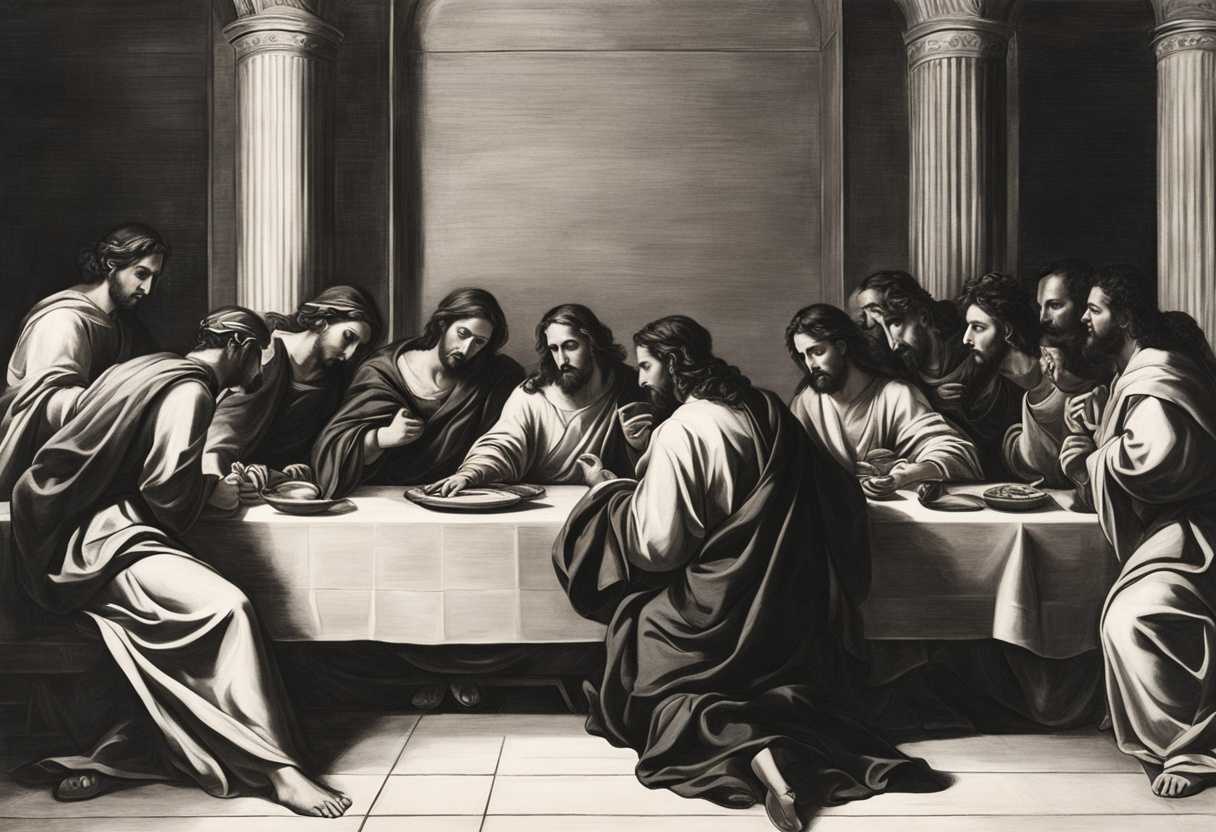
Setting the Scene for John 13:21-38
The scene in John chapter 13 takes place during the Last Supper, a significant event in the life of Jesus and his disciples. Jesus and his twelve disciples, including Peter, John, Judas Iscariot, and the others, are gathered in an upper room in Jerusalem to share a final meal before Jesus’ crucifixion. The room is dimly lit by oil lamps, casting a warm glow over the group as they recline at the table.
As they eat, Jesus drops a bombshell by revealing that one of his closest followers will betray him. The news sends shockwaves through the room, and the disciples look at each other in disbelief, wondering who among them could commit such an act. Peter, always impulsive, asks John to inquire of Jesus who the betrayer is. John, the beloved disciple, leans back against Jesus and asks him quietly. Jesus responds by indicating that it is the one to whom he will give a piece of bread. Judas, the one who would later betray Jesus, takes the bread from Jesus, and Satan enters him as he leaves the room to carry out his betrayal.
The atmosphere in the room is tense as Jesus speaks of his impending death and departure. He gives his disciples a new commandment to love one another as he has loved them, foreshadowing the ultimate act of love he will demonstrate on the cross. The disciples are confused and fearful, not fully understanding the events that are about to unfold but trusting in Jesus’ words.
What is John 13:21-38 about?
Jesus demonstrates his divine knowledge in this verse by foretelling the events that will unfold – Judas Iscariot’s betrayal and Peter’s denial. Despite knowing that these painful betrayals will occur, Jesus does not act out of spite or anger. Instead, He shows remarkable compassion and grace by forgiving these actions even before they happen. This verse prompts us to reflect on the importance of forgiveness and understanding in our own lives. It challenges us to consider how we respond to betrayal and denial from those around us. Do we react with anger and resentment, or do we strive to emulate Jesus’ example of forgiveness and compassion? Contemplating this verse encourages us to reflect on our own capacity for grace and forgiveness in the face of personal betrayals. Jesus also reminds us of the complex nature of humanity in the midst of this powerful teaching. Even those closest to Him – Judas and Peter – are capable of betraying and denying Him. This verse serves as a poignant reminder of the fragility of human relationships and the importance of extending grace and understanding to others, even in the face of betrayal. Let us embody Jesus’ spirit of forgiveness and compassion in our own lives by taking this lesson to heart and striving.
Understanding what John 13:21-38 really means
- Introduction
-
In the poignant setting of the Last Supper, a momentous occasion before Jesus’ crucifixion, we delve into a passage rich with themes of betrayal, love, and the foretelling of Peter’s denial.
-
Verse Breakdown and Commentary
-
Verses 21-30: The Betrayal Foretold
- Witness Jesus’ inner turmoil as He foretells the betrayal by one of His own, Judas Iscariot, showcasing the profound pain of betrayal from within His trusted circle.
- Through Jesus’ revelation, we are reminded of the universal experience of betrayal and the importance of responding with grace and forgiveness, mirroring His example.
- Connecting with Psalms and Matthew, we see the fulfillment of prophecies and the intricate tapestry of God’s plan unfolding through human actions.
- How do we navigate betrayal in our lives? Jesus’ response serves as a guiding light, illuminating the path of forgiveness and resilience in the face of betrayal.
-
Verses 31-35: The New Commandment
- Jesus speaks of His impending glorification and issues a revolutionary commandment: to love one another as He has loved us, setting a new standard for His followers.
- Drawing parallels with other biblical passages, we are reminded of the centrality of love in the Christian faith and the transformative power it holds.
- In a world marred by discord, Jesus’ call to love stands as a beacon of hope, urging us to bridge divides and embody His love in our interactions.
- How can we embody this radical love in our daily lives? Let Jesus’ commandment resonate in our hearts, inspiring acts of compassion and unity in a fractured world.
-
Verses 36-38: Peter’s Denial Foretold
- Jesus forewarns Peter of his impending denial, underscoring human frailty and the need for divine grace in moments of weakness.
- Through Peter’s journey of denial and restoration, we glean a profound truth: failure does not define us, but God’s grace can redeem and propel us forward.
- Reflecting on Peter’s story, we find solace in the assurance that God’s grace is boundless, offering restoration and purpose despite our shortcomings.
- Have you ever felt like Peter, grappling with failure and doubt? Let his story be a testament to God’s unfailing love and transformative power in our lives.
-
Conclusion
- As we unravel the tapestry of betrayal, love, and restoration in these verses, let us ponder the profound lessons they hold for our own journeys.
- May we heed the call to love fiercely, forgive relentlessly, and embrace the hope of redemption, mirroring the example set by Christ.
- In prayer or reflection, may we seek strength, love, and grace to walk in the footsteps of Jesus, embodying His teachings in our relationships and interactions.
How can we show love and unity to others?
We can show love and unity to others by being patient and understanding with one another, just as Jesus did with his disciples. Jesus, in the verse, was aware that one of his disciples would betray him, yet he did not react with anger or judgment. Instead, he showed love and compassion even in the face of betrayal. We can foster a sense of unity and strengthen our bonds with others by practicing patience and understanding in our own relationships.
Furthermore, we can show love and unity by serving one another selflessly, following the example set by Jesus when he washed the feet of his disciples. We demonstrate a deep love and respect for those around us by humbling ourselves and putting the needs of others before our own. Through acts of service and kindness, we can build stronger connections and create a sense of unity within our communities.
Lastly, we can show love and unity by encouraging and supporting one another in times of need. We can uplift those around us with our words and actions, just as Jesus reassured his disciples and offered them guidance and support. We can foster a spirit of unity and create a sense of belonging and care within our relationships by being a source of strength and compassion for others.
Application
Think of your faith as a commitment, just like your dedication to your family or your job. John 13:21-38 calls us to go beyond words and live out our beliefs through our actions. Remember Judas’ betrayal and choose loyalty, even when times get tough. Show love and kindness, as Jesus did when He washed His disciples’ feet. How will you prove your love for Jesus and others today?

Reverend Michael Johnson is an experienced Church Minister with a profound expertise in spirituality and guidance. With a serene presence and a compassionate heart, he has faithfully served his congregation for over 20 years, leading them on a spiritual journey towards inner peace and enlightenment. Reverend Johnson’s extensive knowledge of religious philosophies and profound understanding of human nature have made him a trusted confidant and mentor to many, as he seamlessly weaves his profound wisdom into life teachings. Reverend Johnson’s calming demeanor and empathetic nature continue to uplift and heal souls, nurturing a sense of unity and tranquility within his community.