
John 19:16-42 is about the crucifixion and burial of Jesus Christ, symbolizing his sacrificial atonement for the sins of humanity and the fulfillment of Old Testament prophecies.
16 So he delivered him over to them to be crucified.
17 and he went out, bearing his own cross, to the place called The Place of a Skull, which in Aramaic is called Golgotha.
18 There they crucified him, and with him two others, one on either side, and Jesus between them.
19 Pilate also wrote an inscription and put it on the cross. It read, “Jesus of Nazareth, the King of the Jews.”
20 Many of the Jews read this inscription, for the place where Jesus was crucified was near the city, and it was written in Aramaic, in Latin, and in Greek.
21 So the chief priests of the Jews said to Pilate, “Do not write, ‘The King of the Jews,’ but rather, ‘This man said, I am King of the Jews.’”
22 Pilate answered, “What I have written I have written.”
23 When the soldiers had crucified Jesus, they took his garments and divided them into four parts, one part for each soldier; also his tunic. But the tunic was seamless, woven in one piece from top to bottom.
24 so they said to one another, “Let us not tear it, but cast lots for it to see whose it shall be.” This was to fulfill the Scripture which says, “They divided my garments among them, and for my clothing they cast lots.” So the soldiers did these things,
25 but standing by the cross of Jesus were his mother and his mother’s sister, Mary the wife of Clopas, and Mary Magdalene.
26 When Jesus saw his mother and the disciple whom he loved standing nearby, he said to his mother, “Woman, behold, your son!”
27 Then he said to the disciple, “Behold, your mother!” And from that hour the disciple took her to his own home.
28 After this, Jesus, knowing that all was now finished, said (to fulfill the Scripture), “I thirst.”
29 A jar full of sour wine stood there, so they put a sponge full of the sour wine on a hyssop branch and held it to his mouth.
30 When Jesus had received the sour wine, he said, “It is finished,” and he bowed his head and gave up his spirit.
31 Since it was the day of Preparation, and so that the bodies would not remain on the cross on the Sabbath (for that Sabbath was a high day), the Jews asked Pilate that their legs might be broken and that they might be taken away.
32 So the soldiers came and broke the legs of the first, and of the other who had been crucified with him.
33 But when they came to Jesus and saw that he was already dead, they did not break his legs.
34 But one of the soldiers pierced his side with a spear, and at once there came out blood and water.
35 He who saw it has borne witness—his testimony is true, and he knows that he is telling the truth—that you also may believe.
36 For these things took place that the Scripture might be fulfilled: “Not one of his bones will be broken.”
37 And again another Scripture says, “They will look on him whom they have pierced.”
38 After these things Joseph of Arimathea, who was a disciple of Jesus, but secretly for fear of the Jews, asked Pilate that he might take away the body of Jesus, and Pilate gave him permission. So he came and took away his body.
39 Nicodemus also, who earlier had come to Jesus by night, came bringing a mixture of myrrh and aloes, about seventy-five pounds in weight.
40 So they took the body of Jesus and bound it in linen cloths with the spices, as is the burial custom of the Jews.
41 Now in the place where he was crucified there was a garden, and in the garden a new tomb in which no one had yet been laid.
42 So because of the Jewish day of Preparation, since the tomb was close at hand, they laid Jesus there.
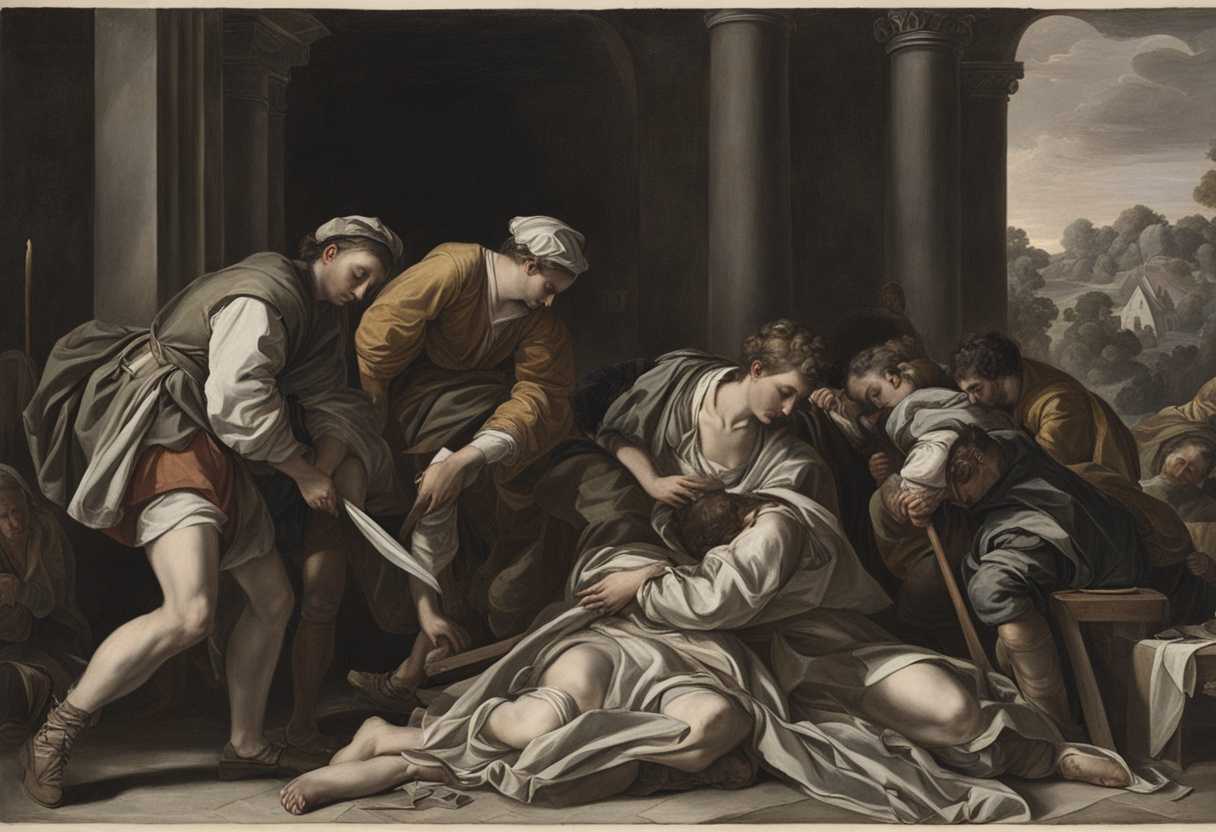
Setting the Scene for John 19:16-42
The scene in John chapter 19 takes place at Golgotha, the place of the Skull, where Jesus was crucified. The Roman soldiers, along with a crowd of onlookers, have gathered to witness the crucifixion of Jesus. Among the crowd are Mary, the mother of Jesus, Mary Magdalene, and the disciple whom Jesus loved, traditionally believed to be John. They are standing at the foot of the cross, watching in sorrow as Jesus hangs there, suffering.
The sky is dark and ominous, as if the very earth is mourning the death of the Son of God. The soldiers are carrying out their duty with callous indifference, while some of the onlookers mock Jesus and challenge him to save himself if he truly is the Son of God. Despite the chaos and cruelty surrounding them, Mary, Mary Magdalene, and John stand steadfast in their love and devotion to Jesus, bearing witness to his sacrifice.
As Jesus hangs on the cross, he speaks words of forgiveness and compassion, even for those who have crucified him. The scene is filled with a sense of profound sadness and yet also a glimmer of hope, as Jesus’s sacrifice is ultimately an act of love that will bring salvation to all who believe in him.
What is John 19:16-42 about?
This verse carries profound significance in the Christian faith, depicting the sacrificial act of Jesus Christ as he willingly undergoes crucifixion, death, and burial. Jesus exemplifies his divine purpose and love for humanity by fulfilling the prophecies foretold in the Scriptures. Through his ultimate sacrifice, Jesus showcases the extent of his compassion and commitment to redeeming mankind from sin and offering the gift of salvation. Jesus demonstrates immense love and selflessness through his crucifixion and death. Jesus embodies the epitome of love and grace by willingly enduring such intense suffering, paving the way for forgiveness and eternal life for all who believe in him. His burial symbolizes the completion of his earthly mission, laying the foundation for the resurrection that will bring hope and new life to believers. Reflect on the profound depth of Jesus’ sacrifice and allow it to inspire gratitude, humility, and a deeper understanding of the divine love that was displayed on the cross.
Understanding what John 19:16-42 really means
The passage of John 19:16-42 delves into the poignant account of Jesus’ crucifixion, death, and burial, pivotal events in Christian theology. It serves as a cornerstone of the Christian faith, illustrating the profound sacrifice made by Jesus for the redemption of humanity’s sins. As we delve into the key phrases within this passage, each word carries significant weight and symbolism. “They took Jesus” marks the beginning of His journey to the cross, signifying His unwavering submission to God’s divine plan. “Carrying his own cross” symbolizes Jesus shouldering the burden of humanity’s sins, showcasing His unparalleled love and selflessness.
In the climactic moment, Jesus utters the words, “It is finished,” signifying the completion of His mission to atone for the sins of the world. The imagery of “blood and water flowed out” holds profound symbolism, representing the cleansing and life-giving power of Jesus’ sacrificial death. These phrases encapsulate the depth of Jesus’ love and the magnitude of His sacrifice for all mankind. Connecting this narrative to other biblical passages, such as Isaiah 53:5, we see the fulfillment of prophecies regarding the suffering servant in Jesus’ crucifixion.
Moreover, in Luke 23:34, Jesus’ plea for forgiveness for His tormentors exemplifies His boundless mercy and forgiveness, even amidst excruciating suffering. Romans 5:8 further underscores the incomprehensible love of God, demonstrated through Christ’s death for humanity while they were still in sin. These verses emphasize the transformative power of forgiveness, grace, and unconditional love that Jesus embodied through His sacrifice on the cross.
The relevance of this passage extends to contemporary times, urging believers to reflect on the themes of sacrifice, redemption, forgiveness, and hope. Jesus’ crucifixion serves as a poignant reminder of the ultimate sacrifice made for humanity’s redemption, inspiring believers to extend forgiveness and grace to others, mirroring Christ’s example. His death and resurrection offer hope for eternal life and spiritual renewal, guiding believers towards a life rooted in faith and love.
Consider the profound impact of Jesus’ forgiveness towards those who wronged Him, juxtaposed with our struggles to forgive others. Reflecting on Jesus’ unwavering grace can inspire us to embody forgiveness and extend compassion, even in the face of adversity. In conclusion, the narrative of John 19:16-42 encapsulates a profound message of love, sacrifice, and redemption, calling believers to emulate Jesus’ example of forgiveness, grace, and hope in their daily lives.
What is the significance of Jesus’ crucifixion and burial?
The crucifixion and burial of Jesus hold immense significance in Christian theology and belief. Jesus’ crucifixion, often viewed as the culmination of his earthly mission, is seen as a sacrifice for the sins of humanity. Christians believe that through his death on the cross, Jesus provided a way for the forgiveness of sins and reconciliation between God and humankind. His crucifixion is central to the concept of atonement, serving as the ultimate act of love and redemption.
Following his crucifixion, Jesus was buried in a tomb, which is a crucial element in the narrative of his death and resurrection. The burial signifies the completion of his earthly life and the reality of his death, highlighting the humanity of Jesus. Furthermore, the burial sets the stage for the miraculous event of his resurrection, which is foundational to the Christian faith. The tomb serves as a temporary resting place before Jesus conquers death and emerges victorious over sin and the grave. The crucifixion and burial of Jesus represent a profound sacrifice and a pivotal moment in Christian belief. They illustrate the depth of God’s love for humanity, the fulfillment of prophecy, and the eventual triumph over sin and death through the resurrection. This sequence of events is central to Christian faith, serving as a source of hope, redemption, and salvation for believers.
Application
Imagine the busiest day in your life—work deadlines, family obligations, everything piling up. Reflect on John 19:16-42, where Jesus faced the ultimate sacrifice on the cross. His act wasn’t just a historical event; it’s a beacon for us today. Take a moment to let that immense love and dedication fuel your soul. In your daily grind, how will you honor such a profound gift? Will you rise and spread His hope and redemption?

Reverend Michael Johnson is an experienced Church Minister with a profound expertise in spirituality and guidance. With a serene presence and a compassionate heart, he has faithfully served his congregation for over 20 years, leading them on a spiritual journey towards inner peace and enlightenment. Reverend Johnson’s extensive knowledge of religious philosophies and profound understanding of human nature have made him a trusted confidant and mentor to many, as he seamlessly weaves his profound wisdom into life teachings. Reverend Johnson’s calming demeanor and empathetic nature continue to uplift and heal souls, nurturing a sense of unity and tranquility within his community.