
John 3:26-30 is about John the Baptist wholeheartedly accepting his role as a messenger preparing the way for Jesus Christ, surrendering his own significance and joyfully witnessing the rise of Jesus as the true Messiah.
26 And they came to John and said to him, “Rabbi, he who was with you across the Jordan, to whom you bore witness—look, he is baptizing, and all are going to him.”
27 John answered, “A person cannot receive even one thing unless it is given him from heaven.”
28 You yourselves bear me witness, that I said, ‘I am not the Christ, but I have been sent before him.’
29 The one who has the bride is the bridegroom. The friend of the bridegroom, who stands and hears him, rejoices greatly at the bridegroom’s voice. Therefore this joy of mine is now complete.
30 He must increase, but I must decrease.
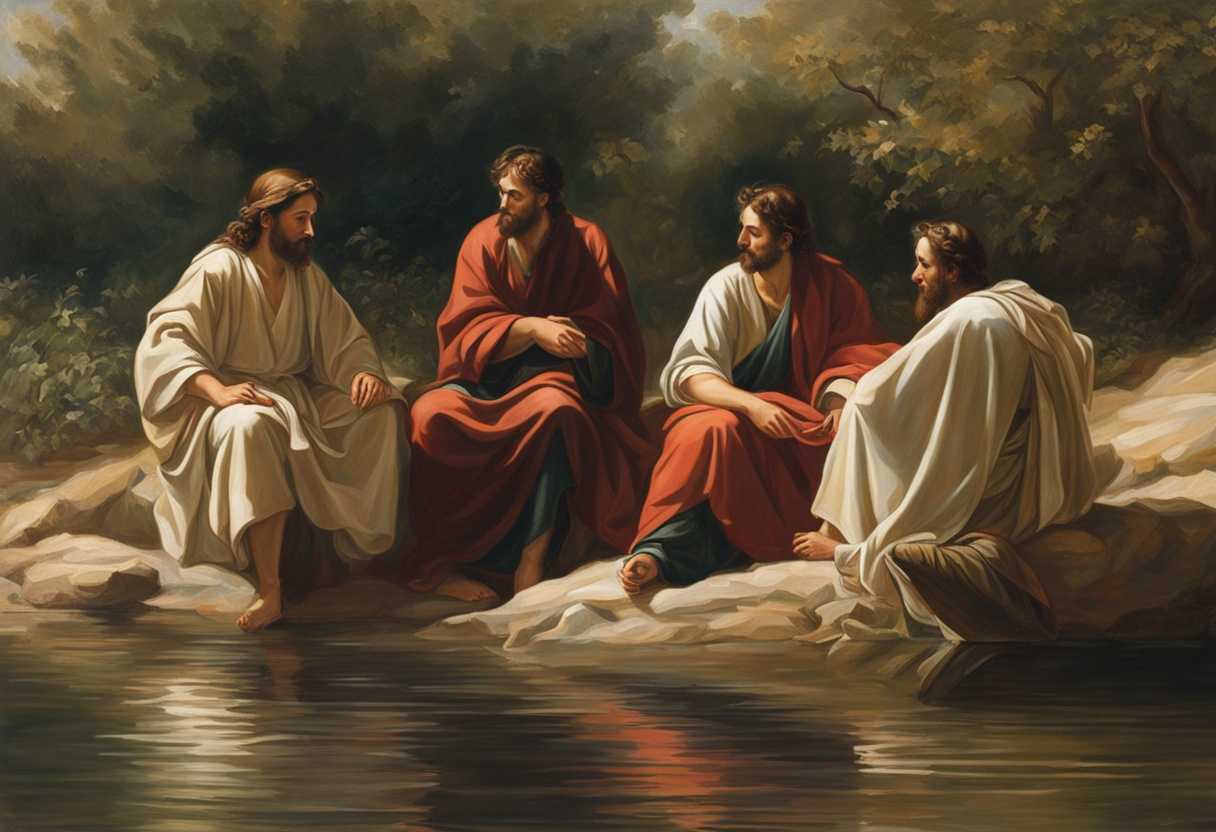
Setting the Scene for John 3:26-30
In John chapter 3, we find John the Baptist and his disciples in the midst of a conversation about Jesus and His growing ministry. John’s disciples were concerned that Jesus was baptizing more people than John, and they were worried about the implications of this for John’s own ministry. John, however, reassured them that this was all part of God’s plan and that he was simply fulfilling his role as the forerunner to the Messiah.
The scene is set in the wilderness near the Jordan River, where John the Baptist had been baptizing people as a sign of repentance. The air is filled with the sound of rushing water and the calls of various birds. The disciples are gathered around John, their faces reflecting a mix of confusion and loyalty. John, with his rugged appearance and fiery demeanor, is speaking passionately about Jesus, whom he had baptized and recognized as the Lamb of God.
As the sun begins to set, casting a warm glow over the landscape, John’s words resonate with his disciples, who begin to understand the significance of Jesus’ ministry. The scene is one of deep spiritual reflection and anticipation, as John humbly acknowledges that Jesus must increase while he must decrease. It is a pivotal moment in the narrative, as John prepares his followers for the next chapter in God’s redemptive plan.
What is John 3:26-30 about?
John the Baptist is demonstrating profound humility and recognition of Jesus’ divine authority in this verse. John is highlighting the immense honor and reverence that he has for Jesus by saying that he is not even worthy to untie the sandals of Jesus. This statement also showcases John’s understanding of his own place in the grander scheme of God’s plan. Despite his important role as a prophet and forerunner to Jesus, John recognizes that Jesus is the ultimate authority and the fulfillment of God’s promise.
Have you ever reflected on your own humility and willingness to acknowledge the authority of others in your life? John’s example serves as a powerful reminder for us to always remain humble and respectful towards those who hold authority over us. Additionally, this verse prompts us to consider our own roles in God’s plan and how we can align ourselves with His greater purpose. How can we emulate John’s humility and willingness to serve in order to fulfill our own unique roles in God’s plan?
Understanding what John 3:26-30 really means
In John 3:26-30, we witness a poignant exchange between John the Baptist and his disciples, where concerns arise about Jesus baptizing more people than John. John’s response is a profound display of humility and understanding of his role in God’s divine plan. He humbly acknowledges that Jesus must increase while he must decrease, encapsulating the essence of his mission to prepare the way for Christ. This passage serves as a pivotal moment in the transition from John the Baptist’s ministry to Jesus’ ministry, emphasizing the importance of recognizing God’s sovereignty and one’s place in His grand design.
John’s statement, “He must become greater; I must become less,” resonates with a powerful message of humility and selflessness. It underscores the significance of acknowledging God’s supremacy and submitting to His will, even if it means stepping aside for others to shine. By highlighting that all authority and gifts come from heaven, John emphasizes the divine source of our roles and responsibilities, urging us to accept them with gratitude and obedience. The metaphor of the friend of the bridegroom waiting joyfully for the bridegroom’s arrival beautifully illustrates the fulfillment and joy found in serving Christ and witnessing His work unfold.
Drawing parallels from related Bible passages like Philippians 2:3-4 and Matthew 3:11, we see a consistent theme of humility and exaltation of Christ throughout Scripture. These verses reinforce the importance of valuing others above ourselves, just as John exemplified by recognizing Jesus’ superior role. In a world that often glorifies self-promotion and personal achievement, John the Baptist’s example challenges us to find joy in serving others and celebrating God’s work, rather than seeking personal glory. His attitude serves as a countercultural reminder of the beauty found in selfless service and surrender to God’s will.
To illustrate this concept further, consider a workplace scenario where a senior employee mentors a new hire without feeling threatened by their potential. Instead, the senior employee takes delight in the new hire’s growth and success, mirroring John the Baptist’s attitude towards Jesus. Just as the senior employee finds fulfillment in the achievements of others, we too can experience profound joy in witnessing God’s plan unfold, even if it means stepping back and allowing others to take the lead.
In conclusion, John 3:26-30 imparts valuable lessons on humility, the joy of serving Christ, and embracing our God-given roles with gratitude. By internalizing these principles, we can find true fulfillment in selflessly contributing to God’s kingdom and rejoicing in the success of His work. May we learn from John the Baptist’s example and strive to emulate his humility and unwavering dedication to God’s greater purpose.
How can we decrease so Christ may increase?
To decrease so Christ may increase means to humble ourselves and shift the focus away from our own desires, ambitions, and recognition, and instead to elevate and prioritize Jesus. It involves recognizing that Jesus is greater than us and allowing Him to take the lead in our lives. We should acknowledge our own limitations and surrender to the authority and preeminence of Christ, just as John the Baptist understood his role as a mere messenger preparing the way for Jesus.
Decreasing so Christ may increase requires us to cultivate a mindset of selflessness, servanthood, and obedience. It involves letting go of ego, pride, and self-centeredness, and embracing a posture of humility and submission to God’s will. We create space for His influence, glory, and work to be magnified in and through us by aligning our hearts, thoughts, and actions with the example and teachings of Jesus. Experiencing a transformation where Christ becomes more present, influential, and visible in our lives while our own desires and ambitions take a secondary role is ultimately about decreasing so Christ may increase. It is a continual process of dying to self, surrendering control, and allowing Jesus to be the focal point of our thoughts, decisions, and actions. We become more effective witnesses and instruments of His love, grace, and truth in the world as we yield to His lordship and allow His character to shine through us.
Application
Embrace humility and purpose like John the Baptist did. Discover your unique role in spreading love and truth. Don’t let pride or envy deter you. Serve your purpose faithfully, just like John did. Will you step up and pursue your divine purpose?

Reverend Michael Johnson is an experienced Church Minister with a profound expertise in spirituality and guidance. With a serene presence and a compassionate heart, he has faithfully served his congregation for over 20 years, leading them on a spiritual journey towards inner peace and enlightenment. Reverend Johnson’s extensive knowledge of religious philosophies and profound understanding of human nature have made him a trusted confidant and mentor to many, as he seamlessly weaves his profound wisdom into life teachings. Reverend Johnson’s calming demeanor and empathetic nature continue to uplift and heal souls, nurturing a sense of unity and tranquility within his community.