
John 4:5-30 is about Jesus breaking societal, cultural, and religious norms by engaging in a profound conversation with a Samaritan woman at the well, demonstrating the universality of salvation and the transformative power of belief in him.
5 So he came to a town of Samaria called Sychar, near the field that Jacob had given to his son Joseph.
6 Jacob’s well was there; so Jesus, wearied as he was from his journey, was sitting beside the well. It was about the sixth hour.
7 A woman from Samaria came to draw water. Jesus said to her, “Give me a drink.”
8 For his disciples had gone away into the city to buy food.
9 The Samaritan woman said to him, “How is it that you, a Jew, ask for a drink from me, a woman of Samaria?” (For Jews have no dealings with Samaritans.)
10 Jesus answered her, “If you knew the gift of God, and who it is that is saying to you, ‘Give me a drink,’ you would have asked him, and he would have given you living water.”
11 The woman said to him, “Sir, you have nothing to draw water with, and the well is deep. Where do you get that living water?
12 Are you greater than our father Jacob? He gave us the well and drank from it himself, as did his sons and his livestock.
13 Jesus said to her, “Everyone who drinks of this water will be thirsty again,
14 but whoever drinks of the water that I will give him will never be thirsty again. The water that I will give him will become in him a spring of water welling up to eternal life.”
15 The woman said to him, “Sir, give me this water, so that I will not be thirsty or have to come here to draw water.”
16 So Jesus said to her, “Go, call your husband, and come here.”
17 The woman answered him, “I have no husband.” Jesus said to her, “You are right in saying, ‘I have no husband’;
18 There is no fear in love, but perfect love casts out fear. For fear has to do with punishment, and whoever fears has not been perfected in love.
19 The woman said to him, “Sir, I perceive that you are a prophet.
20 Our fathers worshiped on this mountain, but you say that in Jerusalem is the place where people ought to worship.”
21 Jesus said to her, “Woman, believe me, the hour is coming when neither on this mountain nor in Jerusalem will you worship the Father.”
22 You worship what you do not know; we worship what we know, for salvation is from the Jews.
23 But the hour is coming, and is now here, when the true worshipers will worship the Father in spirit and truth, for the Father is seeking such people to worship him.
24 God is spirit, and those who worship him must worship in spirit and truth.
25 The woman said to him, “I know that Messiah is coming (he who is called Christ). When he comes, he will tell us all things.”
26 Jesus said to her, “I who speak to you am he.”
27 Just then his disciples came back. They marveled that he was talking with a woman, but no one said, “What do you seek?” or, “Why are you talking with her?”
28 So the woman left her water jar and went away into town and said to the people,
29 “Come, see a man who told me all that I ever did. Can this be the Christ?”
30 They went out of the town and were coming to him.
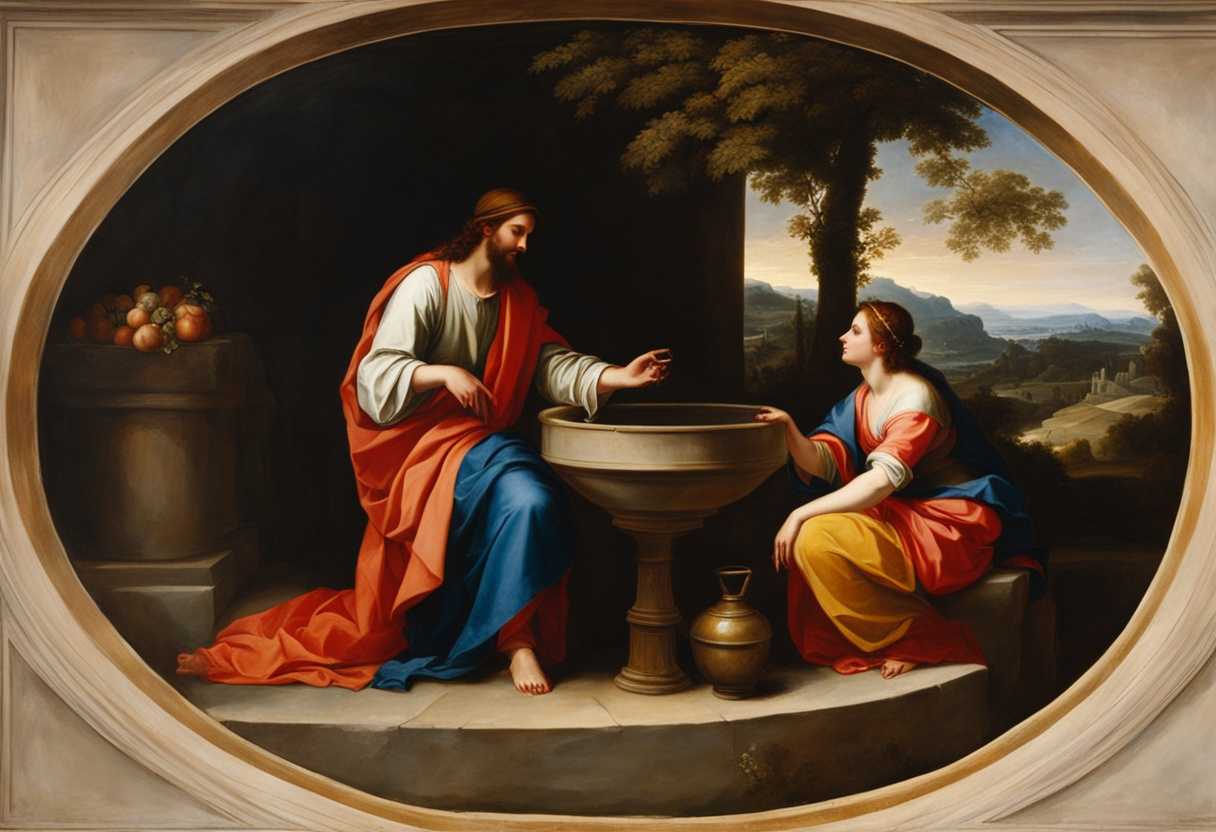
Setting the Scene for John 4:5-30
In John chapter 4, we find Jesus traveling through Samaria on his way to Galilee. Tired from his journey, he stops at a well in the Samaritan town of Sychar while his disciples go into the town to buy food. It is midday, and the sun beats down on the dusty ground as Jesus sits alone by the well.
Soon, a Samaritan woman approaches the well to draw water. Her name is not mentioned in the passage, but we learn that she has had five husbands and is currently living with a man who is not her husband. Jesus engages her in conversation, asking her for a drink of water. This interaction leads to a profound discussion about living water, worship, and the true nature of God. The woman is amazed by Jesus’ insight and goes back to the town to tell others about him, leading many to come and see Jesus for themselves. The scene at the well is one of unexpected connection and transformation, as Jesus breaks down cultural barriers and offers the gift of eternal life to all who believe in him.
What is John 4:5-30 about?
This verse from the Bible highlights an incredible encounter between Jesus and a Samaritan woman. Jews and Samaritans had a strained relationship in the cultural context of that time, which made such interactions rare. Jesus initiated a conversation with this Samaritan woman, breaking societal norms and demonstrating His radical love and inclusivity. Jesus showed that His offer of salvation and grace was meant for all, regardless of ethnicity or background, by revealing Himself as the Messiah to her.
Reflecting on this verse, we are reminded of the universal nature of Jesus’ message and how he transcends barriers that divide us. It prompts us to examine our own preconceived notions and prejudices, encouraging us to reach out to those who may be different from us with love and compassion. This encounter challenges us to see beyond societal labels and treat each person we meet with the same respect and dignity, just as Jesus did with the Samaritan woman at the well. How can we embody Jesus’ example in our own interactions with others, breaking down barriers and extending grace to all we encounter? We should strive to emulate His love and inclusivity as we navigate our own encounters and relationships in this world.
Understanding what John 4:5-30 really means
Jesus’ encounter with the Samaritan woman at Jacob’s well in John 4:5-30 provides a profound insight into spiritual thirst and the transformative power of genuine worship. As Jesus breaks social norms by engaging with a Samaritan woman, who is isolated and marginalized, He offers her “living water,” symbolizing eternal life and spiritual fulfillment. This contrasts with the temporary satisfaction of earthly desires, emphasizing the deeper longing of the human soul for a connection with God. The imagery of “living water” resonates with Old Testament passages like Isaiah 55:1, inviting all who are thirsty to find fulfillment in God.
In a world where people often seek fulfillment in transient pursuits such as career success, relationships, or material possessions, the Samaritan woman’s quest for physical water mirrors our spiritual thirst for something more profound. Jesus’ message of “living water” challenges us to look beyond temporary gratification and find lasting satisfaction in Him. The promise of “rivers of living water” flowing from within those who believe in Jesus, as mentioned in John 7:37-38, underscores the transformative power of a relationship with Him.
Moreover, Jesus’ willingness to engage with a Samaritan woman, breaking cultural, racial, and gender barriers, teaches us the importance of inclusivity and compassion in our interactions. Just as Jesus transcended societal norms to reach out to the marginalized, we are called to break down barriers and show love to all, regardless of background or status. The call to worship the Father in spirit and truth emphasizes the need for authentic, heartfelt connection with God, transcending mere religious rituals and traditions.
In a contemporary context, the Samaritan woman’s experience resonates with individuals who may feel isolated and unfulfilled despite pursuing worldly pleasures. Like her, many today seek satisfaction in external sources only to find themselves still “thirsty.” This anecdote serves as a poignant reminder of the universal human need for the spiritual nourishment that Jesus offers, a need that transcends time and cultural differences.
Ultimately, the encounter at Jacob’s well challenges us to seek deeper spiritual fulfillment through Jesus, to break down societal barriers, and to engage in genuine worship. It prompts us to reflect on where we seek satisfaction and reminds us that true fulfillment comes not from external sources but from a personal relationship with God. As we ponder the significance of this encounter, may we be inspired to embrace the “living water” that quenches our deepest longings and leads us to a life of authentic worship and connection with the Divine.
How can we truly worship God in spirit and truth?
We can truly worship God in spirit and truth by approaching Him with authenticity and sincerity, allowing our hearts and minds to be fully engaged in worship. Worshiping in spirit means that our worship is genuine, heartfelt, and comes from a place of deep reverence and love for God. It involves connecting with Him on a personal level, aligning our inner selves with His presence, and allowing the Holy Spirit to guide and inspire our worship.
Worshiping in truth involves being honest and transparent before God, acknowledging our weaknesses and imperfections, and seeking His truth to transform and renew our hearts and minds. It requires us to worship God in accordance with His revealed truth in Scripture, following His commands, and living a life that reflects His character and teachings. True worship in spirit and truth goes beyond outward rituals or empty observance; it is a genuine expression of our love, devotion, and obedience to God, grounded in the reality of who He is and who we are in relation to Him.
Application
Think about your daily interactions. Just like in your work meetings or family talks, genuine conversations can spark incredible change. Jesus connected with the Samaritan woman at the well, breaking barriers and offering compassion. Are you ready to step beyond your usual circles, listen deeply, and share hope with someone new? Will you rise to this chance to be a catalyst for change today?

Reverend Michael Johnson is an experienced Church Minister with a profound expertise in spirituality and guidance. With a serene presence and a compassionate heart, he has faithfully served his congregation for over 20 years, leading them on a spiritual journey towards inner peace and enlightenment. Reverend Johnson’s extensive knowledge of religious philosophies and profound understanding of human nature have made him a trusted confidant and mentor to many, as he seamlessly weaves his profound wisdom into life teachings. Reverend Johnson’s calming demeanor and empathetic nature continue to uplift and heal souls, nurturing a sense of unity and tranquility within his community.